

ICD-10 Code S42.444P: Medial epicondyle fracture, right humerus
ICD-10 Code S42.444P: full descriptor and code validity ICD-10 Code S42.444P car...

Last Updated: Oct 13, 2026
Billable Code Specific Code
T32.97 is the billable ICD-10-CM code for corrosions involving 90% or more of body surface with 70-79% third degree corrosion.
Getting T32.97 onto a clean claim takes more than the code itself. The record also has to name the chemical agent and support both halves of the extent descriptor. Those are the details medical billing compliance reviews look at first.
Let Pabau's smart automation suggest the right codes, reduce claim denials, and keep your practice compliant—effortlessly.
Automate repetitive tasks and focus on what matters most—your patients.
Reduce coding errors and ensure compliance with the latest regulations.
Clean claims, fewer denials, and faster reimbursements.
Powerful insights and reporting to help your practice thrive.
HIPAA compliant SOC 2 certified GDPR-compliant Trusted by 4,000+ clinics worldwide

ICD-10 Code T32.97 describes corrosions involving 90% or more of body surface with 70-79% third degree corrosion, caused by chemical agents, not heat
T32.97 is a billable ICD-10-CM code valid for FY2026 (effective October 1, 2025) and accepted for HIPAA-covered transaction submission
Missing the causative chemical agent external cause code or the TBSA secondary code are the most common documentation errors with T32.97
Pabau’s claims management software integrates with Claim.MD to support accurate ICD-10 code capture and clean claim submission for burn and corrosion diagnoses
ICD-10 Code T32.97 is a billable ICD-10-CM diagnosis code for corrosions involving 90% or more of body surface with 70-79% third degree corrosion. It became effective on October 1, 2025 under the FY2026 update and is valid on HIPAA-covered transactions. The CDC/NCHS ICD-10-CM web tool places it in chapter S00-T88, Injury, poisoning, and certain other consequences of external causes. Within that chapter it sits in the T30-T32 block, Burns and corrosions of multiple and unspecified body regions.
The code is specific and billable, meaning it can stand alone as a primary diagnosis on a claim without requiring a more detailed child code. It is not a placeholder or non-billable category code.
The table below summarises the key administrative and billing attributes of ICD-10 Code T32.97 for quick reference.
Corrosions in ICD-10-CM terminology are chemically induced injuries, distinct from thermal burns. T32.97 applies when chemical corrosion affects 90% or more of the total body surface area (TBSA). Of that surface, 70-79% involves third degree, or full thickness, corrosion.
Third degree corrosion destroys all layers of the skin, including the epidermis, dermis, and portions of the subcutaneous tissue. At 70-79% third degree involvement across 90%+ TBSA, this represents one of the most extreme injury presentations in the ICD-10-CM corrosion classification. Survival rates drop sharply at these TBSA thresholds; cases typically require intensive care, mechanical ventilation, and staged surgical intervention.
Causative agents include strong acids such as sulfuric, hydrochloric and nitric. They also include alkalis such as sodium hydroxide and calcium hydroxide, plus other corrosive industrial chemicals. Unlike thermal burns, chemical corrosions may keep damaging tissue after the initial exposure if the agent is not fully decontaminated.
Coders should look for these clinical markers in the patient record when considering T32.97:
The distinction between burns and corrosions in ICD-10-CM is clinically and legally significant. Confusing T31 (thermal burns classified by extent) with T32 (chemical corrosions classified by extent) is one of the most common coding errors in this category. Etiology drives code selection in the injury chapter, not the appearance of the wound.
The CMS ICD-10-CM codes page and the ICD-10-CM Official Guidelines for Coding and Reporting agree on the rule. When documentation specifies a chemical agent, T32 codes apply regardless of how the wound looks.
Both T31 (thermal burns) and T32 (chemical corrosions) use an identical two-axis classification system based on total body surface area (TBSA). Understanding this structure is essential to correctly interpreting where T32.97 sits and why it carries such a specific code.
The 4th character encodes the total TBSA affected. The 5th character encodes the proportion of that TBSA involving third degree injury. For T32.97:
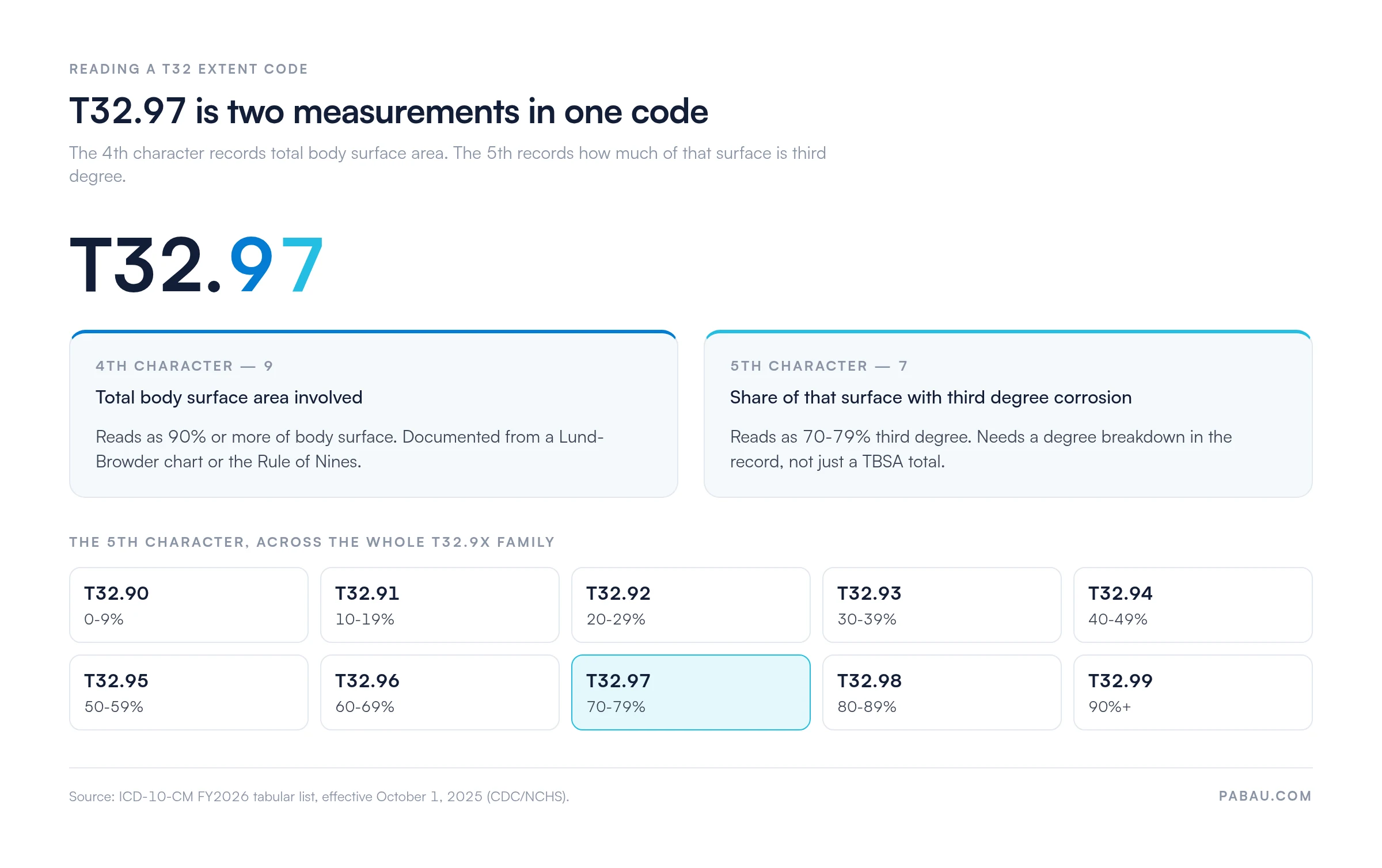
This dual-axis logic means a coder must verify both values independently from the clinical record. A chart that documents 90%+ TBSA but does not specify degree breakdown cannot support T32.97. Similarly, a chart documenting 70-79% third degree involvement across only 60% TBSA would require a different code. The WHO ICD-10 browser provides the parent classification context for understanding how ICD-10-CM derives its extent-based structure from the international standard.
T32.97 belongs to the T32.9x sub-block within the T32 category. Every T32.9x code covers corrosions involving 90% or more of body surface, and the 5th character separates them. Reading the siblings side by side is how coders catch an undercoded or overcoded third degree percentage. The full ICD-10-CM codes index shows where the extent categories sit against the site-specific burn and corrosion codes.
The parent code is T32.9 (non-billable), which in turn falls under T32 (corrosions classified by extent of body surface involved). Coders should never bill the non-billable parent T32.9 when a specific billable sibling like T32.97 applies.
T32.97 groups under MDC 22 (Burns), and the diagnosis code alone does not settle the DRG. The grouper reads the principal diagnosis alongside the procedures performed and any complicating conditions. Two separate DRG pairs can apply, and they turn on different criteria.
The first pair turns on mechanical ventilation over 96 hours, split by whether a skin graft was performed. The second pair carries no ventilation requirement and splits on complication and comorbidity severity instead.
Facilities billing T32.97 as the principal diagnosis should confirm the assignment through their current-year CMS grouper. Titles and pairings shift with the annual update, so a grouper from last October can drop the case in the wrong pair.
Corrosion injuries of this severity generate documentation across several clinical touchpoints. Emergency department notes, burn unit admissions, operative reports, and daily progress notes each carry part of the picture. For T32.97, the record must support both halves of the two-axis classification.
These are the documentation elements required to support T32.97:
Coders should query the attending physician when the TBSA or degree proportion is missing or ambiguous. Submitting T32.97 without supporting documentation for both the 90%+ TBSA and the 70-79% third degree component puts the claim at audit risk.
Audit every T32.97 claim for a secondary external cause code from the T54/T65 series. A claim carrying only T32.97, with no code for the corrosive agent, is what burn center audits flag most often. Catch it at the point of coding, not after the claim has gone out.
T32.97 sits in a category where several predictable errors cluster. The ICD-10-CM Official Guidelines for Coding and Reporting is the authority on sequencing. The table below captures the mistakes coders hit most often on corrosion claims.
Facilities that see burn and corrosion cases regularly should audit their T32.xx claims periodically. A run of denials on one code usually points back at the documentation the coder was given, not at the billing itself.
Accurate coding on a case like T32.97 depends on what the record holds when the coder opens it. In many practices the TBSA diagram sits in one system and the surgeon’s degree note in another. The coder rebuilds the picture by hand.
Practice management software like Pabau keeps them in one chart. Pabau’s claims management software carries the diagnosis code recorded in the clinical note through to the claim. Nothing is retyped on the way.
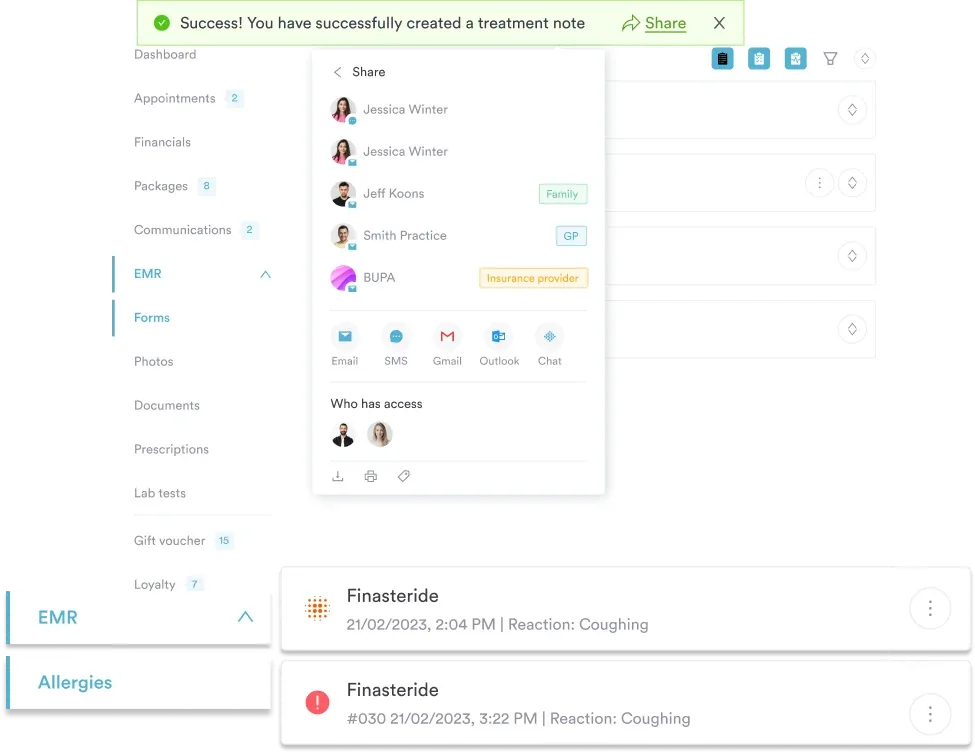
For US practices, Pabau’s Claim.MD integration submits those claims, runs eligibility checks, and returns ERA/835 remittance files. A denial on a T32 claim reaches the team while the chart is still fresh enough to query the attending.


Pabau connects the clinical note to the claim through Claim.MD, so practices submit cleanly and track remittance on complex diagnosis codes. See how it works for your practice.

T32.97 is among the most specific codes in the ICD-10-CM corrosion classification. The record has to confirm the 90%+ TBSA threshold and the 70-79% third degree proportion. It also needs an external cause code for the chemical agent. Miss one of those and the claim is exposed to denial or audit.
The DRG follows the operative report as much as the diagnosis, so read the ventilation hours and the graft before you assume a pair. Book a demo to see how Pabau moves a coded corrosion case from the chart to a clean claim.

Need a structured approach to medical billing compliance? Medical billing compliance requirements covers the documentation standards and audit risks that affect complex inpatient claims.
Want to understand how clearinghouses process ICD-10 claims? Medical claims clearinghouse workflows explains how 837P files, eligibility checks, and ERA remittance work together.
Dealing with denied claims on complex diagnoses? Denial codes in medical billing breaks down the most common CARC codes and how to respond effectively.
ICD-10 Code T32.97 is a billable ICD-10-CM diagnosis code for corrosions involving 90% or more of body surface with 70-79% third degree corrosion. It documents chemical rather than thermal injuries that affect at least 90% of total body surface area. Within that surface, 70-79% has sustained full thickness third degree damage. The code became effective October 1, 2025 and is valid for FY2026 HIPAA-covered transaction submission.
Yes, T32.97 is a billable and specific ICD-10-CM code, valid for use in FY2026 claims. It can be submitted directly on HIPAA-covered transactions without requiring a more specific child code. The non-billable parent code T32.9 should never be submitted in its place. Verify the code’s validity annually against the AAPC ICD-10-CM code lookup, as code sets update each October 1.
T32.97 groups under MDC 22 (Burns), and the DRG depends on the procedures and comorbidities on the claim. DRG 927 covers mechanical ventilation over 96 hours with a skin graft, and DRG 933 covers the same ventilation criterion without a graft. Neither carries a CC or MCC split. DRG 928 and DRG 929 apply to a full thickness burn with skin graft or inhalation injury, split by CC or MCC. Neither requires long ventilation. Confirm the final grouping against the current-year CMS grouper.
ICD-10 Code T32.97 became effective on October 1, 2025, as part of the FY2026 ICD-10-CM update. It is valid for all HIPAA-covered transaction submissions during the FY2026 coding year. ICD-10-CM code sets are updated annually on October 1; always verify active status through the CDC/NCHS ICD-10-CM web tool for each new fiscal year.




