ICD-10 Code Y76.0: Diagnostic obstetric and gynecological devices
ICD-10 Code Y76.0: Definition and billable status ICD-10 Code Y76.0 is a valid, ...

Last Updated: Oct 23, 2026
Billable Code Specific Code
T32.86 is the billable ICD-10-CM code for corrosions involving 80-89% of body surface with 60-69% third degree corrosion.
Let Pabau's smart automation suggest the right codes, reduce claim denials, and keep your practice compliant—effortlessly.
Automate repetitive tasks and focus on what matters most—your patients.
Reduce coding errors and ensure compliance with the latest regulations.
Clean claims, fewer denials, and faster reimbursements.
Powerful insights and reporting to help your practice thrive.
HIPAA compliant SOC 2 certified GDPR-compliant Trusted by 4,000+ clinics worldwide

T32.86 is a billable ICD-10-CM code for corrosions covering 80-89% of body surface, with 60-69% of that area classified as third degree (full thickness).
The code is valid for FY2026 HIPAA-covered transactions, and it sits beneath parent subcategory T32.8.
A site-specific corrosion code is listed as the primary diagnosis, with T32.86 reported second to quantify the extent.
Third-degree corrosion depth must be documented by the treating clinician. Coders cannot infer depth from the causative agent alone.
Practice management software like Pabau supports ICD-10-CM documentation and electronic claim submission for corrosion encounters.
ICD-10 code T32.86 describes corrosions involving 80-89% of body surface with 60-69% third degree corrosions. It is specific and billable, so it may be submitted on HIPAA-covered claims without a more detailed child code. The code is effective for encounters from October 1, 2025 through September 30, 2026 (FY2026).
Two distinct percentage measurements define the code. The first (80-89%) is the total body surface area affected by corrosion. The second (60-69%) is the subset of that area where the corrosion has reached full thickness, or third degree. Both values must appear in the clinical documentation before T32.86 can be assigned.
T32.86 sits within a four-level hierarchy. Reading it from the top down keeps a coder from submitting a header code that payers will not accept.
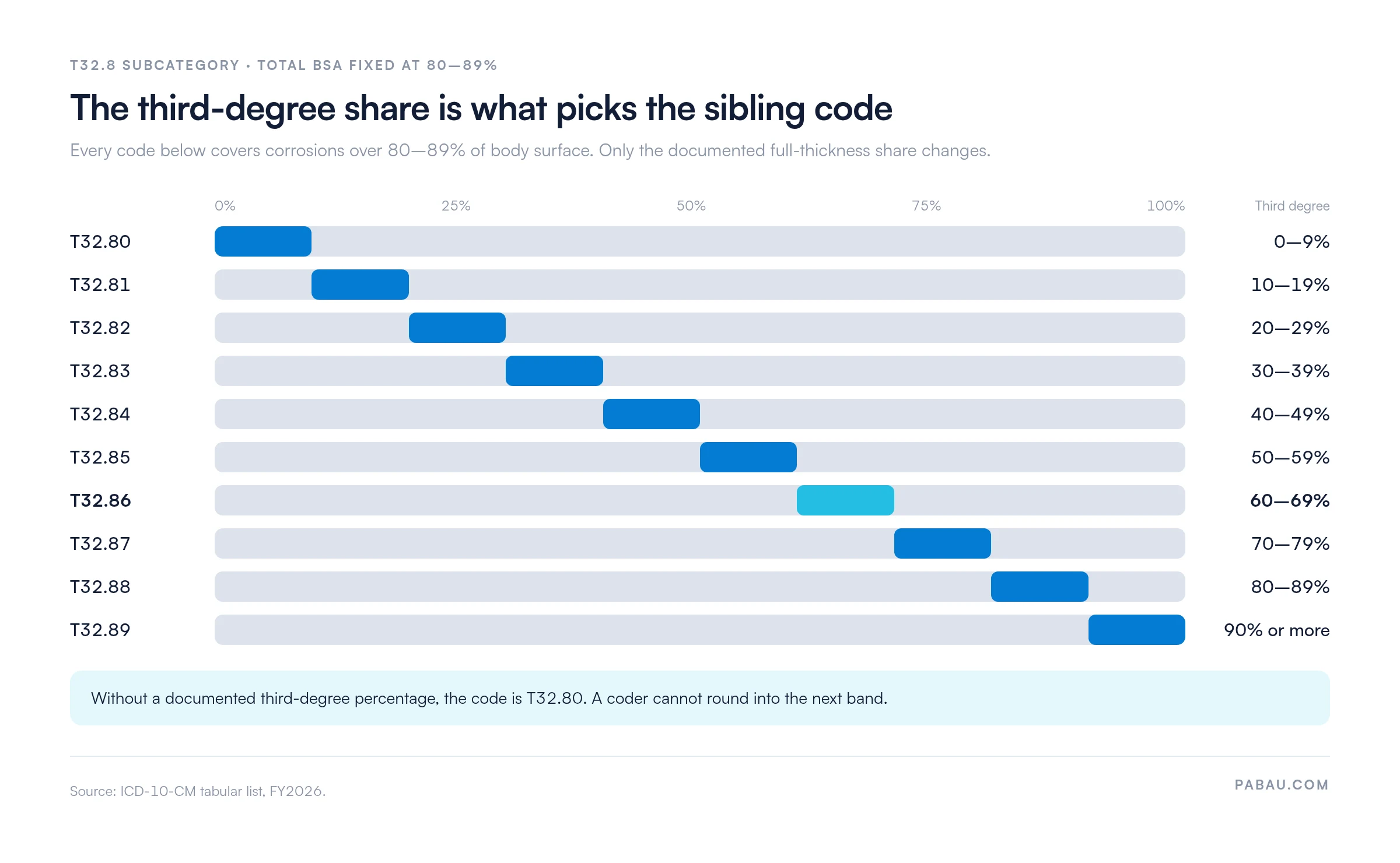
The full set of sibling codes under T32.8 is shown below. Each sibling differs only in the percentage of third-degree involvement. Selecting the correct sibling requires clinical documentation of that percentage.
Laid out on a single axis, the ten siblings show how narrow each code’s window is. One documented percentage decides which of them applies.
Codes for other injury categories are indexed in our ICD-10 diagnostic codes library, arranged by chapter and subcategory.
The T32 ICD-10 code category classifies corrosions strictly by extent of body surface involved. Two separate axes drive code selection. The first is the total BSA percentage affected, and the second is the proportion of that area involving third-degree destruction.
Coders unfamiliar with this dual-axis structure often assign a sibling code with the wrong depth qualifier, which triggers a denial. The depth qualifier is the part that gets misread, because it describes a share of the corroded area rather than a share of the body.
Corrosion under T32 refers specifically to injuries caused by chemical or caustic agents. This is a clinically and legally distinct category from thermal burns (T31). The distinction must be established in the medical record before T32.86 or any other T32 code is assigned.
Check the ICD-10-CM Official Guidelines published jointly by CMS and NCHS before assigning any T32 code. The instructional notes in the tabular list specify which additional codes are required, and the guidelines clarify sequencing when multiple corrosion sites are involved.
ICD-10-CM separates thermal burns from corrosions at the category level. Thermal burns classified by extent fall under T31. Corrosions caused by chemical or caustic agents fall under T32. Using the wrong category is one of the most common errors in burn-related coding.
The treating clinician’s documentation must identify the causative agent as chemical or caustic in order to support a T32 code. When documentation states “burn” without specifying the mechanism, query the physician before defaulting to T31. Coding from ambiguous documentation is a compliance risk.
Assigning ICD-10 code T32.86 correctly requires documented BSA percentages for both total corrosion extent and third-degree depth. Clinicians typically use one of two estimation tools. Coders should know which method the physician used before checking the percentages against the T32.86 criteria.
For T32.86, the treating clinician must document that the total corrosion covers 80-89% of BSA. The record must also show that 60-69% of that area involves third-degree injury. Neither figure can be inferred or estimated by the coder. If only total BSA is documented without a depth breakdown, the correct code is T32.80, not T32.86.
Third-degree corrosion is full-thickness chemical destruction of the skin, extending through the epidermis and dermis into the subcutaneous tissue. Superficial and partial-thickness corrosion spares the deeper structures. Full-thickness injury destroys nerve endings, sebaceous glands, and hair follicles, and the record must name it as third degree rather than “severe” or “deep.”
For coding purposes under ICD-10 code T32.86, two documentation elements are non-negotiable. First, the clinician must classify the corrosion as third degree rather than second degree or unspecified. Second, the clinician must specify that third-degree involvement covers 60-69% of the total corrosion area. A note reading “extensive full-thickness chemical burns” carries no percentages, so it will not support T32.86.
The ICD-10-CM Official Guidelines and tabular instructional notes require additional codes alongside ICD-10 code T32.86. Missing them is the most common reason T32-related claims are denied or returned for more documentation. The guidelines are revised every fiscal year, and the current set is published on the CMS ICD-10 codes page.
Practices running claims management software can build these requirements into a review step. A corrosion claim is then checked for the full code set before it goes out.

Sequencing rule: T32.86 is coded as a secondary diagnosis. A site-specific corrosion code identifying the affected body area is listed first as the principal diagnosis. T32.86 then follows to quantify the extent of BSA involvement. Never list T32.86 as the only code on a corrosion claim.
Most T32.86 coding errors fall into four patterns, and each one is preventable with a documentation review before submission. Submitting clean claims on the first attempt means catching these four in the practice, rather than hearing about them from the clearinghouse.
Build a T32 coding checklist into your burn and corrosion encounter workflow. Confirm the causative agent is chemical, so the encounter is coded under T32 rather than T31. Document both BSA percentages, and list the site-specific code first. Attach every required external cause code before submission.
A corrosion encounter leaves its evidence in several places. Depth sits in the clinician’s note, the BSA estimate sits in the observation chart, and the substance is usually recorded at intake. When those live in separate systems, the coder rebuilds the picture by hand before the claim can be built.
Pabau keeps the clinical note, the attached forms, and the billing record on one patient timeline. The coder reads the encounter in one place and assigns the site-specific code, T32.86, and the external cause codes against it. Claims then go out electronically from the same record.
That shortens the trip from encounter to submission and keeps the documentation behind each code within reach. When a payer asks what supported the third-degree percentage, the note is attached to the invoice that carried the code.

Pabau’s claims management tools help practice teams document, code, and submit corrosion and burn encounters from one patient record. Each claim is then tracked through to payment.

Two percentages decide this code, and both belong to the clinician rather than the coder. Where the note gives the total BSA but no depth breakdown, T32.80 is the honest choice and T32.86 is not available.
So the work that pays off happens before the claim is built. A physician query costs an afternoon, while a denied corrosion claim costs the rebill and the delay behind it. Book a demo to see how Pabau keeps corrosion coding, documentation, and claim submission on one record.

Need to understand how clearinghouse validation works for ICD-10 claims? Our Claim.MD clearinghouse guide explains how electronic claim validation catches coding errors before they reach the payer.
Want to reduce ICD-10 claim denials across your practice? Denial codes in medical billing covers the most common remittance codes that accompany rejected injury claims and how to respond.
Looking for guidance on ICD-10-CM documentation standards? Medical billing compliance outlines the documentation requirements that apply across diagnosis code categories, including external cause code obligations.
ICD-10 code T32.86 is the billable diagnosis code for corrosions involving 80-89% of body surface with 60-69% third degree corrosions. It belongs to the T32 category, which classifies chemical and caustic injuries by extent of body surface involved. The code is valid for HIPAA-covered transactions in FY2026.
Yes. T32.86 is a billable and specific ICD-10-CM diagnosis code. It may be submitted on HIPAA-covered claims without a more detailed child code. The code is valid for encounters between October 1, 2025 and September 30, 2026.
Thermal burns caused by heat, flame, electricity, or radiation are coded under T31 (burns classified by extent). Corrosions caused by chemical or caustic agents are coded under T32. The causative mechanism must be documented by the treating clinician before either category is assigned.
Clinicians use the rule of nines for adult patients, which assigns approximate 9% BSA values to major body regions. The Lund-Browder chart is used for pediatric patients. Both are estimation tools, so the coder relies on the documented percentages and cannot calculate BSA values independently.
Per the ICD-10-CM Official Guidelines, T32.86 requires a site-specific corrosion code as the primary diagnosis. It also requires an external cause code for the corrosive substance, a place of occurrence code, an activity code, and an external cause status code. All are required for initial encounters.
The rule of nines gives clinicians a standardized way to estimate total body surface area affected. Each major body region represents roughly 9% of BSA in adults. Coders use the documented figures to select the correct T32 code. The rule is an approximation, and the Lund-Browder chart is more precise for children.