ICD-10 code S61.201A: Open wound of left index finger without nail damage
ICD-10 code S61.201A covers a left index finger wound of unstated type ICD-10 co...

Last Updated: Oct 16, 2026
Billable Code Specific Code
T32.70 is the billable ICD-10-CM code for corrosions involving 70-79% of body surface with 0% to 9% third degree corrosion.
Let Pabau's smart automation suggest the right codes, reduce claim denials, and keep your practice compliant—effortlessly.
Automate repetitive tasks and focus on what matters most—your patients.
Reduce coding errors and ensure compliance with the latest regulations.
Clean claims, fewer denials, and faster reimbursements.
Powerful insights and reporting to help your practice thrive.
HIPAA compliant SOC 2 certified GDPR-compliant Trusted by 4,000+ clinics worldwide

ICD-10 Code T32.70 is non-billable. Select one of seven child codes, T32.71 to T32.77, by the percentage of third-degree corrosion.
Corrosion codes in T32 cover chemical agents, while burn codes T30-T31 cover thermal injuries. Mixing the two categories is a common coder error.
A T54 series code identifies the chemical agent, and a Y92 code records where the exposure happened.
Every child code also needs a seventh character: A for initial treatment, D for healing care, S for a late effect.
Practice management software like Pabau submits the finished claim through Claim.MD and tracks its status, so rejections surface without a separate portal.
ICD-10 Code T32.70 is the ICD-10-CM header code for corrosions involving 70-79% of total body surface area (TBSA) with 0% to 9% third-degree involvement. It is effective for all HIPAA-covered transactions in FY2026. The code sits in Chapter 19 of the tabular list, which covers injury, poisoning and certain other consequences of external causes (S00-T88). Within that chapter it belongs to category T32, which classifies corrosions by the extent of body surface affected.
The clinical picture at 70-79% TBSA is severe. Patients typically present with multi-system compromise and prolonged intensive care admissions, with fluid resuscitation calculated using the Parkland formula. Third-degree corrosion describes full-thickness chemical destruction of every skin layer, including the dermis. Where that component stays between 0% and 9%, most of the involved surface retains at least partial thickness.
No, T32.70 is not billable. It is a header code in the ICD-10-CM tabular list, and a claim carrying it as the diagnosis will be rejected. Payers require a diagnosis code at the maximum level of specificity available. To code a corrosion in the 70-79% TBSA range, use one of the seven child codes in the T32.7x subcategory. Each child code adds one dimension to the header. That dimension is the share of the corroded area involving third-degree, full-thickness destruction.
The distinction moves money, because the third-degree percentage feeds MS-DRG assignment on inpatient burn cases. A hospital coding a 70-79% TBSA corrosion with 50-59% third-degree involvement uses T32.75. That lands on a different DRG weight than the same TBSA total coded as T32.71.
The T32.7x subcategory contains seven billable child codes, one for each 10% increment of third-degree corrosion within the 70-79% TBSA total. Each is a complete, specific, billable ICD-10-CM diagnosis. Select the code that matches the documented percentage of full-thickness involvement, as recorded by the treating burn surgeon or attending physician.
T32.70 itself, which covers 0-9% third degree, stays the non-billable header. The first billable child code is T32.71, and it begins at 10-19% third-degree involvement. Where the documented third-degree percentage falls below 10%, take it back to the attending physician before coding. Either a lower TBSA category applies, or the documented extent genuinely rounds into the 70-79% band.
Total body surface area is the foundational measurement for selecting any T32 code. The standard clinical tool for adults is the Rule of Nines, which divides the body into regions each representing roughly 9% of total surface area. The treating provider has to document the TBSA percentage explicitly in the medical record. Coders cannot calculate or estimate it themselves.
For pediatric patients and unusual body habitus, the Lund-Browder chart is the preferred assessment tool, because it adjusts for age-related proportional differences. Burn surgeons document both the total percentage and the depth breakdown. That depth breakdown drives selection among the T32.71-T32.77 child codes. If the documentation states only “70% TBSA” without the third-degree component, query the physician before assigning a child code.
Corrosions and burns are different injuries with different ICD-10-CM categories. Corrosions result from chemical agents such as acids, alkalis and caustics, while burns result from thermal sources such as flame, scald, contact and radiation. Category T32 codes corrosions by extent of body surface, and T31 does the same job for burns. The two are not interchangeable, and using T31 for a chemical injury is a coding error that may trigger a clinical audit.
The practical way to settle the category is to check the clinical notes for the agent. Sulfuric acid, sodium hydroxide (lye), hydrofluoric acid and similar substances point to T32. Open flame, boiling water, steam or radiant heat point to T31, whose matching 70-79% header is T31.70. Where the record is ambiguous, a physician query is appropriate before coding.
The ICD-10-CM Official Guidelines for Coding and Reporting are maintained jointly by CMS and the National Center for Health Statistics. They set specific requirements for coding corrosion injuries in the T32 category. Follow them precisely, because an incomplete code set on a corrosion claim is a known audit trigger.
ICD-10-CM guidelines require additional codes alongside any T32.7x child code. Leaving them off is a common source of claim denials, and it belongs on the checklist for any coding audit. Incomplete-code-set rejections sit alongside the other common denial codes a burn unit’s billing team works through each month.
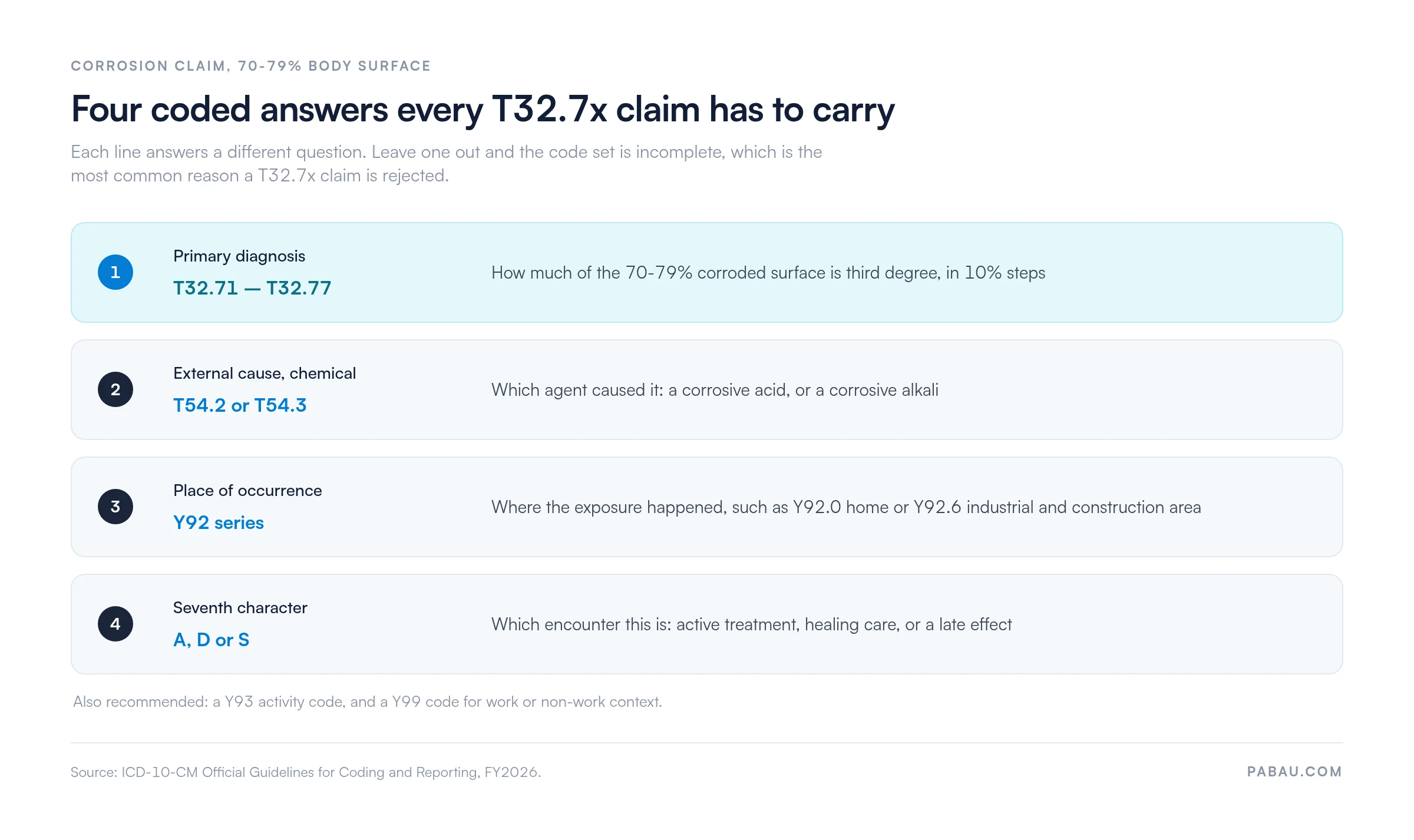
A corrosion case should capture all of these code categories before the claim is transmitted, rather than as a retrospective correction after a denial. Claims software can flag administrative fields that are still blank, such as a missing membership number or authorization code. The clinical code set itself still rests with the coder and the physician’s documentation. The four coded answers a complete T32.7x claim has to carry are set out below.
Each T32.7x child code requires a seventh character that identifies the type of encounter. The three valid characters for T32 codes follow the standard ICD-10-CM injury coding convention.
For a 70-79% TBSA corrosion, the initial inpatient admission takes “A”. Outpatient wound care visits during healing take “D”. Late reconstructive surgery for scarring or contracture takes “S”. Applying the wrong character is a common error on long-term cases, where patients move from acute care to rehabilitation and then to reconstruction.
Category T32 covers corrosions classified by the extent of body surface involved. Each subcategory represents a 10% increment of TBSA, from T32.0 (less than 10%) through T32.9 (90% or more). ICD-10 Code T32.70 sits in the T32.7x subcategory, which covers the 70-79% band. Checking the band first is the quickest way to confirm you are in the right subcategory before choosing a child code.
The same structure repeats in every lower band. A corrosion documented at 20-29% total extent belongs under T32.20, which carries its own set of third-degree child codes.
You can verify current code validity against the official CDC/NCHS ICD-10-CM web tool, which is updated annually and reflects the current fiscal year’s tabular list. The WHO ICD-10 browser holds the international parent classification that the US clinical modification is built from.
ICD-10 Code T32.70 and its child codes apply when a chemical corrosion covers 70% to 79% of total body surface area. Less than 10% of that area involves full-thickness destruction. A 70% TBSA exposure reaches almost every major body region at once under the Rule of Nines. Fluid loss, systemic inflammation and any inhalation injury together put the patient in burn center-level intensive care.
Common scenarios include large-volume industrial chemical spills, occupational exposures in chemical manufacturing, and accidental immersion events. Cases at this severity are managed in burn and reconstructive surgery units, with specialized wound care protocols, nutritional support teams and long rehabilitation timelines. DRG assignment for these encounters moves facility reimbursement substantially, and payers scrutinize high-severity injury codes closely.
Before coding any T32.7x child code, confirm the medical record contains three documented values: total TBSA percentage, third-degree percentage, and the causative chemical agent. If any of the three is missing, query the attending physician. Submitting without all three risks a denial and audit exposure on an already high-dollar case.
ICD-10-CM recognizes several clinical synonyms and index references for T32.70. These alternative descriptions appear in coding lookup tools. They help coders confirm the right code when searching by clinical language rather than by code number. You can cross-reference the terms using the AAPC Codify ICD-10-CM lookup.
When searching by synonym in coding software, confirm the code returned sits in the T32.7x family rather than T31.7x. The two descriptions read almost identically. Autocomplete in EHR-based coding tools has been known to surface the thermal burn equivalent when a coder searches by body surface percentage alone.
A T32.7x claim is a multi-code submission. The child code, the T54.x external cause code, the place-of-occurrence code and the seventh character all have to line up on the same claim. In most burn and reconstructive units that alignment is checked by hand, after the coder has already closed the encounter.
Practice management software like Pabau keeps the encounter, the coded claim and the payer response in one patient record. Pabau’s software that submits claims connects to Claim.MD, our US clearinghouse partner, which reaches thousands of US payers. Remittance advice returns to the same record, so a rejected T32.7x claim appears next to the encounter it came from.
The coder still owns the code set, and no software replaces the physician query behind a third-degree percentage. What changes is the chase afterwards. Billing staff see a rejection in the record instead of discovering it in a clearinghouse portal three weeks later.

Pabau’s claims management software transmits coded claims through Claim.MD and returns the payer response to the same patient record. Billing teams catch a rejected T32.7x claim in days rather than weeks.

ICD-10 Code T32.70 opens the 70-79% TBSA corrosion subcategory, and the coding decision never stops there. It ends with a child code, a T54.x external cause companion, a Y92 place-of-occurrence code, and a seventh character for the encounter type.
The judgment worth carrying away is that the third-degree percentage belongs to the physician, not to the coder. Where the record does not state it, a query costs a day. A guess costs the denial, the rework and the audit exposure that follow on a case of this size.
Book a demo to see how Pabau keeps the coded claim, its companion codes and the payer response inside one patient record.

strongWant to cut rejections on multi-code claims?/strong a href=https://pabau.com/blog/denial-management-in-healthcare/Denial management in healthcare/a covers the code-set errors that trigger rejections and the workflow for appealing them.
strongNeed the end-to-end claim picture?/strong a href=https://pabau.com/blog/what-is-medical-billing/Medical billing fundamentals/a explains where an ICD-10 diagnosis code sits in the submission and reimbursement process.
strongDocumenting the charge before it reaches the payer?/strong a href=https://pabau.com/blog/superbill/What a superbill includes/a walks through the fields a charge document needs before it is submitted.
ICD-10 Code T32.70 is the non-billable header code in ICD-10-CM for corrosions involving 70-79% of body surface with 0% to 9% third degree corrosion. It is valid for FY2026 HIPAA-covered transactions. Because it is a header code, coders must use one of its seven billable child codes. Those run from T32.71 through T32.77, each stating the exact percentage of full-thickness involvement.
No. T32.70 is a non-billable header code. Claims submitted with T32.70 as the primary diagnosis will be rejected by payers. Coders must select the appropriate billable child code from T32.71 through T32.77 based on the documented percentage of third-degree corrosion within the 70-79% TBSA total.
The seven billable child codes are T32.71 (10-19% third degree), T32.72 (20-29%), T32.73 (30-39%), T32.74 (40-49%), T32.75 (50-59%), T32.76 (60-69%), and T32.77 (70-79%). Each represents a 10% increment of full-thickness corrosion within the 70-79% TBSA band.
Burns, coded in T30-T31, result from thermal sources such as flame, scalds, or contact heat. Corrosions, coded in T32, result from chemical agents such as acids, alkalis, or caustic substances. The causative agent documented in the medical record determines which category applies. Mixing the two categories is a coding error and can trigger clinical audits.
ICD-10-CM guidelines require a T54.x series code identifying the specific chemical agent, for example T54.2 for corrosive acids or T54.3 for corrosive alkalis. A Y92 place-of-occurrence code is also required, and Y93 activity and Y99 external cause status codes are recommended. Submitting the T32.7x child code without the T54.x companion is a common denial trigger.