

ICD-10 code S61.201A: Open wound of left index finger without nail damage
ICD-10 code S61.201A covers a left index finger wound of unstated type ICD-10 co...

Last Updated: Oct 16, 2026
Billable Code Specific Code
T32.64 is the billable ICD-10-CM code for corrosions involving 60-69% of body surface with 40-49% third degree corrosion.
Let Pabau's smart automation suggest the right codes, reduce claim denials, and keep your practice compliant—effortlessly.
Automate repetitive tasks and focus on what matters most—your patients.
Reduce coding errors and ensure compliance with the latest regulations.
Clean claims, fewer denials, and faster reimbursements.
Powerful insights and reporting to help your practice thrive.
HIPAA compliant SOC 2 certified GDPR-compliant Trusted by 4,000+ clinics worldwide

ICD-10 code T32.64 describes corrosions involving 60-69% of body surface with 40-49% third degree corrosions, classified under the T32 corrosion category.
T32.64 is a billable ICD-10-CM diagnosis code valid for FY2026 (effective October 1, 2025) and is HIPAA-compliant for covered transactions.
Documentation must capture total TBSA affected, the proportion that is third degree, and the causative chemical agent to support this code accurately.
Pabau’s claims management software helps clinical teams submit T32.64 and related corrosion codes accurately, reducing claim errors and denials.
The table below summarizes the key attributes of T32.64 for quick reference during coding and claim submission.
ICD-10-CM separates corrosions from thermal burns by cause, not by how the wound looks. Conflating the two is one of the most common errors on severe injury claims.
For coders working with T32.64, the causative agent must be chemical. If documentation references flame, steam, or hot water, the injury belongs under T31 for extent instead. The AAPC ICD-10-CM code lookup lets you read the burn and corrosion ranges side by side.
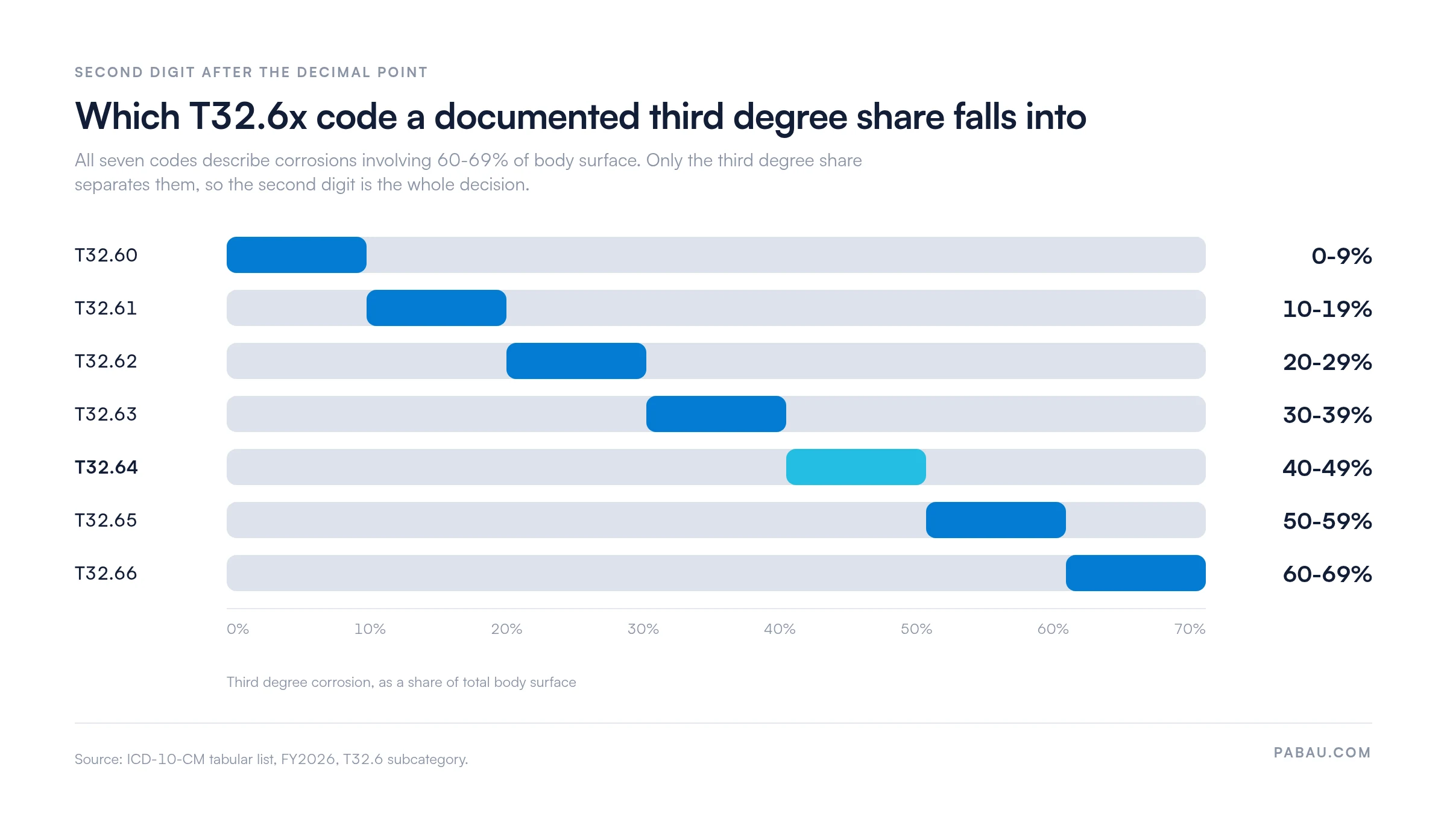
The T32 category uses a two-digit logic after the decimal point. Each digit encodes a distinct clinical measurement, and both must be supported by documentation.
The bands do not overlap, so one documented percentage resolves to exactly one code in the subcategory. A third degree portion under 10% puts the same 60-69% case in T32.60 instead.
Clinicians estimate TBSA with the rule of nines, which assigns 9% to each of the following regions.
Genitalia account for the remaining 1%. For pediatric patients, clinicians use age-adjusted charts such as the Lund-Browder chart, because the rule of nines does not reflect a child’s body proportions.
In practice, T32.64 describes a critically injured patient. More than half the body is chemically compromised, with nearly half of the total body surface at full-thickness depth. Coding accuracy here directly affects MS-DRG assignment and the reimbursement a facility receives for a resource-intensive admission.
Understanding the full hierarchy helps coders verify they are at the correct specificity level and spot adjacent codes when clinical documentation is ambiguous.
Use the CDC/NCHS ICD-10-CM web tool to verify the tabular list hierarchy and confirm code validity for any fiscal year. Our ICD-10-CM codes index covers the neighboring categories in the same injury chapter.
Selecting the correct code requires confirming both digits. The table below lists the T32.6x sibling codes alongside the adjacent subcategories. That makes the right level of specificity easy to find when documentation falls near a boundary.
When TBSA estimates sit near a boundary, defer to the physician’s documented measurement rather than rounding to a neighboring code. The icd10data.com T32 category page is useful for cross-checking the adjacent codes.
The ICD-10-CM Official Guidelines for Coding and Reporting are published jointly by CMS and the NCHS. They carry the sequencing and pairing rules for T32 corrosion codes, and the ones that matter for T32.64 are below.
Errors in sequencing and missing external cause codes are among the top reasons T32.64 claims are flagged for review. Both are easier to catch on a pre-submission check than after a denial arrives.
Document the TBSA calculation method in the clinical note, not just the percentage result. Stating ‘rule of nines applied, yielding 64% TBSA with 42% third degree involvement’ gives auditors the evidence trail they need. They can then validate T32.64 without abstracting the chart.
Accurate TBSA-based coding depends entirely on what the physician documents. Without the measurements and the causative agent recorded, the coder cannot assign T32.64 with confidence. The claim then becomes vulnerable to denial or an audit downgrade.
Consistent, structured documentation is the foundation of medical billing compliance for complex injury codes. When documentation is incomplete at the time of coding, query the attending physician. Assigning T32.64 on an assumed TBSA is what an audit catches.
T32.64 maps to MS-DRG groupings under the burn and trauma categories maintained by CMS. Corrosions at 60-69% TBSA with near-half third degree involvement are a severe presentation. The code therefore groups to high-complexity DRGs, which carry significant resource intensity.
DRG assignment is determined by the MS-DRG grouper based on the full claim, not by a single code. Accurate mapping depends on complete coding of all procedures performed, all comorbidities present, and correct sequencing of the principal diagnosis. Reimbursement amounts vary by facility, payer, and contractual rate. The DRG alone does not set a dollar value.
Practice management software like Pabau submits these claims electronically through Claim.MD, a clearinghouse connected to thousands of US payers. Clean submission on the first pass shortens the lag between discharge and reimbursement. CMS publishes the MS-DRG classifications and software files used to verify grouping each fiscal year.
The present on admission (POA) indicator is required on all Medicare inpatient claims and by most Medicaid and commercial payers. For T32.64, the correct indicator depends on where and when the corrosion injury occurred relative to the inpatient admission.
For the vast majority of T32.64 admissions the correct indicator is Y, because chemical corrosion injuries of this magnitude almost always predate admission. N is appropriate when a patient admitted for another reason sustains a corrosive exposure during the stay. It also applies when TBSA involvement only reaches the T32.64 threshold after admission. Requirements and consequences vary by payer, so confirm your facility’s rules before finalizing the indicator.
Getting T32.64 right depends on what the clinician records at the bedside. Pabau gives burn and emergency teams a structured place to put each data point the code needs.
Where a site-specific corrosion code from T20-T25 accompanies T32.64, both codes trace back to the same documented record. That is what keeps the pairing consistent when a payer asks for support.

Pabau gives clinical teams structured templates and digital records that capture the data points coders need for ICD-10 corrosion codes like T32.64. See how it works for your practice.

T32.64 leaves a coder very little room. Both digits after the decimal point are measurements, and a payer can ask for the note behind each one.
So the work finishes before the claim is built. Confirm the TBSA figure, the third degree share, and the causative agent in the record. Then assign the code alongside its external cause code.
Pabau’s structured clinical documentation and Claim.MD integration help practices capture those figures and submit clean claims. Book a demo to see how Pabau handles documentation and billing for complex injury admissions.

Want the fields a payer checks before it pays? What is a clean claim in medical billing sets out what has to be right on the first submission.
Want to reduce claim denials across your billing workflow? Denial management in healthcare covers the systematic approach to identifying and resolving coding denial patterns.
Exploring how clearinghouse integration works for ICD-10 submissions? Claim.MD clearinghouse overview explains how Pabau connects to thousands of US payers for clean electronic claim submission.
ICD-10 code T32.64 is a billable ICD-10-CM diagnosis code describing corrosions involving 60-69% of body surface with 40-49% third degree corrosions. It covers severe chemical injury where more than half the body surface is affected. Nearly half of the total body surface has reached full-thickness depth. The code is valid for FY2026 and is HIPAA-compliant for covered transactions.
Yes. T32.64 is a billable ICD-10-CM diagnosis code, confirmed valid for fiscal year 2026 (effective October 1, 2025). It can be submitted on HIPAA-covered transactions and is accepted for inpatient and outpatient claims where the full clinical criteria are met and documented.
Cause is the difference. Thermal burns come from heat sources such as flame, steam, or hot objects. Chemical corrosions come from caustic substances such as acids or alkalis. T20-T25 codes both by anatomical site, while T31 codes burns by extent and T32 codes corrosions by extent. T32.64 applies only to corrosions, so a comparable thermal injury would be coded under T31 instead.
T32.64 covers corrosions involving 60-69% of total body surface area, of which 40-49% is third degree (full-thickness) corrosion. Both figures must be explicitly documented by the treating physician to support this code at audit. TBSA is typically calculated using the rule of nines for adults or a Lund-Browder chart for pediatric patients.
T32.64 typically maps to MS-DRGs 927-929 or 933. Which one depends on whether mechanical ventilation exceeded 96 hours and whether a skin graft was performed. The specific DRG is determined by the MS-DRG grouper after reviewing the complete claim, including all procedures and comorbidities. Reimbursement amounts vary by facility and payer contract.
Yes. T32.64 is valid for FY2026, effective October 1, 2025, through September 30, 2026. The code appears in the 2026 ICD-10-CM tabular list and is accepted for HIPAA-covered transactions during this period. Verify current code validity annually using the CDC/NCHS ICD-10-CM web tool at the start of each fiscal year.
An X-series external cause code identifying the causative chemical substance should accompany T32.64 as an additional code. The specific X code depends on the substance involved (for example, X46 for contact with other caustic substances). External cause code use is recommended by ICD-10-CM Official Guidelines and required by many payers, though specific requirements vary by payer contract. Confirm the payer’s rule before you submit.



