ICD-10 code S61.201A: Open wound of left index finger without nail damage
ICD-10 code S61.201A covers a left index finger wound of unstated type ICD-10 co...

Last Updated: Oct 16, 2026
Billable Code Specific Code
T31.62 is the billable ICD-10-CM code for burns involving 60-69% of body surface with 20-29% third degree burns.
Let Pabau's smart automation suggest the right codes, reduce claim denials, and keep your practice compliant—effortlessly.
Automate repetitive tasks and focus on what matters most—your patients.
Reduce coding errors and ensure compliance with the latest regulations.
Clean claims, fewer denials, and faster reimbursements.
Powerful insights and reporting to help your practice thrive.
HIPAA compliant SOC 2 certified GDPR-compliant Trusted by 4,000+ clinics worldwide

ICD-10 Code T31.62 is burns involving 60-69% of body surface with 20-29% third degree burns.
T31 covers thermal, electrical and radiation burns. Chemical injuries belong to the parallel corrosion category, where T32.62 is the matching code.
T31.62 is the primary code when the burn site is not documented. It becomes a supplementary code once a site code from T20-T25 is known.
T31.62 is complete at five characters. It takes no seventh character, and it is never reported for the sequela of a burn.
Practice management software like Pabau keeps the diagnosis and its companion codes consistent across every encounter in a long burn admission.
ICD-10-CM code T31.62 means burns involving 60-69% of body surface with 20-29% third degree burns. Specifically, it records how much of the body burned, and how much of that burned to full thickness. Notably, the descriptor does not name the burn site, which travels on a separate code. Both figures have to appear in the note, because the second one is what moves the encounter into a heavier burn DRG.
This page also covers the descriptor, how the T31 category is built, and why the code carries no seventh character. It then sets T31.62 against the corrosion code T32.62, and lists the companion codes a burn of this size almost always needs.
The T31 category sorts burns by how much body surface is involved, not by where the burn is. In other words, that split is deliberate: codes in T20-T28 say where the burn sits and how deep it goes, while T31 says how much of the patient burned.
Typically, each T31 code carries two digits after the decimal: T31.[fourth character][fifth character]. Namely, the fourth character is total body surface area in 10% bands. The fifth character is the share of body surface with third degree involvement, in the same bands. So T31.62 reads as 60-69% burned in total, of which 20-29% is full thickness.
Those bands are read off one assessment, so a lower documented total moves the code out of the T31.6x group. A note recording 55% of body surface burned, with 30-39% third degree, is T31.53 instead.
Categories T31 and T32 are built on the classic rule of nines. Specifically, it assigns nine percent to the head and neck, nine to each arm, and 18 to each leg. Similarly, the anterior trunk and the posterior trunk take 18 percent each, and the genitalia take one percent. However, providers may adjust those shares for infants and children, who have proportionately larger heads.
Section I.C.19.d.6 of the ICD-10-CM Official Guidelines for Coding and Reporting carries the full rule, and the CDC/NCHS ICD-10-CM web tool similarly shows the current tabular entry. Adding those region shares together is how a coder reaches both of the figures inside T31.62.
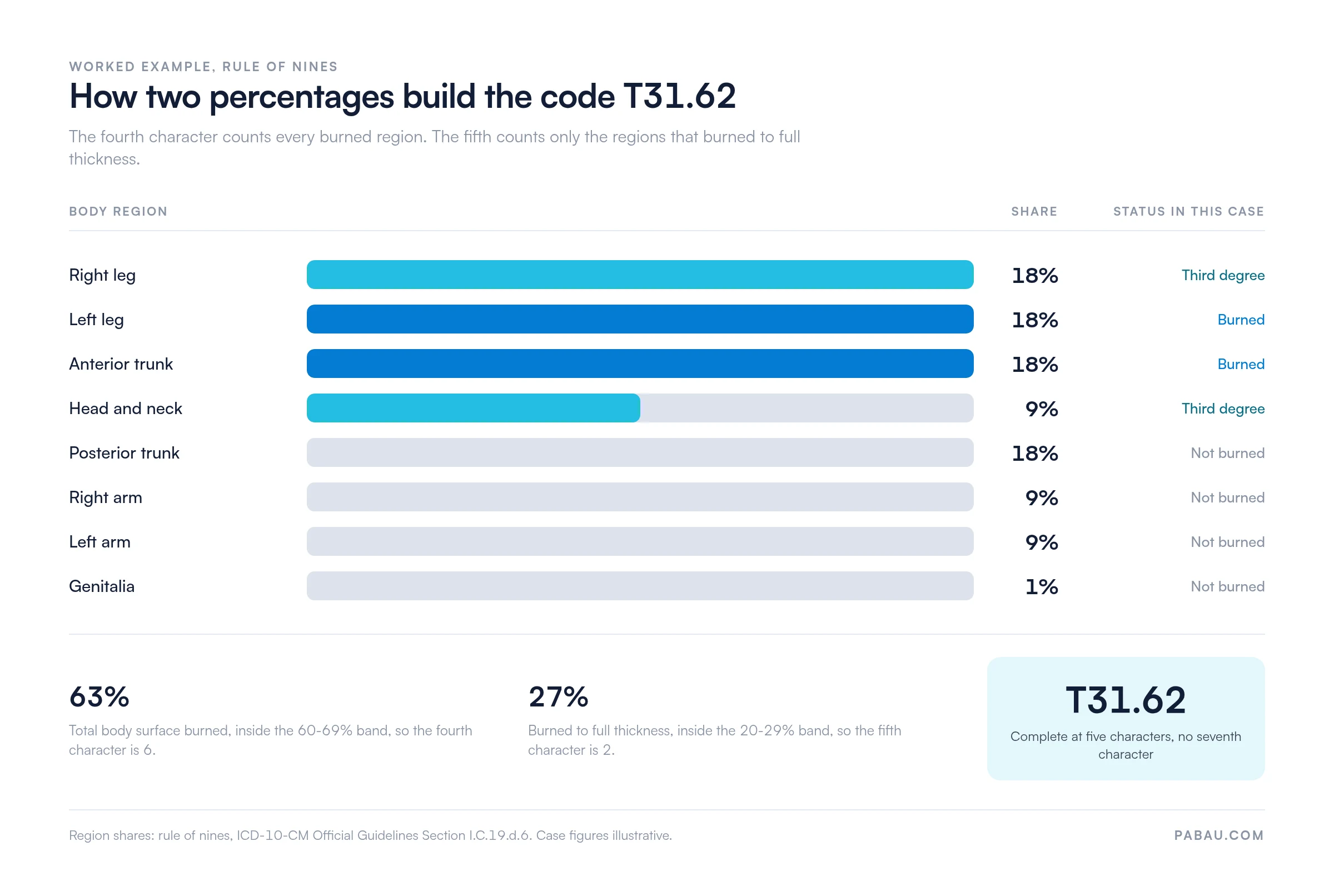
Overall, every code in the T31.6x group describes a burn covering 60-69% of body surface. The only thing that changes across the group is the third degree share. The fifth character is where audits find errors, because a note often records a TBSA total with no depth figure attached.
The group stops at T31.66, where third degree burns also cover 60-69% of body surface. A note recording 70% full thickness puts the case above this group, because the TBSA total must be at least as high.
When the note gives a TBSA total but no third degree figure, query the physician rather than defaulting to T31.60. T31.60 reads as 0% to 9% full thickness, so it badly understates a case with a quarter of the body burned to depth. As a result, that understatement can push the encounter out of the heavier burn MS-DRGs in MDC 22. For reference, the AAPC Codify entry for T31.6 lists the whole subcategory in one place.
T31 and T32 are parallel categories, and they are not interchangeable. Specifically, T31 covers thermal burns from a heat source, plus burns caused by electricity and radiation. In contrast, T32 covers corrosions, which are burns caused by chemicals. For example, a patient with a 65% acid injury and 25% full thickness damage takes T32.62, not T31.62.
Both categories sit inside the same block, T30-T32, Burns and corrosions of multiple and unspecified body regions. Indeed, that shared block heading is why the two get confused. The Official Guidelines are worded identically for burns and corrosions, but the codes themselves are not shared.
Clinical notes call chemical injuries burns as well, so read for the agent rather than the word. An alkali splash documented as a burn is a corrosion in ICD-10-CM, and its extent code comes from T32.
In short, T31.62 is complete at five characters. Specifically, the A, D and S seventh characters belong to the site specific burn codes in T20-T28, not to the extent codes in T31 and T32. Adding a placeholder X or a seventh character produces an invalid code, so T31.62XA is not something a payer will accept.
Encounter type still reaches the claim. It travels on the site code instead. A third degree burn of the right ankle at the first treatment encounter is T25.311A, and T31.62 sits beside it with no extension at all.
Sequelae, however, work the same way. Section I.C.19.d.6 states that codes from T31 and T32 are not used for the sequelae of burns or corrosions. Instead, late effects such as scar contracture or joint contracture take the site specific burn code with seventh character S, and no extent code follows.
Together, Section I.C.19.d.6 and the tabular note at category T31 give T31.62 two distinct roles. It is the primary code when the site of the burn is not specified. Once a site code from T20-T25 is documented, T31.62 becomes a supplementary code and the site code is sequenced first. So, calling T31 codes secondary only, or ruling them out as a principal diagnosis, misreads the guideline.
The guidelines also make T31 advisable as an additional code in two situations. The first is supplying burn mortality data of the kind burn units need. The second is any mention of a third degree burn covering 20 percent or more of body surface. T31.62 sits inside that second situation by definition, so a burn center should report it even when the site codes are already complete.
Sequencing carries this much weight because payers read it to assign the DRG, estimate length of stay and benchmark cost of care. Effective denial management starts with first-pass accuracy, before the claim leaves the facility.
Generally, a burn at this extent rarely closes with two codes. Instead, the record usually needs site codes, an external cause code, and codes for the complications that follow a long admission.
Occasionally, a patient can arrive with both a current burn and the late effects of an older one. Accordingly, Section I.C.19.d.8 allows a current burn code and a sequela code on the same record. Also, our ICD-10-CM code library holds the reference pages for the companion codes above.
A burn covering 60-69% of body surface with 20-29% full thickness damage is a survivable but critical injury. Accordingly, it clears every American Burn Association threshold for transfer to a verified burn center. From there, care runs through ICU management, serial excision and grafting, and months of rehabilitation. Encounters like this group into MDC 22, the burn DRG family, where the documented extent drives the payment.
For billing teams at facilities that take burn transfers, a quarterly documentation audit is the cheapest control available. Indeed, it only has to confirm that both percentages appear as separate figures in the note. Meanwhile, CMS publishes the current ICD-10-CM files, which is where to settle a descriptor question during that review.
Build the burn code set in the same order every time. Site codes come first by descending degree, then the T31 extent code, then external cause, place and activity. A fixed order makes a missing extent code obvious on review.
Across a burn admission the diagnosis set moves every few days. Consequently, coders rebuild it from operative notes, wound care notes and flow sheets that all live in different places. As a result, the extent code that was right on day one can be wrong after the second graft, and nobody notices until the remittance lands.
Pabau, however, keeps the clinical record and the billing record in one system. So the codes your coder enters sit on the encounter beside the note that supports them. Its medical claims management tools then carry that code set onto the claim without a re-entry step. The Claim.MD integration then runs payer edits against the submitted combination, not one code at a time.
So the sequence you intended is the sequence that reaches the payer. When a claim does come back, the rejection points at a code you can open in seconds. As a result, nobody has to rebuild it from three separate sets of notes.


Pabau’s claims management tools support accurate ICD-10 entry, multi-code sequencing and electronic claim submission for encounters as complex as a major burn. See how it works for your practice.

T31.62 is the burns code and T32.62 is the corrosion code. That decision comes before either percentage, and it is the one this code family gets wrong most often. Afterward, two figures settle the choice: 60-69% of body surface burned in total, and 20-29% of it burned to full thickness.
Report T31.62 as the principal diagnosis when the site is undocumented, and alongside the T20-T25 codes when it is known. Then re-check the fifth character after every graft, because excision changes the documented full thickness share. Finally, to see how Pabau keeps a burn admission’s codes consistent from admission to discharge, book a demo with our team.

Need guidance on ICD-10 documentation for denial prevention? Denial management in healthcare covers the most common claim rejection patterns and how to address them upstream.
Want to understand how clearinghouse claim edits work? Claim.MD clearinghouse explains how electronic claim validation catches code errors before they reach the payer.
Wondering what makes a burn claim pass at the first attempt? Clean claim sets out the fields and code combinations a payer accepts without a review.
T31.62 means burns involving 60-69% of body surface with 20-29% third degree burns. It records the extent of the burn, not its location. The code is complete at five characters and takes no seventh character.
No. T31.62 covers thermal, electrical and radiation burns. T32.62 covers corrosions, which are burns caused by chemicals such as acids and alkalis. The two categories run in parallel and are never interchangeable, even though they share the T30-T32 block.
T31 is the category for burns classified according to extent of body surface involved. The fourth character gives total body surface area in 10% bands. The fifth character gives the share of body surface with third degree involvement, in the same bands.
Yes. T31.62 is the primary code when the site of the burn is not specified. Once a site code from T20-T25 is documented, T31.62 becomes a supplementary code and the site code is sequenced first.
No. T31.62 is a complete five-character code. The A, D and S seventh characters belong to the site specific burn codes in T20-T28. T31.62XA is not a valid code, and a payer will reject it.
All three cover burns across 60-69% of body surface. They differ in third degree involvement: T31.61 is 10-19%, T31.62 is 20-29%, and T31.63 is 30-39%. The note has to state the third degree percentage to support the choice.
A burn of this extent usually needs site codes from T20-T28 and an external cause code for the source and intent. Add a place of occurrence code, plus a code for any documented burn infection. Code inhalation injury separately, because it does not count toward the TBSA figure.