ICD-10 code S61.201A: Open wound of left index finger without nail damage
ICD-10 code S61.201A covers a left index finger wound of unstated type ICD-10 co...

Last Updated: Oct 16, 2026
Billable Code Specific Code
T31.53 is the billable ICD-10-CM code for burns involving 50-59% of body surface with 30-39% third degree burns. Its fifth character reports depth. It tells the payer what share of the patient's total body surface is full thickness, not what share of the burned area is.
Coders reach for T31.53 when the third-degree total sits between 30% and 39%. At 40% the case moves up to T31.54, and at 29% it drops to T31.52. Payers read that character as a severity signal on a high-value claim, so a one-tier slip is a routine denial trigger. T31.53 covers active burns only, and it is never a sequela code.
Let Pabau's smart automation suggest the right codes, reduce claim denials, and keep your practice compliant—effortlessly.
Automate repetitive tasks and focus on what matters most—your patients.
Reduce coding errors and ensure compliance with the latest regulations.
Clean claims, fewer denials, and faster reimbursements.
Powerful insights and reporting to help your practice thrive.
HIPAA compliant SOC 2 certified GDPR-compliant Trusted by 4,000+ clinics worldwide

T31.53 reports burns covering 50-59% of total body surface area, with 30-39% of that total surface third degree.
The T31 category note makes T31.53 the primary code only when the burn site is unspecified, and a supplementary code whenever the site is documented.
T31.50 is not an unspecified option. It reports 0% to 9% third-degree involvement, and the T31.5 subcategory stops at T31.55.
T31 codes take no 7th character, so T31.53 is never a sequela code. Late effects are coded from T20-T25 with 7th character S.
Every T31.53 claim also needs an external cause code naming the source and the intent of the burn.
ICD-10 code T31.53 reports burns involving 50-59% of body surface with 30-39% third degree burns. That is the wording in the ICD-10-CM Tabular List.
The code sits in Chapter 19, Injury, Poisoning and Certain Other Consequences of External Causes. Above it, the T31 category reads “Burns classified according to extent of body surface involved.”
The CDC/NCHS ICD-10-CM web tool lists T31.53 as a valid, billable code. Read it on three levels. The T31 category sets extent-based coding, the fourth character 5 sets 50-59% TBSA, and the fifth character 3 sets 30-39% third degree. Getting all three right is what separates a clean claim from a fifth-character denial.
Total body surface area burned is the percentage of skin surface the injury involves. ICD-10-CM Official Guidelines section I.C.19.d.6 states that categories T31 and T32 are based on the classic rule of nines. Under that method, each body region carries a fixed percentage.
So a patient with burns to both arms (18%), the whole anterior trunk (18%), and the head and neck (9%) reaches 45% TBSA. Add one leg (18%) and the total climbs to 63%, which moves the case out of T31.5 and into T31.6.
The same guideline lets providers adjust these assignments for infants and children, whose heads are proportionately larger. It allows the same adjustment for patients with large buttocks, thighs, or abdomen. In pediatric burns, the Lund-Browder chart is the usual tool for that.
Documenting how TBSA was calculated, and by which method, is not optional. Payers and Medicare Administrative Contractors increasingly ask for the attending physician’s burn diagram or a signed TBSA calculation note. That request comes before payment on a 50-59% claim is authorized.
Third-degree burns are full-thickness injuries that destroy both the epidermis and the dermis, often reaching into subcutaneous tissue.
The fifth character in T31.53 says that 30-39% of the patient’s total body surface is full thickness. It does not mean 30-39% of the burned area alone.
Take a patient with 55% TBSA burned, of which 35% of total body surface is third degree and 20% is second degree. That case maps to T31.53. If the same patient has only 25% third degree, the code drops to T31.52.
Depth documentation therefore has to give a percentage and a body region for each burn depth. A line reading “extensive third-degree burns” cannot support a fifth character. The sequence below shows how that one case builds up.
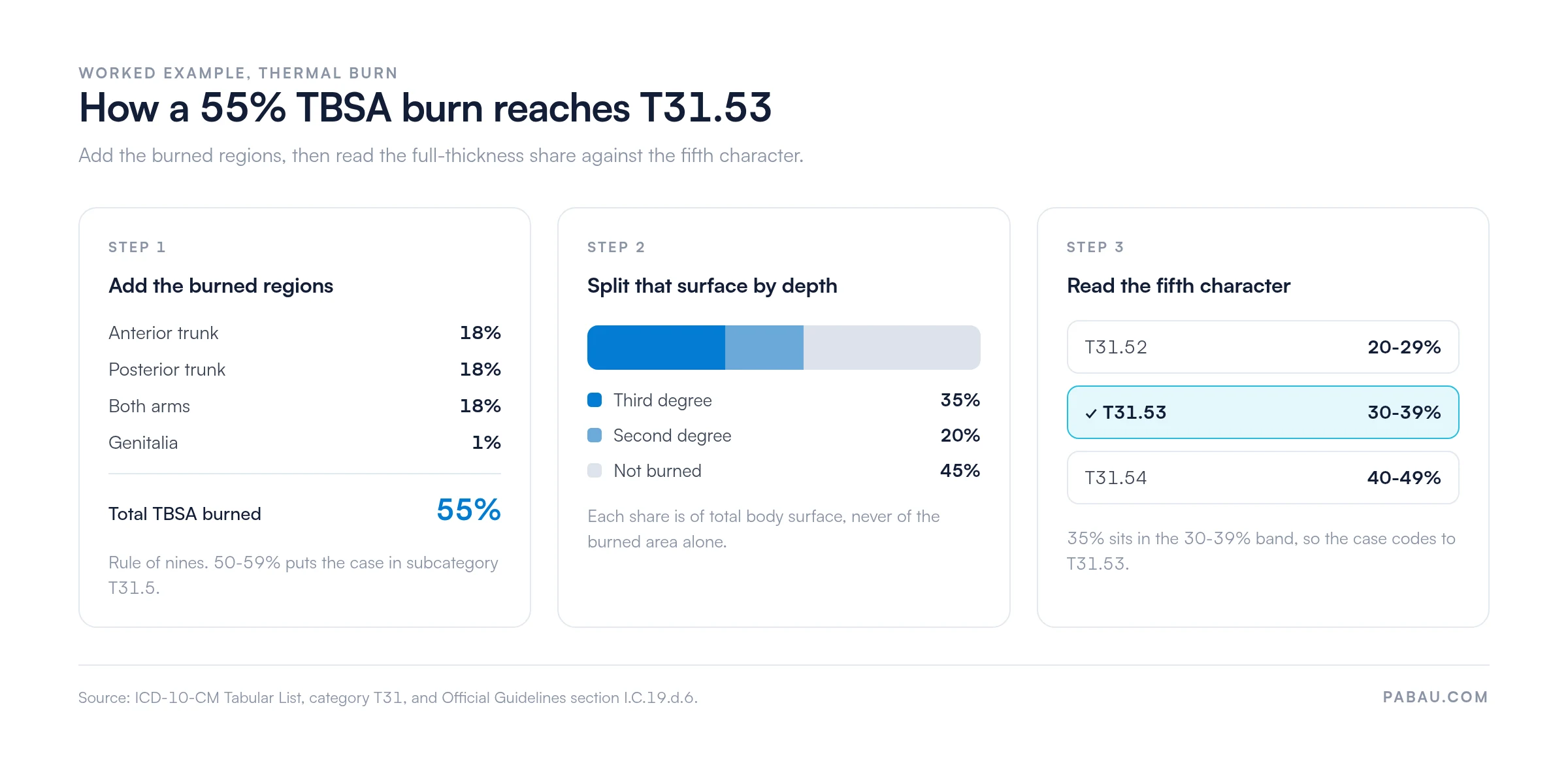
Every T31.5x code covers the same 50-59% TBSA range, so the fifth character alone decides which one is correct.
Picking the wrong neighbor is a common and auditable error. It happens most often when depth documentation changes between admission and a later coding review.
T31.50 is not an unspecified fallback, and treating it as one is a recurring error. It reports 0% to 9% third-degree involvement, so assigning it to a chart documenting 35% full-thickness burns understates the case badly. When the record does not quantify third-degree involvement at all, the right response is a provider query.
The subcategory also stops at T31.55. Third-degree involvement cannot exceed the total burned surface, so there is no T31.56 through T31.59. A patient with more than 59% full-thickness burns has more than 59% TBSA burned, which places them in T31.6 or higher.
T31 carries no Excludes1 note at all. The only exclusions that reach it sit at the T20-T32 block level, and every one of them is an Excludes2.
That distinction matters for claim building, because an Excludes2 note permits both codes on the same encounter when both conditions are documented.
The rule that does constrain T31.53 is the category note in the Tabular List. It states that T31 “is to be used as the primary code only when the site of the burn is unspecified.”
The same note adds that T31 “should be used as a supplementary code with categories T20-T25 when the site is specified.” Most T31.53 sequencing disputes start there, not with an exclusion.
Chemical burns run on a separate track. Corrosions classified by extent go to T32 rather than T31, alongside the corrosive substance code from T51-T65. A patient with both thermal and chemical burns therefore needs two coding sequences. T31.53 covers the thermal extent, and the matching T32 subcategory covers the corrosion.
Do not strip a sunburn or radiation-dermatitis code off a T31.53 claim on the assumption that it conflicts. The T20-T32 exclusions are Excludes2, so both codes can stand when the record documents both conditions. Removing a correctly documented code to clear an imagined Excludes1 edit loses data the payer never asked you to drop.
T20-T25 capture which body region is burned, such as the face, a hand, the trunk, or a lower limb. T31.53 captures how much of the whole body is burned, and how much of that is third degree. The two answer different questions, so on most claims they appear together.
A worked example helps. A patient is admitted with third-degree burns of the chest wall (T21.31XA) and the right hand (T23.301A), totaling 55% TBSA with 35% third degree.
Both burns are third degree, so the circumstances of admission decide which site code leads. T31.53 then follows the site codes and supplies the severity quantification that DRG assignment and case-mix calculations read.
Missing or vague documentation is the single biggest driver of T31.53 denials. A billing system can hold the claim until every required field is filled, which is the easy half of cleaner claims management. The clinical detail behind the code still has to originate in the record. Payers reviewing major burn admissions look for the following.

A burn-specific documentation checklist belongs in intake and discharge, not in the coder’s inbox. Building it into the record as the case moves cuts down on queries later and shortens the revenue cycle.
Guidelines section I.C.19.d.9 requires an external cause code alongside T31.53, identifying the source and intent of the burn and the place where it happened. Clinical context often calls for further codes as well.
The AAPC ICD-10-CM lookup tool shows the full T31 category with its linked external cause options. It is a quick way to confirm the right X-code pairing for the documented mechanism.
Major burn claims carry high dollar values, so they attract closer payer review. Five patterns account for most T31.53 rejections.
Each traces back to a documentation or sequencing decision rather than to the code itself. Medical billing denial codes name the outcome, while the table below names the cause.
Notice what those five have in common. None of them is a coding-knowledge problem. Each one is something a reviewer could have caught before the claim left the building.
Burns covering 50-59% TBSA almost always need surgical intervention. The CPT codes below are the ones commonly paired with T31.53 under standard burn care protocols.
Pairing accuracy affects reimbursement, so verify each against the relevant MAC’s LCD and the payer’s medical policy before submission.
The CMS Physician Fee Schedule lookup carries current RVU values and payment amounts for each CPT code. Confirm the body-region add-on codes before finalizing, since face and hands use different CPT codes than trunk and extremities.
T31.53 is an extent code for an active burn, and it is never used for a sequela. ICD-10-CM Official Guidelines section I.C.19.d.6 states plainly that “codes from categories T31 and T32 should not be used for sequelae of burns or corrosions.” The category also has no 7th character position, so a form such as “T31.53XS” is not a code at all.
That is the structural difference between the two burn families. Site-specific codes such as T21.31 expand to T21.31XA, T21.31XD, and T21.31XS for initial encounter, subsequent encounter, and sequela. Every T31 code is complete at five characters in the CDC code list, with no encounter-type axis to extend.
Section I.C.19.d.7 sets out what to code instead. A patient may return months after a 55% TBSA burn for scar revision, contracture release, or reconstructive grafting. That encounter is coded from the site-specific burn family, not the extent family. Here is the sequence.
One encounter can still carry both a current burn and a late effect. Section I.C.19.d.8 allows a burn code with 7th character A or D alongside a separate burn code with S on one record. Burns at different sites heal at different rates. T31.53 may appear on that record too, but only to quantify the burn surface still under active treatment.
All of the rules above meet on one screen, at the moment the claim is built. Five quick checks catch the cases that come back.
Work the list in that order and most of the five denial patterns never get the chance to fire. A clean claim on the first pass beats chasing a denial three weeks later.
A 55% TBSA admission produces a long code string. Site-specific T20-T25 codes for each burn, T31.53 for extent, an external cause code, and a place-of-occurrence code all have to land on one claim. So do the CPT codes for debridement and grafting.
Rekeying that string between an EMR and a billing system is where transcription errors get in. Practice management software like Pabau builds the claim from the patient record instead. The CPT code attached to the service lands on the charge line, and the ICD-10 slots are seeded from the problem list in the chart.
Built-in ICD-10-CM and CPT lookup libraries hold more than 20,000 codes, refreshed with each official release. So a coder can confirm T31.53 against the current descriptor without leaving the claim form.
Pabau then checks that every field the payer requires is complete before the claim can be sent. That keeps claims from leaving without a membership number or an authorization code. Eligibility checks, claim-status tracking and remittance posting sit in the same place, so a rejection surfaces where the claim was built.

Pabau’s claims management software pre-fills the claim from the chart and keeps current ICD-10-CM and CPT lookups in the claim form. Every required field is checked before the claim is sent.

T31.53 is a high-stakes code. Burns at this severity generate long, multi-code claims that Medicare and commercial payers audit closely. The fifth character decides whether the claim survives review, and it rests on the attending documenting a specific third-degree percentage.
Two rules do most of the work. T31.53 leads the claim only when the burn site is unspecified, and it never carries a sequela suffix, because T31 codes stop at five characters. Get those two right, and the rest of a burn claim comes down to ordinary documentation discipline.
If your team still retypes burn codes from the chart into a billing system, that is where the fifth character goes missing. Book a demo to see how Pabau builds the claim from the patient record and checks it before it leaves.

List Item #1
List Item #2
Query the attending. The fifth character is a banded value. An approximation on a band edge can drop the claim to T31.52 or hold it at T31.53. Ask for a stated percentage of total body surface. A coder’s own estimate will not survive an audit.
The treating provider. A nurse’s burn diagram and a therapist’s wound measurements support the code. The depth and extent statement behind it still comes from the physician. Where only nursing notes quantify the burn, query before coding.
Yes, on an inpatient claim. Every reported diagnosis carries a POA indicator, and a burn the patient arrived with is reported as present on admission. The external cause codes reported with T31.53 carry their own indicators too, so check them before the claim drops.
Yes. T31.53 is valid wherever the documentation supports it, including the emergency department and outpatient care for an active burn. The bar does not move with the setting. The record still needs a calculated TBSA and a stated third-degree percentage.
Code from the documentation that stands when the case is coded. If an operative note raises the full-thickness total to 40% or more of body surface, the case belongs in T31.54 instead. Where the claim has already gone out, correct it rather than leave the earlier fifth character in place.