ICD-10 code S61.201A: Open wound of left index finger without nail damage
ICD-10 code S61.201A covers a left index finger wound of unstated type ICD-10 co...

Last Updated: Oct 16, 2026
Billable Code Specific Code
T31.88 is the billable ICD-10-CM code for burns involving 80-89% of body surface with 80-89% third degree burns.
The code carries two numeric thresholds. The first, 80-89%, is the total BSA percentage. The second, also 80-89%, is the share of body surface carrying third-degree (full-thickness) burns. Both must be documented explicitly by the treating physician before a coder can assign T31.88.
T31.88 does not record where the burn is. Burn site comes from T20-T25, the categories for burns and corrosions of the external body surface specified by site. Those site codes are sequenced first, and T31.88 is added to record the extent. T31.88 carries a claim on its own only when the record leaves the burn site unspecified.
Let Pabau's smart automation suggest the right codes, reduce claim denials, and keep your practice compliant—effortlessly.
Automate repetitive tasks and focus on what matters most—your patients.
Reduce coding errors and ensure compliance with the latest regulations.
Clean claims, fewer denials, and faster reimbursements.
Powerful insights and reporting to help your practice thrive.
HIPAA compliant SOC 2 certified GDPR-compliant Trusted by 4,000+ clinics worldwide

T31.88 is a billable ICD-10-CM code for burns covering 80-89% of total body surface area, with third-degree burns over 80-89% of body surface. It is valid for FY2026, which runs October 1, 2025 through September 30, 2026.
T31 codes classify burns by extent, not by anatomical site. Burn site is coded from T20-T25, and never from the S-chapters.
Sequencing puts the site first. A T20-T25 code leads the claim, and T31.88 follows as a supplementary code for extent. T31.88 stands alone only when the site is unspecified.
Two other companion rules apply. Add T59.- for any associated inhalation injury, and A41.- for burn-related sepsis.
Practice management software like Pabau, integrated with Claim.MD, helps burn care teams submit accurate T31.88 claims and catch documentation problems before denial.
T31 codes classify burns by extent of body surface area involved, not by anatomical location. Site belongs to a separate set of categories: T20-T25, burns and corrosions of the external body surface specified by site.
The ICD-10-CM classification uses T31 to answer how much of the patient’s body is burned and how much of it is full-thickness. T20-T25 answer which body region was burned.
The six site categories run from head to foot, and one of them applies to every documented burn region:
The S-chapters carry no burn codes at all. Every S-block, from S00-S09 through S90-S99, opens with an Excludes2 note routing burns and corrosions to T20-T32. Reaching for an S code to describe a burn site produces an invalid code assignment, and payers reject it.
T31.88 sits within the T31.8x subcategory, which covers all burns with 80-89% total BSA involvement. The fifth character records how much of the body surface carries third-degree burns. This two-axis structure means coders must always identify both the total burn extent and the third-degree extent.
Accurate code assignment for T31.88 depends entirely on the TBSA assessment documented at the point of care. The Rule of Nines is the standard method used for adults. It divides the body into regions, each representing roughly 9% of total surface area, or a multiple of 9%.
For adults, the Rule of Nines assigns the following percentages to major body regions, per CDC/NCHS ICD-10-CM guidance. Reaching the 80-89% BSA threshold typically involves burns to most or all major body regions simultaneously:
Reaching 80-89% BSA in an adult means virtually the entire body surface is burned. Take the arithmetic. Head and neck (9%), anterior trunk (18%), posterior trunk (18%), both arms (18%) and both legs (36%) add up to 99% BSA.
A patient with sparing of only a small area, such as the genitalia and partial lower extremities, lands in the 80-89% range.
Pediatric patients need the Lund-Browder chart instead. It adjusts the head and leg proportions by age, so the adult Rule of Nines values understate a child’s head involvement.
Third-degree burns, also called full-thickness burns, destroy the epidermis, dermis, and extend into subcutaneous tissue. Clinically, they show a leathery, waxy, or charred appearance and no blistering. Pain sensation is absent in the affected area, because the nerve endings have been destroyed. For T31.88, the treating physician must confirm third-degree burns over 80-89% of body surface.
Coders cannot infer burn depth from procedure codes alone. The physician must explicitly document the depth classification in the medical record. A note stating only “extensive burns” or “major burn injury” is not enough to support T31.88. Without the third-degree percentage, expect a denial or a query from the coding team.
When reviewing burn admission documentation, check the attending physician’s burn assessment note specifically. Emergency department triage notes often record initial estimates that may differ from the definitive assessment. Always code from the final attending physician documentation, not the triage estimate.
T31.88 belongs to the T31.8x subcategory, which covers all burns involving 80-89% of body surface area. The sibling codes differ only in the second axis, the percentage of body surface that carries third-degree burns. The subcategory ends at T31.88, because third-degree extent can never exceed total burn extent.
When the documentation puts full-thickness burns in the 60-69% band instead, T31.86 is the code for that same 80-89% extent.
The choice gets tight when the documented third-degree percentage sits close to a band edge. Verify against the AAPC ICD-10-CM code lookup for current descriptions. Our ICD-10-CM code library covers the neighboring burn codes in the same detail.
The ICD-10-CM Official Guidelines for Coding and Reporting carry specific instructional notes for T31.88. Those guidelines are maintained jointly by the Centers for Medicare and Medicaid Services (CMS) and the National Center for Health Statistics (NCHS). Coders must apply the notes alongside the code assignment itself.
The diagram below shows the order those codes take on the claim, and the companion codes that attach behind them.
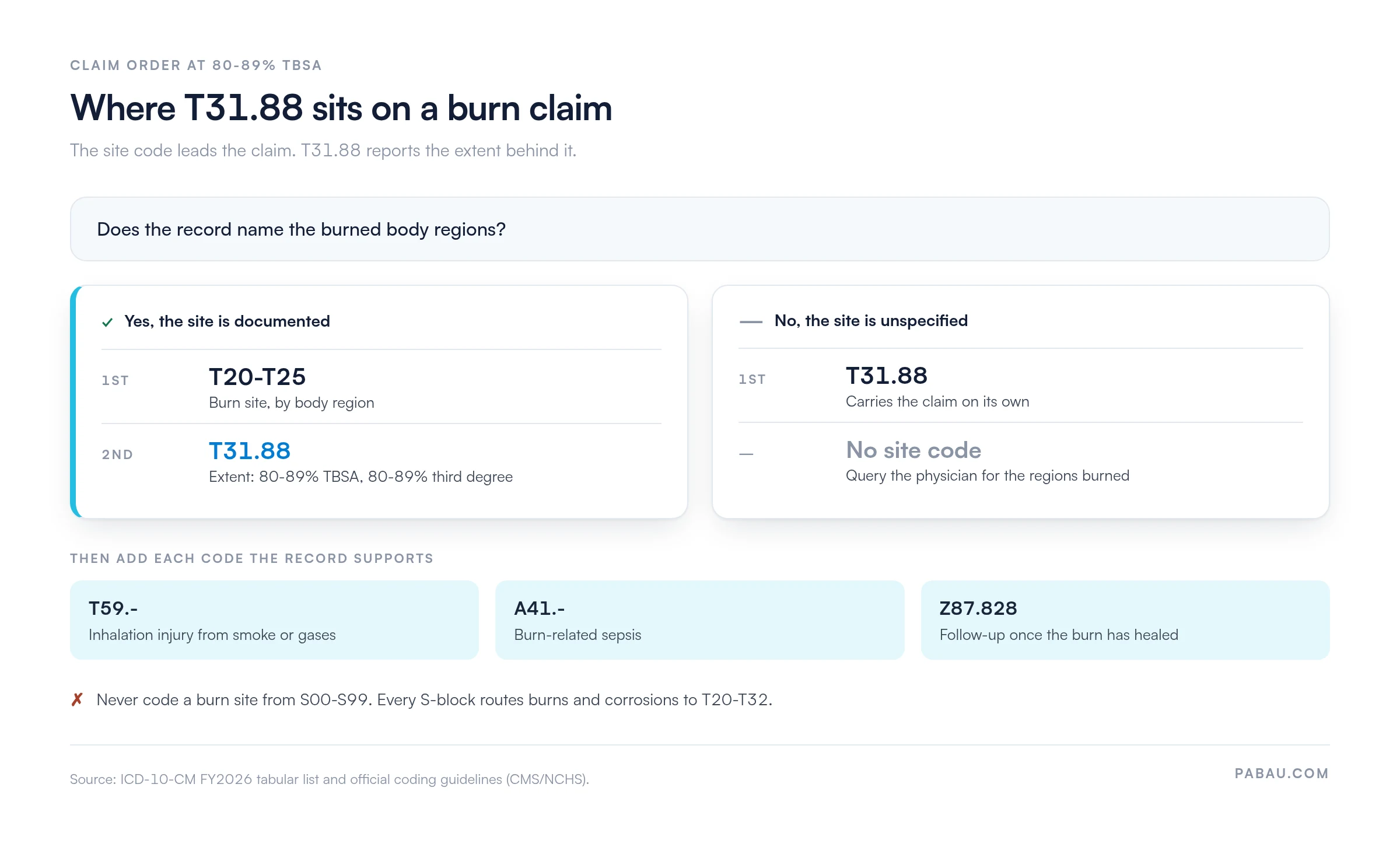
Check the sequence before the claim goes out, not after. A burn claim that leads with T31.88 while the chart names the burned regions has the order backwards. Put the T20-T25 site code first and let T31.88 report the extent behind it.
Burn cases at the 80-89% BSA level involve multisystem management. The table below shows companion codes frequently assigned with ICD-10 code T31.88. Practice management software like Pabau validates these combinations before submission through its Claim.MD integration. A missing required code surfaces while the coder can still add it.
Incomplete documentation is the leading cause of T31.88 claim denials. The medical record must contain explicit, physician-authored language supporting both axes of the code. A clean claim for a burn case at this severity level requires all of the following elements in the clinical notes before coding begins.
Understanding when T31.88 applies, and when an adjacent sibling code is more accurate, prevents the most common burn coding errors. The distinction often comes down to a single percentage point in the third-degree burn documentation.
Denials on burn cases usually point at the fifth character. T31.87 and the T31.9- codes are the common substitutions when T31.88 was the intended assignment. Lower down the same subcategory, T31.83 keeps the 80-89% total burn extent with third-degree burns over 30-39% of body surface.
A burn case at this severity passes through several hands before a claim leaves the building. The burn surgeon records TBSA and depth, the coder assigns the T20-T25 site codes and T31.88, and the billing team files the claim. When those steps sit in separate systems, a missing site code shows up only in the denial.
Pabau keeps the clinical record and the claim in one place. Structured clinical forms hold the TBSA percentage, the third-degree extent, and each region involved, so your coder reads numbers instead of interpreting a narrative note. Attending attestation is captured on the same record, which is the element payers query most often on burn admissions.
The Claim.MD integration then checks the claim before submission and flags companion code problems while the case is still open. Your team reworks fewer denials, and payment lands closer to the date of service.

Pabau’s claims management software, integrated with Claim.MD, helps burn care teams validate companion codes and check documentation. Submit accurate T31.88 claims to thousands of US payers without the back-and-forth.

ICD-10 code T31.88 applies to one of the most severe burn presentations in clinical coding. It requires explicit documentation of 80-89% total BSA involvement and third-degree burns over 80-89% of body surface. The two-axis T31 system demands precision at every step, from the bedside assessment to the T20-T25 site codes that lead the claim.
Pabau’s software for billing teams validates T31.88 claims before they leave the building. It catches missing companion codes and the documentation shortfalls payers use to deny. To see how it works for your team, book a demo.

Need guidance on how ICD-10 updates affect your billing workflows? What is revenue cycle management covers how the full RCM cycle connects diagnosis coding to reimbursement.
Submitting burn claims through a clearinghouse? Understanding the 837 file format explains how electronic claims carry diagnosis code data to payers.
Concerned about claim denials on complex inpatient cases? Denial codes in medical billing breaks down the most common denial reasons and how to resolve them.
ICD-10 code T31.88 is a billable ICD-10-CM diagnosis code for burns involving 80-89% of total body surface area. Third-degree (full-thickness) burns must cover 80-89% of body surface. The code is valid for fiscal year 2026, which runs October 1, 2025 through September 30, 2026.
Yes, T31.88 is a billable ICD-10-CM diagnosis code confirmed in the CMS FY2026 tabular list. It can be used as a principal or additional diagnosis code on claims submitted through HIPAA-covered electronic transactions.
T20-T25 identify where the burn is, by body region. T31 records how much body surface is burned and how much of it is third-degree. The two work together on one claim, with the T20-T25 site code sequenced first and T31.88 added for extent. Burn site is never coded in S00-S99, because every S-block excludes burns and corrosions.
Start with a site code from T20-T25 for every burned region, sequenced ahead of T31.88. If inhalation injury is documented, add the appropriate T59.- code. If sepsis develops, add A41.-. On follow-up encounters after healing, Z87.828 covers personal history of other (healed) physical injury and trauma. The AAPC ICD-10-CM lookup lists all instructional notes for T31.88.
A T31 code replaces the site codes only when the record does not specify the burn site. In that situation it carries the claim on its own. Whenever the site is documented, a T20-T25 code leads and T31 follows as a supplementary code for extent and third-degree involvement.
The attending physician must explicitly document the total TBSA percentage and the third-degree burn percentage, both within 80-89%. The record must also name the body regions affected and address inhalation injury status. Narrative descriptions without numeric percentages are insufficient. Coders should query the physician if any of these elements are missing from the medical record, per ICD-10 classification principles.