ICD-10 Code S82.242H: Displaced spiral tibial shaft fracture, delayed healing
ICD-10 Code S82.242H: Definition and code details ICD-10 Code S82.242H designate...

Last Updated: Oct 15, 2026
Billable Code Specific Code
T31.64 is the billable ICD-10-CM code for burns involving 60-69% of body surface with 40-49% third degree burns.
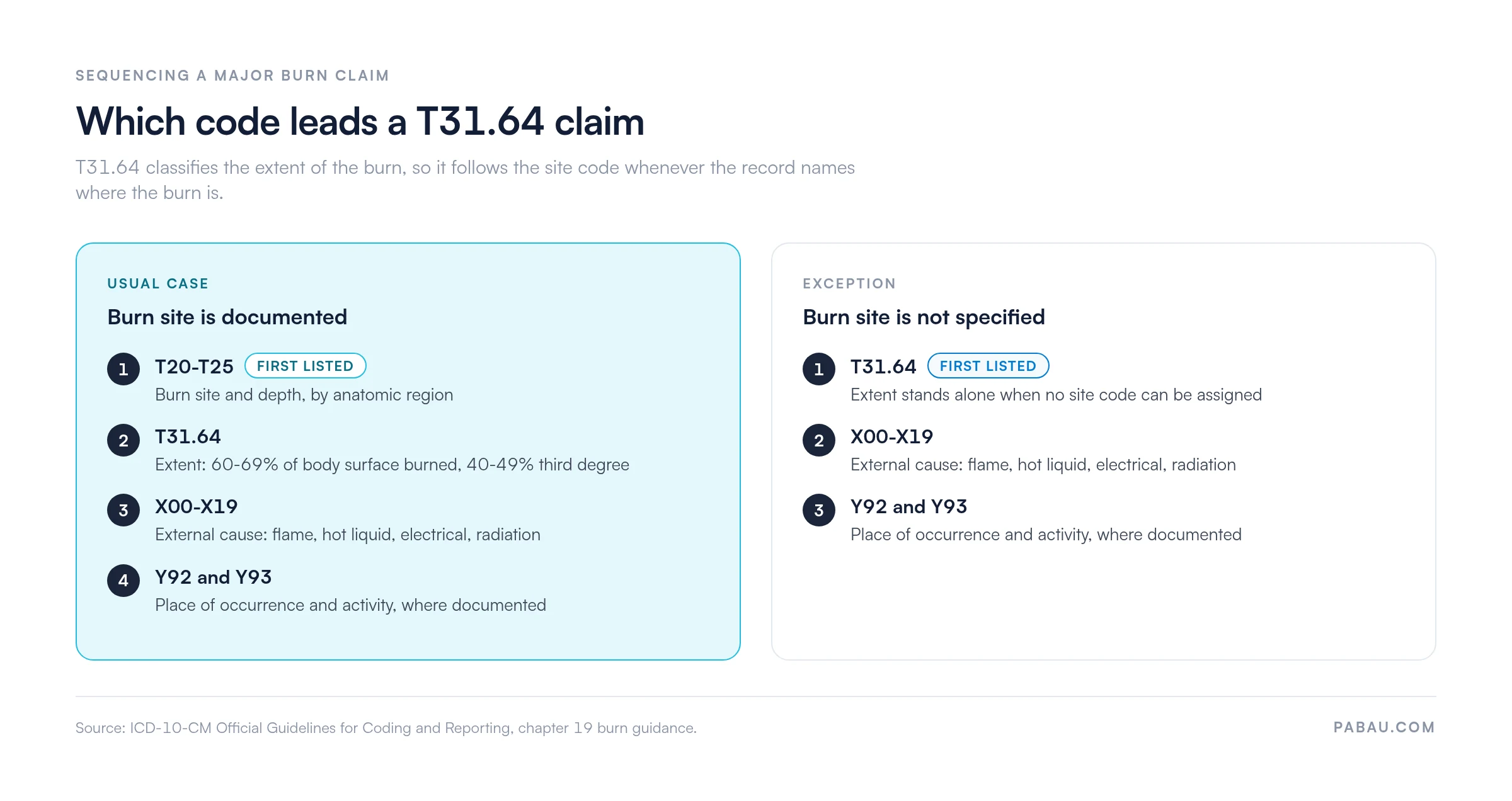
Sequencing is what decides whether the claim reads correctly. When the record names the burn site, a code from T20-T25 is first listed, and T31.64 follows it as an additional code. T31.64 leads the claim only where the site is unspecified.
Two documentation errors account for most trouble with this code. Coders conflate the total burn extent with the third-degree share, or they leave out the companion codes for site and external cause.
Let Pabau's smart automation suggest the right codes, reduce claim denials, and keep your practice compliant—effortlessly.
Automate repetitive tasks and focus on what matters most—your patients.
Reduce coding errors and ensure compliance with the latest regulations.
Clean claims, fewer denials, and faster reimbursements.
Powerful insights and reporting to help your practice thrive.
HIPAA compliant SOC 2 certified GDPR-compliant Trusted by 4,000+ clinics worldwide

T31.64 is a billable ICD-10-CM code for burns involving 60-69% of body surface, with 40-49% of body surface classified as third degree.
The code has been in ICD-10-CM since the US implementation date of October 1, 2015, so it is not a recent addition.
The record needs two separate figures, the total burn extent and the third-degree share, each measured against body surface.
Where the burn site is documented, the T20-T25 site code is first listed and T31.64 is reported as an additional code.
Practice management software like Pabau submits burn claims to thousands of US payers through its Claim.MD integration.
T31.64 turns up in inpatient and acute-care records for major burns. Unlike most injury codes, it carries a dual-percentage requirement, which is what makes verifying the documentation worth the extra minute.
The CDC/NCHS ICD-10-CM web tool is the authoritative source for verifying T31.64’s current billable status each fiscal year. Annual updates take effect on October 1, so confirming validity before submitting claims on or after that date is standard practice.
The T31 category classifies burns by the extent of body surface involved, not by anatomic location. It runs parallel to the T20-T25 site-specific burn codes, which carry the location and the depth of the injury.
T31 codes run on two axes. The fourth and fifth characters carry the total burn extent as a share of body surface. The sixth character carries the share of body surface with third-degree burns. T31.64 sits in the T31.6X subcategory, so total extent is 60-69%, and the sixth character puts third-degree involvement at 40-49%.
The clinical record has to support both figures independently. A note that documents total extent without separately identifying the third-degree share cannot support code selection past T31.60.
Two validated methods determine TBSA for T31 code selection. Coders should confirm which method the treating clinician used, since each produces slightly different figures, particularly in pediatric patients.
The CMS ICD-10-CM coding resources and the ICD-10-CM Official Guidelines for Coding and Reporting govern how burn extent is coded and reported. The guidelines are maintained jointly by CMS and the CDC National Center for Health Statistics.
Sequencing errors and missing companion codes are the leading causes of denial on major burn claims. Both are avoidable at the point of coding, provided the coder knows which code the payer expects to see first.
T31.64 classifies a burn by extent, so it rarely leads the claim. The ICD-10-CM Official Guidelines put the site code first whenever the record names where the burn is. T31.64 is then reported as an additional code that captures how much of the body was burned.
The exception is a record that never specifies the site. T31.64 becomes the first-listed diagnosis there, because no T20-T25 code can be assigned. The two orders are set out below.
The AAPC ICD-10-CM lookup carries coding notes that supplement the official tabular, including the use-additional-code instruction attached to the T31 category. Checking that instruction in both places keeps sequencing consistent across a coding team. On burn cases, denial management usually comes down to a companion code that never made it onto the claim.
The T31 parent category carries official Includes and Excludes notes that define its boundaries. These must be reproduced faithfully from the ICD-10-CM tabular list and never paraphrased.
Knowing the sibling codes in the T31.6X subcategory and the adjacent subcategories (T31.5X, T31.7X) helps coders judge whether T31.64 is the right level of specificity. The wider ICD-10 code library follows the same structure, so a neighboring code can be checked the same way.
T32.64 is the corrosion counterpart to T31.64, covering corrosions involving 60-69% of body surface with 40-49% third degree. Corrosions are chemical burns caused by a caustic substance. The clinical and coding distinction matters on the claim.
Run a dual audit before any T31.64 claim goes out. First, confirm that two separate percentages appear in the clinical notes, the total burn extent and the third-degree share. Second, confirm the sequence: the T20-T25 site code first, T31.64 as the additional code, then the external cause code. A missing companion code is the most common reason major burn claims come back as incomplete.
T31.64 is one of the most documentation-intensive codes in the injury chapter. Every element the code specifies has to appear in the clinical record. Where one is missing, a payer auditor can challenge the code and recover the payment.
Burn units often add a physician query template for T31-series cases. It prompts each element above at the point of care, rather than during retrospective coding review. The NCHS ICD-10-CM code files hold the official descriptors, and they are worth checking before a major burn claim goes out.
Major burn cases coded with T31.64 run through inpatient stays, surgical procedures, and long multi-code claims. Every companion code has to travel with the claim, and every remittance has to be matched back to it. That reconciliation work is where a busy billing team loses hours.
Practice management software like Pabau covers the submission side of that job. Pabau’s faster claims management tools send claims electronically through Claim.MD, our US clearinghouse partner, which reaches thousands of US payers. Eligibility checks run in real time, and electronic remittance advice is tracked against each claim as it comes back.
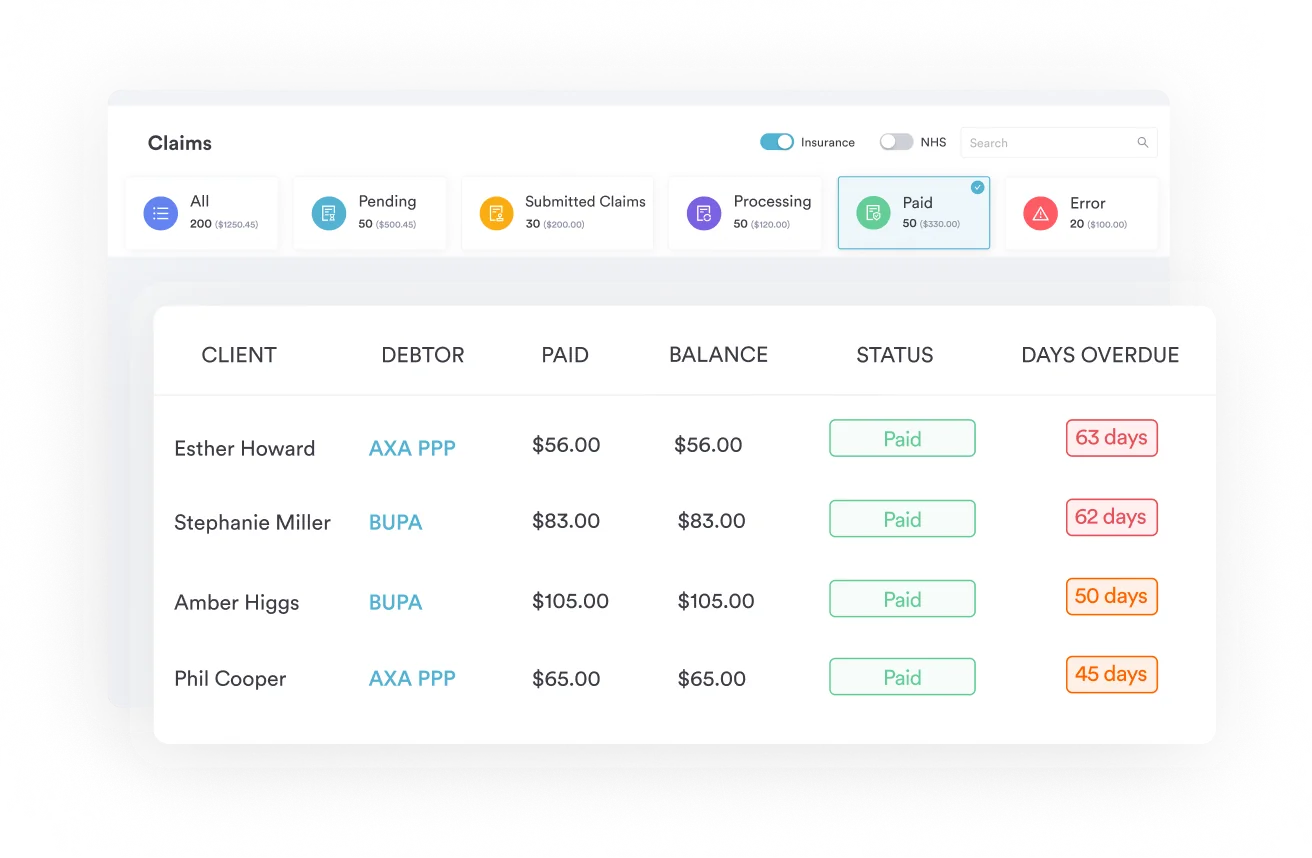
Pabau does not assign diagnosis codes and does not check ICD-10-CM sequencing. That judgment stays with the coder, working from the record and the guidelines. What the software removes is the manual effort of submitting, chasing, and reconciling the claim once the codes are set.

Pabau sends claims electronically to thousands of US payers through Claim.MD, runs real-time eligibility checks, and tracks every remittance against the claim it belongs to. Your coders keep the coding judgment, and your billing team stops chasing paperwork.

T31.64 is a straightforward code to assign once the record carries both figures and names the burn site. The order follows from there. The T20-T25 site code leads, T31.64 reports the extent, and the external cause code closes the set.
The point worth keeping is that T31.64 answers how much of the body burned, while the T20-T25 code answers where. Treat it as the supporting code it is, and the claim holds up on audit. Book a demo to see how Pabau submits and tracks complex burn claims end to end.

Need to understand medical billing fundamentals before coding? What is medical billing explains the end-to-end workflow from encounter to payment posting.
Dealing with denied burn claims? Denial management in healthcare covers the root causes and resolution strategies for high-complexity claims.
Want to optimize your revenue cycle for inpatient cases? What is revenue cycle management walks through the full billing cycle from eligibility to collections.
ICD-10 Code T31.64 is the billable diagnosis code for burns involving 60-69% of the total body surface area. Third-degree burns account for 40-49% of body surface. It classifies the extent of the burn rather than its anatomic site. When the site is documented, a T20-T25 code is first listed and T31.64 is reported as an additional code.
Clinicians use either the rule of nines or the Lund-Browder chart. The rule of nines divides adult body surface into 9% and 18% segments by region. The Lund-Browder chart adjusts for age and suits pediatric patients. Coders should identify which method the record used. The third-degree share must be documented separately from the total burn extent before a T31 code is selected.
T31.64 is reported with a T20-T25 site code that identifies the anatomic burn location, plus an external cause code from X00-X19 or a related category. The site code is first listed whenever the record names the burn site. T31.64 leads the claim only where the site is unspecified. Y92 and Y93 add place of occurrence and activity where documented.
The T31.6X subcategory contains seven codes, T31.60 through T31.66, each recording a different share of body surface with third-degree burns. T31.60 covers 0-9% third degree. T31.61 through T31.66 then step through 10-19%, 20-29%, 30-39%, 40-49% for T31.64, 50-59%, and 60-69%.