ICD-10 Code Y74.2: General hospital and personal-use implant failure
ICD-10 code Y74.2: Definition, descriptor, and billable status ICD-10 code Y74.2...

Last Updated: Oct 29, 2026
Billable Code Specific Code
T31.43 is the billable ICD-10-CM code for burns involving 40-49% of body surface with 30-39% third degree burns.
Both percentages measure the whole body. The patient has 40-49% of total body surface area (TBSA) burned, and 30-39% of TBSA is third-degree (full-thickness). A burn of 45% TBSA with 35% TBSA full-thickness codes to T31.43, while 45% with 15% TBSA full-thickness codes to T31.41.
Let Pabau's smart automation suggest the right codes, reduce claim denials, and keep your practice compliant—effortlessly.
Automate repetitive tasks and focus on what matters most—your patients.
Reduce coding errors and ensure compliance with the latest regulations.
Clean claims, fewer denials, and faster reimbursements.
Powerful insights and reporting to help your practice thrive.
HIPAA compliant SOC 2 certified GDPR-compliant Trusted by 4,000+ clinics worldwide

T31.43 reports burns covering 40-49% of total body surface area (TBSA), with 30-39% of TBSA being third-degree (full-thickness).
Both figures are percentages of the whole body, so the third-degree figure can never exceed the total burned figure.
The physician must document total TBSA and third-degree TBSA as separate numbers before T31.43 can be assigned.
T31.43 covers thermal burns only, and corrosions from chemicals are reported with T32.43 instead.
Pabau, the practice management platform we build, pre-fills claims from codes already on the patient record and submits them through Claim.MD.
ICD-10 Code T31.43 reports burns covering 40-49% of total body surface area (TBSA), with 30-39% of TBSA third-degree. It is a valid, billable ICD-10-CM code in the FY2027 code set, which runs from October 1, 2026, to September 30, 2027.
T31.43 combines two measurements, and both are percentages of the patient’s total body surface area. Each character after the category carries one of them.
The fifth character measures third-degree burns against the whole body, not against the burned area. A patient with 45% TBSA burned, of which 35% TBSA is full-thickness, receives T31.43. A patient with 45% TBSA burned and 15% TBSA full-thickness receives T31.41 instead. The chart below lines up all five T31.4 depth bands on the same whole-body scale.
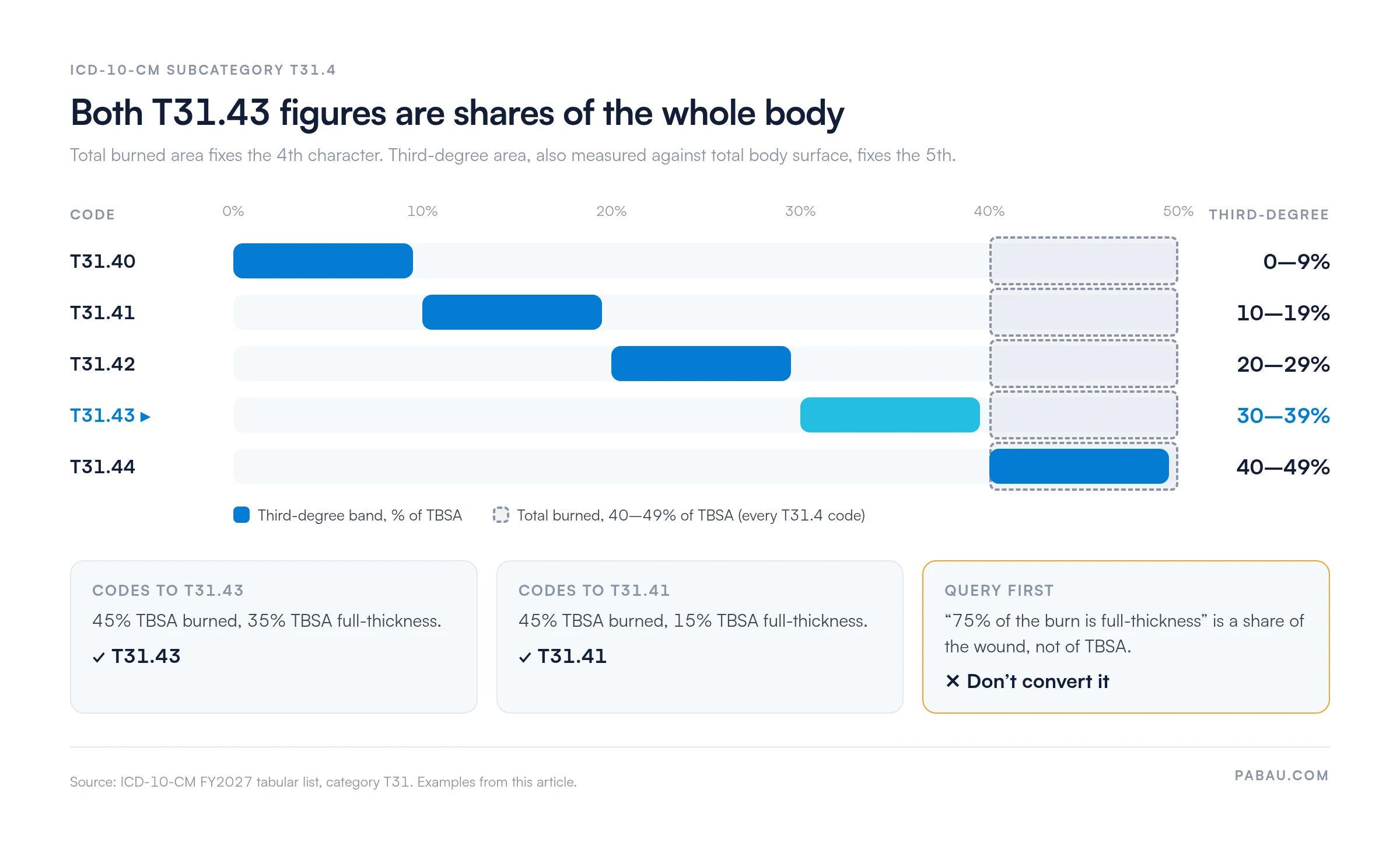
Because both figures share the same denominator, the third-degree band can never exceed the total band. That is why the T31.4 subcategory stops at T31.44, where third-degree burns reach 40-49% of TBSA.
Burn notes sometimes describe depth as a share of the wound, such as “about 75% of the burn is full-thickness.” That phrasing is not a TBSA figure. On a 45% burn it works out to roughly 34% TBSA, but the coder should not do the conversion. Query the physician for the third-degree extent as a percentage of TBSA.
Category T31 runs from T31.0 through T31.99. T31.0 covers burns of less than 10% of body surface and takes no fifth character. T31.99 covers burns of 90% or more of body surface with 90% or more third-degree.
T31.4 is the fifth TBSA band, after T31.0, T31.1, T31.2 and T31.3. Within it, T31.43 is the fourth of five codes, one for each third-degree band from 0-9% to 40-49%.
T31 differs from the T20-T25 codes, which classify burns by anatomic site and depth. T32 is the parallel series for corrosions, so T31.43 is never used for chemical burns. Confirm whether the injury was thermal (T31) or chemical (T32) before assigning any extent code.
Burn teams estimate TBSA with the Rule of Nines for adults and the Lund-Browder chart for children. The coder takes the result from the physician’s note and never calculates it.
The Rule of Nines divides the adult body into regions worth 9% or a multiple of 9%. Head and neck account for 9%, each arm 9%, each leg 18%, the anterior trunk 18%, the posterior trunk 18%, and the perineum 1%.
A burn spanning the anterior trunk and both legs covers 18% + 36% = 54% TBSA, which already sits above the T31.4 band.
Burn teams adjust these percentages for infants and children, whose heads are proportionately larger, so use the physician’s documented TBSA figures rather than recalculating.
To support T31.43, the physician documents two figures, and both are percentages of total body surface area. The total burned area must fall between 40% and 49%. The full-thickness area must fall between 30% and 39% of TBSA. Both figures must appear explicitly in the medical record.
When reviewing documentation for T31.43, confirm the third-degree figure is stated as a percentage of total body surface area. A note reading ‘45% TBSA, 15% TBSA third-degree’ points to T31.41, not T31.43. If the note gives depth as a share of the wound instead, query the physician for the TBSA figure.
The codes surrounding T31.43 are the most frequent source of miscoding. Each neighbor differs on one axis, either total TBSA or third-degree TBSA, often by a few percentage points.
T31 codes serve a different purpose than T20-T25. Under ICD-10-CM Official Guidelines Section I.C.19.d.6, T31 is used when the burn site is not specified or when extra data is needed. With documented sites, the T20-T25 codes come first and T31.43 is added to report extent.
The guidelines also advise adding a T31 code when third-degree burns involve 20% or more of body surface. Every T31.43 case meets that threshold, since its third-degree extent is at least 30% of TBSA.
Incomplete documentation is a leading reason T31.43 claims are denied or downgraded. The medical record should contain the five elements below before the code is assigned.
Query the treating physician when the record gives total TBSA but omits the third-degree extent. A note stating “45% TBSA burn” alone does not support T31.43. Do not default to T31.40 in that case. T31.40 states that third-degree burns cover 0-9% of TBSA, so it misreports extent when deeper burns are charted.
ICD-10-CM Official Guidelines Section I.C.19.d governs burn and corrosion coding. These provisions apply directly to T31.43.
A burn of this size meets American Burn Association criteria for burn center referral. Those criteria include partial-thickness burns over 10% of TBSA and any full-thickness burn. Expect payers to require authorization for inpatient burn care and for surgery such as skin grafting.
Requirements differ by plan and contract year. Elective burn reconstruction usually needs its own authorization, separate from the acute admission.
The five denial causes below recur on T31.43 claims, and a coder can catch each one before submission. Applied to burn claims, denial management in healthcare starts with these checks.
Practices with high burn-claim volumes should keep a list of medical billing denial codes to hand. The CARC on each remittance tells the billing team which of the five causes to correct before resubmitting. The clean claim submission requirements for burn cases include both TBSA figures, correct sequencing and any prior authorization number.
T31.43 is a diagnosis code, so the claim pairs it with procedure codes for the burn care delivered. Grafting usually drives the claim value, and CPT 15100 is the base code for split-thickness autografts on the trunk, arms and legs. Verify NCCI edits and any LCD or NCD before submitting a combination, because rules for burn procedures vary by payer.
Build an authorization check into your revenue cycle management workflow before T31.43 claims with grafting codes go out. These encounters carry high claim values, so a missing authorization is costly.
When billing skin grafting alongside T31.43, report graft area accurately. CPT 15100 covers the first 100 sq cm, or 1% of body area in infants and children. CPT 15101 is the add-on for each additional 100 sq cm or 1%. Omitting 15101 on large-area grafts understates the procedure and its reimbursement.
Burn claims at this extent pass through several hands, and the two TBSA figures have to survive each handoff. When coders re-key diagnosis codes into a separate billing system, a T31.41 can become a T31.43 by accident.
Pabau keeps the treatment record and the claim in one system. Its claims management software pre-fills the claim from the diagnosis and procedure codes already on the patient record. In the US, it then submits and tracks the claim through the Claim.MD clearinghouse, with real-time eligibility checks.
The result is fewer keying errors between chart and claim, and a clear status trail when a payer asks for documentation. Medical billing compliance on burn cases depends on both correct codes and a submission pathway you can audit.

Pabau pre-fills claims from the codes on the patient record and submits them through Claim.MD. Your T31.43 claims match the documentation that supports them.

Assign T31.43 only when the note states both figures as percentages of total body surface. When depth arrives as a share of the wound, or not at all, a physician query costs less than a corrected claim.
Getting this right protects more than one claim. Burn units and payers use the extent code to judge injury severity, so a wrong fifth character misstates how badly the patient was burned.
Pabau’s Claim.MD clearinghouse integration submits and tracks burn claims built from the codes on the patient record. Book a demo to see how Pabau keeps your burn claims in step with the chart.

Need help understanding denial codes on burn claims? Denial codes in medical billing explains CARC reason codes and how to build an effective appeal workflow.
Want to understand how clearinghouse claim validation works? Medical claims clearinghouse guide covers payer connectivity, 837P submission, and real-time eligibility verification.
Building a billing compliance program around complex diagnoses? Medical billing compliance covers documentation standards, audit risk, and payer policy requirements for complex diagnoses.
ICD-10 Code T31.43 is the billable ICD-10-CM code for burns involving 40-49% of total body surface area (TBSA), with 30-39% of TBSA being third-degree. Both figures measure the whole body. It is valid in the FY2027 code set and applies in inpatient and outpatient settings. Chemical burns (corrosions) take T32 codes instead.
T31.40 and T31.43 share the same total of 40-49% TBSA but differ in depth. T31.40 means third-degree burns cover 0-9% of TBSA, while T31.43 means they cover 30-39% of TBSA. T31.40 is not a default for undocumented depth. If the record omits the third-degree extent, query the physician.
TBSA is estimated with the Rule of Nines for adults or the Lund-Browder chart for children. The Rule of Nines assigns 9% to the head and neck and 9% to each arm. Each leg, the front of the trunk and the back of the trunk count 18% each, and the perineum counts 1%. The physician documents total TBSA and third-degree TBSA, both as percentages of the whole body. The coder does not calculate either figure.
Most denials come from missing documentation or wrong code selection. Claims fail when total TBSA is not documented, or when the third-degree extent is missing or stated as a share of the burn. Sequencing T31.43 ahead of documented site codes also triggers denials. So does using T31.43 for a chemical burn that belongs in T32.43. A pre-coding documentation check prevents most of them.