ICD-10 code S61.201A: Open wound of left index finger without nail damage
ICD-10 code S61.201A covers a left index finger wound of unstated type ICD-10 co...

Last Updated: Oct 16, 2026
Billable Code Specific Code
T25.421S is the billable ICD-10-CM code for corrosion of unspecified degree of right foot, sequela.
ICD-10-CM codes are updated annually, according to the Centers for Medicare and Medicaid Services (CMS). Each fiscal year edition takes effect on October 1. The 2026 edition of T25.421S became effective October 1, 2025 and stays valid for current-year submissions.
Let Pabau's smart automation suggest the right codes, reduce claim denials, and keep your practice compliant—effortlessly.
Automate repetitive tasks and focus on what matters most—your patients.
Reduce coding errors and ensure compliance with the latest regulations.
Clean claims, fewer denials, and faster reimbursements.
Powerful insights and reporting to help your practice thrive.
HIPAA compliant SOC 2 certified GDPR-compliant Trusted by 4,000+ clinics worldwide

ICD-10 code T25.421S covers corrosion of unspecified degree of the right foot, sequela.
The code is billable for HIPAA-covered claims and took effect on October 1, 2025.
The 7th character S is mandatory. Parent code T25.421 is non-billable and gets rejected.
S applies only once the original corrosion has healed. Use D while the wound is still being treated.
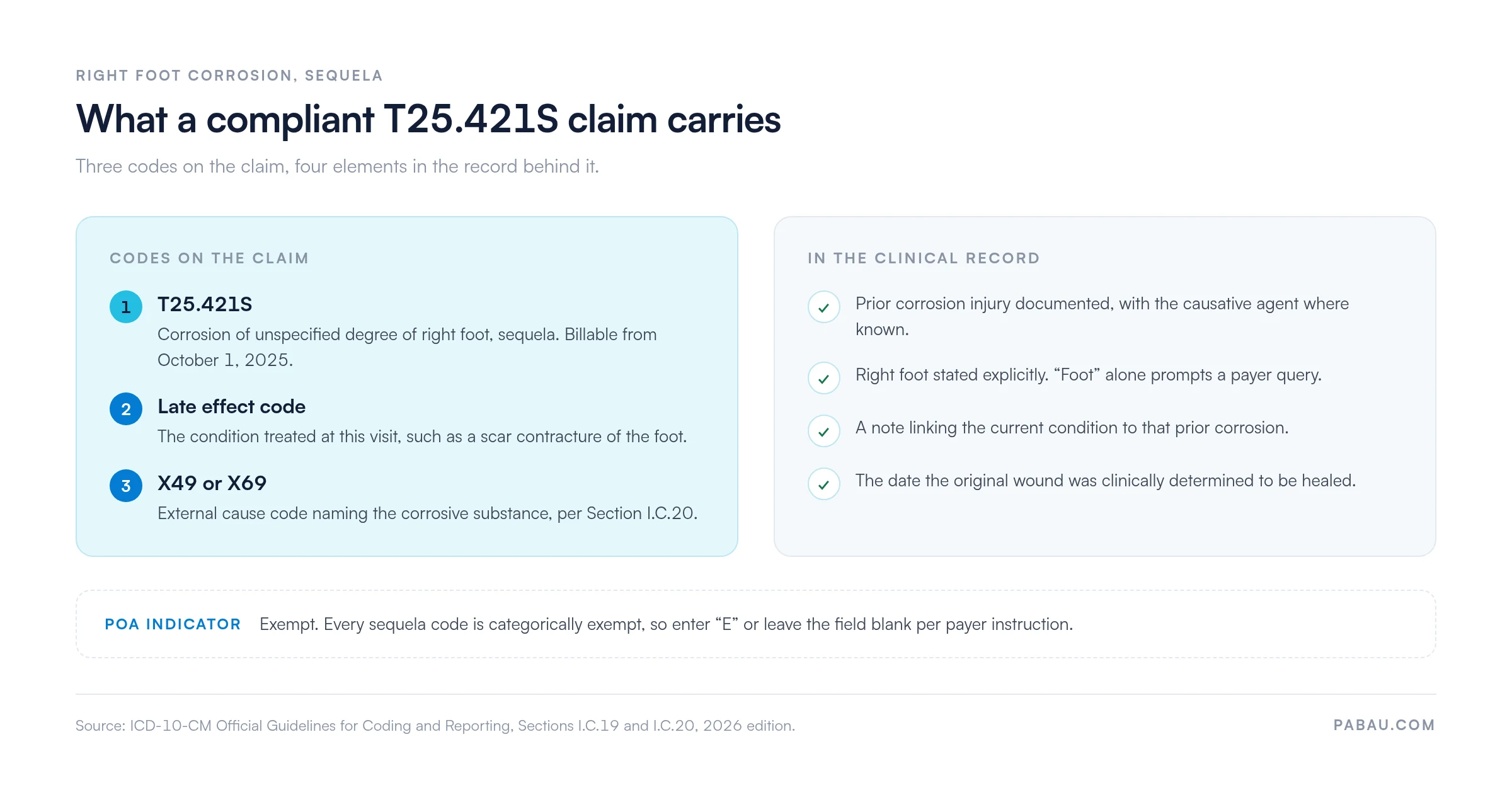
A compliant claim adds the late effect code plus an external cause code from the X49 or X69 range.
T25.421S is a billable, specific code in ICD-10-CM. It can be submitted for reimbursement on its own, with no more detailed child code needed. The table below carries the facts a coder or biller checks before the claim goes out.
For a broader lookup, the CDC/NCHS ICD-10-CM web tool holds the official tabular list and index for every fiscal year edition.
T25.421S means corrosion of unspecified degree of the right foot, sequela. Each segment of the code carries its own clinical meaning:
“Unspecified degree” is a distinction worth pausing on. T25.421S does not cover first-degree, second-degree or third-degree corrosion injuries, which have separate codes. It applies when the original injury record does not document the degree. It also applies when the degree cannot be determined clinically at the time the sequela is treated.
Site matters as much as degree here. Where the record points to the ankle and names no side, the sequela is coded T25.419S instead.
Assigning T25.421S to an active second-degree corrosion wound is a coding error. Where the documentation names first degree and omits the side, a follow-up visit during healing is coded T25.529D instead.
The T25 category follows the same structural logic as other injury chapters. You move from category to subcategory, then to specificity, then to the encounter type in the 7th character.
The parent code T25.421 is non-billable on its own, so a 7th character is required to make it valid for submission. Three options exist, and each one represents a distinct phase of care. Picking the wrong one is a common reason corrosion injury claims get flagged before payment.
A practical rule: once the wound has healed and treatment has concluded, later encounters for conditions the corrosion caused use T25.421S. The sequela code sits alongside the code for the specific late effect being treated, such as a scar contracture code. It does not replace it, and both codes belong on the claim.
A sequela is a condition that results from a prior injury after the acute phase has resolved. The ICD-10-CM Official Guidelines for Coding and Reporting set that definition out in Section I.C.19. The 7th character S states this to payers and reviewers. The condition exists because of a past corrosion injury, and that injury is no longer being treated.
Three conditions must be true before using the S character on a corrosion injury code:
The most common coding error is reaching for T25.421S during active wound treatment. While the wound is still healing, D is the correct character. Switching to S early gives the payer grounds to reject the claim, because the treatment documented does not match the encounter type. Sequela coding therefore depends on documentation that dates the resolution of the original injury.
A sequela code is also distinct from a new injury. If a patient sustains a second, independent corrosion injury to the right foot, the correct code is T25.421A for an initial encounter.
Document the date of the original corrosion incident and the date the wound was clinically determined to be healed. Payers auditing sequela claims look for that continuity. Missing it is the most common reason T25.421S claims get queried after payment.
Knowing where T25.421S sits in the wider classification helps with crosswalks, DRG grouping and picking related codes. The same parent-to-child pattern runs through the whole ICD-10-CM code index. Once you have walked the route from chapter to billable code, it looks familiar everywhere. The full hierarchy for this code is below.
Clinical terminology varies across providers, referral letters and older records. The terms below all map to T25.421S in ICD-10-CM. When one of them appears in the record alongside documentation of a sequela encounter, T25.421S is the code to assign. The one thing to confirm first is laterality: the note has to say right foot.
“Chemical burn” and “corrosion” are interchangeable in ICD-10-CM terminology. Both describe tissue damage caused by a corrosive substance, whether an acid, an alkali or another chemical agent. Thermal burns from heat sources are coded separately.
Choosing the right code often comes down to comparing sibling and parent codes. The table below covers the codes most often cross-referenced to T25.421S. The AAPC Codify ICD-10-CM lookup confirms the active status of each one at the time of submission.
Payers treat T25.421S and T25.422S as distinct codes. Submitting the left-foot code when the documented injury is to the right foot is an auditable error. Verify laterality in the clinical notes before choosing between the two.
Degree and the number of sites affected matter just as much as laterality. A record documenting third-degree corrosion across multiple sites of the left ankle and foot points to T25.792S, another sequela code in the T25 category.
Getting the code right is only half of the claim. The record behind it has to hold up under payer review, and thin documentation drives most retrospective denials on sequela codes.
Submitting corrosion injury claims through the Claim.MD clearinghouse validates each claim against thousands of US payers before it goes out. That catches documentation-linked rejections before they reach the payer.
The clinical record must establish four things to support T25.421S:
An external cause code is required alongside T25.421S. Section I.C.20 of the ICD-10-CM Official Guidelines says corrosion injuries must carry an additional code from the X49 or X69 range.
That code identifies the substance responsible for the corrosion. Omitting it does not invalidate the claim with every payer, but it raises audit risk and breaks with official coding guidelines.
Taken together, a compliant T25.421S claim carries three codes, backed by four elements in the clinical record.
Practices with structured digital records can pull the original corrosion incident date straight into the sequela encounter note, which shortens the audit trail.
Practice management software like Pabau keeps the full patient history in view at the point of coding. Our claims management software carries the ICD-10-CM catalog next to the chart, so a sequela claim rarely goes out without its causal link documented.

Validation before transmission is what catches a missing external cause code. The alternative is a payer rejection that arrives weeks later, by which time the encounter is cold and the coder has to reconstruct it.
Add a short attestation to the note when you code a sequela visit. Write: ‘This [condition] is a direct sequela of the right foot corrosion sustained on [date], which healed on [date].’ One sentence makes the relationship explicit for any reviewer.
T25.421S is exempt from Present on Admission (POA) reporting. The exemption covers every sequela code in ICD-10-CM by definition. A sequela arises from a prior injury, so it could not have been present on admission in the conventional sense.
On inpatient claims subject to POA requirements, no POA indicator is needed for T25.421S. Entering “E” for exempt and leaving the field blank are both acceptable, depending on the billing system and the payer contract. Confirm the current exemption list each year, because CMS updates POA-exempt code lists with every fiscal year release.
POA status does not change the claim format. The transaction still has to meet EDI 837 requirements, so the structure of the claim matters as much as the indicator field. Tracking remittance data in one billing system also makes POA-related rejection patterns easier to spot, because the ERA/835 data lands beside the claim it answers.
Coding a corrosion sequela is only worth the effort if the causal link survives the trip to the payer. In many practices the original injury note lives in one system and the claim gets built in another. The coder retypes the healed date from memory, and the chart never proves what the claim asserts.
Pabau integrates with Claim.MD, our US clearinghouse partner. Claims go out in CMS-1500 and 837P formats to thousands of US payers, and real-time eligibility checks run across over 400 payers. ERA/835 remittances come back into the same ledger, so payment lands against the claim that earned it.
Built-in CPT and ICD-10-CM catalogs put T25.421S within reach at the point of code entry. Coders attach the external cause code beside the sequela code, and the claim gets validated before transmission. The original injury date and healed status are already in the chart, so nobody has to go looking for them.

Pabau validates ICD-10 claims through Claim.MD before submission, across thousands of US payers. See how sequela documentation travels from the patient record to the remittance.

T25.421S is straightforward once the record is straight. Confirm the right foot, confirm the corrosion has healed, document the causal link, then add the external cause code. The 7th character carries the whole decision: S for a late effect, D while the wound is still being treated.
The trade-off worth remembering is that a sequela code moves the burden of proof from the code to the chart. Payers accept T25.421S readily and audit it later. That makes the attestation sentence in the note more valuable than any second opinion on the code itself.
Book a demo to see how Pabau keeps injury dates, healed dates and claim codes in one patient record for US billing.

Coding an active corrosion injury rather than a late effect? ICD-10 code T20.79XA shows how the initial encounter character works on a third degree corrosion code.
Need the same sequela rules applied to a burn code? ICD-10 code T22.342S walks through a third degree burn sequela, including the laterality check.
Trying to understand why sequela claims get denied? Denial management in healthcare covers the remittance codes you will see most and how to recover from them.
Want the claim accepted the first time it goes out? Clean claim sets out what a payer needs on the claim before it will pay without a query.
T25.421S is the ICD-10-CM billable code for corrosion of unspecified degree of the right foot, sequela. It covers a late effect that appears after a prior corrosive chemical injury has resolved. It does not cover an active wound under treatment.
Yes. T25.421S is a billable, specific ICD-10-CM code valid for HIPAA-covered claim submission from October 1, 2025. The parent code T25.421 has no 7th character, so clearinghouses and payers reject it.
The 7th character sets the encounter type. A is the initial encounter, the first visit with active treatment. D is a subsequent encounter, a follow-up during active treatment. S is sequela, a late effect after the injury has healed. Only one character applies per encounter.
A subsequent encounter (D) applies while the original corrosion is still being actively treated. A sequela (S) applies after it has healed, when the patient returns for something that injury caused. Scarring, contracture and sensory loss are the usual examples.
Yes. Every sequela code in ICD-10-CM is categorically exempt from POA reporting. A sequela arises from a prior injury, so it cannot be present at the start of a new inpatient admission.
Corrosion injuries need an additional external cause code naming the causative substance, per Section I.C.20. Codes in the X49 range cover accidental exposure and the X69 range covers intentional self-harm. That external cause code also carries the S character.