ICD-10 Code S42.444P: Medial epicondyle fracture, right humerus
ICD-10 Code S42.444P: full descriptor and code validity ICD-10 Code S42.444P car...

Last Updated: Oct 13, 2026
Billable Code Specific Code
T24.011S is the billable ICD-10-CM code for burn of unspecified degree of right thigh, sequela. You report it when a patient returns for a condition caused by an earlier right thigh burn, after active treatment has ended. Scar tissue, contracture, and post-burn neuropathy are the usual reasons for that visit.
The code took effect on October 1, 2025, in the 2026 ICD-10-CM edition. It is the causal code, so it never leads the claim. The residual condition goes first.
Let Pabau's smart automation suggest the right codes, reduce claim denials, and keep your practice compliant—effortlessly.
Automate repetitive tasks and focus on what matters most—your patients.
Reduce coding errors and ensure compliance with the latest regulations.
Clean claims, fewer denials, and faster reimbursements.
Powerful insights and reporting to help your practice thrive.
HIPAA compliant SOC 2 certified GDPR-compliant Trusted by 4,000+ clinics worldwide

T24.011S is a billable ICD-10-CM code for burn of unspecified degree of right thigh, sequela, valid for reimbursement from October 1, 2025.
The 7th character ‘S’ designates a sequela encounter, distinct from ‘A’ (initial) and ‘D’ (subsequent) encounters for the same burn.
The residual condition is first-listed on the claim, and T24.011S follows it as the causal code.
Sequela codes like T24.011S are exempt from Present on Admission (POA) reporting per CMS guidelines.
Practice management software like Pabau ties ICD-10 codes to the clinical note, so the claim keeps the sequence.
ICD-10 Code T24.011S is the specific, billable ICD-10-CM code for “Burn of unspecified degree of right thigh, sequela.” It belongs to the Injuries, poisoning, and certain other consequences of external causes chapter (S00-T88), within the burns and corrosions block (T20-T25). The National Center for Health Statistics (NCHS), which maintains the ICD-10-CM code set, confirms this code is valid for FY2026 reimbursement purposes.
The “unspecified degree” label reflects a record where the clinician never wrote down whether the burn was first, second, or third degree. Degree-specific siblings do exist — T24.111S, T24.211S, and T24.311S each name a degree. Reach for T24.011S only when the documentation leaves the degree unstated.
Payers generally accept the unspecified degree code when the record lacks the detail for a more specific one. Where the original chart is available, query the provider before you default to it.
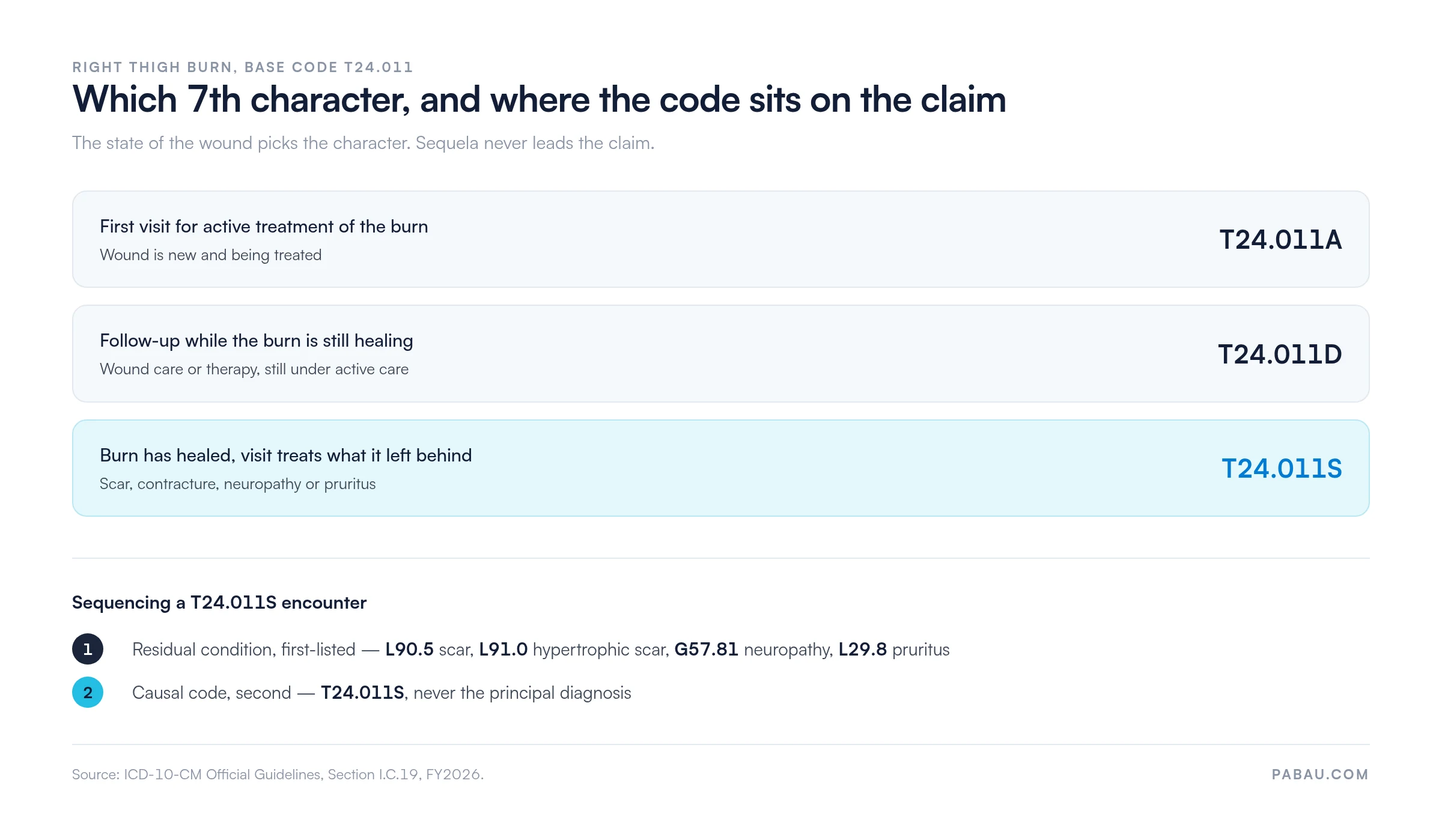
The 7th character ‘S’ marks a sequela encounter. The patient is seen for a condition caused by an earlier injury, after active treatment has ended. The CMS ICD-10-CM Official Guidelines (Section I.C.19) define sequela as a late effect of an acute injury. Two other 7th characters attach to the same base code, T24.011, and picking the wrong one is this family’s most common error.
A patient returning for scar revision three months after a right thigh burn has healed warrants T24.011S. The same patient seen two weeks post-injury for a wound check is still in the active phase and should be coded T24.011D. Switching from D to S is a clinical judgment call, not a calendar-based transition. Burn sequela codes at other body sites work the same way, including T22.342S.
The hierarchy tells you whether T24.011S is as specific as the record allows, and which burn codes sit beside it. The WHO’s ICD-10 classification supplies the structure that ICD-10-CM expands on for US clinical use.
Knowing the parent codes helps when you query claims data or build practice-level reporting on burn outcomes. It also makes it obvious when a coder has stopped one level short of a billable code.
The table only walks one branch of category T24. A second degree burn documented at the right knee takes T24.221A on an initial encounter.
ICD-10-CM cross-references T24.011S to several approximate synonyms that may appear in clinical documentation. Coders should recognize these alternative phrasings as equivalent to the official diagnosis description.
Notes often read “residual scarring from prior right thigh burn” or “contracture secondary to healed right thigh burn.” Both map to T24.011S as the causal code. The residual condition itself — scar, contracture, neuropathy — usually needs its own code alongside it. Those codes are listed further down.
Supplemental coding works differently on a sequela visit than it does on an acute burn. Applying the acute-phase rules to a sequela encounter is a common audit finding.
Total body surface area (TBSA) codes come from category T31 for burns and T32 for corrosions. They are required alongside an acute burn code. On a sequela visit they are usually not needed, unless the provider records the extent of the original burn as relevant context. Our ICD-10-CM diagnostic codes library covers the edge cases where the original burn’s extent still shapes treatment.
T24.011S is the causal code. The residual condition being treated must be coded separately and listed as the principal or first-listed diagnosis. The sequela code follows it in the coding sequence. For example:
ICD-10-CM does not require external cause codes on a sequela encounter, though some payers and facilities still ask for them. Where they are used, the code describing the original burn mechanism carries the ‘S’ character too. Confirm what your payer expects before you add one.
ICD-10-CM Section I.C.19 governs burn coding. The guidelines separate aftercare visits from sequela visits. Aftercare still treats the burn itself. A sequela visit treats what the burn left behind.
Applied consistently, these four rules keep a sequela claim defensible under audit. The panel below condenses them into the two decisions a coder actually makes.
Moving a patient from T24.011D to T24.011S? Write the rationale into the note. State that the wound has healed, name the residual condition you are treating, and confirm it traces back to the burn. That short paragraph is what answers an audit query later.
A T24.011S claim is incomplete without the code for the condition being treated. These are the residual conditions that follow a right thigh burn most often, with the code each one takes.
Each of these conditions is the first-listed diagnosis on the claim, with T24.011S immediately following. Claims management software that preserves multi-code sequencing keeps the causal code off line one, without a coder re-checking every claim.

A coded claim is only as defensible as the note behind it. Sequela burn denials usually start in the record, not in the code the coder picked. Here is what the note has to establish for T24.011S.
One sentence tying the current condition back to the burn is often what separates a paid claim from a denied one. It costs the provider five seconds at the point of documentation. The AAPC’s ICD-10-CM code reference carries further guidance on 7th character sequela documentation across injury chapters.
Build a burn sequela prompt into your EHR template. It needs three fields: a checkbox for ‘original burn site healed’, a free-text ‘current sequela condition’, and a laterality dropdown. Three seconds of structured input removes the most common T24.011S audit triggers.
T24.011S is a billable code accepted by Medicare, Medicaid, and most commercial payers. The code is exempt from Present on Admission (POA) reporting, which simplifies hospital inpatient submissions. Payment tracks the sequela being treated rather than the burn code itself. A wound care visit for scar revision carries different RVU weights than a neurology consult for post-burn neuropathy.
Practices submitting sequela burn claims should check payer-specific LCD (Local Coverage Determination) policies for the residual condition codes that accompany T24.011S. Some payers apply additional documentation requirements for scar revision procedures. A complete claim on the first submission saves the back-and-forth these encounters otherwise generate.
Where charting and billing live in separate systems, a sequela visit gets coded twice. The clinician writes the note, then someone re-keys the diagnosis codes into a billing screen. Sequence is what usually breaks on that second pass, and T24.011S ends up on line one.
Practice management software like Pabau keeps the note and the claim in the same patient record. The insurer and policy sit on the record, so an invoice routes to the right third party without re-keying. In the US, claims go out through Claim.MD, the clearinghouse Pabau connects to, straight from the invoice.
For a coder working burn sequelae, the residual condition stays first-listed and T24.011S stays second. Every claim shows its live status on one dashboard, so a rejection on a sequela code surfaces the same day rather than a month later.

Pabau holds ICD-10 codes on the clinical note and carries them, in sequence, onto the insurance claim. Submit to Claim.MD without leaving the patient record, and track every claim’s status in one dashboard.

T24.011S describes a specific moment in burn care. The wound has healed, and the patient still needs treatment for what it left behind. Three steps separate a clean sequela claim from a denied one. Pick the right 7th character, list the residual condition first, and document the causal link in the note.
If your coders switch burn patients from D to S on a calendar rather than on the chart, fix that habit first. Book a demo to see how Pabau keeps the diagnosis codes, the sequence, and the claim in one record.

List Item #1
List Item #2
ICD-10 Code T24.011S is the billable ICD-10-CM diagnosis code for “Burn of unspecified degree of right thigh, sequela.” Use it when a patient is treated for a condition caused by a right thigh burn that has already healed. Scarring, contracture, and neuropathy are typical examples. The code took effect on October 1, 2025.
Yes. T24.011S is a billable, specific ICD-10-CM code valid for reimbursement from Medicare, Medicaid, and most commercial payers. It is also exempt from Present on Admission (POA) reporting, which simplifies inpatient claim submission for facilities.
All three share the base code T24.011, burn of unspecified degree of right thigh. T24.011A covers the initial encounter, when the patient first receives active treatment. T24.011D applies to follow-up visits while the burn is still healing. T24.011S is reserved for sequela encounters, once the burn has healed and the visit treats a resulting condition.
Switch to T24.011S once the burn wound has healed and the visit addresses a residual condition rather than active wound management. This is a clinical judgment, not a time-based rule. The provider must document that the burn has healed and that the visit treats a consequence of it. A scar or contracture is the usual example.
T24.011S is the causal code, so it is sequenced after the residual condition code, which becomes the principal diagnosis. Common companion codes include L90.5 for scar or fibrosis of skin, L91.0 for hypertrophic scar, and G57.81 for peripheral neuropathy. TBSA codes (T31/T32) are generally not required on sequela encounters. External cause codes are optional, though a specific payer may ask for them.
The most commonly paired codes are L90.5 for scar conditions and fibrosis of skin, and L91.0 for hypertrophic scar. Either one is the first-listed diagnosis, with T24.011S immediately following to name the causal burn. For contractures, M62.451 (muscle contracture, right thigh) may apply, depending on the tissue involved.
The note must confirm right thigh laterality, state that the original burn has healed, and name the residual condition being treated. It also has to link that condition to the prior burn. A line such as “hypertrophic scarring, right thigh, sequela of healed burn injury” gives a coder what they need to assign T24.011S.