ICD-10 Code S42.444P: Medial epicondyle fracture, right humerus
ICD-10 Code S42.444P: full descriptor and code validity ICD-10 Code S42.444P car...

Last Updated: Oct 13, 2026
Billable Code Specific Code
S92.215G is the billable ICD-10-CM code for nondisplaced fracture of cuboid bone of left foot, subsequent encounter for fracture with delayed healing.
The character doing the work is the seventh. G means delayed healing, D means routine healing, and K means a nonunion somebody has confirmed.
That one letter is a clinical statement, and payers read it as one. If the note behind it says only "left cuboid fracture, healing", the code has no support in the record.
Let Pabau's smart automation suggest the right codes, reduce claim denials, and keep your practice compliant—effortlessly.
Automate repetitive tasks and focus on what matters most—your patients.
Reduce coding errors and ensure compliance with the latest regulations.
Clean claims, fewer denials, and faster reimbursements.
Powerful insights and reporting to help your practice thrive.
HIPAA compliant SOC 2 certified GDPR-compliant Trusted by 4,000+ clinics worldwide

S92.215G is a billable ICD-10-CM code for a nondisplaced left cuboid fracture with delayed healing. It has been valid since October 1, 2025.
The 7th character G says the fracture is healing slowly at a follow-up visit. Use D for routine healing and K for a confirmed nonunion.
The direct parent is S92.21, fracture of cuboid bone, which sits under S92.2 for other and unspecified tarsal bones.
Laterality and displacement both have to be documented, because a displaced left cuboid fracture is S92.212G rather than S92.215G.
Practice management software like Pabau pre-fills the claim from the patient record and checks required fields before submission, so fewer claims come back.
S92.215G describes a nondisplaced fracture of the cuboid bone of the left foot at a subsequent encounter, with the fracture healing slowly.
The CDC/NCHS ICD-10-CM lookup tool lists it as a valid, billable code for FY2026, effective October 1, 2025. It already carries a full 7th character, so no further specificity code is needed to put it on a claim.
The cuboid sits on the outer side of the foot, between the calcaneus and the fourth and fifth metatarsals. Breaks here turn up less often than calcaneal or metatarsal fractures, but they follow the same S92 structure.
The direct parent is S92.21, fracture of cuboid bone, which in turn sits under S92.2 for other and unspecified tarsal bones.
G marks a subsequent encounter where the fracture is healing with delay. Subsequent means active treatment is finished and the patient has moved into the recovery phase. It does not mean second visit. Coders who count appointments instead of reading the note tend to land on the wrong character.
G applies once clinical or radiographic evidence shows repair is running behind the expected pace for that fracture, and before anyone confirms a nonunion. S92.215 accepts seven 7th characters in total, and they are listed below.
The G and K split is the one payers watch. Delayed healing means repair is still under way, just slowly. Nonunion means repair has stopped. Naming the imaging finding or the clinical sign that puts the patient in one camp is what holds the code up under review.
A nondisplaced fracture is one where the bone fragments have stayed in line. For the cuboid, that answer sets the sixth character, and it is settled before encounter type comes into it at all.
S92.215G covers the nondisplaced left cuboid. A displaced cuboid fracture of the left foot is S92.212G at the same 7th character. Getting the sixth character wrong is still a coding error, however carefully the seventh was chosen.
Displacement has to come from the treating clinician, usually in the imaging report or the encounter note. A note reading only “cuboid fracture, left foot” defaults to unspecified displacement, which does not support S92.215G.
CMS ICD-10-CM coding guidance points coders toward a provider query rather than reading displacement out of imaging language alone.
S92.215 covers the whole encounter range for a nondisplaced left cuboid fracture. Its neighbors handle the right foot, the unspecified foot, and displaced fractures.
Only two characters decide which one you need, and the grid below shows how they combine.
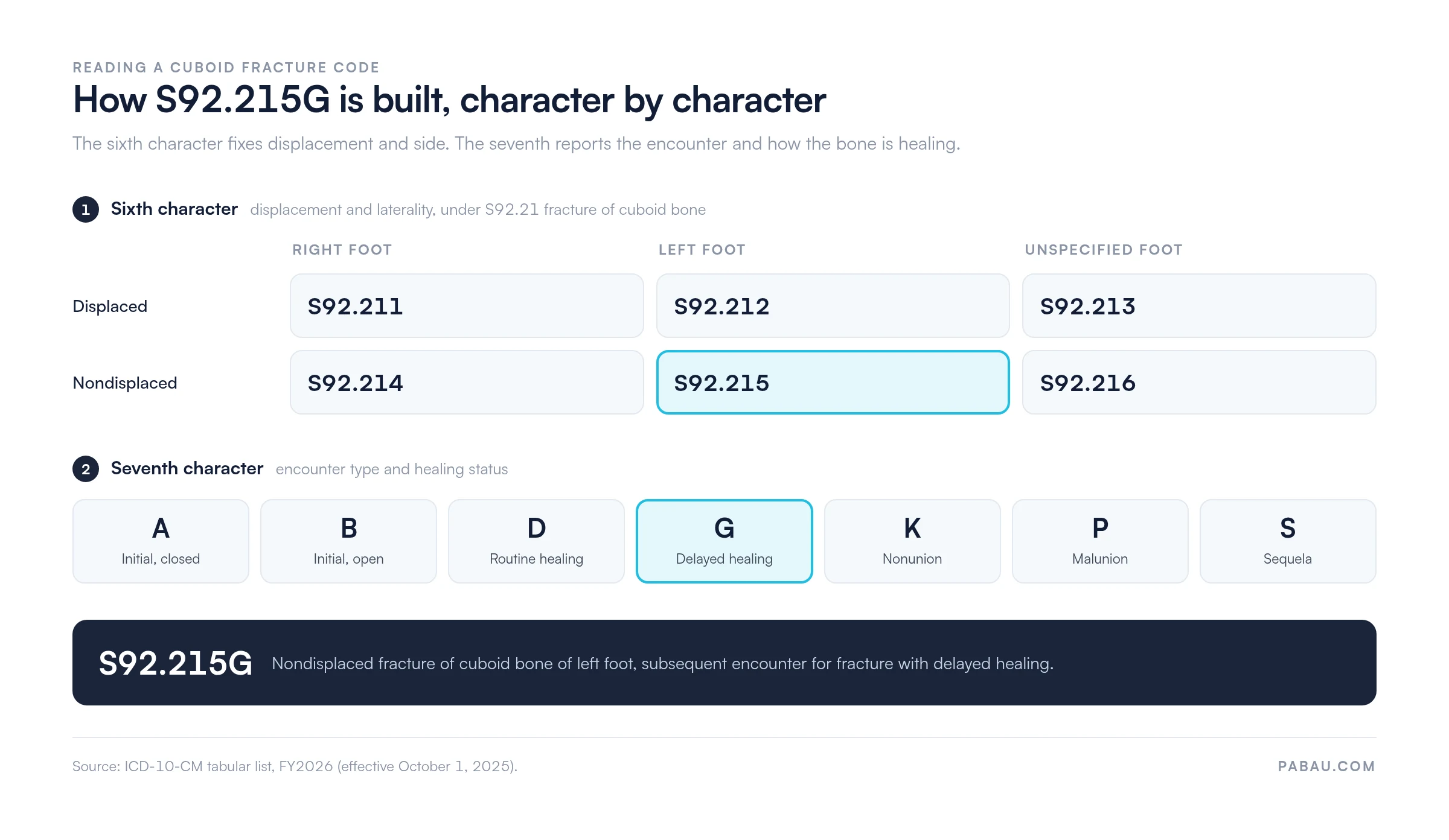
Reach for the table when laterality, displacement, or encounter type shifts. The same two-part logic runs through the rest of the ICD-10-CM codes for injuries, so it is worth learning once and reusing.
When a patient moves from routine healing (D) to delayed healing (G) between visits, document the finding that triggered the change. A line such as ‘minimal callus formation at 8 weeks, expected timeline exceeded’ gives the payer a clear rationale. It also cuts the odds of a medical necessity denial on the changed encounter type.
Four elements have to be in the record. Miss one and a payer can downcode the claim or deny it outright. At that point the fix means an appeal instead of a quick edit.
Run the coded encounter past these five questions. Each one takes seconds, and together they catch most of what gets S92.215G sent back.
Once S92.215G is on the charge line, the claim leaves the practice through a clearinghouse. That is the first screen, and it checks structure rather than clinical logic. Rejections at this stage are format problems, and three of them account for most of the volume.
Denials arrive later and look different. The claim was accepted, adjudicated, and then reduced or refused on medical necessity. That is where the delayed-healing documentation earns its keep, since the payer is testing whether the record supports the healing status you reported.
Steady denial management puts G-character codes on a standing review list, because delayed healing has to be re-substantiated at every visit.
The ICD-10-CM Official Guidelines for Coding and Reporting govern how the code is applied. Per AAPC’s ICD-10-CM code reference, care phase and healing status are two separate dimensions riding on one character.
Both have to be right for the claim to hold.
S92.215G maps approximately to ICD-9-CM 825.23, closed fracture of cuboid. The mapping keeps the bone and the closed status, and drops the rest. ICD-9-CM had no laterality for this bone, no displacement split, and no way to record encounter type or healing status.
Treat it as a historical equivalence for data migration, retrospective audits, or pre-2015 payer reconciliation, never as a clinical match.
Clinical notes rarely use the tabular wording. The phrasings below all land on S92.215G when the record carries the full picture: nondisplaced, left foot, subsequent encounter, delayed healing. Read for meaning rather than waiting for ICD-10-CM language to show up verbatim.
“Delayed union” and “delayed healing” mean the same thing for coding purposes, and both take G. “Suspected nonunion” takes G as well, because K needs a confirmed finding. That distinction keeps practices from upcoding to K while the clinical picture still supports delayed healing.
Plenty of practices still do this by hand. Someone reads the encounter note and picks the code from a printed list or from memory. Then it gets typed into a claim form, with no check that the October update left it standing. Each of those steps is a place where the 7th character can drift away from what the clinician wrote.
Practice management software like Pabau shortens that distance. Codes recorded against the patient seed the claim form, so S92.215G travels from the record to the charge line without being retyped. A searchable ICD-10-CM and CPT library sits inside the claim screen, refreshed with each official annual release. Coders work from current codes rather than last year’s printout.
Before a claim can go, Pabau’s claims management software checks that the required fields are complete, then submits electronically through the clearinghouse for your region. In the US that runs through Claim.MD, which returns eligibility checks, claim status, and electronic remittance advice.
Deciding whether the note supports a G rather than a D is still a coder’s judgment. What the software takes away is the retyping, the stale code list, and the half-finished claim form.

Pabau pre-fills claims from the patient record and keeps current ICD-10-CM and CPT lookup libraries a click away. Required claim fields are checked before submission, so your coders retype less and your claims come back less often.

S92.215G is a narrow code, and that is exactly its value. In eight characters it tells the payer the fracture is nondisplaced, on the left, past active treatment, and behind on healing.
Finding the code is the easy part. The work sits in the note behind it. That note has to name the side, the displacement, the encounter, and the finding that shows healing has slowed.
Review your G-character claims as a batch rather than one at a time. A run of them from one provider with thin healing documentation points at the note template. Book a demo to see how Pabau pre-fills fracture claims from the patient record and checks them for completeness before they leave the practice.

Need to understand how claims move from code to payment? Revenue cycle management fundamentals explains the full billing lifecycle from encounter to remittance.
Tracking denials across your fracture codes? Medical billing compliance covers the documentation standards that cut denial rates on musculoskeletal claims.
Comparing clearinghouses for US claim submission? Claim.MD pricing and features outlines what the integration costs and what it returns on each claim.
No. S92.215 already runs to six characters, so the 7th character G attaches straight onto the end. A placeholder X is only needed when a code is shorter than six characters and still requires a 7th.
Yes. In the S92 subcategory, only the initial-encounter characters A and B separate open from closed. From the first follow-up onward, G reports delayed healing whether the fracture was open or closed.
ICD-10-CM sets no time limit. G holds for as long as the record shows healing is behind the expected course and nonunion has not been confirmed. Once a clinician confirms nonunion, the encounter moves to S92.215K.
Yes, when both cuboids are fractured. ICD-10-CM has no bilateral cuboid code, so a patient with delayed healing in both feet takes S92.214G for the right and S92.215G for the left.
It depends on how the initial encounter was reported. If the practice billed global fracture care at the start, follow-ups inside the global period are not reported separately. Where care was billed visit by visit, the follow-up is an evaluation and management service.