ICD-10 code S61.201A: Open wound of left index finger without nail damage
ICD-10 code S61.201A covers a left index finger wound of unstated type ICD-10 co...

Last Updated: Oct 16, 2026
Billable Code Specific Code
S92.151B is the billable ICD-10-CM code for displaced avulsion fracture (chip fracture) of right talus, initial encounter for open fracture.
The code is published by the Centers for Medicare and Medicaid Services (CMS). The National Center for Health Statistics maintains it, in coordination with the World Health Organization.
Let Pabau's smart automation suggest the right codes, reduce claim denials, and keep your practice compliant—effortlessly.
Automate repetitive tasks and focus on what matters most—your patients.
Reduce coding errors and ensure compliance with the latest regulations.
Clean claims, fewer denials, and faster reimbursements.
Powerful insights and reporting to help your practice thrive.
HIPAA compliant SOC 2 certified GDPR-compliant Trusted by 4,000+ clinics worldwide

ICD-10 code S92.151B describes a displaced avulsion (chip) fracture of the right talus, initial encounter for open fracture
S92.151B is a billable ICD-10-CM code valid for HIPAA-covered transactions, effective October 1, 2025 for FY2026
The 7th character B designates an open fracture at initial encounter. Submitting A (closed) or D (subsequent) instead causes automatic claim denials
Pabau’s claims management software integrates with Claim.MD to submit ICD-10-CM codes including S92.151B electronically to 4,000+ US payers
The talus is the ankle bone that sits between the heel (calcaneus) and the two bones of the lower leg (tibia and fibula). It bears the body’s full weight during standing and walking, making fractures at this site clinically significant.
A fragment can break away from the bone at the point of ligament or tendon attachment. That is classified as an avulsion fracture, also called a chip fracture.
Three documentation elements determine which S92.1x code applies. They are laterality, displacement status, and whether the overlying skin is intact or broken. Missing any one of them prevents clean-claim submission and triggers a documentation request from the payer.
ICD-10 code S92.151B sits within the S92 chapter covering fractures of the foot, which itself falls under the S00-T88 injury and external causes block. Understanding the full hierarchy helps coders navigate to the correct level of specificity without stopping at a non-billable parent code.
The ICD-10-CM fracture code hierarchy follows a consistent parent-to-child logic across all traumatic injury chapters.
The 7th character in S92.151x is what makes the code billable and tells payers exactly which phase of care is being billed. ICD-10-CM coding conventions require the correct 7th character on every fracture claim. Submitting the wrong one is among the most common reasons fracture claims are denied outright.
The distinction between A (closed initial) and B (open initial) matters because open fractures carry higher surgical and reimbursement complexity. The same 7th character logic applies across every traumatic fracture category in ICD-10-CM.
Accurate use of ICD-10 code S92.151B depends on five documentation elements confirmed in the clinical note before claim submission. Skipping any one of them creates a payer audit trail or an outright denial. Catching a 7th character error at the documentation stage is far faster than working the denial afterward.
Four of those five elements act as branch points. Avulsion morphology is what puts the note in the S92.15x family in the first place, so the other four decide which code inside it applies.
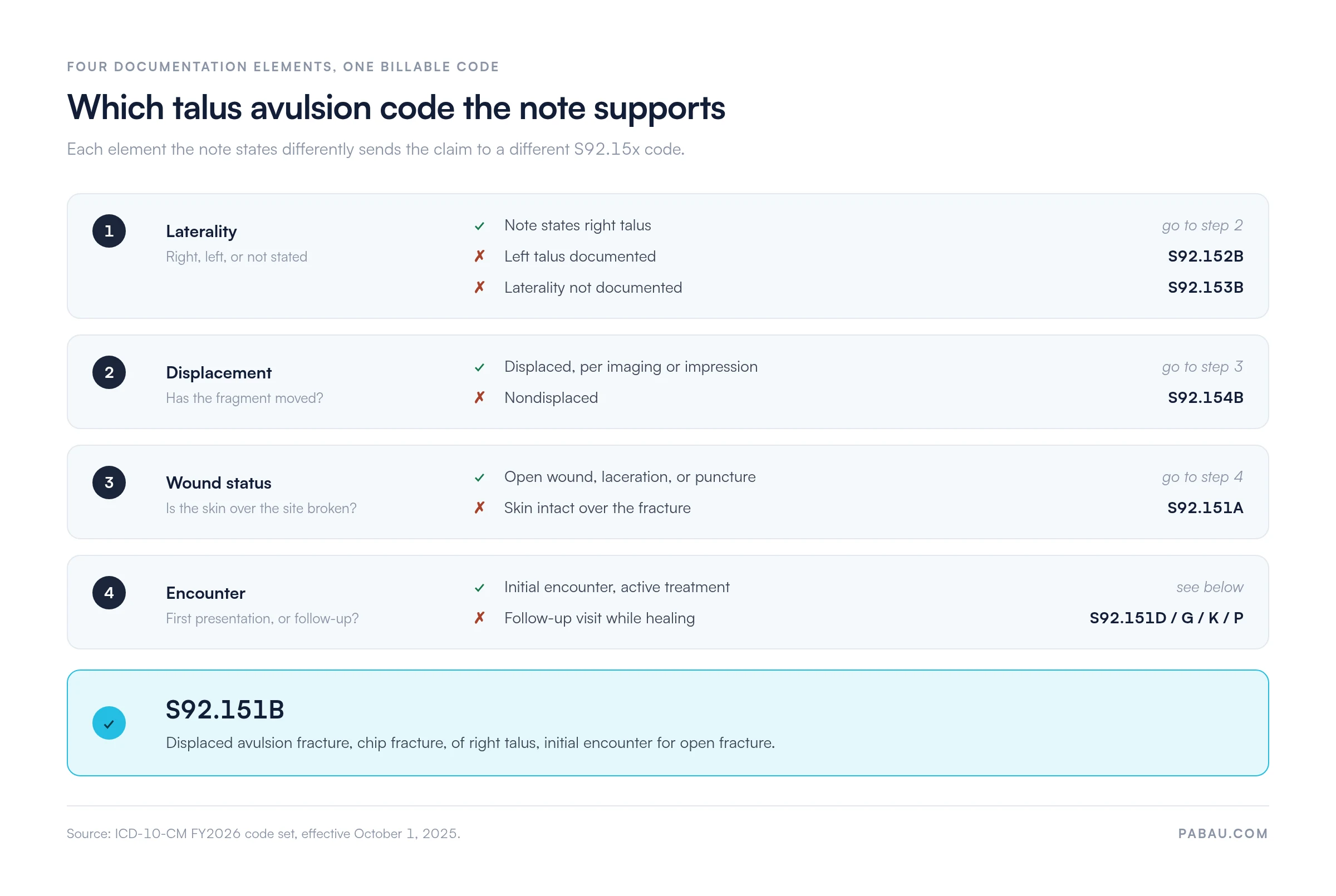
Per the ICD-10-CM Official Guidelines for Coding and Reporting, the provider’s documentation is the authoritative source for all coding decisions. For S92.151B specifically, the following must appear in the clinical record. A structured note template built around these five items keeps them in the chart rather than in the coder’s memory.
Multiple clinical phrasings map to ICD-10 code S92.151B. Coders searching by clinical terms rather than alphanumeric codes will encounter these alternate descriptions in the ICD-10-CM alphabetic index and commercial lookup tools. The ICD List free code browser and the AAPC Codify ICD-10-CM lookup both return S92.151B when searching these synonym terms.
S92.151B is one of several codes within the S92.1 (fracture of talus) subcategory. Knowing the sibling and adjacent codes prevents laterality or displacement errors at claim submission. The CDC/NCHS ICD-10-CM web tool allows year-specific browsing of the full S92.1 hierarchy, including all 7th character variants for each laterality-displacement combination.
The sibling codes below all sit on the talus itself. When the note points to a neighboring foot bone instead, start from the full list of ICD-10-CM codes.
Once documentation supports ICD-10 code S92.151B, the code pairs with the appropriate CPT procedure code on the claim form before going to the payer. Open talus fractures typically require surgical management, so CPT codes in the 28000-28899 foot fracture range are common companions.
The most common root cause of an open fracture denial is a 7th character mismatch. Either A (closed) goes out when the note documents an open wound, or D (subsequent) goes out at the initial encounter. A clearinghouse edit catches both before the claim reaches the payer’s adjudication system.
Reviewing denial patterns by code with structured denial management workflows surfaces recurring S92.151B errors across a practice’s caseload.
Audit open fracture claims using the S92.151B code series quarterly. Pull all S92.151x claims and verify the 7th character matches the encounter note. Practices that catch A/B mismatches before submission save an average of one to two denial cycles per fracture case.
Most practices assign S92.151B in the clinical record, then re-key it into a separate billing tool or a payer portal. Each hand-off is another chance for the 7th character to drift away from what the note actually says.
Practice management software like Pabau keeps the note and the claim on the same record. Its claims management software carries built-in ICD-10-CM catalogs, so a coder picks S92.151B against the encounter rather than typing it a second time.
The Claim.MD integration then submits the claim electronically to over 4,000 US payers. Real-time eligibility checks run before the surgical appointment, so the practice knows what the payer covers while the fracture is still being treated.


Pabau integrates with Claim.MD to send ICD-10-CM codes including S92.151B to over 4,000 US payers. Real-time eligibility checks, built-in code catalogs, and denial tracking all sit in one system.

ICD-10 code S92.151B is only as good as the sentence in the note that supports it. Right-side laterality, displaced morphology, an open wound, and initial encounter status all have to be written down rather than inferred by the coder. One wrong character in the 7th position turns a billable claim into a denial.
So fix this at the point of documentation, not at appeal. Give the treating surgeon a note template that asks for all four elements, and the coder stops reconstructing them from an imaging report. Book a demo to see how Pabau submits ICD-10-CM claims, tracks denials, and checks eligibility in one system.

Need to manage fracture claim denials systematically? Denial codes in medical billing covers the most common CARC denial reasons and how to resolve them before resubmission.
Want to understand the clearinghouse submission process? Medical claims clearinghouse explains how claims flow from the practice to the payer and where errors are caught.
Looking for superbill documentation guidance? Superbill documentation walks through how to structure encounter summaries that support ICD-10 and CPT code pairing for clean claim submission.
ICD-10 code S92.151B is a billable ICD-10-CM diagnosis code for a displaced avulsion fracture (chip fracture) of the right talus, initial encounter for open fracture. It is valid for HIPAA-covered transactions and became effective October 1, 2025 for FY2026.
Yes. S92.151B is a billable, specific ICD-10-CM code valid for claim submission on HIPAA-covered transactions. It requires no additional 7th character beyond the B already present in the code.
S92.151A is for the initial encounter of a closed fracture, with the skin intact. S92.151B is for the initial encounter of an open fracture, where the skin is breached. S92.151D is for a subsequent encounter during routine healing. Selecting the wrong 7th character is the most common cause of S92.151x claim denials.
The 7th character B designates an initial encounter for an open fracture across S92 and most other traumatic fracture categories in ICD-10-CM. The 7th character A applies to closed fractures at initial encounter. Both require documentation of the specific encounter type in the clinical note.
The direct parent is S92.151 (displaced avulsion fracture of right talus, unspecified encounter), which is not billable on its own. The hierarchy runs: S92 (fracture of foot) to S92.1 (fracture of talus) to S92.15 (avulsion fracture of talus) to S92.151 to the billable S92.151B.
Use S92.151B when the clinical note documents a displaced avulsion (chip) fracture of the right talus with an open wound at initial encounter. Confirm all five elements: right laterality, displaced status, avulsion/chip morphology, open wound, and first presentation for active treatment of this injury.