ICD-10 code S61.201A: Open wound of left index finger without nail damage
ICD-10 code S61.201A covers a left index finger wound of unstated type ICD-10 co...

Last Updated: Oct 16, 2026
Billable Code Specific Code
S92.122B is the billable ICD-10-CM code for displaced fracture of body of left talus, initial encounter for open fracture.
The code took effect on October 1, 2025 under the FY2026 edition of ICD-10-CM, published by the Centers for Medicare and Medicaid Services (CMS). Character B is the element coders get wrong most often. It requires a physician-documented wound at the fracture site, so the note has to say more than "left talus fracture".
Let Pabau's smart automation suggest the right codes, reduce claim denials, and keep your practice compliant—effortlessly.
Automate repetitive tasks and focus on what matters most—your patients.
Reduce coding errors and ensure compliance with the latest regulations.
Clean claims, fewer denials, and faster reimbursements.
Powerful insights and reporting to help your practice thrive.
HIPAA compliant SOC 2 certified GDPR-compliant Trusted by 4,000+ clinics worldwide

ICD-10 Code S92.122B describes a displaced fracture of the body of the left talus, initial encounter for an open fracture. It is billable in FY2026.
The seventh character B means the record documents a wound at the fracture site. Without that wording, the closed-fracture code S92.122A applies instead.
S92.122B is left-talus specific. A displaced body fracture of the right talus takes S92.121B on the initial open encounter.
Practice management software like Pabau validates ICD-10 and CPT pairings before submission, so open-fracture claims stop bouncing back from the payer.
S92.122B sits in Chapter 19 of ICD-10-CM, which covers injury, poisoning and certain other consequences of external causes. Each level of the hierarchy narrows the diagnosis by bone, then by side, then by displacement, then by encounter. Reading it downward is the fastest way to land on the right code from a clinical note.
The National Center for Health Statistics (NCHS) co-maintains ICD-10-CM alongside CMS. Verify the code against the CDC/NCHS ICD-10-CM web tool for the current fiscal year, because descriptions and chapter notes change with the annual update.
The seventh character sets the encounter type, and the wrong one is a common reason fracture claims get denied. Chapter 19 applies the same seventh-character conventions across its injury codes, so the logic below transfers to any fracture family.
Seven seventh characters are valid for the S92.122 subcategory. Character B designates the initial encounter for an open fracture. It means the patient is receiving active treatment for the first time, and the fracture involves a break in the overlying skin or soft tissue.
S92.122B belongs to a tightly grouped code family, and coders move between its members on laterality, displacement, and encounter type. A nondisplaced talus fracture leaves this subcategory altogether for the S92.14- codes, such as S92.145K.
The talus is the tarsal bone that connects the leg to the foot, and it forms the lower half of the ankle joint. It carries the body’s full weight load on a limited blood supply. That is why a displaced talus fracture brings a meaningful risk of avascular necrosis when treatment is delayed.
A displaced fracture means the bone fragments have shifted out of their normal alignment. An open fracture means the bone or the fracture site has breached the overlying skin or soft tissue. Both point to a higher-energy injury. Motor vehicle collisions, falls from height, and industrial accidents are the mechanisms documented most often.
Verify laterality in every note before coding. Emergency department notes sometimes use “left” and “right” inconsistently when describing radiograph findings versus the patient’s affected limb. If the documentation is ambiguous, query the treating provider before assigning S92.122B.
The choice between S92.122A (closed) and S92.122B (open) drives most coding queries on this subcategory. The difference is clinical, and a coder cannot settle it independently. Three documented facts decide the code, and the record has to carry all three.
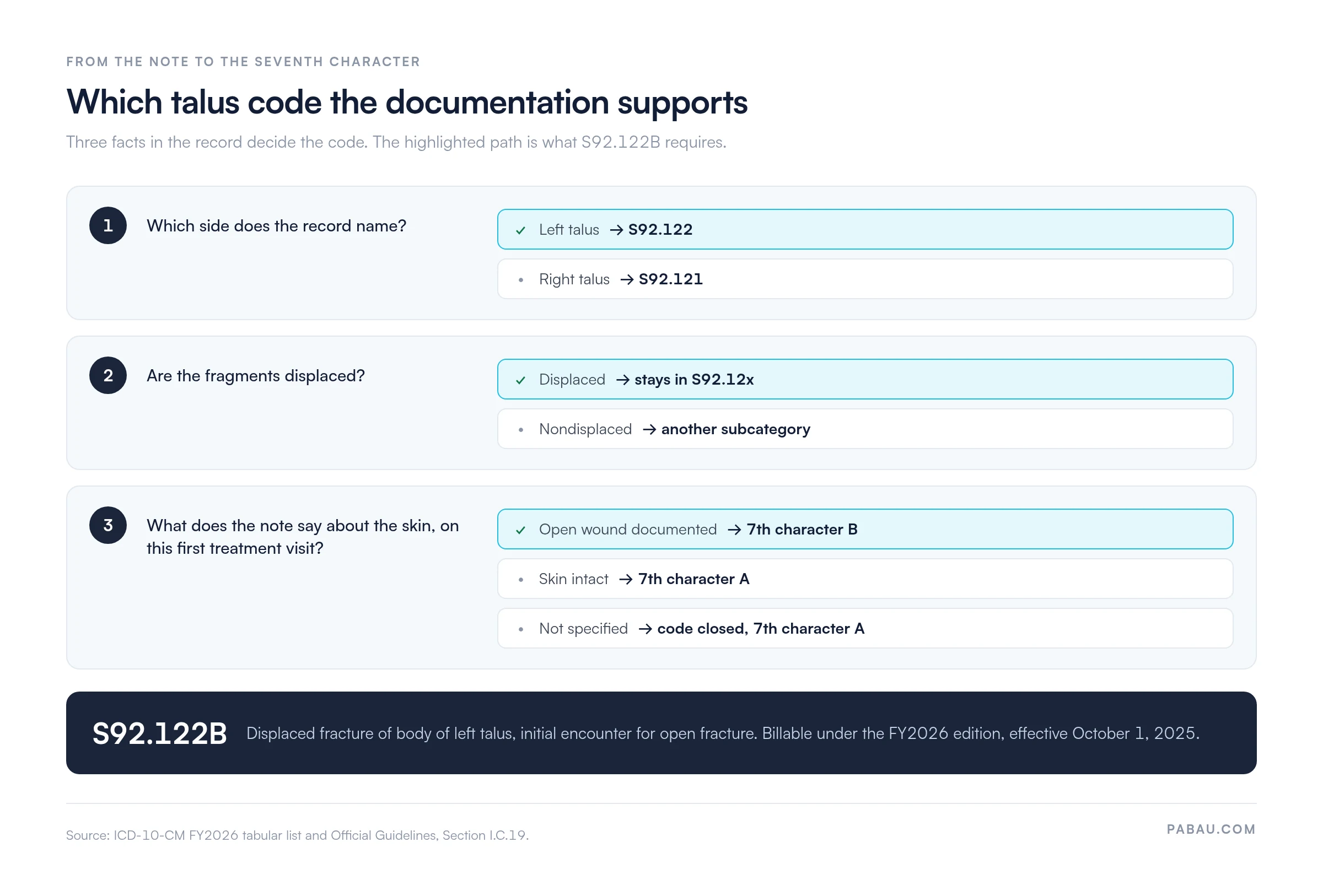
Per the ICD-10-CM Official Guidelines for Coding and Reporting (Section I.C.19), default to closed when the fracture type is not specified as open or closed. Assigning B without explicit documentation of an open fracture is upcoding, and it creates audit exposure.
Incomplete documentation is the main reason S92.122B claims are denied or downcoded. Review the medical record for all four elements below before you assign the code. Thorough documentation also keeps the claim clear of the denial codes payers reach for on open-fracture billing. It carries the appeal when one lands anyway.
Structured intake and clinical documentation tools make this far more reliable. The note has to capture all four elements at the time of the encounter, not weeks later when a coder queries the chart.
Document the Gustilo-Anderson classification for every open fracture in your operative or emergency note. Payers increasingly ask for it to validate open-fracture coding on high-acuity orthopedic claims. The Type I to Type IIIC distinctions also guide the associated CPT code selection.
S92.122B is a diagnosis code, so it pairs with procedure codes that describe the treatment performed. The surgeon’s operative report governs CPT selection, not the diagnosis. The codes below are the ones most commonly associated with open talus fracture management.
CPT 28455 sits beside 28445 in the tarsal series, and it does not apply here. It covers treatment of a tarsal bone fracture with manipulation, and it excludes the talus. Check the descriptor in the AAPC ICD-10-CM lookup before a crosswalk goes out.
The ICD-10-CM tabular list carries no Applicable To notes unique to S92.122B. The broader S92 category does carry the convention that a fracture not indicated as open or displaced is coded to displaced and closed.
Two exclusions apply at the S92 category level, and both are worth checking whenever you review foot injury documentation:
Open-fracture codes are denied at a high rate relative to how often they are billed. S92.122B needs four documented elements, and a claim that arrives missing one comes back as a rejection. That rework typically costs a billing team two to three weeks.
Pabau validates diagnosis and procedure codes before a claim leaves the practice. Its clearinghouse integration catches a mismatched ICD-10 and CPT pairing, or a missing modifier, at submission rather than at adjudication. Orthopedic and emergency medicine teams coding open fractures every week feel that front-end check first.
Pabau’s claims management software then carries the claim from documentation capture through denial follow-up. Billing staff code, submit, and work rejections in one place, so nobody rebuilds an open-fracture claim from a spreadsheet and a payer portal.

Pabau validates ICD-10 codes and CPT pairings before a claim reaches the payer. See how orthopedic and emergency medicine practices cut rejection rates on complex injury codes.

Open talus fractures are low-volume, high-complexity injuries, and one missing phrase in the record stalls the whole claim. S92.122B needs four facts confirmed: left laterality, displacement, open fracture status, and an initial encounter.
Check all four before the claim goes out, and query the provider whenever the note is ambiguous. That one habit prevents most rejections on this code, and it holds up when a payer audits the open-fracture designation later. Book a demo to see how Pabau validates ICD-10 coding and claims submission for orthopedic practices.

Need to understand how claim rejections get resolved? Denial management in healthcare covers the workflow from root-cause identification through appeal submission.
Billing a complex orthopedic claim for the first time? How superbills work in medical billing explains how to combine diagnosis and procedure codes for payer submission.
Coding another hindfoot fracture? ICD-10 Code S92.042G walks through calcaneus fracture coding in the same S92 category.
Tracking a claim from encounter to payment? Revenue cycle management fundamentals shows where coding accuracy decides how fast a practice gets paid.
ICD-10 Code S92.122B is a billable ICD-10-CM diagnosis code for a displaced fracture of the body of the left talus. The record documents it as an initial encounter for an open fracture. It is valid for HIPAA-covered transactions in FY2026, effective October 1, 2025. The code is specific to the left foot, so it never covers a bilateral or right-side injury.
Yes. S92.122B is a billable, specific ICD-10-CM code, valid for reimbursement and for HIPAA-covered transactions in FY2026. It reached its current form on October 1, 2025. It appears in the current tabular list with no non-billable parent restriction.
S92.122A covers a displaced fracture of the body of the left talus on an initial encounter for a closed fracture, with the skin intact. S92.122B covers the same fracture on an initial encounter for an open fracture, where the bone or fracture site has breached the overlying skin. The physician must document open fracture status, because a coder cannot infer it.
S92.122B applies to the initial encounter, when the patient receives active treatment for the first time. S92.122D applies to subsequent encounters during the healing phase, such as cast checks, follow-up imaging, or wound care visits. Once active treatment is under way, every later visit in that episode shifts to D.
CPT 28445 covers open treatment of a talus fracture, including internal fixation when performed, and it is the usual procedure code for surgical management. Debridement codes 11010 or 11012 may apply to the wound at the open fracture site. The operative report determines the correct CPT, because S92.122B alone does not dictate a procedure code.
Four elements must appear in the medical record. The note must confirm left-side laterality and displacement of the fracture fragments. It must also document an open fracture or a wound communicating with the fracture site, on an initial encounter with active treatment. If any one of the four is missing, query the provider before you code.