

ICD-10 code S61.201A: Open wound of left index finger without nail damage
ICD-10 code S61.201A covers a left index finger wound of unstated type ICD-10 co...

Last Updated: Oct 16, 2026
Billable Code Specific Code
S91.042A is the billable ICD-10-CM code for puncture wound with foreign body, left ankle, initial encounter.
Billers meet this code after nail, glass, and splinter injuries, where a wrong pick returns as a denial or a provider query.
Let Pabau's smart automation suggest the right codes, reduce claim denials, and keep your practice compliant—effortlessly.
Automate repetitive tasks and focus on what matters most—your patients.
Reduce coding errors and ensure compliance with the latest regulations.
Clean claims, fewer denials, and faster reimbursements.
Powerful insights and reporting to help your practice thrive.
HIPAA compliant SOC 2 certified GDPR-compliant Trusted by 4,000+ clinics worldwide

ICD-10 code S91.042A reports a puncture wound with a foreign body in the left ankle, initial encounter, and is billable for FY2026 claims.
The 7th character A covers the first active treatment visit, D covers follow-up care, and S covers late effects.
Documentation has to confirm the puncture wound type, the left side, and a foreign body in the wound.
Category S91 carries two Excludes1 notes, so open fractures and traumatic amputations of the ankle belong in S92 and S98 instead.
On an inpatient stay, S91.042A groups to MS-DRG 913 or 914 under the FY2026 grouper, version 43.
S91.042A is a billable ICD-10-CM diagnosis code for a puncture wound with a foreign body of the left ankle, at the initial encounter.
It carries the three specificity markers a trauma code needs. Those are the wound subtype, the laterality, and the encounter type. The code sits inside category S91, which covers open wounds of the ankle, foot, and toes.
Per the CMS ICD-10 codes page, the code took effect on October 1, 2025 with the FY2026 update. It stays valid for HIPAA-covered transactions through the current fiscal year.
The puncture versus laceration call is where the errors usually start. A laceration tears tissue and leaves irregular edges. A puncture leaves a narrow, deep channel made by a pointed object.
When the note also records foreign material in that channel, the “with foreign body” subtype applies. If the provider wrote “laceration”, or said nothing about a foreign body, S91.042A is the wrong code.
Before a claim goes out, a biller wants the same handful of administrative facts. The table below pulls them together, matching the data published on the CDC/NCHS ICD-10-CM web tool.
Confirming that a code is still valid for the current fiscal year takes seconds. It heads off one of the duller rejection reasons in billing. Codes get added, revised, and retired every October 1.
The 7th character records the stage of care, so it changes with the visit rather than with the wound. Three values apply to the S91.042 base. Coding a third follow-up visit with “A” is a familiar audit trigger, and payers look for it.
A short rule covers most visits. While the patient is still under active treatment for the wound, meaning debridement, foreign body removal, or irrigation, use “A”. Once the visit is a wound check or a dressing change, move to “D”. If the patient returns months later with scarring or nerve damage from that injury, use “S”.
Document the phase of care explicitly in the encounter note. A note reading ‘wound check, healing well, no signs of infection’ signals a subsequent encounter (D), not an initial one (A). Payers audit this distinction, and S91.042A on a third follow-up visit invites a medical necessity review.
ICD-10-CM runs from chapter to billable code through a fixed hierarchy, and S91.042A sits at the bottom of it. Tracing that path is the quickest way to see why the parent codes cannot go on a claim.
S91.042 needs a 7th character before it becomes valid, so a claim carrying the bare parent gets rejected at the front end. Code to the highest level of detail the record supports, and no further than that.
The S91.042 family holds three encounter variants, and the neighboring subcategories cover the other side and the other wound types.
The table maps the codes a coder reaches for inside the open ankle wound range. The AAPC ICD-10-CM lookup is useful for browsing the rest of the S91.04 family.
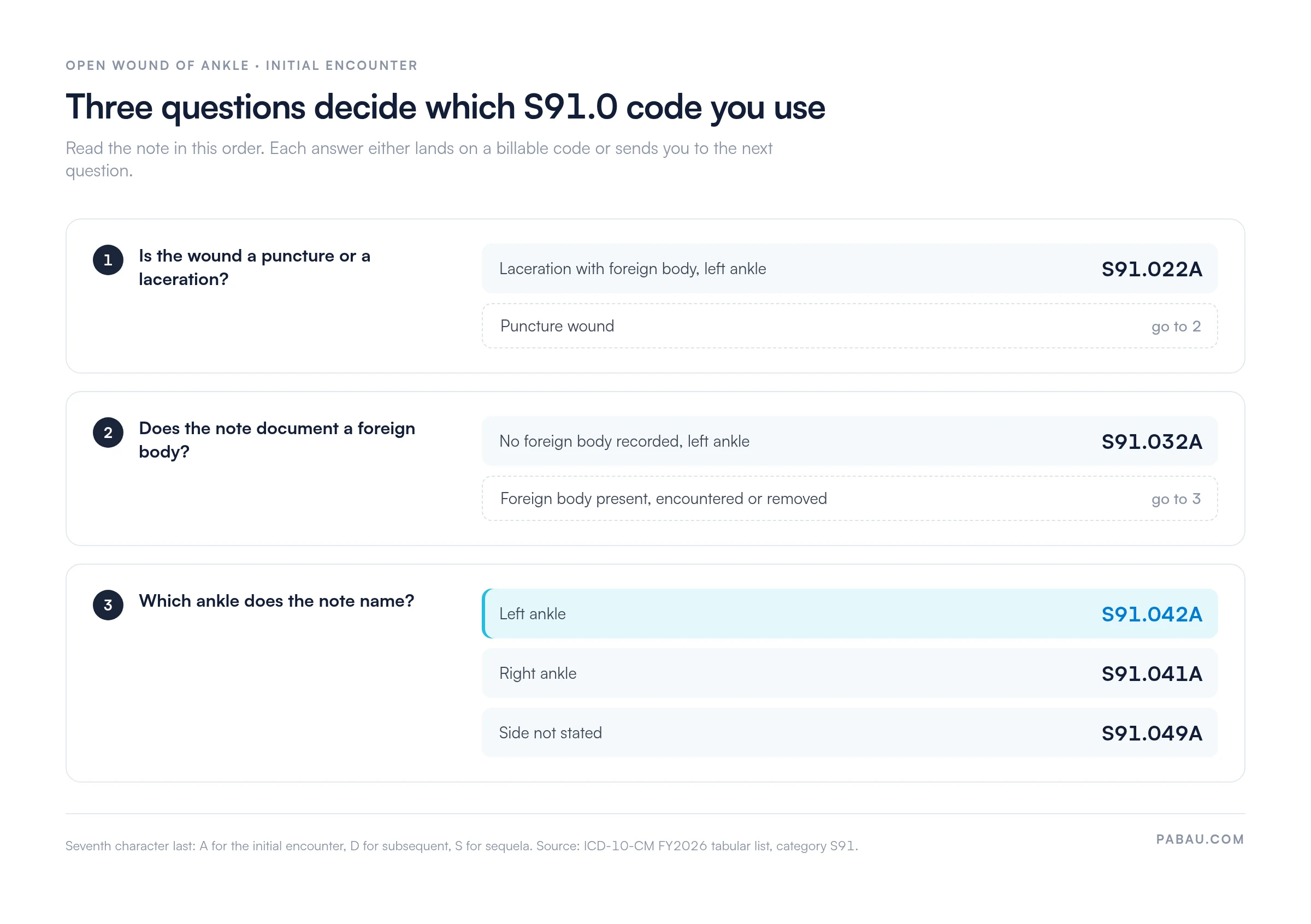
The sharpest distinction here is S91.042A against S91.032A. Say the note reads “stepped on a nail, 2 cm puncture over the left lateral malleolus, wood fragment removed under local”. That supports S91.042A.
Delete the wood fragment line and the same wound becomes S91.032A, because the subtype is no longer documented. Query the provider whenever the note leaves foreign body involvement open.
Working through the note in a fixed order turns the choice into three quick questions rather than a judgment call.
The same foreign body question comes up at the knee, under category S81 rather than S91. A knee puncture with no retained object and no side documented is ICD-10 code S81.039A at the initial encounter.
Category S91 carries two Excludes1 notes and one “Code also” instruction, and all three sit above the code you are about to pick.
An Excludes1 note means the two codes never appear together for the same condition. That decides which family the injury belongs to, well before the 7th character comes up.
The “Code also” note earns its keep on follow-up visits. A puncture that gets infected between the first visit and the wound check picks up a second code. Sequencing is discretionary, so lead with whichever problem brought the patient back in.
On an outpatient claim, S91.042A never touches a DRG, so a practice biller can move past this section. The grouper runs on the inpatient facility claim that the hospital files.
Where the code lands there as a principal or secondary diagnosis, the case groups on whether a major comorbidity or complication (MCC) is documented.
CMS updates the grouper and its relative weights with each IPPS final rule. FY2026 runs on version 43, published as v43.0 and refreshed as v43.1 in April 2026.
Quoting an older grouper in a payment model puts the weights out by several years. The current files sit on the CMS MS-DRG classifications page.
For a traumatic ankle wound, the present on admission indicator is almost always “Y”, because the injury happened before the patient arrived.
The indicator is required on inpatient claims for Medicare and Medicaid patients, and it tells the payer whether the diagnosis was there at admission.
Outpatient claims carry no POA reporting at all. On the inpatient side, a wrong indicator becomes a slow and avoidable denial. A short pre-bill POA review earns its place in the coding routine.
Specificity comes out of documentation, and S91.042A is one of the more demanding codes in the S91 family. Each part of the code description needs a matching line in the medical record.
Ambiguity in any one of these costs a query cycle, and a query cycle runs in days rather than minutes. Catching it at the point of care is far cheaper.
Build a three-question prompt into the ankle wound order set. Which ankle, left or right? Puncture or laceration? Any foreign body present, removed, or suspected? Clinicians answer those in about twenty seconds, while a retrospective query costs the coder days.
Providers rarely write the code description word for word. The tabular list’s “Applicable To” notes and synonyms let a coder confirm that the clinical picture matches, even when the vocabulary does not. These phrasings all land on S91.042A.
None of these phrasings stretch the code any further than the tabular list does. A laceration stays a laceration, and a right ankle stays a right ankle, whatever vocabulary the note uses.
On an outpatient claim, S91.042A travels on the CMS-1500 form, or its electronic twin the 837P, as a primary or secondary diagnosis. It has to point at a procedure line that makes clinical sense for a puncture wound. Here is the route it takes.
Three problems account for most of the stalls. The claim carries S91.042 with no 7th character. The encounter type says “A” on a visit the note describes as a wound check. Or the diagnosis points at a procedure line the payer will not accept for a puncture wound.
Each one comes back with its own remark code, and our list of denial codes explains what those mean.
A short pre-submission pass catches the errors above while they are still cheap to fix. Read the note first, then the claim, and answer each of these.
Two mistakes survive that list often enough to name. The first is coding a foot injury as an ankle, since foot punctures with a foreign body sit in S91.34- instead. The second is reusing “A” on every visit in the episode.
Both slip past a clearinghouse edit and fail at the payer, which is the expensive place to fail. The wider set of pre-submission checks sits in our guide to clean claim requirements.
Most of the work above is reading. The rest is data entry, and that is where a practice quietly loses hours. The diagnosis sits in the clinical note, the procedure sits on the treatment record, and someone retypes both into a claim form.
Practice management software like Pabau closes that loop. Pabau’s claims software for practices builds the CMS-1500 from the record the clinician already completed. The CPT code attached to the service lands on the charge line, and the ICD-10 slots are seeded from the client’s recorded problem list.
Built-in ICD-10-CM and CPT lookup libraries sit behind a search icon, so a coder can confirm S91.042A without leaving the claim.
For US practices, Pabau connects to the Claim.MD clearinghouse and submits professional claims, meaning CMS-1500 and 837P, to thousands of payers. Real-time eligibility checks run before the visit, claim status is tracked after it, and ERA remittances post back against the invoice.
Required claim fields, such as membership and authorization numbers, are checked for completeness before the send button unlocks.
The software does not pick the code for you, and no lookup library can read a clinical note. What it removes is the retyping, the blank required field, and the hunt for a remittance that landed in a different system.
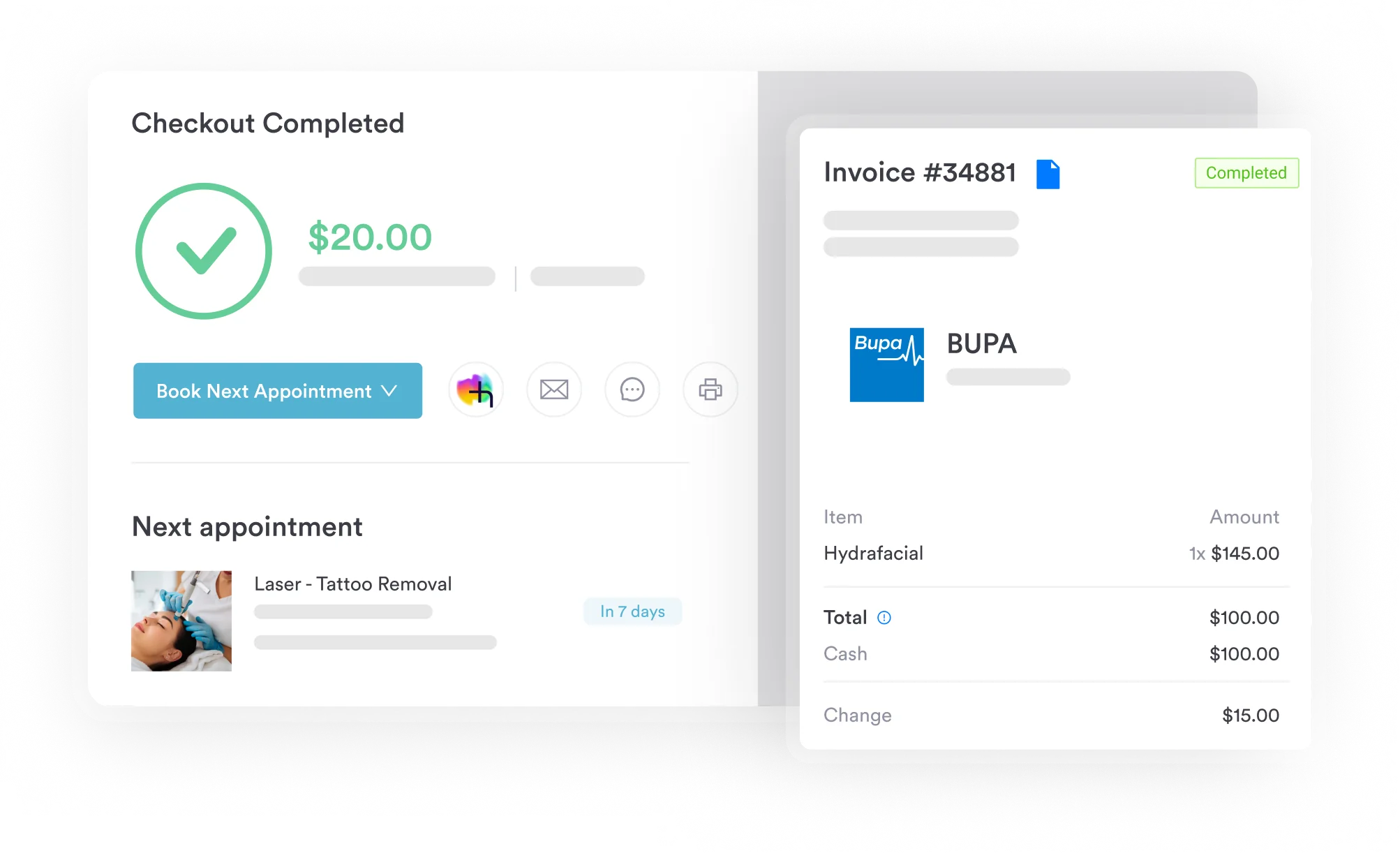

Pabau builds the CMS-1500 from the clinical record, checks that every required claim field is complete, and submits to US payers through Claim.MD. Eligibility, claim status, and ERA remittances all stay in one place.

S91.042A is not a hard code to assign, but it is an easy one to lose. Three separate lines in the note have to agree. The wound has to read as a puncture. Laterality has to be documented as the left ankle. A foreign body has to appear somewhere in the record.
Miss one and the fix is a provider query, while the claim sits and waits. Fixing that at the source beats fixing it at the clearinghouse. A three-question prompt in the ankle wound order set earns its twenty seconds.
The 7th character, the DRG, and the POA indicator all follow from those same three answers. Get the note right before anyone opens a claim form.
Retyping between the note and the claim is where a lot of practices lose time. Book a demo to see how Pabau builds the claim from the record your clinician already signed.

Want the full pre-submission checklist? Clean claim requirements sets out the fields and checks that stop a claim bouncing on its first pass.
Working a stack of denied injury claims? Denial management in healthcare walks through identifying, appealing, and preventing the denials that keep repeating.
Wondering how US claims reach the payer? Claim.MD clearinghouse explains how Pabau submits professional claims and posts remittances back to the invoice.
Not sure what the 835 file is telling you? Electronic remittance advice decodes the remark codes that arrive with every payment.
Building a coding routine that survives an audit? Medical billing compliance covers the documentation habits that hold up under review.
Not as a national rule. The ICD-10-CM official guidelines set no mandatory reporting requirement for external cause codes, the V, W, X and Y categories. Some states mandate them, and some payers and trauma registries ask for them, so check your own requirements. When you do report one, it is always a secondary code.
Report both codes. ICD-10-CM offers no bilateral option in this range, so a left ankle puncture with a foreign body takes S91.042A and the right takes S91.041A. Sequence the more severe wound first, or the one that drove the visit.
No. The S91.04 subcategory stops at the ankle. A puncture wound with a foreign body in the foot belongs in S91.34-, so a left foot injury is S91.342A. Toe wounds have their own subcategories again, and the heel and dorsum count as foot rather than ankle.
No. The code describes the diagnosis, not the treatment. A puncture left open to drain is coded the same way as one that gets closed. The repair, the irrigation, or the foreign body removal is reported separately, with its own CPT code.



