

ICD-10 code S61.201A: Open wound of left index finger without nail damage
ICD-10 code S61.201A covers a left index finger wound of unstated type ICD-10 co...

Last Updated: Oct 16, 2026
Billable Code Specific Code
S81.039A is the billable ICD-10-CM code for puncture wound without foreign body, unspecified knee, initial encounter. It applies when a pointed object pierced the skin over the knee, nothing remains in the wound, and the chart does not name the side.
The code sits in category S81, open wound of knee and lower leg. Its 7th character A marks active treatment rather than a first visit, so it can span several encounters. Routine healing-phase visits after active treatment ends move to S81.039D.
Let Pabau's smart automation suggest the right codes, reduce claim denials, and keep your practice compliant—effortlessly.
Automate repetitive tasks and focus on what matters most—your patients.
Reduce coding errors and ensure compliance with the latest regulations.
Clean claims, fewer denials, and faster reimbursements.
Powerful insights and reporting to help your practice thrive.
HIPAA compliant SOC 2 certified GDPR-compliant Trusted by 4,000+ clinics worldwide

S81.039A codes a puncture wound without foreign body of the unspecified knee, initial encounter. Lacerations, bites, and unspecified open knee wounds each have their own sibling codes.
7th character A means active treatment is ongoing, not that it is the patient’s first visit. It can apply across several encounters while the provider is still actively treating the wound.
Unspecified laterality is an audit trigger when the chart documents the right or left knee. Use S81.031A or S81.032A whenever the side is recorded.
Practice management software like Pabau submits claims through Claim.MD and tracks their status, so your team can correct a rejected claim and resubmit it quickly.
ICD-10 Code S81.039A is the billable ICD-10-CM code for a puncture wound without foreign body of the unspecified knee, at the initial encounter. Use it when a pointed object has pierced the skin over the knee and nothing remains in the wound. The chart also does not state which knee. The code is valid for the current fiscal year (October 1 update) and sits in the injury chapter of ICD-10-CM.
According to the CDC/NCHS ICD-10-CM web tool, S81.039A is verified as billable for the current fiscal year. Re-confirm validity each October 1, when CMS releases the updated code files and descriptions can change.
A knee puncture wound is a narrow, deep wound made when a pointed object pierces the skin over the knee and is then withdrawn. The entry hole is often small, but the track can reach the prepatellar bursa or the joint capsule. Emergency departments and urgent care see these injuries first, and physical therapy and orthopedic settings often manage them afterward. Four clinical features define S81.039A.
A retained fragment moves the code to the S81.04- series, puncture wound with foreign body. A cut or tear is coded as a laceration (S81.01-), and a bite that breaks the skin is coded as an open bite (S81.05-). Surgical wounds and wounds created during a procedure are not coded here either.
Document the wound mechanism in the clinical note before selecting a code. A nail puncture with no retained fragment and no documented side is S81.039A. The same wound with an embedded nail fragment is S81.049A. Code from what the note documents, and query the provider when the note is silent.
Each character in S81.039A narrows the code, from the injury chapter down to the treatment phase. Reading it left to right shows which detail in the note drives each character.
The 7th character “A” in S81.039A designates an initial encounter. It means the patient is still in the active treatment phase for this wound, not that it is their first physical visit. The ICD-10-CM Official Guidelines for Coding and Reporting (Section I.C.19) make this distinction explicit. “A” applies for as long as the provider is actively managing the injury, even across multiple visits. Assigning “A” only to the first appointment and “D” to every follow-up misstates the treatment phase, and payers can reject the claim.
Practical rule: if the provider is actively irrigating, debriding, repacking, or monitoring for infection, use “A.” Once active treatment ends and the visit is routine healing-phase care, shift to “D.”
The “9” in the 6th character position means laterality is unspecified. Payers, particularly Medicare Administrative Contractors, expect the most specific code the documentation supports. That expectation comes from the ICD-10-CM Official Guidelines, which call for the most specific code the record supports. Defaulting to “unspecified” when the chart clearly reads “right knee puncture wound” is a common audit trigger.
When you genuinely cannot determine laterality from the record, S81.039A is appropriate. Record in the chart why the side could not be confirmed. An unspecified code backed by that note holds up far better on audit than one billed against a chart that names the right knee.
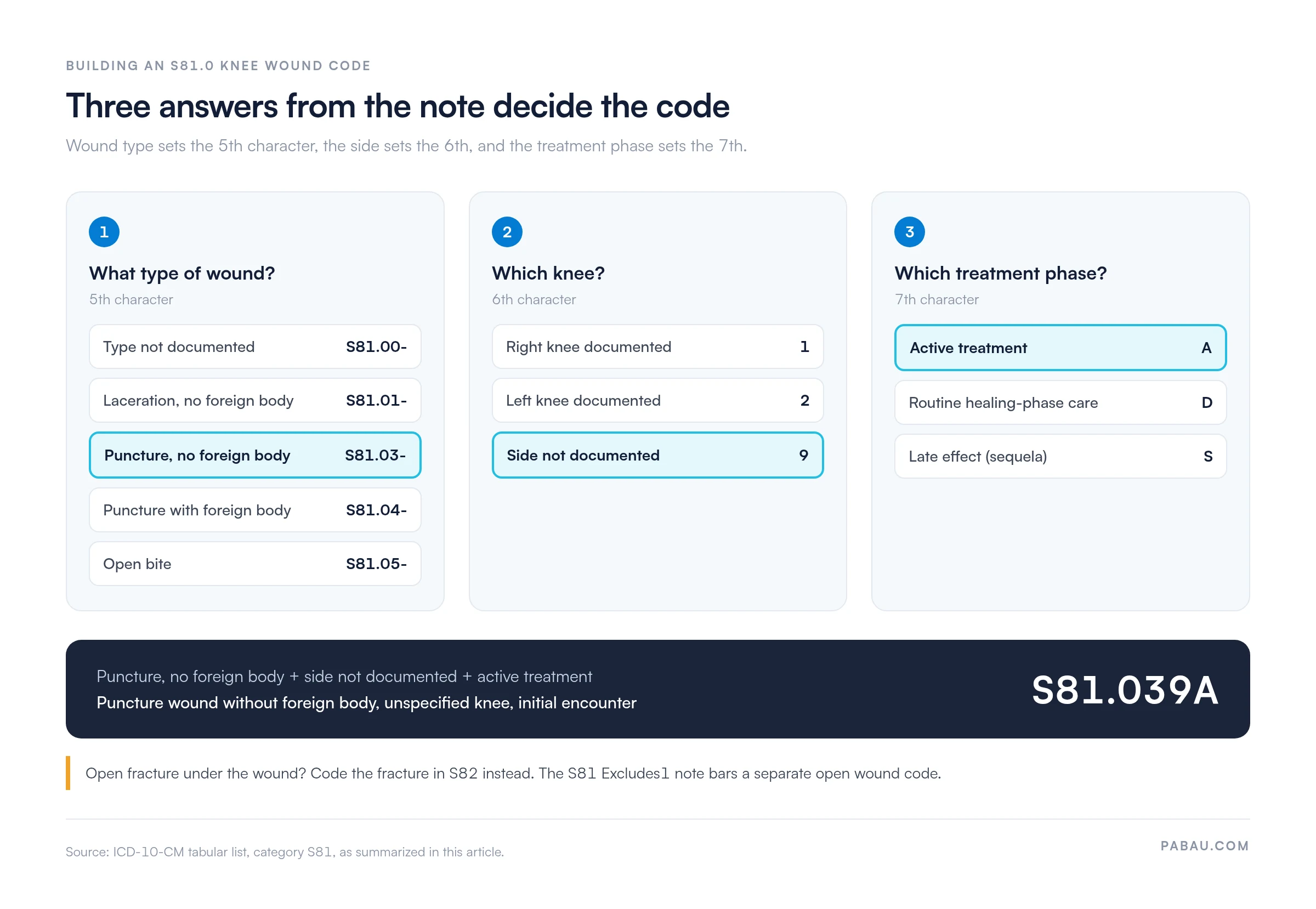
Several ICD-10-CM codes are close neighbors of S81.039A in both structure and clinical presentation. Picking the wrong sibling is an easy error on knee wound encounters. Within S81.0, the 5th character sets the wound type, the 6th sets the side, and the 7th sets the treatment phase. The three choices below build the code one character at a time.
The table sets S81.039A against the neighbors it is most often confused with.
The S81 category carries official ICD-10-CM instructional notes that govern what S81.039A can and cannot represent. These notes appear in the tabular list and bind every code in the category.
The Excludes1 note is a hard exclusion. If the puncture reaches an underlying fracture, code the open fracture in S82 instead of S81. Applying S81.039A to an open knee fracture misrepresents the injury, and the claim is likely to fail payer code edits.
ICD-10 Code S81.039A is a diagnosis code, so it always pairs with a CPT procedure code for billing. Many puncture wounds are cleaned and left open rather than closed, so an E/M service and tetanus prophylaxis are often the main billed services. When a puncture is closed, the repair code depends on wound length, depth, and repair complexity. A superficial closure of 2.5 cm or less is usually 12001, and longer or layered repairs move down the table below. Check the current AMA CPT code set guidelines for length thresholds, which are revised periodically.
A superbill for a knee puncture wound encounter should capture the ICD-10 diagnosis code and every CPT code billed. When a repair is billed, record the wound length in centimeters, because payers audit that pairing closely.
A clean claim for S81.039A rests on the clinical note. The documentation must support both the diagnosis code and any CPT repair code billed alongside it. Practice management platforms like Pabau include built-in claims management software that pulls the details already on the patient record into a pre-filled claim. It then submits the claim through Claim.MD, our US clearinghouse partner, and tracks its status. A knee puncture note should cover each item below.
Medicare and commercial payers may request the procedure note on audit. CMS expects that record to be complete, legible, dated, and signed by the treating provider. A thin or cloned note is hard to defend when that request arrives.
The table below pairs six common S81.039A denial reasons with their root cause and the fix. When a rejection arrives on an ERA, match it to its CARC with this guide to medical billing denial codes.
Once a month, pull the S81.039A claims denied in the prior 90 days and sort them by CARC. When one CARC keeps recurring, fix the coding step that produces it before reworking individual claims.
A knee wound claim usually passes through several hands. The clinician documents the puncture, a biller re-keys the codes into a separate billing tool, and someone checks a clearinghouse portal for rejections. Each re-keying step is another chance for a D to replace an A, or for the documented side to drop off.
Pabau keeps the treatment note and the claim on the same patient record. Details already on the record are pulled into a pre-filled claim, which Pabau submits through Claim.MD, our US clearinghouse partner. Eligibility checks, claim status, and remittances come back into Pabau, so your billing team works rejections without switching systems.
Your coders still choose the codes. The difference is fewer re-keying errors, and a supporting note that sits next to the claim when a payer asks for it.

Pabau pulls the details on the patient record into a pre-filled claim and submits it through Claim.MD. Your team sees each claim’s status and can correct a rejection quickly.

S81.039A is a narrow code. It fits one wound type, a puncture with nothing left behind, on a knee the chart does not name. Confirm the wound type first, then the side, then the treatment phase, and most avoidable rejections on these claims never reach the payer.
The trade-off is a few extra minutes in the note. A provider query about laterality or a retained fragment is quick, while reworking a rejected claim can take days.
Pabau’s integrated medical billing workflow keeps that note on the same record as the claim and submits it through the Claim.MD clearinghouse. Book a demo to see how Pabau handles traumatic wound claims in practice.

Need a framework for managing claim denials across ICD-10 injury codes? Denial management in healthcare covers the workflow for identifying, appealing, and preventing rejections.
Want to see what a clearinghouse checks before a claim reaches the payer? Medical claims clearinghouse explains how clearinghouses screen claims before they reach payers.
Weighing Claim.MD for your practice’s claim submissions? Claim.MD clearinghouse explains how Pabau’s US clearinghouse partner fits into the claim workflow.
Looking for the ERA remittance codes that accompany a denial on a wound claim? Electronic remittance advice decodes ERA transaction sets and CARC/RARC denial codes.
Want fewer wound claims coming back for rework? Clean claim lists the data a claim needs to pass payer edits on the first submission.
ICD-10 Code S81.039A is the billable diagnosis code for a puncture wound without foreign body of the unspecified knee, initial encounter. It applies when a pointed object pierced the skin over the knee, nothing remains in the wound, and the chart does not say which knee. The A means the patient is still in active treatment, not merely at a first visit. Lacerations, bites, and unspecified open knee wounds use sibling codes such as S81.019A, S81.059A, and S81.009A.
No. S81.039A is a puncture wound without foreign body. When the record documents a retained object, such as glass, gravel, or a metal fragment, the correct code is S81.049A. That code covers a puncture wound with foreign body of the unspecified knee. If a fragment is found at a later visit, switch to S81.049- from that visit, using the 7th character that matches the treatment given.
The most common pairings are CPT 12001 and 12002 for simple repair, 12031-12037 for intermediate repair, and 13120-13122 for complex repair. Wound length and closure complexity decide which applies. Emergency department encounters may also include an E/M code (99283-99285) with modifier 25 when a separately identifiable evaluation is documented. The CPT selection must be supported by wound dimensions and repair technique in the clinical note. Verify current length thresholds in the AMA CPT manual.
No. The “A” suffix is specific to the initial/active-treatment encounter. For a subsequent encounter after active management has concluded, use S81.039D. For a late effect or sequela of the original wound, use S81.039S. Submitting S81.039A for a clearly post-healing visit may generate a payer audit flag. The risk is highest when the claim date falls well after the injury date in the chart.



