ICD-10 Code S62.664D: Nondisplaced ring finger fracture
ICD-10 Code S62.664D: quick reference ICD-10 Code S62.664D reports a follow-up v...

Last Updated: Oct 21, 2026
Billable Code Specific Code
S83.202S is the billable ICD-10-CM code for bucket-handle tear of unspecified meniscus, current injury, unspecified knee, sequela. It records a late effect of a healed bucket-handle tear, such as stiffness or instability, when the notes don't say which meniscus or which knee.
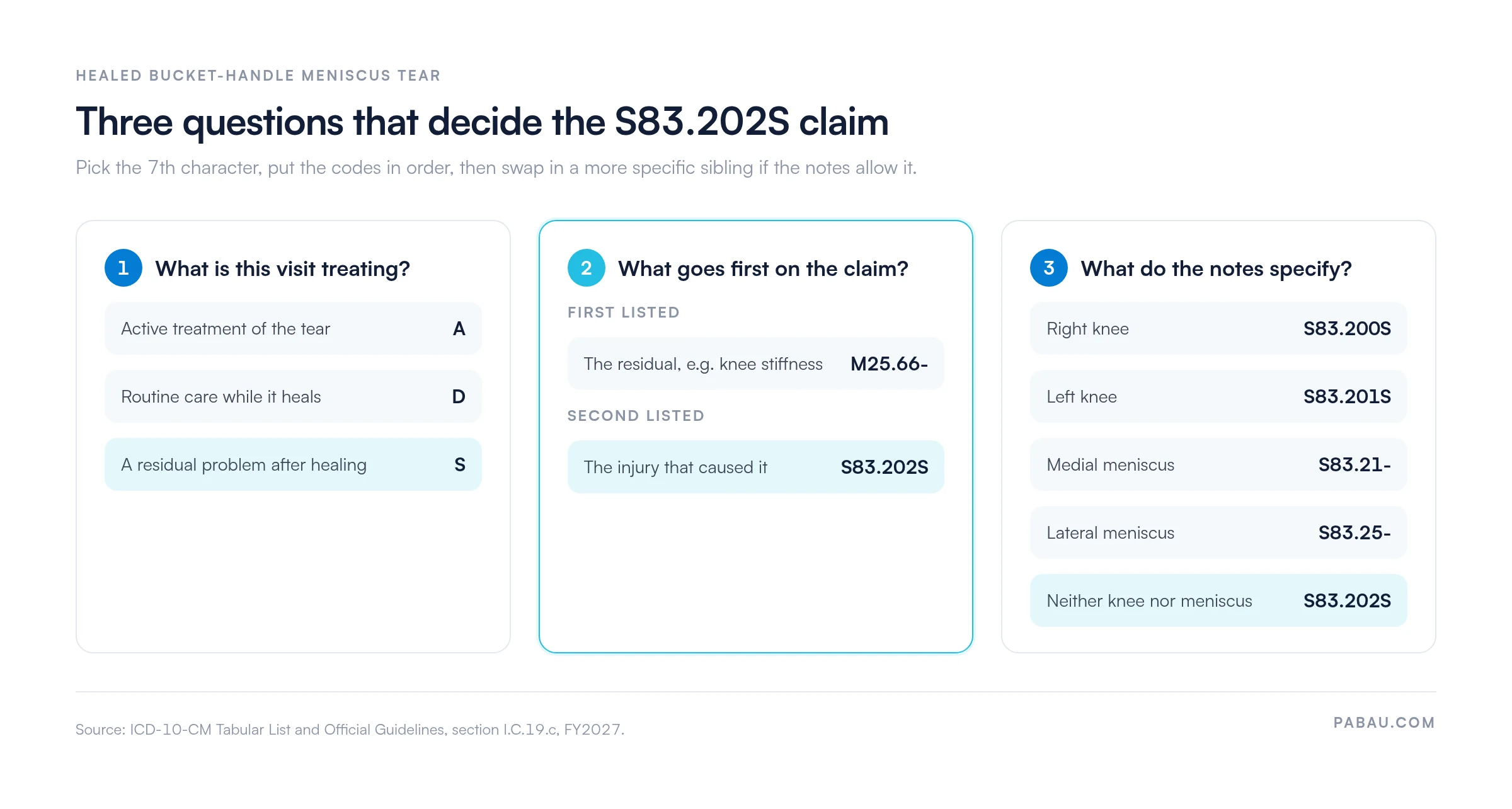
The code rarely stands alone. Official guidelines list the residual condition first, with S83.202S second to show its cause. The 7th character S also separates this visit from active care (A) and routine healing follow-up (D). Below, you'll find the code's structure, its sibling codes, the documentation payers expect, and a checklist to run before you submit.
Let Pabau's smart automation suggest the right codes, reduce claim denials, and keep your practice compliant—effortlessly.
Automate repetitive tasks and focus on what matters most—your patients.
Reduce coding errors and ensure compliance with the latest regulations.
Clean claims, fewer denials, and faster reimbursements.
Powerful insights and reporting to help your practice thrive.
HIPAA compliant SOC 2 certified GDPR-compliant Trusted by 4,000+ clinics worldwide

S83.202S is a billable ICD-10-CM code for the sequela of a bucket-handle meniscus tear when the notes name neither the meniscus nor the knee.
Code the residual condition first, such as knee stiffness, and add S83.202S second to show what caused it.
The 7th character S applies once active treatment and routine healing care are over, and the notes tie the problem to the original tear.
Use S83.200S or S83.201S when the right or left knee is documented, and S83.21- or S83.25- for a documented medial or lateral tear.
An old bucket-handle tear (M23.2-) is an Excludes1 condition, so it should not be reported with S83.202S for the same condition.
ICD-10 code S83.202S is the billable ICD-10-CM code for “Bucket-handle tear of unspecified meniscus, current injury, unspecified knee, sequela.” It sits in chapter 19, which covers injury, poisoning and certain other consequences of external causes. Its category is S83, dislocation and sprain of joints and ligaments of the knee.
In plain terms, the tear has healed but left a problem behind. The visit treats that problem, and S83.202S tells the payer where it came from. Each character in the code narrows the meaning a little further.
Two parts of that descriptor are unspecified. The meniscus is unspecified because the notes don’t say medial or lateral. Medial and lateral bucket-handle tears have their own subcategories, S83.21- and S83.25-.
The knee is unspecified too. The 6th character carries laterality here, so S83.200, S83.201 and S83.202 cover the right, left and unspecified knee.
Yes, S83.202S is a billable ICD-10-CM code. It carries all seven characters a chapter 19 injury code needs. The CDC/NCHS ICD-10-CM code tool lists it as valid for the current fiscal year (FY2027), which began on October 1, 2026.
The parent S83.202 is not billable. Send it without a 7th character and the claim is rejected as invalid before anyone reviews the medical record.
Treat any change to the 7th character as a coding decision. Moving from A or D to S signals a new phase of care and changes the diagnosis order. Have a second coder check those edits before the claim goes out.
In chapter 19, the 7th character records the phase of care. S83.202 takes one of three: A for initial encounter, D for subsequent encounter, and S for sequela. Pick the wrong one and the claim no longer matches the medical record.
A sequela is a residual condition that remains after the acute phase of an injury ends. The ICD-10-CM Official Guidelines set no time limit on when one can appear.
S83.202S rarely goes on a claim alone. Under guideline I.C.19.c, the nature of the sequela is sequenced first. The injury code with 7th character S follows it. The first code says what the visit treats, and S83.202S explains the cause.
Residual conditions that often lead to an S83.202S claim include:
The panel below walks through the three choices in the order a coder makes them.
The provider’s note must say the current problem is a consequence of the prior tear. “Residual knee stiffness following bucket-handle meniscus repair on [date]” supports that link. “Knee pain” on its own does not.
Knowing the neighbors in the S83.2 family prevents laterality and tear-type errors. Check the specific code in the tabular list before you submit.
S83.202S fits only when the notes specify neither the knee nor the meniscus. If laterality is documented, use S83.200S for the right knee or S83.201S for the left. Specificity needs positive documentation, so never assume a side the provider didn’t record.
Read the original operative report before coding a sequela visit. If the surgeon documented the medial or lateral meniscus, use a medial or lateral meniscus code (S83.21-/S83.25-) instead. Do the same for a documented right or left knee. Some payers treat a needless unspecified code as incomplete documentation.
Two kinds of exclusion note apply to this code, and they work differently.
Subcategory S83.2 carries an Excludes1 note for old bucket-handle tear (M23.2-). Excludes1 means the two should not be reported together for the same condition. An old tear that is itself the problem belongs in M23.2-. A healed tear that left a separate residual problem points to S83.202S.
Category S83 also carries Excludes2 notes. They cover internal derangement of the knee (M23.-) and strain of muscle, fascia and tendon of the lower leg (S86.-), among others. Excludes2 means the condition isn’t part of S83, but both codes may be reported when both are documented.
The CPT code comes from the procedure or visit the note describes. Even so, a familiar set of codes turns up on S83.202S claims.
On each of these claims, set the diagnosis pointers so the residual condition comes first and S83.202S second. Our guides to CPT 29881 and CPT 29882 cover the surgical side in more depth.
For therapy visits, the CPT 97110 guide explains timed-unit billing. Check every pairing against the operative report and the payer’s local coverage determination (LCD). The AAPC CPT-to-ICD-10 crosswalk is a useful starting point.
A sequela claim passes through five hands before it’s paid. Here’s the route, step by step.
Errors made at steps one and two travel down the line. Fix them before the claim leaves the practice, and the later steps stay routine.
Payer review is one stage of the wider medical billing process. For a sequela claim, it’s the stage where the link between the old injury and today’s problem gets tested.
Medicare covers treatment of a residual condition when the provider documents medical necessity and a clear link to the original injury. Coverage for knee procedures follows the LCDs of each Medicare Administrative Contractor (MAC).
Check the applicable LCD before submitting a surgical claim with S83.202S. CMS publishes the annual code files and guidelines on its ICD-10 coding page.
Most commercial payers follow the ICD-10-CM guidelines but apply their own medical necessity rules. Medicaid rules vary by state. In both cases, get any referral or authorization before the visit, and keep the original injury notes ready to send.
Workers’ comp claims need causation linking the residual problem to a workplace injury. State rules govern how long a case can stay open for sequela care.
Confirm the injury date, the state, and whether the carrier still accepts the original injury. If the carrier sees the condition as new, you face a liability dispute on top of a coding denial.
A correct code still fails review without the right records. Sequela coding links two separate episodes of care, so the record has to show both.
Keep the record continuous from the first S83.202A encounter, through any D visits, to the current S visit. A broken trail between those visits is hard to defend in an audit.
Most S83.202S denials trace back to a short list of avoidable errors. Good denial management catches them before the claim is sent.
When a denial does arrive, our guide to denial codes maps the codes on the 835 remittance to these causes.
Sequela claims tend to stall on paperwork. The original injury notes sit in one system, the current visit in another, and the claim in a third.
Pabau, the practice management and EMR platform we build, keeps treatment notes and claims on the same patient record. Its claims management software submits claims to US payers through the Claim.MD integration, in CMS-1500 and 837P formats.
So your coder can read the original tear’s notes before choosing the 7th character, then send the claim without switching systems. Fewer handoffs leave fewer chances for the wrong suffix to slip through.
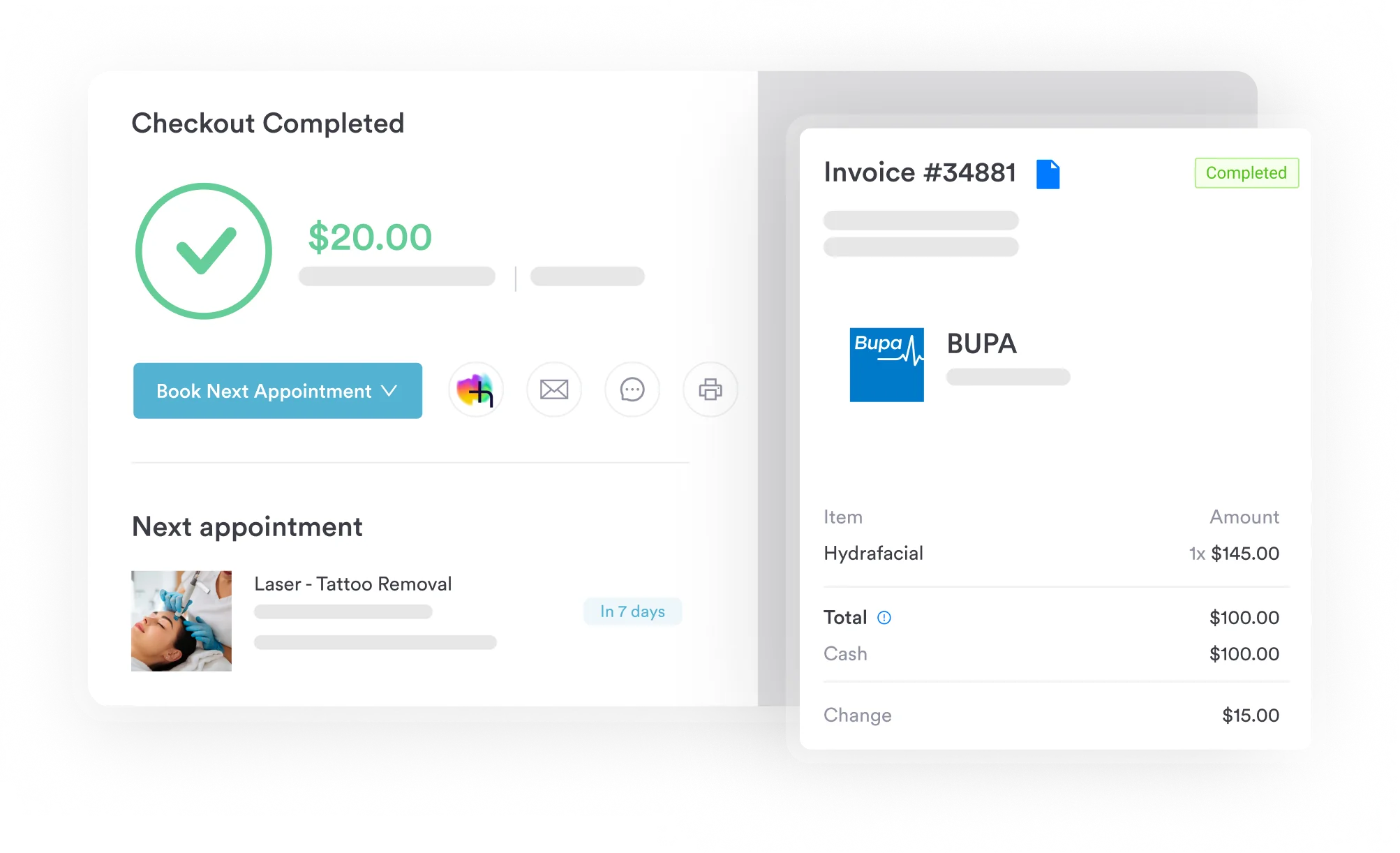

Pabau’s claims management software submits claims to US payers through the Claim.MD integration, in CMS-1500 and 837P formats. Notes and claims share one patient record, so the injury history is always at hand.

S83.202S works when the claim tells a simple story. The tear has healed, a residual problem remains, and the record connects the two. Code that problem first, add S83.202S second, and switch to a laterality or meniscus code whenever the notes allow it.
The trade-off is a few minutes at the start of the process. Checking the operative report and the 7th character costs far less than reworking a denial later. Build that check into every sequela visit, and these claims become routine.
Want notes and claims on one record? Book a demo to see how Pabau sends orthopedic and therapy claims to US payers through Claim.MD.

New to the revenue cycle? What is medical billing walks through the full claim journey, from patient intake to payment.
Sending claims through a clearinghouse? Claim.MD clearinghouse overview explains how Pabau routes ICD-10-coded claims through Claim.MD for 837P submission.
Want fewer rejections on the first pass? Clean claim requirements covers the coding and documentation standards payers use to process claims without delay.
Did the old tear lead to a knee replacement? CPT code 27447 explains how to bill total knee arthroplasty and document medical necessity.
No. The ICD-10-CM guidelines set no time limit on when a sequela can appear. A residual problem can show up months or years after the tear, as long as the notes link it to that injury.
Rarely. The guidelines list the nature of the sequela first and the sequela code second. S83.202S explains the cause, while the first-listed code, such as knee stiffness, says what the visit treats.
A new tear from a new injury is a current injury in its own right. Code it with the matching S83.2- code and 7th character A for active treatment. S83.202S covers only problems left by the healed original tear.
The phrase comes from subcategory S83.2, which separates acute tears from old ones coded in M23.2-. The 7th character S then marks the visit as a late effect of that acute tear.
Yes. S83.202S is a billable ICD-10-CM code valid for the current fiscal year (FY2027), which began on October 1, 2026. The parent code S83.202 has no 7th character and is not billable.