

ICD-10 Code S42.444P: Medial epicondyle fracture, right humerus
ICD-10 Code S42.444P: full descriptor and code validity ICD-10 Code S42.444P car...

Last Updated: Oct 13, 2026
Billable Code Specific Code
S82.876D is the billable ICD-10-CM code for nondisplaced pilon fracture of unspecified tibia, subsequent encounter for closed fracture with routine healing.
Let Pabau's smart automation suggest the right codes, reduce claim denials, and keep your practice compliant—effortlessly.
Automate repetitive tasks and focus on what matters most—your patients.
Reduce coding errors and ensure compliance with the latest regulations.
Clean claims, fewer denials, and faster reimbursements.
Powerful insights and reporting to help your practice thrive.
HIPAA compliant SOC 2 certified GDPR-compliant Trusted by 4,000+ clinics worldwide

S82.876D describes a nondisplaced pilon fracture of the unspecified tibia at a subsequent encounter for a closed fracture with routine healing. It is billable and valid for fiscal year 2026.
A pilon fracture breaks the tibial plafond, the weight-bearing articular surface at the bottom of the tibia. S82.87 is a tibia subcategory, not a fibula one.
The sixth character carries displacement and laterality together. Character 6 means nondisplaced with the side unstated, so document left or right and use S82.875D or S82.874D wherever the record allows.
ICD-10-CM excludes pilon fracture from S82.3, S82.5 and S82.6. Bimalleolar, trimalleolar and Maisonneuve fractures sit in S82.84, S82.85 and S82.86.
Pabau integrates with Claim.MD so practices can submit ICD-10 coded claims electronically to thousands of US payers and track them through to remittance.
ICD-10 Code S82.876D is a billable diagnosis code for a nondisplaced pilon fracture of the unspecified tibia, subsequent encounter for closed fracture with routine healing. Specifically, coders and clinicians apply it at follow-up visits after a pilon fracture of the distal tibia, once the fracture is closed and healing on schedule.
The code is current for fiscal year 2026 and took effect on October 1, 2025. In fact, the CDC/NCHS ICD-10-CM web tool lists it as billable and specific, so it can go on a claim with no more detailed code beneath it.
Notably, S82.876D has been in the code set since the first non-draft edition in fiscal year 2016, and it has not been revised since.
The sixth character 6 means the record never says which tibia was fractured. As a result, payers increasingly question unspecified laterality on an extremity injury. Because of this, confirm the side in the note and code S82.875D or S82.874D whenever the documentation supports it.
The pilon, also called the tibial plafond, is the ceiling of the ankle joint. Specifically, it is the weight-bearing articular surface at the lower end of the tibia, sitting directly on top of the talus. In fact, pilon is the French word for pestle, a reference to the way the talus is driven up into the tibia during the injury.
Pilon fractures typically follow a high-energy axial load, such as a fall from height or a motor vehicle collision. Specifically, the fracture line crosses the joint surface, which makes this an intra-articular ankle injury. That is what separates it from a distal tibia fracture that spares the plafond. It is also why ICD-10-CM gives pilon fractures their own subcategory at S82.87.
Nondisplaced means the fragments stayed in anatomic alignment. In fact, ICD-10-CM sets a default here that is worth memorizing. A fracture not documented as displaced or nondisplaced is coded to displaced, so S82.876 needs the record to state nondisplaced in so many words.
Closed means the skin over the fracture is intact, with no open wound or surgical exposure at the site. The classification also defaults to closed when the record is silent. Similarly, routine healing means the fracture is moving through normal repair, with no documented delayed union, nonunion, malunion or infection.
The fibula plays no part in this code. Instead, distal fibula and malleolar injuries sit in other subcategories, which the related-codes section below sets out.
S82.87 splits into six five-character codes. Specifically, the sixth character carries two variables at once, so read it in both directions. Characters 1 to 3 are displaced fractures and characters 4 to 6 are nondisplaced. Then, inside each group, right, left and unspecified run in that order.
None of these six codes is billable on its own. Instead, each one takes a seventh character, which brings the code to a full seven characters with no placeholder X required. As a result, coders in orthopedic and rehabilitation settings see the whole family over the life of a single injury.
The seventh character is mandatory throughout S82. Specifically, it records the encounter type, the open or closed status, and the healing trajectory. Consequently, a missing or mismatched seventh character is one of the most common reasons a fracture claim is rejected.
S82.876 takes 16 valid seventh characters, and the table below lists every one of them. Also note that ICD-10-CM skips I, L and O to avoid confusion with the digits one and zero.
Character D applies only when three conditions hold at the same time. Specifically, the encounter is a follow-up rather than the first active treatment, the fracture is closed, and healing is on track. Therefore, change any one of those and the character changes with it.
Read as a grid rather than an alphabet, the 16 characters fall into a clear pattern. Specifically, encounter type and healing status set the row, and fracture type sets the column.
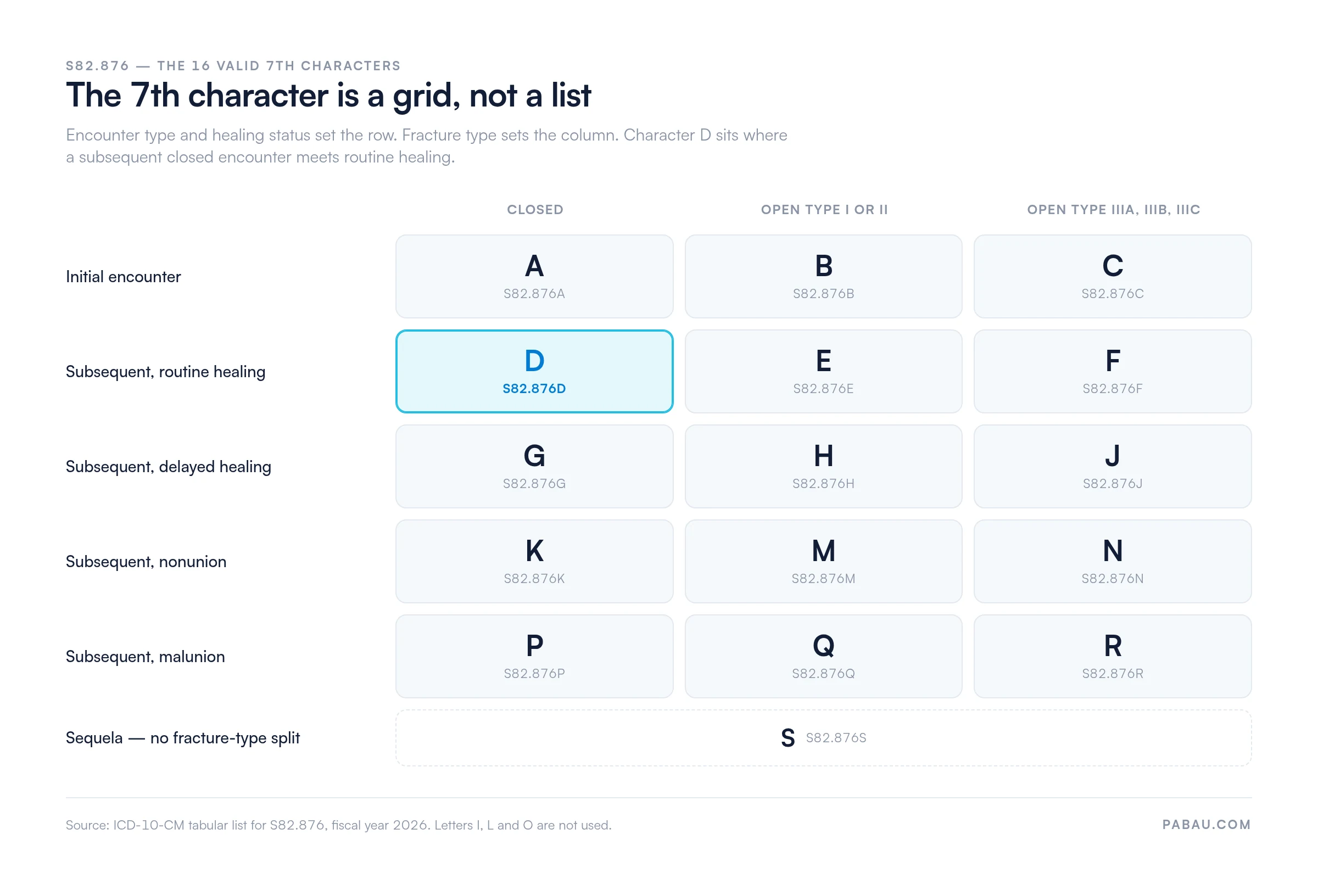
The open-fracture characters carry an implication worth spelling out. For example, an open pilon fracture at a routine-healing follow-up takes character E or F, depending on the Gustilo type recorded at the initial encounter. The sixth and seventh characters move independently, so a displaced right-side fracture healing slowly becomes S82.871G.
Document healing status explicitly at every follow-up. A note that reads ‘patient doing well’ will not support seventh character D under audit. Record callus formation on imaging, weight-bearing progress, and any change to immobilization or the rehabilitation plan.
S82.876D sits inside a structured code tree. In fact, walking the parent chain confirms you are in the right chapter and subcategory before you commit to a code. According to the CMS ICD-10 codes page, category S82 covers fractures of the lower leg including the ankle.
Three instructional notes sit at the S82 level and govern every code beneath it. First, a fracture not indicated as displaced or nondisplaced is coded to displaced. Second, a fracture not indicated as open or closed is coded to closed. Finally, open fracture designations follow the Gustilo classification.
Category S82 also includes fracture of the malleolus, and it excludes traumatic amputation of the lower leg, which belongs in S88.
Two sets of codes matter here. The first is the sibling group inside S82.87, where only the sixth character changes. The second is the set of neighboring subcategories that ICD-10-CM explicitly keeps separate from pilon fracture.
These are the five-character siblings at the same subsequent encounter with routine healing:
The next set accounts for most pilon fracture miscoding. Specifically, ICD-10-CM carries an Excludes1 note for pilon fracture of the distal tibia under S82.3, S82.5 and S82.6. Therefore, those codes and S82.87 can never be reported together for the same fracture.
Build this distinction into your code lookup lists. After all, a pilon fracture and a malleolar fracture look similar in casual notes, and they land in different subcategories.
Five clinical facts have to line up before you assign this code. Miss any one of them and a different code applies.
For this purpose, the AAPC ICD-10-CM code lookup is a practical way to confirm the full descriptor and scan adjacent codes before a claim goes out.
The errors below account for most of the corrections auditors make on pilon fracture claims. In fact, each one is easy to catch during a pre-bill review.
Surgeons and radiologists rarely write the ICD-10-CM descriptor word for word. Instead, these are the phrasings that point to S82.876D when the side is not stated in the record.
In the alphabetic index, coders reach this family under Fracture, traumatic, then tibia, then lower end. In any case, always confirm displacement, side, encounter type and healing status against the tabular list before settling on the seventh character.
The ICD List free lookup tool supports the same navigation and mirrors official CMS and NCHS data. Similarly, our diagnostic code library walks the same chain for neighboring S82 codes.
S82.876D is a diagnosis code, so it carries no relative value units and no payment rate of its own. Instead, it supports the visit or procedure code billed alongside it. For example, subsequent pilon fracture care usually pairs with an evaluation and management code, interval imaging, or therapy services.
Two structural points shape how the code behaves. First, S82.876D is exempt from present on admission reporting, which is standard for subsequent-encounter injury codes. Second, on the inpatient side, the MS-DRG grouper (version 43.0) assigns it to DRG 559, 560 or 561. Specifically, those are the aftercare musculoskeletal system and connective tissue groups, split by complication and comorbidity level.
Global periods matter on this code more than most. For instance, operative fixation of a pilon fracture is reported with 27827 or 27828, and routine follow-up inside the surgical global period is not separately billable. Therefore, check the payer global-period assignment before billing a subsequent-encounter visit.
Payer rules on diagnosis-to-procedure pairing vary widely. Meanwhile, Claims software for practices tracks each submission and groups denials by payer. A recurring rejection then shows up while there is still time to appeal it.
Clinical documentation has to support every element built into S82.876D. Indeed, auditors read the descriptor as a checklist and look for each qualifier in the note. For example, a line that says follow-up ankle fracture will not carry the code.
Structure the follow-up note around the six elements below, which map one to one onto the code.
Audit your submitted S82.876D claims once a quarter. Pull every one that was denied or downcoded, then read the note against the six documentation elements above. Most denials trace back to missing healing-status language or an unstated side.
Fracture aftercare generates a long tail of short visits. Specifically, each one needs the right seventh character, the right diagnosis-to-procedure pairing, and a note that backs both up. Yet most practices manage that across a scheduling tool, a separate notes system, and a billing portal that none of them talk to.
Practice management software like Pabau keeps the whole sequence in one record. For example, clinicians write the follow-up note against the same chart the appointment came from. The coded claim is then built from what is already in that record.
Its Claim.MD integration submits that claim electronically to thousands of US payers, in CMS-1500 and 837P formats. Meanwhile, eligibility checks run before the visit.
As a result, there are fewer rekeyed claims and less time between the visit and the remittance. In addition, denials come back into the same dashboard, so a pattern across one payer is visible within days rather than at quarter end.
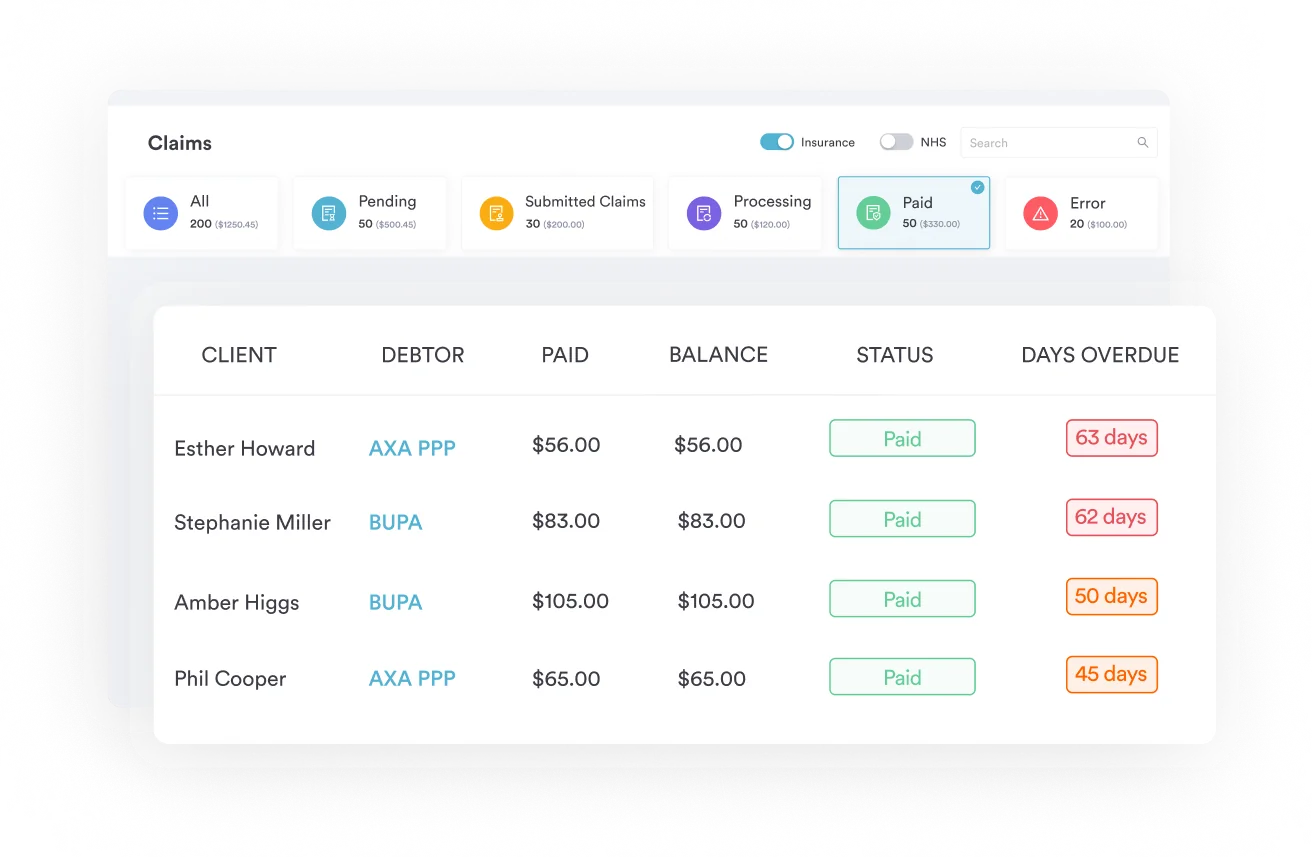

Pabau integrates with Claim.MD to submit ICD-10 coded claims electronically, verify eligibility in real time, and track reimbursement across thousands of US payers. See how practices cut claim denials and get paid sooner.

S82.876D is a narrow code doing a specific job. Specifically, it marks a follow-up visit for a closed, nondisplaced pilon fracture of the tibia that is healing as expected, with the side left unstated. In short, four checks in the note settle it every time. The plafond is involved, the fracture is nondisplaced, the encounter is subsequent, and healing is routine.
The single highest-value habit is chasing down the laterality. In fact, character 6 exists for records that genuinely do not name a side, and most records can name one. Ask the question and code S82.875D or S82.874D instead.
Pabau connects to the Claim.MD clearinghouse, so practices can submit these claims electronically and track remittance advice as it lands. To see how it handles ICD-10 billing across orthopedic and rehabilitation settings, book a demo.

Want to understand clearinghouse claim submission? How a medical claims clearinghouse works explains the path from claim creation to ERA receipt.
Not sure what makes a submission clean? What is a clean claim sets out the fields a payer checks before it pays.
Seeing repeat denials on follow-up visits? Denial management in healthcare covers how to work a denial queue and stop the pattern repeating.
New to the billing cycle end to end? What is medical billing walks through each stage from encounter to payment.
ICD-10 Code S82.876D is a billable diagnosis code for a nondisplaced pilon fracture of the unspecified tibia, subsequent encounter for closed fracture with routine healing. It is used at follow-up visits after a pilon fracture of the distal tibia, once the fracture is closed and healing on schedule.
A pilon fracture, also called a tibial plafond fracture, breaks the weight-bearing articular surface at the lower end of the tibia. It is usually caused by a high-energy axial load such as a fall from height. Because the fracture line crosses the ankle joint surface, it is an intra-articular injury.
Follow-up visits are most often reported with evaluation and management codes 99213 or 99214, depending on complexity. Interval imaging may use 73590, splint reapplication may use 29515, and rehabilitation may use 97110. Routine aftercare inside a surgical global period is not separately billable.
Switch from S82.876D to S82.876K once the record confirms nonunion. Nonunion has to be documented explicitly and is usually supported by imaging findings. Do not keep using character D after nonunion is established.
Routine healing means the fracture is moving through normal repair with no documented complication. Clinical indicators include callus formation on imaging, reduced pain and swelling, and progressive weight bearing. A generic note that the patient is doing well does not substantiate routine healing for coding purposes.




