ICD-10 Code S42.444P: Medial epicondyle fracture, right humerus
ICD-10 Code S42.444P: full descriptor and code validity ICD-10 Code S42.444P car...

Last Updated: Oct 13, 2026
Billable Code Specific Code
S82.443E is the billable ICD-10-CM code for displaced spiral fracture of shaft of unspecified fibula, subsequent encounter for open fracture type I or II with routine healing.
Each qualifier in that descriptor is a separate coding decision: encounter type, fracture openness, Gustilo grade, healing status, and laterality. Change any one of them and the code changes with it.
Let Pabau's smart automation suggest the right codes, reduce claim denials, and keep your practice compliant—effortlessly.
Automate repetitive tasks and focus on what matters most—your patients.
Reduce coding errors and ensure compliance with the latest regulations.
Clean claims, fewer denials, and faster reimbursements.
Powerful insights and reporting to help your practice thrive.
HIPAA compliant SOC 2 certified GDPR-compliant Trusted by 4,000+ clinics worldwide

ICD-10 Code S82.443E covers a displaced spiral fracture of the shaft of an unspecified fibula.
The 7th character E means a subsequent encounter for an open Gustilo type I or II fracture with routine healing.
S82.443E leaves laterality unspecified, so use S82.441E for the right fibula and S82.442E for the left when the side is documented.
Documentation must confirm the fracture was open, the Gustilo grade, and that healing is on track before this character is assigned.
Practice management software like Pabau keeps encounter type, fracture grade, and healing status on one client record, so coders are not chasing paper.
S82.443E is billable for encounters on or after October 1, 2025. The table below is the at-a-glance summary coders need before pulling it for a claim.
Every term in the S82.443E descriptor carries a coding consequence. Missing one changes the code.
The S82 category uses a standardized 7th character table that applies to every fracture code in the block. Character E is one of 16 possible values for S82.443. Selecting the wrong one is the most common claim error on these codes.
Character E is one of eight subsequent-encounter characters for open fractures (E, F, H, J, M, N, Q, R). It applies when the original fracture was open and graded Gustilo type I or II. The current visit has to be follow-up care with healing on track.
Confusing D with E is one of the most common 7th character errors on fracture claims. The same table drives femur codes such as S72.451K.
ICD-10-CM groups open fractures by the Gustilo-Anderson classification, and that grade decides the 7th character. Coders need the original operative note or emergency department record to confirm which type applied at the time of injury.
The criteria above come from the original 1976 classification by Gustilo and Anderson. You can confirm current guidance in the CDC ICD-10-CM tool.
The operative report from the initial encounter is the primary documentation source. If that chart says “open fracture” without naming a type, query the surgeon before you assign a character tied to Gustilo grade.
A subsequent encounter applies once active treatment for the fracture is complete. The patient is then in routine care during the healing phase, per the CMS Official Guidelines. Use the wrong encounter character and the mismatch can trigger a medical necessity review.
A physical therapist running return-to-activity rehabilitation after fibula shaft repair is documenting under subsequent encounter codes. The injury and the surgery are behind the patient, so the visit belongs in the healing phase.
Before assigning S82.443E, check three things in the prior encounter notes. The fracture was open at the time of injury, the Gustilo type was I or II, and active treatment has finished. Query the treating physician if the records cannot confirm all three.
The parent-child structure helps coders reach the correct code and spot when a more specific option exists. It also signals which tabular instructions apply at each level, the same way it does for femur codes like femur codes like S72.431C.
The S82 block includes a note to use an additional code to identify the associated open wound when applicable. Coders working on sports medicine or orthopedic claims should also check for any sequencing guidelines at the S82 category level before submitting.
S82.443E sits in a family of codes that differ by displacement status, laterality, and 7th character. The table below maps the sibling codes coders meet most often on fibula shaft fracture claims. The same pattern runs through forearm codes such as S52.262K.
The S82.443D vs S82.443E distinction is the most common coding confusion on these claims. Both are subsequent encounter codes for displaced spiral fractures of the unspecified fibula shaft with routine healing. The single difference is whether the original fracture was open (E) or closed (D).
S82.443E is accepted for reimbursement on professional and facility claims under the FY2026 edition. Use the CMS fee schedule lookup to confirm the paired CPT code’s rate by locality. Key billing points:
Orthopedic and physical therapy practices carry most of the risk on these follow-up visits. Check that the 7th character matches the injury type recorded in the surgeon’s operative report.
ICD-10-CM recognizes a range of alternate descriptions that map to S82.443E. Clinical notes using any of these phrases can support this code, as long as the encounter type and healing status also match.
The word “aftercare” in a note does not automatically mean a subsequent encounter. Confirm that active treatment is genuinely complete before you apply a subsequent encounter character.
Five documentation elements have to be present to support S82.443E. Missing any one of them invites a denial or an audit query.
Strong clinical record documentation at every encounter supports accurate coding, payer audits, and medical necessity reviews. The AAPC code reference carries additional notes for the S82 category.
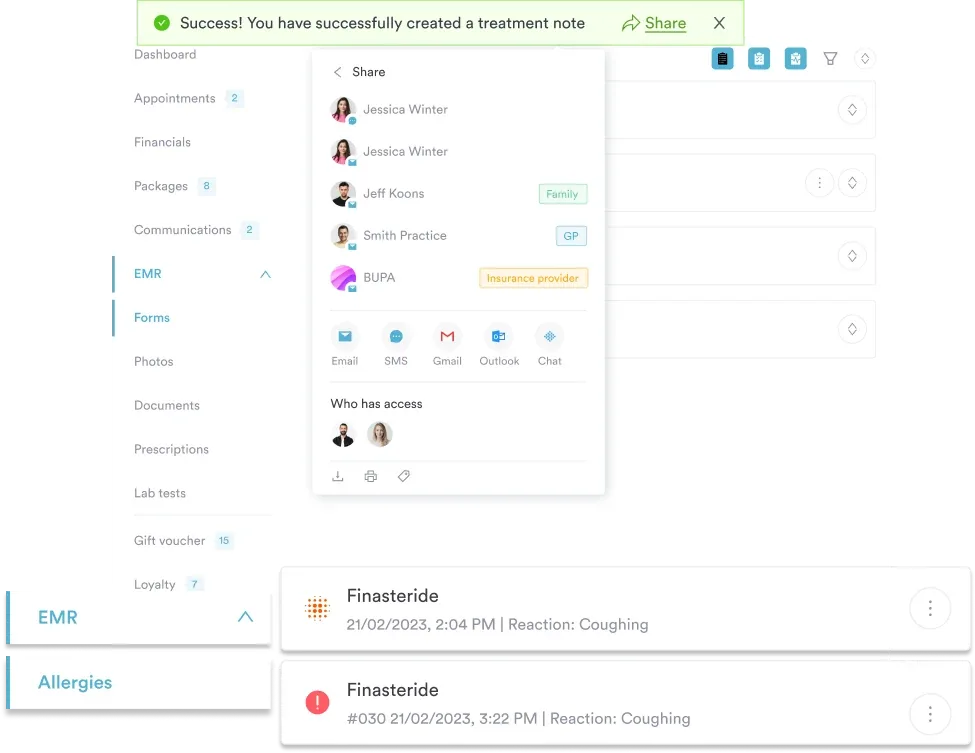
In most orthopedic and physical therapy practices, the four answers a 7th character needs are scattered. The operative report sits in one system and the follow-up note in another. A coder ends up chasing the Gustilo grade by phone before the claim can go out.
Pabau holds all of it on one client record. Custom clinical forms prompt the clinician for encounter type, fracture grade, and healing status while the patient is still in the room. Every follow-up visit is stamped on the same timeline, so the injury history stays attached to the current note. The billing cycle for one claim can run weeks, and most of that time is spent waiting on a payer.
When the coder opens that record, each 7th character question already has an answer in the chart. Pabau’s claims management tools then pull those recorded details into a pre-filled claim and track its status. Fewer queries go back to the surgeon, and fewer follow-up claims come back denied.

Pabau’s clinical forms and client records capture encounter type, Gustilo grade, and healing status at the visit. Coders get what the 7th character needs without chasing paperwork.

S82.443E rests on five checks. The fracture was open, the Gustilo type was I or II, and active treatment has ended. Healing is routine, and laterality is genuinely undocumented. Change one of those and the 7th character changes with it.
The safest habit is to code the follow-up visit from the original operative note rather than from memory of the injury. When that note cannot answer one of the five, a query costs far less than a denial and a rebill.
Book a demo to see how Pabau keeps encounter type, fracture grade, and healing status together for every follow-up visit.

Coding a malunion instead of routine healing? S72.431R shows how the malunion character reshapes a femur claim.
Following a fracture that never united? S62.185K covers the nonunion documentation a wrist claim needs.
Working a hand fracture that stalled? S62.606K walks through nonunion reporting on a finger.
Billing a cardiac calcium scoring CT? CPT code 75571 billing guide covers billing for non-contrast cardiac calcium scoring, a service Medicare does not cover.
Billing a coronary CT angiography claim? CPT code 75574 billing guide covers modifier selection and 3D postprocessing documentation for coronary CT angiography.
ICD-10 Code S82.443E is a billable ICD-10-CM diagnosis code for a displaced spiral fracture of the shaft of an unspecified fibula. It applies at a subsequent encounter, where the original fracture was open and graded Gustilo type I or II. Healing must be routine. The code took effect October 1, 2025 under the FY2026 ICD-10-CM edition.
Yes. S82.443E is a fully billable, specific ICD-10-CM code accepted for reimbursement on professional and facility claims. It is a specific code rather than a header, so it maps to one distinct clinical scenario. You can submit it as a primary or secondary diagnosis, depending on the claim context.
Subsequent encounter fracture codes apply once active treatment is complete. The patient is then back for routine care during healing, such as cast changes, hardware monitoring, or physical therapy follow-up. Per CMS Official Guidelines, the current visit decides the encounter type. The number of prior visits is irrelevant.
Gustilo type I is an open fracture with a wound smaller than 1 cm caused by a low-energy mechanism with minimal soft tissue damage. Gustilo type II involves a wound between 1 and 10 cm without extensive soft tissue damage, periosteal stripping, or arterial injury. Both map to 7th character B at an initial encounter and character E at a subsequent encounter with routine healing. Gustilo type III is more severe, so it maps to C, F, J, N, or R, depending on encounter and healing status.