

ICD-10 Code S42.444P: Medial epicondyle fracture, right humerus
ICD-10 Code S42.444P: full descriptor and code validity ICD-10 Code S42.444P car...

Last Updated: Oct 13, 2026
Billable Code Specific Code
S82.252G is the billable ICD-10-CM code for displaced comminuted fracture of shaft of left tibia, subsequent encounter for closed fracture with delayed healing.
The 7th character G carries most of that meaning. It marks a follow-up visit where the bone is healing more slowly than expected for the injury and the time elapsed.
That one character separates S82.252G from routine healing (D), nonunion (K), and malunion (P). It also covers 7th character selection, the code hierarchy, sibling codes, the ICD-9 crosswalk, and the documentation a coder needs before assigning it.
Let Pabau's smart automation suggest the right codes, reduce claim denials, and keep your practice compliant—effortlessly.
Automate repetitive tasks and focus on what matters most—your patients.
Reduce coding errors and ensure compliance with the latest regulations.
Clean claims, fewer denials, and faster reimbursements.
Powerful insights and reporting to help your practice thrive.
HIPAA compliant SOC 2 certified GDPR-compliant Trusted by 4,000+ clinics worldwide

S82.252G describes a displaced comminuted fracture of the shaft of the left tibia, coded on a subsequent encounter for a closed fracture with delayed healing.
The 7th character G is what makes this code specific. It confirms a follow-up visit where healing is slower than expected. It rules out a first-time presentation (A/B/C), nonunion (K), and malunion (P).
Most coding errors on this code involve using the initial-encounter suffix (A) on follow-up visits. That mismatch triggers claim denials and audit flags from Medicare and commercial payers.
Practice management software like Pabau connects to the Claim.MD clearinghouse, validating codes such as S82.252G against payer rules before submission.
S82.252G is a billable ICD-10-CM diagnosis code valid for HIPAA-covered transactions. It is valid in the 2026 edition of ICD-10-CM, which took effect October 1, 2025.
The code itself has been in the code set since ICD-10-CM implementation in October 2015. The table below captures the reference details coders need before assigning it.
Each character in S82.252G carries a specific clinical meaning. Reading the code segment by segment removes any ambiguity about the patient presentation it describes. According to the CMS ICD-10-CM coding guidelines, all characters must reflect documented clinical findings. Coders cannot infer information the record does not state.
Taken together, S82.252G tells the payer a specific story. The patient has a multi-fragment, displaced left tibial shaft fracture sustained in a closed mechanism. They are returning for ongoing care, and the fracture is not healing within the expected timeframe. Each of those five clinical facts must be supported by documentation in the medical record.
The 7th character is the most consequential coding decision for any fracture in the S82 family. Selecting the wrong suffix is the leading cause of claim denials on tibia fracture codes. The table below lists all valid 7th characters for the S82.252 code family, with their clinical definitions.
These three outcomes are clinically distinct. The ICD-10-CM Official Guidelines require the physician to document the specific healing status before the coder can assign a suffix. The difference between G, K, and P is not a coder’s judgment call.
For a closed fracture, the whole decision reduces to the care phase plus one phrase in the physician’s note. The visual below maps each phrase to the code it supports.
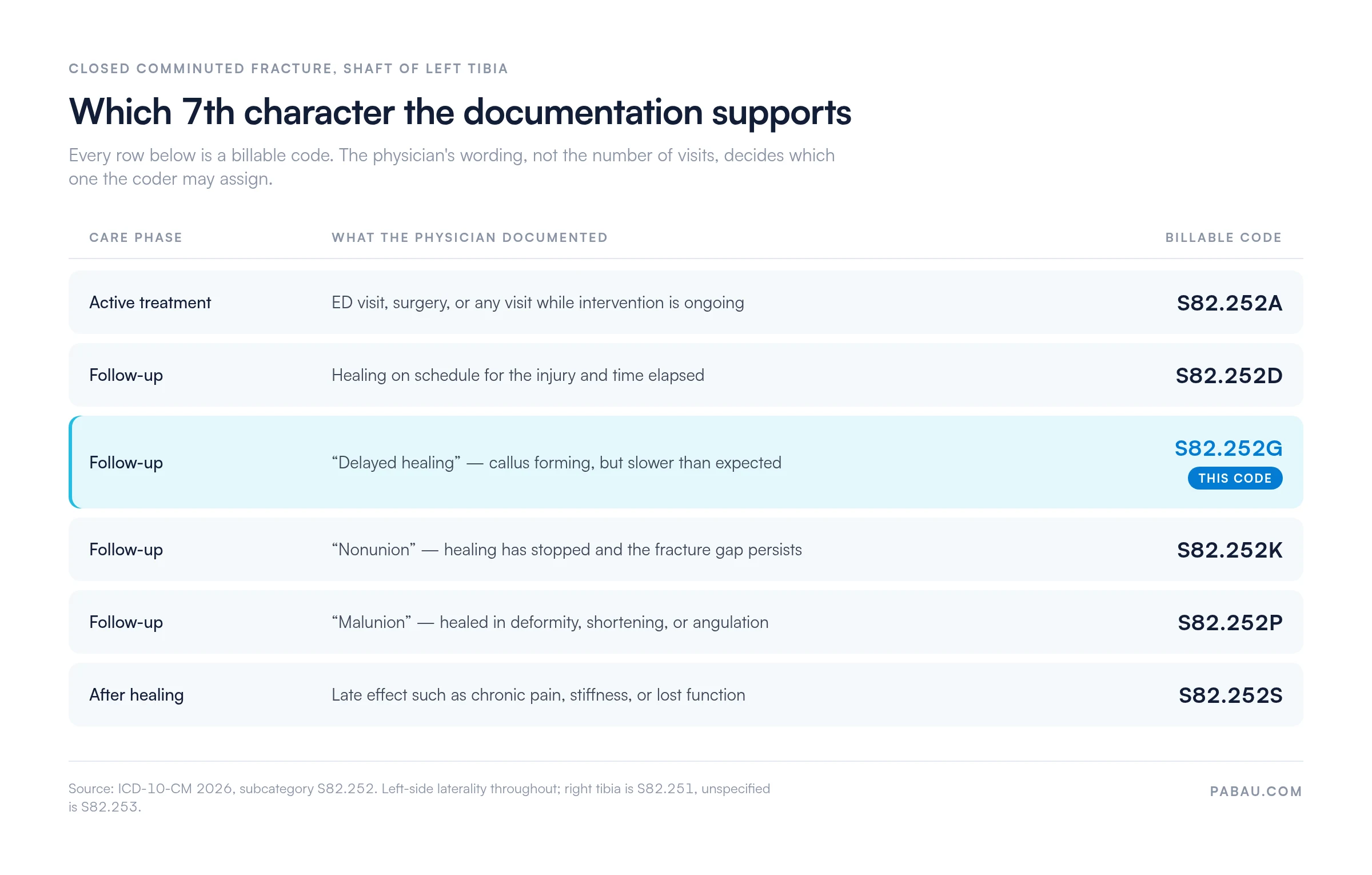
According to ICD-10-CM Official Guidelines Section I.C.19, the encounter type follows the patient’s care phase, not the calendar.
A patient can receive initial encounter coding (A, B, or C) at multiple visits while receiving active surgical or non-surgical treatment. Subsequent encounter coding (D through R) begins when the patient reaches the recovery or rehabilitation phase of care.
Knowing where S82.252G sits in the hierarchy helps coders navigate related codes and verify code specificity. The WHO ICD-10 classification browser and the CDC/NCHS ICD-10-CM web tool both provide hierarchical navigation for code verification. The parent code tree for S82.252G is:
The S82.252 family covers only the left tibia. Laterality and 7th character are both required for a billable code. Coders apply the same laterality conventions across every family in our ICD-10-CM codes reference. The most frequently referenced sibling codes alongside S82.252G are shown below.
Note: S82.253G (unspecified laterality) should only be used when the operative or clinical note genuinely does not specify which side is affected. Laterality is almost always documentable. Payers increasingly flag unspecified-laterality codes for medical review when the record would support a more specific code.
Assigning S82.252G requires that five specific clinical facts appear in the medical record. Missing any one of them means the coder should either query the physician or select a less specific code.
Practices with high orthopedic coding volume should build structured documentation templates for follow-up visits. A template that prompts the physician on each of those five elements is the cheapest fix available. Laterality, fracture type, and healing status then arrive as structured fields rather than free text.
Audit your orthopedic follow-up notes for the phrase ‘delayed healing’ before submitting S82.252G. If the physician’s note says ‘slow progress’ or ‘not fully healed yet’ without the clinical term, query the provider before coding. Payers require the specific language to support the 7th character G.
Practices migrating legacy data or working with older claims may need the ICD-9 equivalent. The General Equivalence Mapping (GEM) crosswalk translates S82.252G to ICD-9-CM V54.16 (Aftercare for healing traumatic fracture of lower leg). That mapping has limits worth understanding before you rely on it for anything beyond historical data.
The GEM crosswalk is a one-to-many mapping. V54.16 maps to multiple ICD-10-CM codes across the S82 family, so it does not carry the specificity of the modern code.
For any current billing transaction, use S82.252G directly. V54.16 is relevant only for historical data analysis, legacy system integration, or a payer that specifically requests an ICD-9 equivalent.
The S82.252 code family generates a disproportionate share of orthopedic claim rejections. Three error-prone decisions collide on it. The coder has to settle the encounter type, the healing status, and the open-versus-closed classification, and each one is avoidable with the right documentation workflow.
A working denial management process turns each rejection into a corrected resubmission rather than a write-off. Practices submitting ICD-10 claims through claims management software can configure payer-specific edits that flag these mismatches before submission.
Practices that track denial patterns by code can see which of these four errors generates the most rework. That is the number worth watching after any change to the follow-up note template.
The following clinical descriptions map to S82.252G. All are acceptable in physician documentation when they accurately reflect the patient’s condition. Coders should recognize these terms and understand that they converge on the same code assignment.
None of these phrases are billable codes themselves. The coder’s role is to recognize that these descriptions satisfy the five documentation requirements for S82.252G. The code turns up across orthopedic, sports medicine, and trauma billing.
In most orthopedic practices the 7th character gets decided twice. The physician writes a follow-up note in one system, and days later a coder reads it and picks a suffix. If the note says “slow progress” rather than “delayed healing,” the coder either raises a query or takes a guess.
Pabau closes that loop inside a single patient record. The follow-up note template asks for laterality, fracture pattern, and healing status while the patient is still in the room. The coder then reads structured fields instead of interpreting free-text prose.
From there the claim goes out through the Claim.MD clearinghouse, and Pabau validates the diagnosis code against payer rules first. An encounter-type mismatch or a missing laterality surfaces while the claim is still yours to fix. That turns a denial into a correction you make before the claim leaves the practice.

Pabau connects clinical documentation directly to claims submission via the Claim.MD clearinghouse. It validates ICD-10 codes including S82.252G against payer rules before the claim leaves your system. See how it works for your practice.

S82.252G captures a precise clinical scenario. It describes a displaced, comminuted, closed left tibial shaft fracture on a subsequent encounter, with healing running behind schedule. Every character in the code is a commitment to a documented clinical fact, and the 7th character is where orthopedic billing teams most often slip.
The practical fix sits upstream of the coder. Get “delayed healing” into the follow-up note as a required field, and the suffix stops being a judgment call. Do nothing, and the same four errors keep arriving as denials months after the visit.
Pabau connects clinical documentation to code validation and submission through the Claim.MD clearinghouse, catching encounter-type and laterality mismatches before they become denials. To see how that works for orthopedic and trauma billing, book a demo with our team.

Looking to understand the full claims lifecycle for ICD-10 submissions? Medical claims clearinghouse guide explains how clearinghouses validate and route ICD-10 claims to payers.
Want to streamline ICD-10 claim submission for orthopedic billing? Claim.MD clearinghouse overview details how Pabau’s integration handles electronic claims for practices using ICD-10-CM codes.
ICD-10 code S82.252G is a billable diagnosis code for a displaced comminuted fracture of the shaft of the left tibia. It applies on a subsequent (follow-up) visit for a closed fracture with delayed healing. The code confirms that the patient is past the initial treatment phase and that the fracture is not healing on schedule.
Yes, S82.252G is a fully billable, HIPAA-valid ICD-10-CM code for the 2026 edition (effective October 1, 2025). It can be submitted on CMS-1500 and UB-04 claim forms to Medicare, Medicaid, and commercial payers. The clinical documentation must support all five elements encoded in the code.
Both codes describe a subsequent encounter for a closed displaced comminuted fracture of the shaft of the left tibia. The healing status is what separates them. S82.252D indicates routine healing, while S82.252G indicates delayed healing. The physician must document the healing status explicitly for the coder to select between them.
The 7th character G indicates a subsequent encounter for a closed fracture with delayed healing. It applies across multiple ICD-10-CM fracture code families, not just S82. It means the patient is past the initial active-treatment phase and the fracture mechanism was closed, with no bone protrusion or open wound. The physician must also have documented that healing is not progressing at the expected rate.
The GEM crosswalk maps S82.252G to ICD-9-CM V54.16 (Aftercare for healing traumatic fracture of lower leg). This is an approximate match only. V54.16 does not capture laterality, displacement, fracture pattern, or the specific healing status that S82.252G encodes. Use V54.16 only for historical data migration or legacy system reference.
Delayed healing in fracture coding means the fracture is showing some healing activity, such as callus formation. Progress is slower than typical for the injury type and elapsed time. It is distinct from nonunion (where healing has stopped entirely) and malunion (where the bone has healed in a deformed position). The treating physician must document “delayed healing” or a clinical equivalent for the coder to assign a G suffix.
Use an initial-encounter code (7th character A, B, or C) while the patient is in the active-treatment phase. That covers emergency visits, surgery, and any follow-up where active intervention is still being administered. Switch to a subsequent-encounter code (D through R) once the patient enters the healing, monitoring, or rehabilitation phase of care. The transition is based on the care phase, not the number of visits.
Verify five documentation elements: (1) comminuted pattern, (2) displaced, (3) shaft of the tibia, (4) laterality, and (5) closed fracture with delayed healing. On laterality, left = S82.252, right = S82.251, and unspecified = S82.253. The physician must document the delayed healing. If all five are confirmed and the encounter is a follow-up visit, assign S82.252G for the left tibia.




