

ICD-10 Code S42.444P: Medial epicondyle fracture, right humerus
ICD-10 Code S42.444P: full descriptor and code validity ICD-10 Code S42.444P car...

Last Updated: Oct 13, 2026
Billable Code Specific Code
S82.225P is the billable ICD-10-CM code for nondisplaced transverse fracture of shaft of left tibia, subsequent encounter for closed fracture with malunion.
Two substitutions dominate this code family. The first is reaching for S82.226P, which looks almost identical but names no side at all. The second is picking a 7th character that contradicts the note, such as 'K' for nonunion or 'D' for routine healing.
Either one describes a different patient than the record does, and payers return the claim. S82.225P is valid for FY2026, which runs October 1, 2025 through September 30, 2026.
Let Pabau's smart automation suggest the right codes, reduce claim denials, and keep your practice compliant—effortlessly.
Automate repetitive tasks and focus on what matters most—your patients.
Reduce coding errors and ensure compliance with the latest regulations.
Clean claims, fewer denials, and faster reimbursements.
Powerful insights and reporting to help your practice thrive.
HIPAA compliant SOC 2 certified GDPR-compliant Trusted by 4,000+ clinics worldwide

ICD-10 Code S82.225P describes a nondisplaced transverse fracture of the shaft of the left tibia. It is coded at a subsequent encounter, where the closed fracture has healed with malunion.
Laterality sits in the sixth character. S82.224 is the right tibia, S82.225 is the left tibia, and S82.226 is the unspecified tibia.
The 7th character ‘P’ specifies subsequent encounter for a closed fracture with malunion. That separates it from nonunion (‘K’), delayed healing (‘G’), and active treatment (‘A’).
Malunion means the bone healed in a non-anatomic position. Nonunion means healing failed entirely, so the two are never interchangeable at billing.
Pabau’s claims management software streamlines ICD-10-CM code submission and tracks claim status across payers for orthopedic and physical therapy practices.
ICD-10 Code S82.225P is a billable ICD-10-CM diagnosis code. It is valid for claim submission during fiscal year 2026: October 1, 2025 through September 30, 2026.
The Centers for Medicare and Medicaid Services (CMS) updates ICD-10-CM codes annually. Coders should verify that the code remains active for the date of service being billed.
Each element of the S82.225P descriptor decides whether the code fits the patient in front of you.
The code applies at follow-up visits, once active fracture treatment has ended. Clinical documentation has to confirm that the malunion complication is established. The treating clinician’s notes must reference the malunion finding explicitly.
The sixth character of this code carries the side, and it is the most misread character in the S82.22 family. Three codes describe the same nondisplaced transverse shaft fracture and differ only there.
S82.224 is the right tibia, S82.225 is the left tibia, and S82.226 is the unspecified tibia. A claim that should read S82.225P becomes a claim about no particular leg if that character slips to a 6.
S82.226P is a legitimate code, but it is a last resort. Reviewers read an unspecified-side fracture code as thin documentation, and some payers return it for clarification rather than pay it. If the operative report, the radiology read, or a progress note names a side, the specific code is the correct one.
Each of those is a separate billable code with its own documentation requirements. Our ICD-10 diagnostic code library carries the full descriptor for each one.
The 7th character is the critical differentiator in ICD-10-CM fracture coding. For S82.225 (the parent code), the 7th character specifies both the encounter type and the healing status.
According to the CDC/NCHS ICD-10-CM coding tool, the ICD-10-CM Official Guidelines for Coding and Reporting govern which 7th character applies to each fracture encounter.
Key distinction: ‘P’ (malunion) means the bone healed, but incorrectly. ‘K’ (nonunion) means the bone has not healed at all. ‘G’ (delayed healing) means healing is progressing more slowly than expected.
The clinical consequence differs at each step. Malunion may call for corrective osteotomy, while nonunion may call for bone grafting or revision of internal fixation. Coding them interchangeably misstates the patient’s condition and invites payer review.
On a closed fracture, that leaves four characters to choose between, and the healing status decides which one.
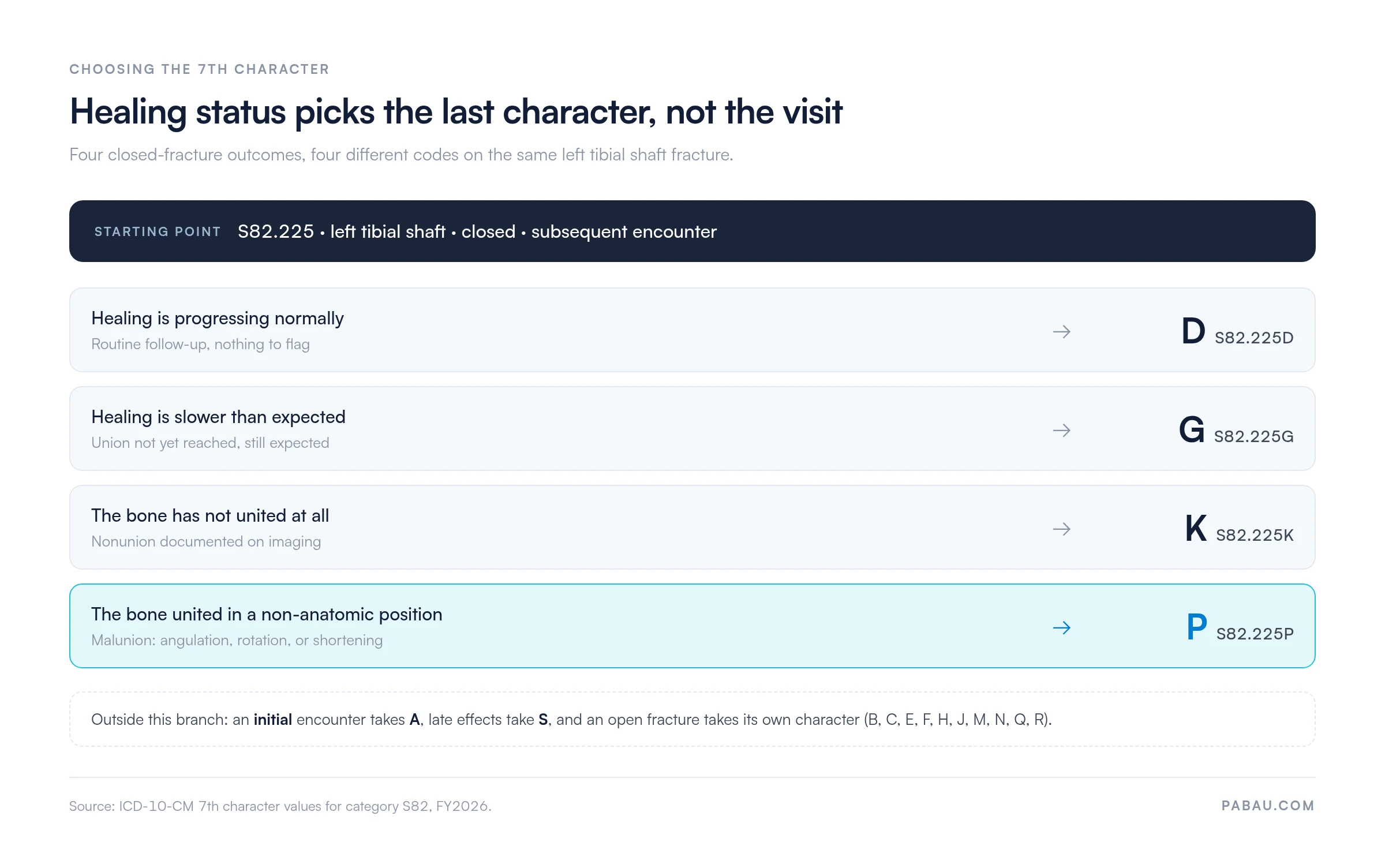
The hierarchical path for ICD-10 Code S82.225P runs through several levels of the ICD-10-CM classification system. Coders and billing teams navigating the tabular list should trace the following path:
S82.225 without a 7th character is not billable. Every code in the S82 fracture family needs a complete 7th character to pass claim validation.
The ICD-10-CM Official Guidelines for Coding and Reporting define a subsequent encounter as any visit after the patient has received active treatment for the fracture. That covers follow-up visits, physical therapy visits, cast changes, and reassessment appointments.
So the first visit after the cast comes off is already a subsequent encounter, even when the practice still files it under fracture care.
A claim carrying S82.225P is only as strong as the note behind it. Reviewers auditing this code look for five specific elements in the record.
Missing any one of these turns a defensible code into a payer query. The side and the complication status are the two that get left out most often.
Confusing malunion with nonunion. The record has to say which complication applies. A radiology note describing angulation is not by itself a malunion diagnosis, and ‘no bridging callus’ is not a malunion at all. Query the physician before assigning P or K on an ambiguous chart.
Using ‘D’ for all subsequent encounters. S82.225D applies only when healing is routine. If documentation shows a complication (delayed healing, nonunion, or malunion), the appropriate complication character must be used. Defaulting to ‘D’ on a chart that documents malunion is a coding inaccuracy.
Incorrect laterality. S82.225P is specific to the left tibia. Right-side fractures require S82.224P (nondisplaced transverse fracture, right tibia, subsequent encounter, closed, malunion). Always confirm laterality against the clinical documentation before coding.
Missing the 7th character entirely. S82.225 without a 7th character is not billable. Claims submitted with a truncated code reject at the clearinghouse before a payer sees them. Every code in this fracture family carries seven characters, with no exceptions.
Document the fracture healing status explicitly in clinical notes at every subsequent encounter. Phrases such as ‘malunion confirmed on imaging’ or ‘nonunion evident on X-ray’ give coders the precise language they need to assign the correct 7th character. Vague notes like ‘fracture follow-up’ default coders to ‘D’ and underrepresent the clinical complexity.
The following clinical terms and phrases map to ICD-10 Code S82.225P. These synonyms appear in operative reports, radiology reads, and clinical notes. They all point to the same diagnosis code when the encounter and fracture characteristics match.
These synonyms do not represent separate codes. They all map to S82.225P when the full clinical picture (nondisplaced, transverse, left tibial shaft, closed, subsequent encounter, malunion) is present. Coders searching by synonym should verify all six descriptor elements before finalizing the code.
Watch for what a synonym leaves out. A phrase such as ‘tibial shaft malunion, subsequent encounter’ names no side, so it does not support S82.225P. Read as written, that note codes to S82.226P instead.
ICD-10-CM includes official instructional notations at the S82 category level that apply to S82.225P. ICD-10-CM adapts the WHO ICD-10 classification, and NCHS and CMS publish the notations that apply here. Coders must apply these instructions at each encounter.
At the S82 category level, an osteoporosis-related fracture also needs a code from category M80 (Osteoporosis with current pathological fracture).
However, for a traumatic nondisplaced transverse shaft fracture in the typical mechanism (direct blow, sports injury), M80 generally does not apply. The physician’s documentation determines whether an underlying pathological condition contributed to the fracture.
ICD-10-CM guidelines recommend assigning external cause codes alongside injury codes where applicable. For a tibia shaft fracture, an external cause code from the V00-Y99 range identifies the mechanism of injury. Common examples are a fall, a motor vehicle accident, or a sports injury.
External cause codes improve data quality, and many payers expect them on musculoskeletal trauma claims even where payment does not depend on them. Payer-specific LCD and NCD policies decide when the reporting is mandatory.
At a subsequent encounter specifically for the malunion complication, S82.225P is typically the principal or first-listed diagnosis.
When the visit addresses multiple conditions, the fracture complication should sequence before other incidental findings unless payer guidelines specify otherwise. Sequencing rules vary by payer, so check yours against a clean claim checklist before you submit.
Claims carrying S82.225P route through standard ICD-10-CM claim submission pathways. In US practices, this means submitting on a CMS-1500 form or 837P electronic transaction.
The code must appear in the diagnosis pointer field, linked to the relevant procedure code. That is usually a CPT code for evaluation and management, or for physical therapy at a subsequent visit.
Rejections in this code family usually happen at the clearinghouse, before a payer ever sees the claim. A truncated code fails validation there, and so does a laterality character that contradicts the attached note.
Payers then return payment information on an electronic remittance advice (835/ERA). When an S82.225P claim is denied, the remittance CARC usually points to coding specificity or missing documentation. Reading those reason codes in batches, rather than one denial at a time, is what stops the same rejection recurring.
Run a monthly audit of all claims submitted with 7th character P, Q, or R in S82 codes. Compare the denial rate against 7th character D claims. A higher denial rate on P, Q, or R usually signals missing malunion documentation rather than coding error. The fix is in the clinical note, not the code.
In most orthopedic and physical therapy practices, this code gets decided twice. The clinician writes the note at the visit, and a coder reads it days later in another system. Whatever the note leaves unstated, the coder settles by inference. That is how S82.226P lands on a chart that plainly says left.
Practice management software like Pabau keeps the note and the claim in the same patient record. The clinician documents the side, the fracture pattern, and the healing status in the treatment note. The claim is then built from that record rather than from a later re-reading of it.
Pabau submits through Claim.MD, our US clearinghouse partner, which checks the finished ICD-10-CM code against payer requirements before transmission. That connection also covers real-time eligibility verification, 837P claim submission to more than 4,000 US payers, and ERA/835 remittance processing.
So the coder works from the clinician’s own words instead of reconstructing them. A truncated or unspecified fracture code gets caught before it reaches the payer. The result is accurate claims management from the treatment note through to the remittance, with less rework on subsequent-encounter claims.
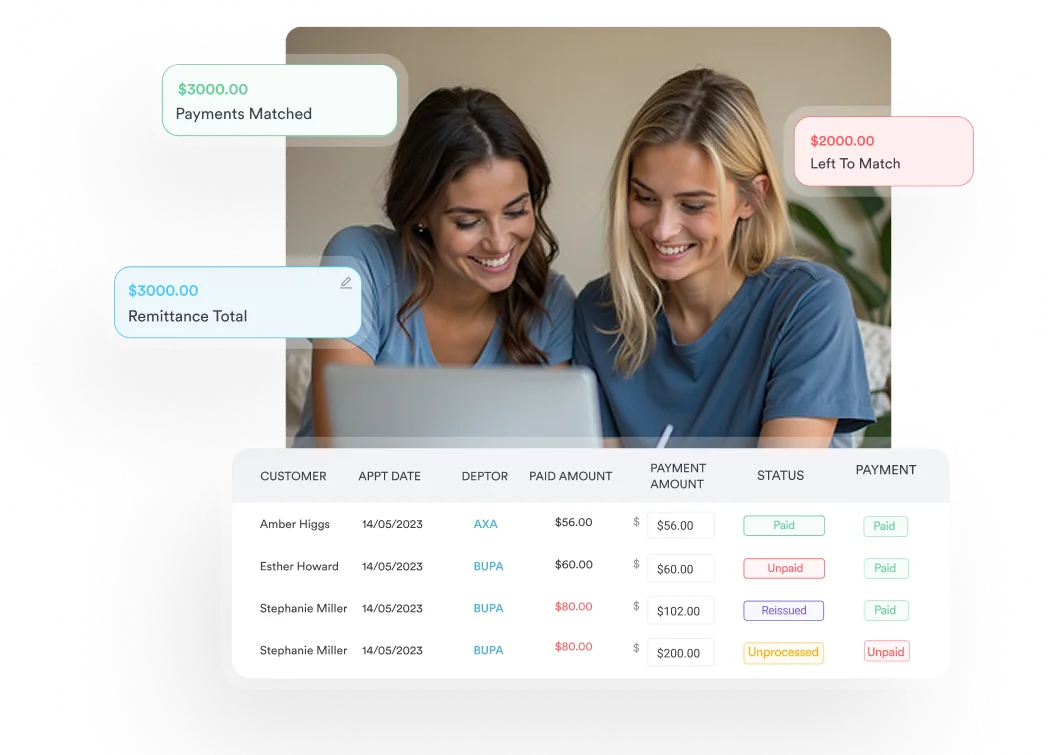

Pabau connects ICD-10-CM code assignment to claim submission, clearinghouse validation, and remittance tracking in one platform. Physical therapy and sports medicine practices use Pabau to reduce coding errors and accelerate reimbursement.

This whole code turns on two characters. The sixth says left, and the seventh says malunion. Both have to be supported by what the clinician wrote at the visit, not by what the coder infers from it days later.
So the fix for S82.225P sits in the note rather than in the code. Ask for the side and the healing status while the patient is still in the room. The claim then goes out without a query. Practices that leave it to the coder end up choosing between an unspecified code and a phone call.
To see how Pabau ties fracture documentation to coding, clearinghouse validation, and remittance tracking, book a demo.

Need to understand clearinghouse submission for orthopedic claims? Medical claims clearinghouse guide explains how 837P electronic transactions reach payers and what happens when they’re rejected.
Tracking denials on fracture complication codes? Denial management in healthcare covers how to categorize, appeal, and reduce claim denials by root cause.
Building a compliant billing workflow for follow-up encounters? Medical billing compliance guide outlines documentation standards, coding accuracy requirements, and audit readiness practices.
ICD-10 Code S82.225P is a billable ICD-10-CM diagnosis code for a nondisplaced transverse fracture of the shaft of the left tibia. The code is used at a subsequent (follow-up) encounter, where the closed fracture has healed with malunion. It applies when the patient is no longer in active fracture treatment and imaging confirms the bone has united in a non-anatomic position.
S82.225P specifies the left tibia. S82.226P describes the same fracture, encounter, and complication on an unspecified tibia, which means the record never states a side. Use S82.225P whenever the documentation says left, and reserve S82.226P for records where laterality was genuinely not documented. The right-sided equivalent of S82.225P is S82.224P.
Yes, S82.225P is a fully billable ICD-10-CM diagnosis code, valid for fiscal year 2026 (October 1, 2025 through September 30, 2026). It can be submitted directly on a CMS-1500 or 837P electronic claim without requiring a more specific code.
The 7th character P designates a subsequent encounter for a closed fracture with malunion. In the S82 fracture family, the 7th character specifies two things. It carries the encounter type (initial, subsequent, or sequela) and the healing status (routine, delayed, nonunion, or malunion). The P character means the fracture has healed but in a non-anatomic position, distinguishing it from nonunion (K), delayed healing (G), or routine healing (D).
Malunion (7th character P for closed fractures) means the bone healed in a non-anatomic position, such as with angular deformity, rotational malalignment, or shortening. Nonunion (7th character K for closed fractures) means the fracture has failed to heal. The bone ends remain separated, or fibrous tissue has formed instead of bone. These are clinically and coding-distinct complications that require different treatment approaches and separate ICD-10-CM codes.
The parent code for S82.225P is S82.225 (Nondisplaced transverse fracture of shaft of left tibia), which is itself non-billable without a 7th character. The full hierarchy runs S82 (Fracture of lower leg) to S82.2 (Fracture of shaft of tibia). From there it runs to S82.22 (Transverse fracture of shaft of tibia), then S82.225, then S82.225P.
Assign S82.225P for subsequent encounters involving a nondisplaced transverse closed fracture of the left tibial shaft with confirmed malunion. For right-side fractures use S82.224P. Clinical documentation must explicitly state the malunion finding, supported by imaging. Pair the diagnosis code with the appropriate CPT procedure code for the type of visit (evaluation and management, physical therapy service, or surgical consultation). Submit via 837P or CMS-1500 with the code in the diagnosis pointer linked to the relevant procedure.




