ICD-10 Code S42.444P: Medial epicondyle fracture, right humerus
ICD-10 Code S42.444P: full descriptor and code validity ICD-10 Code S42.444P car...

Last Updated: Oct 13, 2026
Billable Code Specific Code
S82.225J is the billable ICD-10-CM code for nondisplaced transverse fracture of shaft of left tibia, subsequent encounter for open fracture type IIIA, IIIB, or IIIC with delayed healing.
The 7th character J causes most of the trouble. It reads like malunion, and plenty of secondary references treat it that way. Malunion has its own character on the same fracture. Pick J for a healed bone and the claim contradicts the note.
Let Pabau's smart automation suggest the right codes, reduce claim denials, and keep your practice compliant—effortlessly.
Automate repetitive tasks and focus on what matters most—your patients.
Reduce coding errors and ensure compliance with the latest regulations.
Clean claims, fewer denials, and faster reimbursements.
Powerful insights and reporting to help your practice thrive.
HIPAA compliant SOC 2 certified GDPR-compliant Trusted by 4,000+ clinics worldwide

ICD-10 code S82.225J covers a nondisplaced transverse fracture of the left tibial shaft at a follow-up visit. The 7th character J means delayed healing after an open type IIIA, IIIB, or IIIC injury.
Delayed healing is not malunion. Malunion on this same fracture is S82.225R for an open type III injury, or S82.225P when the fracture was closed.
S82.225J is a billable, POA-exempt ICD-10-CM code, valid through fiscal year 2026. On an inpatient claim it groups to MS-DRG 559, 560, or 561.
Healing status is re-read at every visit. A patient coded J today moves to N for nonunion, or R for malunion, once the picture changes.
Practice management software like Pabau keeps the original Gustilo grade next to each follow-up note, so the 7th character is chosen from the record.
S82.225J is a billable ICD-10-CM diagnosis code, so a payer accepts it without a more specific child code. It has been valid since October 1, 2015, and the FY2026 edition took effect on October 1, 2025.
Fiscal year 2026 runs through September 30, 2026.
According to the CDC/NCHS ICD-10-CM web tool, every code in category S82 needs a 7th character. That rules out submitting S82.225 on its own.
Nothing sits below S82.225J in the tabular list, so this is the most specific code available for the diagnosis.
Six elements sit inside this code, and every one of them has to match the record. A single mismatch sends you somewhere else in the tabular list.
If the imaging read says displaced, or oblique, or right tibia, then S82.225J is wrong. How well the healing status is documented makes no difference at that point.
ICD-10-CM writes the grade assigned at the original injury straight into the 7th character, so it has to be in the record.
Gustilo and Anderson published the original open-fracture grading in the Journal of Bone and Joint Surgery in 1976. A 1984 paper in the Journal of Trauma, by Gustilo, Mendoza, and Williams, split type III into IIIA, IIIB, and IIIC.
ICD-10-CM treats the three subtypes as one block. They share the same five 7th characters, so the choice between IIIA, IIIB, and IIIC changes the surgery rather than the code. The grade still matters, because types I and II route to a different set of characters entirely.
J is the subsequent-encounter character for an open type III fracture that is healing late. Two variables set any 7th character in category S82, and the category carries all sixteen.
One is the original wound, graded closed, open type I or II, or open type III. The other is how the bone is healing right now.
Delayed healing means union is behind schedule but still moving. Callus is forming, the fracture line is closing, and nobody has called it a nonunion. Because the bone has not finished healing, nothing about its final alignment is settled yet.
ICD-10-CM sets no week count for delayed. The Official Guidelines for Coding and Reporting do not define the term, so the judgment sits with the treating provider. A coder assigns J because the note says healing is delayed, not because a stopwatch ran out.
Section I.C.19 of the guidelines also rules out aftercare Z codes here. A follow-up visit for a traumatic fracture takes the fracture code with a subsequent-encounter character, and S82.225J is exactly that.
The table above separates three words that get used loosely at the bedside. They describe three different bones, and ICD-10-CM gives each one its own 7th character.
Confusing them is the most common way an S82.225 claim goes out wrong.
Two inputs decide the character. One is the wound grade at the original injury, and the other is the healing status in today’s note. The grid below crosses them.
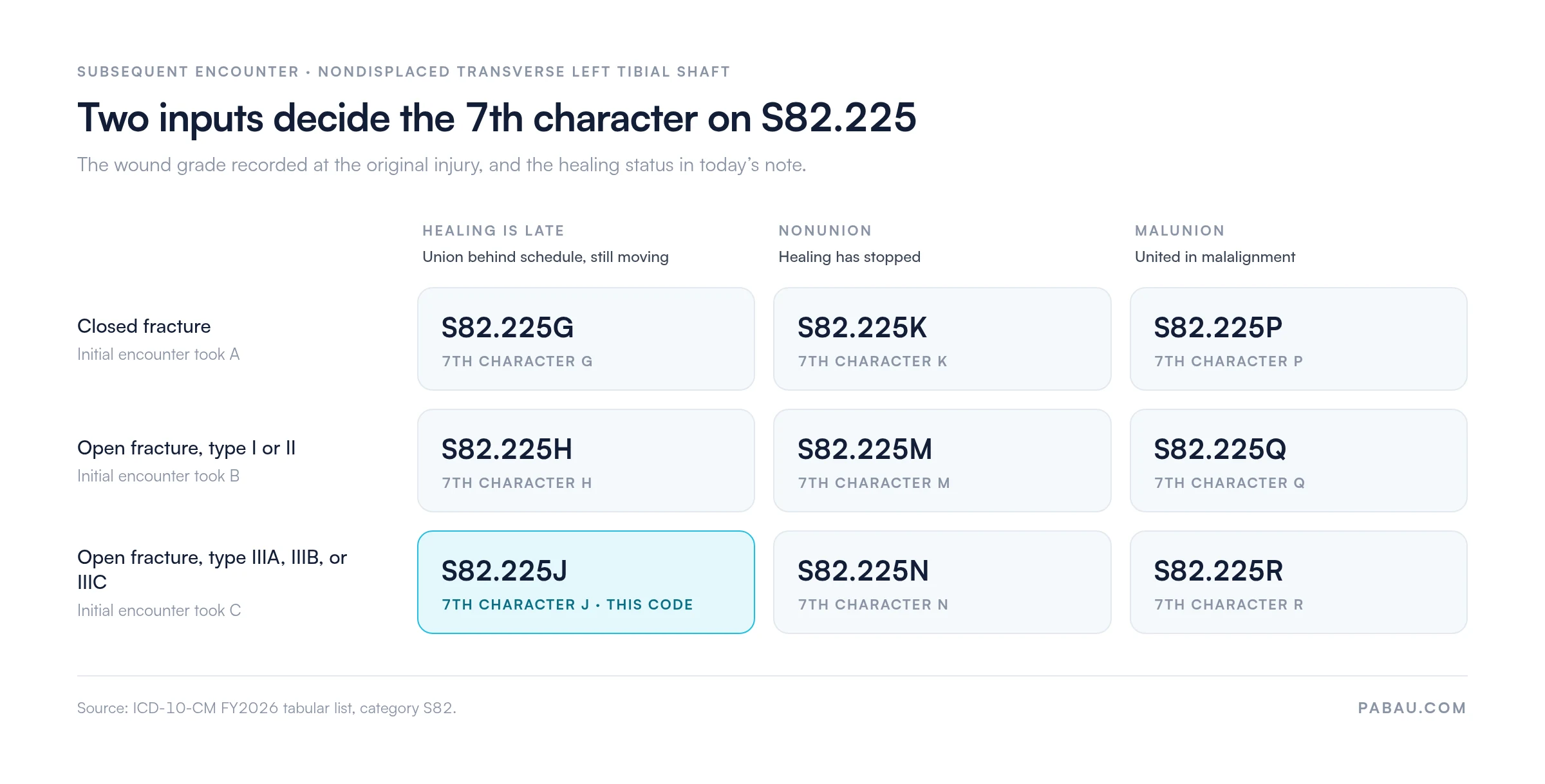
The malunion mix-up is the one to watch for. If the note says the fracture healed crooked, S82.225J is the wrong answer and S82.225R is the right one.
When that same fracture was closed, S82.225P is the code, and corrective osteotomy planning belongs there rather than here.
Healing status changes over months, and the code has to change with it. A coder re-reads the 7th character at every visit, rather than fixing it in the emergency department and carrying it forward.
One patient can pass through four codes on the same tibia, as the worked example below shows.
Each row is a separate claim, and each one has to match the note in front of it. A practice that copies last visit’s diagnosis forward keeps billing F long after healing stalled. That is a coding problem first, and an audit problem second.
The notes that govern S82.225J sit on its parent codes rather than on the code itself. It runs through six levels of the tabular list, and each level can add an instruction. CMS publishes the full tabular each year on its ICD-10 codes page.
The billable code is always the seven-character version. Six-character S82.225 will be rejected, because category S82 requires a 7th character on every code beneath it.
That hierarchy matters because of what is attached to it. Three sets of notes sit above S82.225J in the tabular list, and two of them are defaults that work against this code.
Category S82 carries three notes. A fracture not documented as displaced or nondisplaced codes to displaced. One not documented as open or closed codes to closed. The third note states that the open fracture designations follow the Gustilo classification.
Both defaults cost you this code. Silence on displacement sends the claim to S82.222J, the displaced version. Omit the wound type and it goes to S82.225G, the closed-fracture delayed-healing character.
S82 carries one Excludes1 note and three Excludes2 notes. Traumatic amputation of the lower leg (S88.-) is the Excludes1 entry, so it never appears alongside an S82 code.
The Excludes2 list covers three conditions:
An Excludes2 condition can be reported with S82.225J when the record documents both. That distinction is worth checking, because coders often treat every excludes note as a hard block.
Chapter 19 carries a note to add a secondary code from Chapter 20 to identify the cause of the injury. It also carries a use additional code instruction for a retained foreign body (Z18.-), which comes up often after a type IIIB wound.
Range S80-S89 excludes burns and corrosions (T20-T32), frostbite (T33-T34), and venomous insect bites or stings (T63.4).
The external cause code stays on the claim at a subsequent encounter, with its own subsequent-encounter character. Place of occurrence, activity, and external cause status codes do not repeat, because those are reported once at the initial encounter.
At a visit for the fracture itself, S82.225J is the first-listed or principal diagnosis.
Section I.C.19 of the ICD-10-CM Official Guidelines for Coding and Reporting governs all fracture coding. Within those rules, four mistakes generate most of the trouble on this particular code.
This is the big one, and it survives in a lot of secondary references. J is delayed healing. Malunion on an open type IIIA, IIIB, or IIIC fracture of the left tibial shaft is S82.225R, and malunion on a closed fracture is S82.225P.
Coding J while the note says the bone healed crooked misstates the patient’s status, along with the aftercare that follows from it.
Delayed healing is easy to miss in a busy progress note. If the surgeon writes that union is behind schedule, F is wrong for an open type III fracture. D is wrong for all of them.
The character carries the clinical story, so downgrading it understates the work the visit involved.
J is a subsequent-encounter character. The initial encounter for an open type IIIA, IIIB, or IIIC fracture is S82.225C, not S82.225B.
B belongs to an open type I or II fracture, which is a different Gustilo grade. A subsequent-encounter character on the day of debridement and fixation also conflicts with the procedure codes billed for that date.
S82.225J is the left tibia only. The right-sided code is S82.224J, and the unspecified-side code is S82.226J. Displacement is the second trap, since S82.222J covers the displaced version of the same fracture.
Laterality is among the cheapest denials to prevent, because a pre-bill check catches it in seconds. The AAPC ICD-10-CM code reference carries the cross-references for the full S82 category.
Knowing where those errors surface helps, because a claim for S82.225J passes through five hands before it pays. The coder locks the diagnosis in at step two, which is why a copied-forward code is so hard to catch later.
Steps one and two decide whether the claim survives. When it comes back adjusted, read the remittance before you rebill, since the denial codes on it name which step broke down.
The chart work is only half of it. These five checks belong to the claim itself, and each one takes seconds at the pre-bill step.
All of that depends on what the note actually says, and surgeons rarely write the tabular description word for word. These phrases in an operative note, a radiology read, or a follow-up note should send you to S82.225J.
A note that says only left tibia fracture follow-up will not support the code. The record needs the pattern, the displacement, the original Gustilo grade, and the current healing status. Query the surgeon before assigning S82.225J on anything less than all four.
Payment follows the coding, and on an inpatient stay S82.225J groups to the musculoskeletal aftercare DRGs rather than a fracture DRG. Under MS-DRG version 43.0 that means 559 with an MCC, 560 with a CC, and 561 without either. The code is also exempt from present-on-admission reporting.
That grouping surprises people. A patient admitted for a slow-healing tibia does not land in the fracture family, because the fracture is no longer under active treatment.
Assignments move with the CMS inpatient prospective payment system final rule each year, so check the current grouper version before trusting a prior-year crosswalk.
Most S82.225J claims are outpatient, though. Coding delayed healing accurately supports medical necessity for repeat imaging, bone stimulator review, and continued restricted weight bearing.
Claims sent through a clearinghouse get format and required-field edits first. Catching those before the file leaves the building keeps technical denials off the aging report.
Where a payer adjusts the healing status, appeal with the follow-up radiology report. A report that documents delayed union is what the reviewer asks for, and it settles the question faster than a rebill.
Run three checks on the chart before you assign S82.225J. First, confirm the pattern is transverse and nondisplaced, and that the side is left. Second, confirm the original record grades the open fracture as Gustilo type IIIA, IIIB, or IIIC. Third, confirm the current note says healing is delayed, rather than complete. If the note says the fracture united in malalignment, the code you want is S82.225R.
All of these checks depend on two documents sitting in the same place. Fracture aftercare splits the record in two, because the Gustilo grade and the fracture pattern live in a hospital or emergency note.
Each follow-up visit then generates its own note somewhere else, and a coder has to join the two at every visit.
Practice management software like Pabau holds both halves in one patient record. Its claims software for billers carries a searchable ICD-10-CM library, so a coder confirms the 7th character while building the claim.
For practices billing through the Claim.MD clearinghouse, the integration runs eligibility checks before transmission.
Physical therapy practices handling fracture aftercare gain the same benefit. The original injury note sits beside the current progress note, so checking the Gustilo grade takes a click rather than a records request.
Accurate healing status also protects the revenue behind the visit, because continued care for a delayed union has to be justified on the claim.

Pabau pre-fills the claim from the patient record, then checks it for missing required fields before you send it. Book a demo to see how the workflow fits orthopedic and physical therapy billing teams.

S82.225J earns its place by being narrow, and that narrowness is what makes it worth checking twice. Six elements have to line up in the record, and five of them come from the day of the injury. Only the healing status changes at each visit, so that is the one to read again before you code.
A bone that is still knitting takes J, and a bone that healed crooked never does. Ask that one question at the pre-bill step and most of these denials stop before a payer sees the claim.
Keeping the injury note and the follow-up note in one record is what makes that check quick. To see how Pabau does it for orthopedic and physical therapy billing teams, book a demo.

Was the fracture crooked rather than slow to unite? ICD-10 code S82.225P covers malunion on the same nondisplaced left tibial shaft fracture after a closed injury.
Has healing stopped instead of slowed? ICD-10 code S82.245N walks through nonunion after an open type III tibial shaft injury.
Coding the same delay on a closed fracture? ICD-10 code S82.226G covers the G character, including when an unspecified side is defensible.
Billing the repeat radiographs at each follow-up? CPT code 73590 covers the tibia and fibula X-ray that supports a delayed-healing visit.
Want fewer of these claims coming back? Denial management in healthcare covers the pre-bill audit steps that catch laterality and healing-status errors.
In practice, yes. Providers write delayed union, ICD-10-CM writes delayed healing, and the 7th character is the same either way. Nonunion is the word that changes the code.
Most follow-ups pair it with an established-patient office visit, such as CPT 99213 or 99214. Repeat tibia and fibula radiographs go out with CPT 73590. The diagnosis code stays the same whichever visit level the note supports.
Yes. The character follows the phase of treatment, not the provider’s first sight of the patient. A patient who transfers to another practice for fracture aftercare still gets a subsequent-encounter character.
Not on its own. Medicare’s coverage policy for an electrical bone growth stimulator turns on a documented nonunion. That means serial radiographs showing no healing for three months or more, so a patient coded J has not met it yet.
Report both codes. ICD-10-CM has no bilateral code for a tibial shaft fracture, so each side takes its own entry. Two nondisplaced transverse open type III injuries would give S82.225J on the left and S82.224N on the right.