ICD-10 Code Y76.0: Diagnostic obstetric and gynecological devices
ICD-10 Code Y76.0: Definition and billable status ICD-10 Code Y76.0 is a valid, ...

Last Updated: Oct 23, 2026
Billable Code Specific Code
S82.146G is the billable ICD-10-CM code for nondisplaced bicondylar fracture of unspecified tibia, subsequent encounter for closed fracture with delayed healing.
The seventh character is what decides this code. G is reserved for documented delayed healing, so it is wrong at a routine follow-up and wrong once a clinician declares nonunion. The sixth digit carries its own warning, because it tells the payer that nobody recorded which leg.
Either slip sends the claim back. Here is how the code breaks down, and what has to be in the chart to support it.
Let Pabau's smart automation suggest the right codes, reduce claim denials, and keep your practice compliant—effortlessly.
Automate repetitive tasks and focus on what matters most—your patients.
Reduce coding errors and ensure compliance with the latest regulations.
Clean claims, fewer denials, and faster reimbursements.
Powerful insights and reporting to help your practice thrive.
HIPAA compliant SOC 2 certified GDPR-compliant Trusted by 4,000+ clinics worldwide

S82.146G reports a nondisplaced bicondylar tibia fracture at a follow-up visit, where the closed fracture is healing slowly.
The seventh character G means a subsequent encounter with documented delayed healing, which is not routine healing (D) or nonunion (K).
Laterality is unspecified in this code, so query the treating clinician for right or left before you settle for it.
With a side on record, S82.144G covers the right tibia and S82.145G the left.
Delayed healing has to be a clinical finding in the note. Time since the injury will not support the G on its own.
S82.146G is a billable, valid ICD-10-CM diagnosis code for fiscal years 2025 and 2026, effective for encounters and discharges from October 1, 2024.
The full official description is: Nondisplaced bicondylar fracture of unspecified tibia, subsequent encounter for closed fracture with delayed healing. Here is the record at a glance.
Those details are confirmed in the CDC/NCHS ICD-10-CM web tool, which mirrors the official CMS and NCHS tabular list. Check the code year before you submit, since the ICD-10-CM set changes every October 1.
Read S82.146G left to right and it tells a short story. The category names the bone, the next two characters name the fracture pattern, the sixth carries displacement and side, and the seventh names the visit.
Walking the string in that order is the quickest way to catch an assignment error before the claim leaves the practice.
The digit that follows the subcategory is what separates this code from its neighbors in the S82.1 proximal tibia group. A 4 there means the fracture line crosses both the medial and lateral condyles.
A single-condyle break sits elsewhere. Fracture of the lateral condyle takes S82.12x and fracture of the medial condyle takes S82.13x. S82.11x is a different injury again, the tibial spine.
It is a break that crosses both the medial and lateral condyles of the upper tibia while the bone fragments stay in anatomical alignment.
Those two condyles form the tibial side of the knee joint, and they carry the body’s weight during standing and walking. The fracture lines are there. The joint surface has not shifted.
That distinction changes the treatment plan, which is why coders care about it. Preserved alignment often makes non-surgical management viable, so casting, bracing and protected weight-bearing replace fixation.
Plain radiographs or CT usually confirm it, and the report has to say “nondisplaced” in those words. Without that statement, nondisplacement cannot be assumed.
G is the most misapplied element in subsequent fracture coding, because it looks like a generic “follow-up visit” flag and is not one. It carries two facts at once.
The patient is past active treatment, and the fracture is healing more slowly than expected for this pattern and this patient. Drop either half and a different character applies.
Delayed healing versus nonunion. These two are not interchangeable. Delayed healing means the biology is still working, just behind schedule for the fracture type and the patient. Nonunion means the process has effectively stopped and no bridging callus is forming.
That call is clinical, and it belongs to the provider’s note rather than the coder’s reading of it. Reaching for K when the note only describes slow progress is the kind of error that invites a payer audit.
Here is a worked example. A patient is 16 weeks out from a nondisplaced bicondylar tibia fracture, treated in a brace. Tenderness at the joint line persists, and the latest films show less callus than the surgeon wanted.
The surgeon writes “delayed union” and extends protected weight-bearing. That visit is a G. If the same films had looked on track, the same visit would have been a D.
ICD-10-CM Section I.C.19 governs traumatic fracture coding, and five of its rules do most of the work on this code.
The CMS ICD-10 codes page publishes the official guidelines alongside the annual update files. Keep it open when a case sits on the line between two characters.
The external cause code that travels with S82.146G does not take a G as its seventh character. Chapter 20 offers only A, D and S, so the external cause code on a follow-up visit ends in D instead. Mismatched seventh characters across those two lines are a quiet source of rejections.
Two documented details pick the code inside the S82.14x bicondylar family. The first is whether the fracture is displaced.
The second is which tibia broke. Hold the seventh character at G and those two axes produce six codes. S82.146G is the one you reach for when the side is missing.
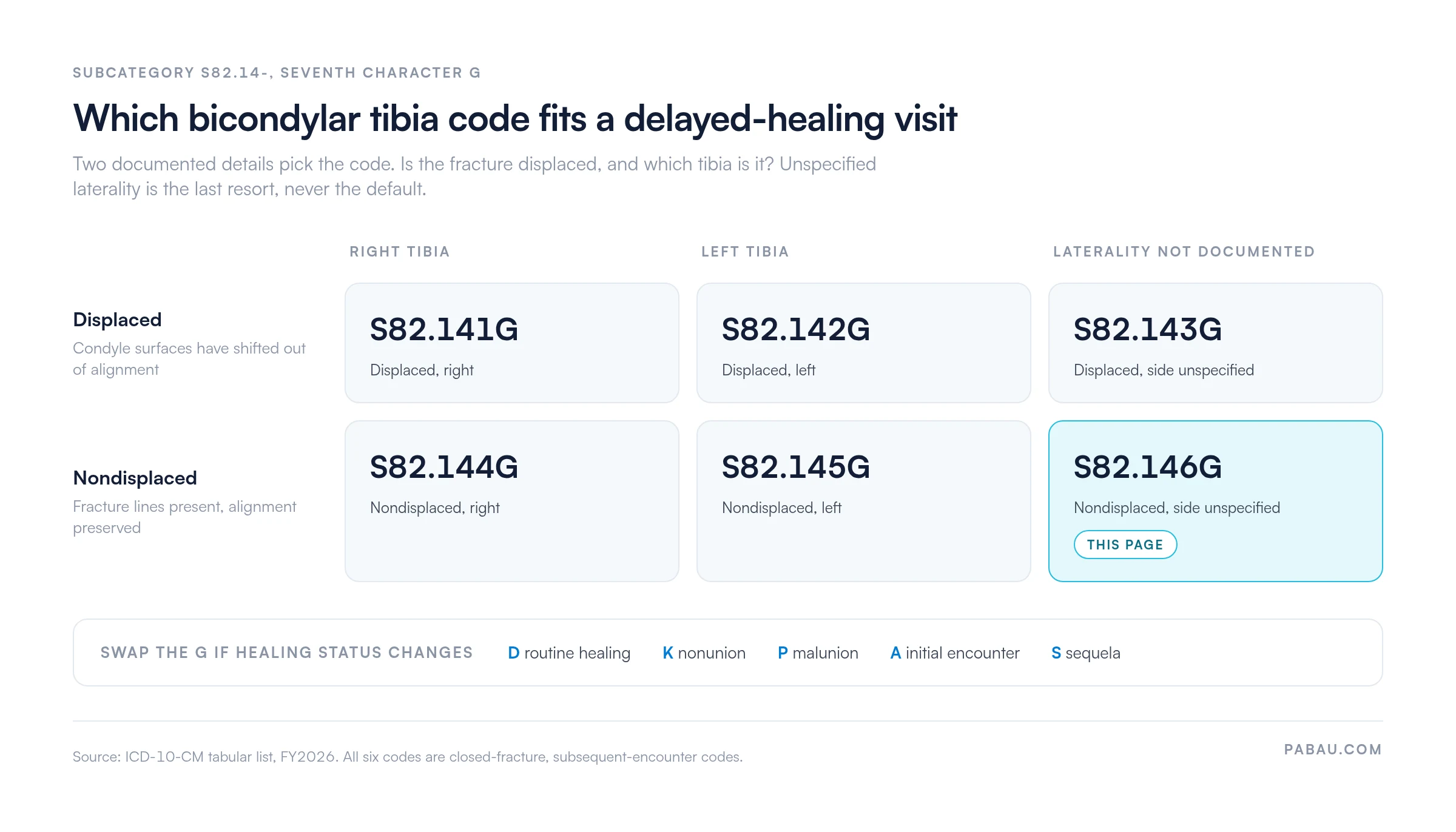
Change the healing status instead of the side and the same base code takes a different tail. The table below runs the seventh characters that pair with S82.146, including the open-fracture options you need when skin integrity is broken.
A complete crosswalk of the wider subcategory sits in the AAPC ICD-10-CM code lookup.
Step up one level and the S82.14x family sits inside S82.1, the proximal tibia subcategory. Its siblings are worth knowing, because a single-condyle break is easy to miscode as bicondylar.
S82.11x covers fracture of the tibial spine, S82.12x the lateral condyle, and S82.13x the medial condyle. Other fractures of the upper end fall to S82.19x. Only a break that crosses both condyles belongs in the S82.14x series.
Within that medial condyle group, S82.135C reports a nondisplaced fracture of the left medial condyle. Its seventh character C marks an initial encounter for an open type IIIA, IIIB, or IIIC wound. Three axes separate it from S82.146G. It covers one condyle, names the left side, and drops the delayed-healing tail that G carries.
Six documentation elements carry this code at audit. Miss one and the assignment can be correct on paper yet indefensible in a review. The reviewer reads the note, not the claim line.
Serial imaging is what usually carries the delayed-healing finding, and films of the lower leg are reported with CPT code 73590. Pull the earlier study alongside the current one while you review the chart, since the comparison is what shows whether callus has appeared.
Reworked fracture claims usually fail on one of six points, and all six are visible in the chart before submission. Work down this list and the claim either goes out clean or goes back to the clinician as a query.
Two of those checks are worth building into the intake step rather than the billing step. A side and a healing statement are far easier to get from the clinician during the visit. Chasing either one a week later usually means the claim came back first.
On the facility side, S82.146G groups to the MS-DRGs that cover musculoskeletal conditions without major complications.
DRG weights and payment rates move every year in the CMS IPPS final rule. Verify the current-year mapping through CMS rather than carrying last year’s figures forward.
On professional claims, the E/M or procedure code drives payment and S82.146G supports it. The diagnosis is what justifies medical necessity for continued care.
That matters when a payer weighs more physical therapy, a bone stimulator, or another round of imaging. Expect requests for the documentation that substantiates the delay.
Two rejections recur on subsequent fracture encounters. The first is a mismatch between the billed encounter type and the seventh character. The second is thin evidence of medical necessity for continued management under a subsequent encounter code.
Learning the denial codes that carry each message tells you which one you are dealing with before you start reworking the claim.
In a lot of orthopedic and physical therapy practices, a follow-up fracture claim crosses three systems before it goes out. The clinician writes the note in one place, a coder checks the seventh character in another, and someone retypes the result into a claim form.
Every hop is a chance for the encounter type and the healing status to drift apart.
Practice management software like Pabau closes those hops. Pabau’s claims management software pre-fills the CMS-1500 from the client record, so the diagnosis on the claim is the one attached to the visit.
ICD-10-CM and CPT lookup libraries sit behind a search icon on the form, and the send button stays locked until the required fields are complete.
From there you can follow each claim through its status stages and run real-time eligibility checks. Remittance advice posts against the right invoice when it comes back.
Pabau does not pick the seventh character for you, and it should not. That call stays with the clinician and the coder. What the software takes away is the retyping between the note and the claim, which is where a G quietly becomes a D.

Pabau pre-fills claim forms straight from the client record and keeps the send button locked until the required fields are complete. From there you can follow each claim’s status through to payment without leaving the platform.

S82.146G is a narrow code, and the narrowness is the point. It says a nondisplaced bicondylar tibia fracture, treated as closed, came back for follow-up and is behind schedule. Two of those five facts have to come from the clinician rather than the coder. This code lives or dies on the note.
So treat the unspecified sixth digit as a question, not an answer. Almost every knee that reaches a delayed-healing visit has been imaged, and an imaged knee has a documented side somewhere in the record. Finding it turns S82.146G into S82.144G or S82.145G, and a specific code is always the stronger claim.
If your practice is rekeying diagnoses between the chart and the claim form, that step is worth removing. Book a demo to see how Pabau carries a fracture diagnosis from the visit note through to a submitted claim.

Managing denial patterns on musculoskeletal claims? Denial management for healthcare claims covers the most common reasons fracture and ortho codes are rejected and how to build a systematic appeals workflow.
Need a full overview of the claims submission process? How a medical claims clearinghouse works explains 837P transmission, real-time eligibility, and ERA reconciliation for outpatient and facility claims.
Tracking coding compliance across your billing team? Medical billing compliance requirements outlines documentation and audit standards that protect practices billing high-volume musculoskeletal codes.
Want to see where fracture claims stall? What is revenue cycle management maps the journey from encounter to payment, so you can spot the stage that is holding your money.
There is no calendar limit. G applies for as long as the clinician documents delayed healing at that visit. Once the note describes healing back on track, move to D. Once it declares nonunion, move to K.
S82.146G is closed-only. An open bicondylar tibia fracture with delayed healing takes H for Gustilo type I or II, and J for type IIIA, IIIB or IIIC. The rest of the code stays the same.
You code each fracture. S82.146G covers the tibial condyles only, so a fibular fracture needs its own code from the S82.4x range. Sequence the more severe fracture first when both are treated at the visit.
Yes. A therapist can carry the fracture code as the treatment diagnosis while the referring physician owns the delayed-healing determination. Your note still has to record the functional deficits that justify the plan of care.
They can. Unspecified-laterality codes increasingly trip specificity edits, and a knee that was imaged almost always has a documented side. Check the imaging report and the operative history before you accept the unspecified digit.