ICD code S82.135C – Nondisplaced medial condyle of tibia fracture
Billable Code•Specific Code
Code Definition
S82.135C is the billable ICD-10-CM code for nondisplaced fracture of medial condyle of left tibia, initial encounter for open fracture type IIIA, IIIB, or IIIC.
The 7th character C reports two facts at once. The fracture is open, and the surgeon graded the wound Gustilo Type IIIA, IIIB, or IIIC rather than the milder Type I or II. That grade must appear in the operative report before the code can be assigned. S82.135C sits in the S82 category, fractures of lower leg including ankle, under ICD-10-CM Chapter 19.
Related Information
Chapter
S00-T88 Injury, poisoning and certain other consequences of external causes
Category
S82 Fracture of lower leg, including ankle
Group
S82.135 Nondisplaced fracture of medial condyle of left tibia
Billable
Yes
Code also known as
open tibial condyle fracture, medial tibial plateau fracture, compound fracture medial condyle of tibia
Save time. Improve accuracy. Get paid faster.
Automate coding with Pabau
Let Pabau's smart automation suggest the right codes, reduce claim denials, and keep your practice compliant—effortlessly.
S82.135CNondisplaced medial condyle of tibia fracture
ICD Code Suggestion
AI
Suggested code
S82.135CNondisplaced medial condyle of tibia fractureHigh match
Confidence score
98%
Why this code?
Matches patient diagnosis
Supported by clinical notes
Commonly used for this condition
Why practices choose Pabau
Save hours every week
Automate repetitive tasks and focus on what matters most—your patients.
Improve accuracy
Reduce coding errors and ensure compliance with the latest regulations.
Get paid faster
Clean claims, fewer denials, and faster reimbursements.
Grow with confidence
Powerful insights and reporting to help your practice thrive.
HIPAA compliant•SOC 2 certified•GDPR-compliant•Trusted by 4,000+ clinics worldwide
Key takeaways
S82.135C is the billable ICD-10-CM code for a nondisplaced open fracture of the left medial tibial condyle, valid for fiscal years 2025 and 2026.
The 7th character C means an initial encounter for an open fracture graded Gustilo Type IIIA, IIIB, or IIIC.
A Gustilo Type I or II wound takes 7th character B, so the two characters are easy to transpose.
The Gustilo grade must appear in the surgeon’s operative report, because coders cannot infer it from radiology alone.
S82.135 carries 16 valid 7th characters, so confirm the encounter phase at every visit rather than only the first.
ICD-10 Code S82.135C: Quick reference and code details
ICD-10 Code S82.135C reports a nondisplaced fracture of the medial condyle of the left tibia at an initial encounter.
The fracture is open, and the surgeon has graded the wound Gustilo Type IIIA, IIIB, or IIIC.
The table below consolidates the reference data a coder needs before submitting the claim through claims management software. Verify the effective year against the CMS annual release before billing.
Field
Value
Full code
S82.135C
Short description
Nondisplaced fracture of medial condyle of left tibia, initial encounter for open fracture type IIIA, IIIB, or IIIC
Code system
ICD-10-CM (United States clinical modification)
Code type
Diagnosis (billable leaf-level code)
Billable status
Yes — specific, valid for claim submission
Applicable ICD-10-CM year
2025, 2026 (verify annually against CMS release)
Parent category
S82 — Fracture of lower leg, including ankle
7th character meaning
C = initial encounter, open fracture Gustilo Type IIIA, IIIB, or IIIC
Anatomical and clinical scope of S82.135C
Each term in the code descriptor carries a specific clinical meaning. Misreading any one of them points the coder toward the wrong code family.
Nondisplaced: the fracture line is present but the bone fragments have not moved from their normal anatomical position. This is distinct from a displaced fracture, where fragments are angulated, rotated, or separated. The displacement status must be stated in the radiology report or operative note, not inferred by the coder.
Medial condyle: the medial (inner) articular prominence at the proximal tibia, forming part of the knee joint. It is one of the two tibial plateau condyles. The lateral condyle has its own code series, S82.12x.
Left tibia: the sixth character of S82.135 carries both the displacement status and the side. The same fracture on the right tibia is S82.134, and an unspecified side is S82.136.
Open fracture: the fracture communicates with the external environment through a skin wound. This carries infection risk and requires immediate surgical attention in most cases. Open status must be documented by the treating clinician.
Initial encounter: the patient is in the active treatment phase. This applies to the first and all subsequent visits during which the fracture is actively being treated, not just the emergency department presentation.
Decoding the 7th character: Why “C” matters for S82.135C claims
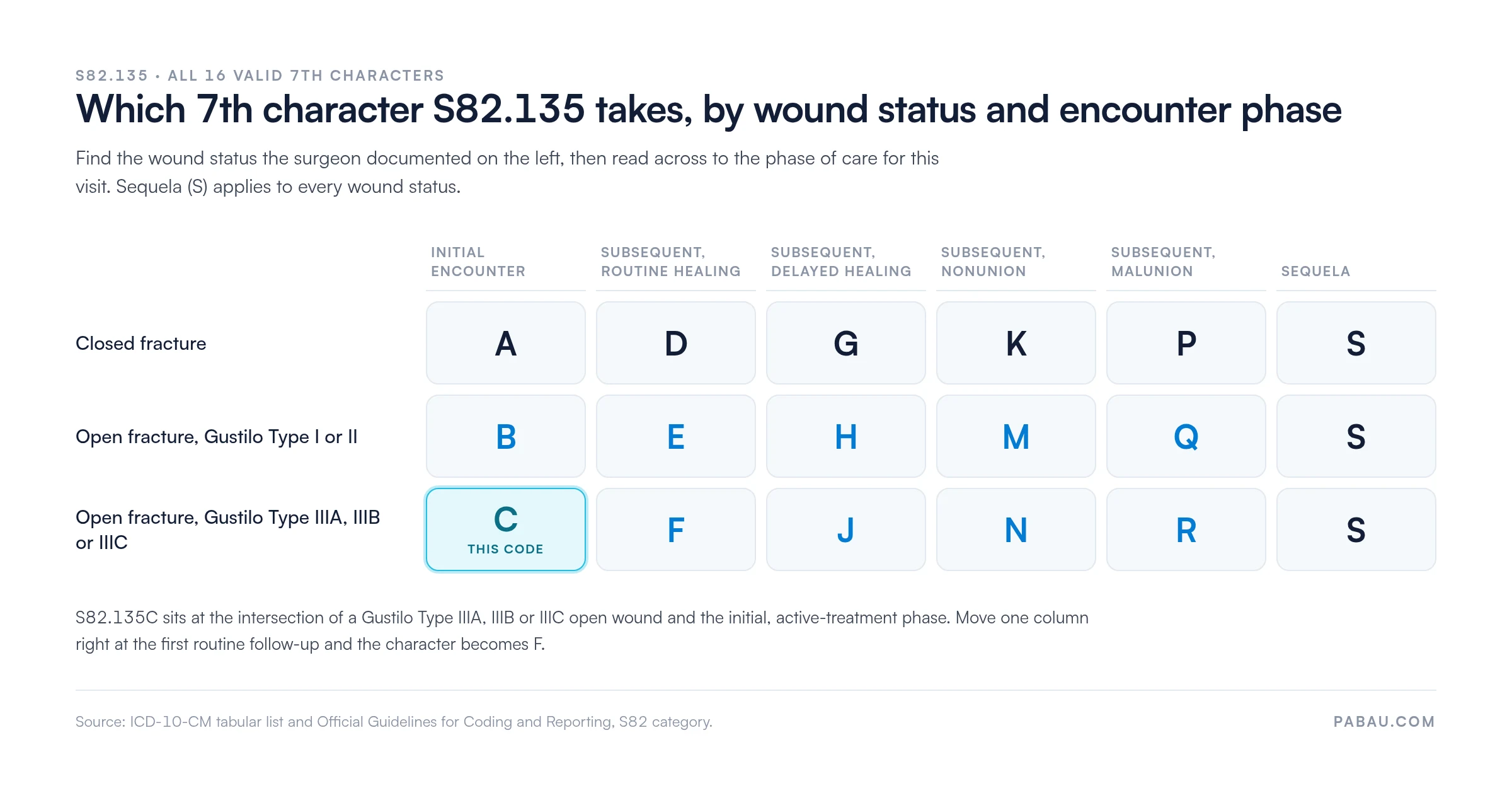
The 7th character is the most claim-sensitive element in any S82.135 code. It encodes both the fracture’s open or closed status and the phase of care at the same time. Two facts decide it, and the grid below plots one against the other.
Wound grade fixes the row and the phase of care fixes the column, which is why C and B sit one step apart. Characters as listed in the ICD-10-CM tabular list for S82.
The table below gives the same 16 characters in list form, with the wording the ICD-10-CM Official Guidelines for Coding and Reporting use.
7th character
Encounter type
Open fracture Gustilo grade
A
Initial encounter
Closed fracture (not open)
B
Initial encounter
Open fracture Type I or II
C
Initial encounter
Open fracture Type IIIA, IIIB, or IIIC
D
Subsequent encounter
Closed fracture, routine healing
E
Subsequent encounter
Open fracture Type I or II, routine healing
F
Subsequent encounter
Open fracture Type IIIA, IIIB, or IIIC, routine healing
G
Subsequent encounter
Closed fracture, delayed healing
H
Subsequent encounter
Open fracture Type I or II, delayed healing
J
Subsequent encounter
Open fracture Type IIIA, IIIB, or IIIC, delayed healing
K
Subsequent encounter
Closed fracture, nonunion
M
Subsequent encounter
Open fracture Type I or II, nonunion
N
Subsequent encounter
Open fracture Type IIIA, IIIB, or IIIC, nonunion
P
Subsequent encounter
Closed fracture, malunion
Q
Subsequent encounter
Open fracture Type I or II, malunion
R
Subsequent encounter
Open fracture Type IIIA, IIIB, or IIIC, malunion
S
Sequela
Late effects of the fracture, such as stiffness or post-traumatic arthritis
Gustilo-Anderson classification and 7th character mapping
The Gustilo-Anderson system grades open fracture severity by wound size, contamination level, and periosteal stripping. ICD-10-CM maps each grade to a specific set of 7th characters, per the CMS ICD-10-CM coding guidelines. The operative surgeon must document the Gustilo grade, because coders cannot assign it from the radiology report alone.
Gustilo type
Wound characteristics
Initial encounter 7th character
Subsequent 7th characters
Type I
Wound less than 1 cm, clean, minimal soft tissue damage
B
E (routine) / H (delayed) / M (nonunion) / Q (malunion)
Type II
Wound 1 to 10 cm, moderate contamination, no extensive soft tissue loss
B
E (routine) / H (delayed) / M (nonunion) / Q (malunion)
Type IIIA
Wound greater than 10 cm, adequate soft tissue coverage remains
C
F (routine) / J (delayed) / N (nonunion) / R (malunion)
F (routine) / J (delayed) / N (nonunion) / R (malunion)
Type IIIC
Arterial injury requiring repair regardless of wound size
C
F (routine) / J (delayed) / N (nonunion) / R (malunion)
S82.135C vs adjacent codes: Choosing correctly
The S82.135 series carries 16 valid 7th characters, and every one of them is billable. Neighboring entries in the ICD-10-CM codes index differ from S82.135C by a single character. Wrong-character selection is a leading source of denials for this code family, so the table below sets out the variants coders confuse most often.
Code
Fracture type
Encounter
Use when…
S82.135A
Closed (not open)
Initial
Skin is intact, with no open wound communicating with the fracture
S82.135B
Open Gustilo Type I or II
Initial
Operative report documents a Type I or II open wound
S82.135C
Open Gustilo Type IIIA, IIIB, or IIIC
Initial
Operative report documents a Type III open wound with soft tissue compromise
S82.135F
Open Type IIIA, IIIB, or IIIC, routine healing
Subsequent
Follow-up visits while the fracture heals as expected
S82.135N
Open Type IIIA, IIIB, or IIIC, nonunion
Subsequent
Imaging confirms the fracture has not united within the expected timeframe
S82.135S
Any type
Sequela
Coding a late effect of the original fracture, such as stiffness or post-traumatic arthritis
Includes, Excludes1, and Excludes2 notes for S82.135C
Excludes notes at the S82 category level control which conditions cannot be coded alongside S82.135C and which may be coded in addition. Review these against the CDC/NCHS ICD-10-CM web tool for the applicable fiscal year before submitting.
Excludes1 (cannot code with S82.135C): traumatic amputation of lower leg, S88. An amputation at this level is coded to the S88 category instead of the S82 fracture series, never alongside it.
Excludes2 (may code with S82.135C when documented): periprosthetic fracture around an internal prosthetic knee implant (M97.1x) and fracture of foot (S92). Physeal fracture of upper end of tibia (S89.0) and fracture of shaft of tibia (S82.2) are also Excludes2. Each describes a distinct condition or site, so both codes may appear on the claim where the record supports each one.
Includes (parent category note): fracture of lateral condyle of tibia and fracture of proximal part of tibia sit within the broader S82.1 grouping. Both require their own specific codes. S82.135C describes the medial condyle of the left tibia exclusively.
Coding guidelines and documentation requirements for open tibial fracture initial encounter
Accurate documentation is the single biggest variable in whether a claim with ICD-10 Code S82.135C clears on first submission. The ICD-10-CM Official Guidelines, Section I.C.19.c, and AHA Coding Clinic guidance set the five requirements below. Treat them as a pre-submission checklist rather than a post-denial repair job.
Gustilo grade in the operative report: the operating surgeon must document the Gustilo-Anderson type in the operative note or wound assessment. The valid grades are I, II, IIIA, IIIB, and IIIC. Coders cannot assign it from imaging alone.
Open vs closed fracture confirmation: the treating clinician must explicitly document that the wound communicates with the fracture. This cannot be inferred from an X-ray showing soft tissue swelling.
Encounter type accuracy: S82.135C applies for the initial, active treatment phase only. Once the fracture moves into routine follow-up, the correct 7th character is F. Applying C to every visit is a common audit finding.
Laterality documentation: S82.135 is specific to the left tibia, so the medical record must name the side treated. A note that says only “tibial condyle fracture” leaves the coder choosing between S82.134, S82.135, and S82.136.
Radiology linkage: the X-ray or CT report confirming the nondisplaced fracture of the medial condyle must be in the record. The clinical description in the imaging report should align with the code descriptor. Conflicting descriptions, such as a report stating “mildly displaced”, require physician clarification before coding.
Pro Tip
Run a pre-submission documentation checklist for every S82.135C claim: Gustilo grade present in operative report? Encounter type correct for this visit? Left tibia specified? Radiology description consistent with ‘nondisplaced’? Addressing all four before filing cuts denial turnaround time significantly.
Commonly associated CPT codes for nondisplaced medial condyle tibia fractures
S82.135C appears on the diagnosis line, and the procedure line requires an appropriate CPT code. The table below lists CPT codes commonly paired with this diagnosis. Pairings are payer- and case-specific, so always verify against the operative report and local coverage determinations. The AAPC CPT-to-ICD-10 crosswalk can confirm medical necessity linkage by payer.
CPT code
Description
Notes
27535
Open treatment of tibial plateau fracture, unicondylar, without internal fixation
Use when surgical exploration is performed without hardware
27536
Open treatment of tibial plateau fracture, unicondylar, with internal fixation
Most common pairing when ORIF is performed for the medial condyle
27540
Open treatment of intercondylar spine(s) or tuberosity fracture(s) of knee
Verify anatomy; applies to the intercondylar spine, not the condyle surface
27880
Amputation, leg through tibia and fibula
Reserved for Gustilo IIIC with non-reconstructable vascular injury
29881
Arthroscopy, knee, with meniscectomy
May pair when arthroscopic-assisted reduction is performed; document accordingly
97110
Therapeutic exercises
Physical therapy encounters during the rehabilitation phase
CPT 27540 covers the lateral tibial plateau and intercondylar structures in most interpretations. For the medial condyle specifically, 27535 and 27536 are the primary surgical codes. Confirm with the payer’s local coverage determination before billing 27540 for medial condyle injuries.
Payer requirements and prior authorization for S82.135C
Medicare and most commercial payers treat open fracture surgery as medically necessary when documentation supports it. The claim still has several payer-specific hurdles to clear. Eligibility should be verified before the procedure date, not on the day of billing.
Medical necessity documentation: the claim must be supported by the operative report and the note confirming the open wound. It also needs the imaging study establishing the nondisplaced condyle fracture. CMS expects all three on audit.
Radiology report linkage: the X-ray or CT report language must be consistent with the ICD-10-CM descriptor. A report noting only “knee injury”, without naming the condyle and the displacement status, leaves the coder without support for S82.135C.
Gustilo documentation for 7th character C: payers increasingly flag open fracture claims where the operative note is absent or does not grade the wound. A claim submitted with S82.135C on an operative note that says only “open fracture” will often draw a CARC 50 denial. That code means the service was not deemed medically necessary. Some payers request additional records instead.
Prior authorization: surgical fixation of tibial plateau fractures may require prior authorization under commercial plans. Check payer-specific requirements before scheduling. Authorization requirements do not apply uniformly under Medicare Parts A and B for emergency surgery.
Reading the electronic remittance advice after adjudication shows the exact CARC code assigned to any denial. The root cause is then identifiable without a phone call to the payer.
Common claim denial reasons for S82.135C
Open fracture claims with a 7th character C carry a higher denial rate than closed-fracture variants. They demand Gustilo documentation that not every operative note provides. The five causes below account for most of them.
Wrong 7th character (C vs A): the most common error. A fracture documented as open in the emergency department note, but lacking a Gustilo grade in the operative report, prompts the coder to guess. S82.135A gets submitted instead to sidestep the Gustilo requirement, which misrepresents the clinical picture and may trigger fraud flags on audit.
Missing Gustilo grade in the operative report: using 7th character C without explicit Gustilo grading is a documentation mismatch. Payers performing audit reviews flag this consistently. The physician must document “Gustilo Type IIIA”, “IIIB”, or “IIIC”, since shorthand like “large open wound” does not satisfy the requirement.
Wrong encounter type on follow-up visits: applying S82.135C to post-operative wound checks and orthopedic follow-up visits is incorrect. Once active surgical treatment is complete, switch to the matching subsequent-encounter character: F for routine healing, J for delayed healing.
Laterality conflict: if the X-ray report says right tibia while the operative note says left, the claim will deny. Resolve the conflict with a physician query before coding.
CPT-diagnosis mismatch: submitting 27540, which covers the intercondylar spine, against S82.135C creates a cross-code mismatch that automated payer edits flag. The procedure code must match the documented surgical anatomy.
How Pabau keeps 7th-character errors off the claim
Most coding teams find a wrong 7th character after the remittance arrives. The operative report sits in one system and the claim sits in another, so nobody compares the two until a denial forces it. By then the payer’s timely filing clock has been running for weeks.
Practice management software like Pabau keeps the clinical record and the claim in one place. The operative note, the imaging report, and the diagnosis code all sit on the patient record. A coder can confirm the Gustilo grade without leaving the claim. Our Claim.MD integration then validates the CPT and diagnosis pair against payer edits before the file is transmitted.
Denials that do come back arrive as electronic remittance advice inside Pabau, with the CARC code attached. Your team can route each case straight to the coder who worked it, instead of rebuilding the history from scratch.
Pabau raises the insurer invoice from the same patient record that holds the diagnosis code, so the claim and the clinical note never drift apart.
Stop denials before they start
Pabau integrates with Claim.MD to validate CPT-diagnosis pairs and flag missing documentation before electronic submission. See how orthopedic and sports medicine practices use Pabau to reduce claim rework.
S82.135C holds up only when the operative surgeon has documented a Gustilo Type IIIA, IIIB, or IIIC open wound. Without that grade in the record, the character is a guess, and an auditor will read it as one. Query the surgeon before the claim goes out, not after the denial lands.
Then check the encounter phase every time the patient comes back. The character that was correct on the day of surgery is wrong at the first routine follow-up, where F replaces C.
Validating the diagnosis and procedure pair before transmission catches these mismatches while they are still cheap to fix. That is what a clean claim process is for, and clearinghouse edits automate most of it. Book a demo to see how Pabau handles CPT-diagnosis crosschecks and denial routing for orthopedic coding teams.
Continue your research
Need a billing compliance framework?Medical billing compliance covers the documentation standards that support ICD-10 claims through audit.
Handling a complex denial appeal?Denial management in healthcare walks through root-cause analysis and appeal workflows for CARC-coded rejections.
Looking up a CARC code from a remittance?Denial codes in medical billing explains what each code means and what an appeal has to show.
Want to understand the clearinghouse process?Medical claims clearinghouse explains how 837P transactions and ERA remittances move between practice, clearinghouse, and payer.
Frequently asked questions
What does ICD-10 Code S82.135C mean?
ICD-10 Code S82.135C is the billable diagnosis code for a nondisplaced fracture of the medial condyle of the left tibia. It applies at the initial encounter, for an open fracture graded Gustilo Type IIIA, IIIB, or IIIC. It sits within the S82 lower leg fracture category and is valid for the 2025 and 2026 fiscal years.
What is the difference between S82.135A and S82.135C?
S82.135A applies when the fracture is closed, with no open wound. S82.135C applies when the fracture is open and the surgeon has documented a Gustilo Type IIIA, IIIB, or IIIC wound. Using A when the wound is open is a coding error. So is using C when Gustilo grading is absent from the operative report. Both trigger denials or audit findings.
Is S82.135C a billable ICD-10 code?
Yes, S82.135C is a fully billable, leaf-level ICD-10-CM code valid for submission on outpatient and inpatient claims. It is not a header or non-specific code. Confirm validity against the CDC/NCHS ICD-10-CM web tool for the applicable fiscal year.
What Gustilo type does the 7th character C represent?
The 7th character C represents Gustilo Type IIIA, IIIB, and IIIC open fractures, the most severe grades in the classification. Type IIIA has a wound larger than 10 cm with adequate soft tissue coverage. Type IIIB involves extensive soft tissue loss, and Type IIIC involves arterial injury requiring repair. Gustilo Type I and Type II wounds use 7th character B for initial encounters.
Can S82.135C be used for subsequent encounters?
No. S82.135C is restricted to initial encounters, meaning visits during the active treatment phase. For subsequent visits while the open fracture is healing routinely, use S82.135F. For delayed healing, use S82.135J. Applying S82.135C to follow-up appointments is one of the most common 7th-character errors for this code.
Why would a claim with S82.135C be denied?
The most common causes are a missing Gustilo grade in the operative report and use of 7th character C on a follow-up visit. Others are a mismatch between the procedure code and the documented anatomy, and a laterality conflict between the X-ray report and the operative note. Each one is preventable with a pre-submission documentation checklist.