ICD-10 Code S42.444P: Medial epicondyle fracture, right humerus
ICD-10 Code S42.444P: full descriptor and code validity ICD-10 Code S42.444P car...

Last Updated: Oct 13, 2026
Billable Code Specific Code
S82.136S is the billable ICD-10-CM code for nondisplaced fracture of medial condyle of unspecified tibia, sequela.
According to the Centers for Medicare and Medicaid Services (CMS), ICD-10-CM codes are updated annually each October 1. S82.136S remains valid and billable for fiscal year 2026, covering October 1, 2025 through September 30, 2026.
Let Pabau's smart automation suggest the right codes, reduce claim denials, and keep your practice compliant—effortlessly.
Automate repetitive tasks and focus on what matters most—your patients.
Reduce coding errors and ensure compliance with the latest regulations.
Clean claims, fewer denials, and faster reimbursements.
Powerful insights and reporting to help your practice thrive.
HIPAA compliant SOC 2 certified GDPR-compliant Trusted by 4,000+ clinics worldwide

ICD-10 Code S82.136S describes a nondisplaced fracture of the medial condyle of unspecified tibia, sequela.
The 7th character S marks a sequela encounter, so the fracture has healed but a late effect persists.
S82.136S is billable from October 1, 2025 through September 30, 2026.
Sequela coding takes two codes, with the residual condition sequenced first and S82.136S second.
Practice management software like Pabau ties the diagnosis code to the patient record and the claim.
ICD-10 Code S82.136S is a billable ICD-10-CM diagnosis code. Its full clinical description is: Nondisplaced fracture of medial condyle of unspecified tibia, sequela.
The code sits in the S82.1 subcategory, which covers fractures of the upper end of the tibia. It also needs a companion code naming the sequela itself. Orthopedic and physical therapy coders meet that pairing on most late follow-up visits.
S82.136S carries the 7th character S, which designates sequela rather than active treatment. The 7th character is the only part of the code that moves between encounters.
A sequela is a late effect or residual condition that persists after the acute phase of an injury resolves. That definition comes from the ICD-10-CM Official Guidelines for Coding and Reporting, Section I.B.10, and from the WHO ICD-10 classification framework.
For this code, the medial condyle fracture has healed. What continues is the late effect: chronic knee pain, instability, or post-traumatic arthritis.
A common mistake is using S82.136D when the fracture is fully healed and the patient returns for a residual complaint. Once healing is complete, D no longer applies.
The encounter becomes a sequela visit, and a second code for the residual condition, such as M25.661 (stiffness of right knee), is required alongside S82.136S.
Encounter-type mismatches sit behind a large share of rejections, and our denial codes reference explains how payers report them back.
The distinction between sequela and subsequent encounter decides which 7th character the claim carries. The table below maps each stage of healing to the codes that belong to it.
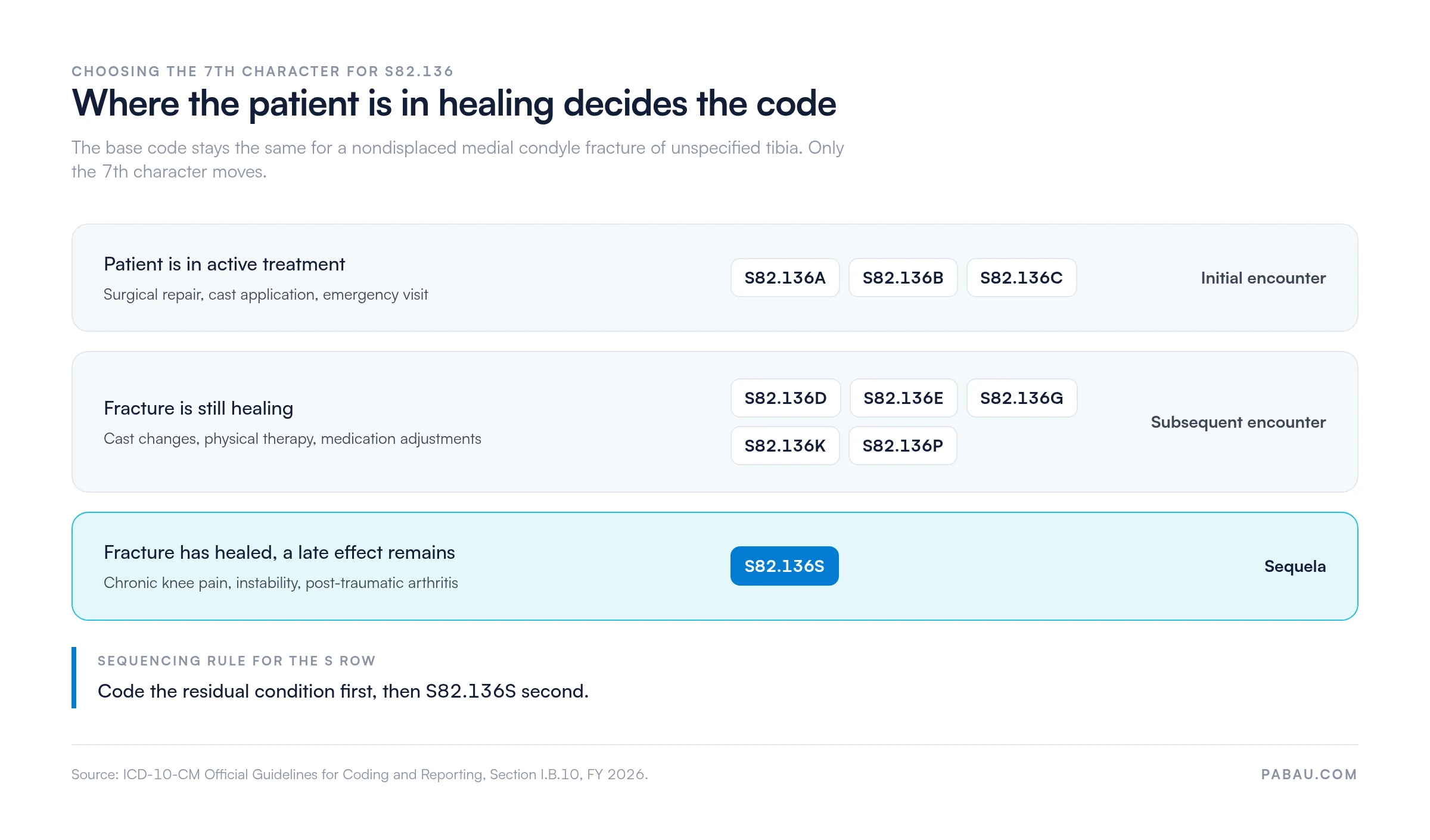
Always document the specific residual condition in your clinical notes before coding a sequela visit. Payers expect a clear causal link between the original injury (the fracture) and the current complaint (the late effect). Without it, sequela claims are prime denial targets.
The medial condyle is the inner prominence of the proximal tibia at the knee joint. It forms the medial plateau of the tibial articular surface and carries a large share of body weight during standing and walking.
Post-traumatic arthritis, joint instability, and chronic pain are the residual conditions that turn a healed medial condyle fracture into a sequela case. Physical therapy and sports medicine practices see most of these presentations.
Knowing where the code sits in the ICD-10-CM hierarchy makes it easier to audit specificity. Each level narrows the picture: first the body region, then the bone, then the displacement, then the encounter type.
The ICD-10-CM Official Guidelines for Coding and Reporting govern how and when to apply S82.136S. The key compliance requirements are summarized below.
Coders can check the current wording in the CDC/NCHS ICD-10-CM web tool, which carries the official FY2026 tabular list and alphabetic index.
Documented laterality changes the code family, and the encounter type sets the 7th character alongside it. A left tibia seen at an initial encounter for an open type IIIA, IIIB, or IIIC fracture takes S82.135C rather than a sequela code.
Accurate ICD-10-CM coding is part of a practice’s wider billing compliance obligations. Practices that build coding into the clinical documentation step cut transcription errors and reduce downstream audit risk.
Query laterality before submitting sequela claims using S82.136S. Payers increasingly flag ‘unspecified’ laterality codes for additional review. A simple provider addendum documenting ‘left’ or ‘right’ upgrades the code and reduces denial risk.
For inpatient hospital billing, ICD-10-CM diagnosis codes map to Medicare Severity Diagnosis Related Groups (MS-DRGs). Sequela fracture codes such as S82.136S generally map to the groups covering musculoskeletal conditions and injuries. Comorbidities and the procedures performed during the stay move the assignment.
The specific MS-DRG depends on the principal diagnosis, which for a sequela visit is the residual condition coded first. Secondary diagnoses and procedures shift it further.
Rates change annually and respond to payer contract terms, so verify current mappings with the CMS MS-DRG grouper rather than a static reference table. The remittance advice a payer returns is the definitive post-submission record of DRG assignment and payment.
Outpatient claims carrying S82.136S go out on CMS-1500 or 837P forms and are reimbursed under the applicable fee schedule. Submitting clean claims with the correct 7th character and the companion sequela code keeps rejection rates down on these encounters.
Standalone ICD-10 reference tools answer the “what is this code?” question and stop there. The costlier problem for a practice is the handoff. A code confirmed in a reference gets retyped into the billing system, or attached to the wrong encounter type.
Pabau is practice management software that removes that handoff with claims management built in. Diagnostic code selection happens on the patient record, and the same code carries through to the claim without a second entry step.
A coder working a sequela visit can attach S82.136S alongside the companion condition code in one workflow, and both codes flow into the 837P submission.
Orthopedic and physical therapy practices run a high volume of these follow-up encounters. Denial reporting by code then shows the coding team which ICD-10 errors keep repeating. Catching a pattern early keeps it from eroding collections.

Pabau connects diagnostic code selection to billing and reporting in one workflow. See how practices reduce claim denials on sequela and subsequent encounter codes.

S82.136S covers a narrow clinical picture that is easy to misread: a nondisplaced medial condyle fracture that has resolved, leaving a late effect behind.
Two decisions protect the claim. Sequence the residual condition first, and pick the 7th character from the patient’s stage of healing rather than from the last code you billed.
The laterality query is worth the extra minute as well. An “unspecified” tibia invites payer review, and a short provider addendum moves the claim onto a more specific code.
Practices with a steady volume of trauma follow-up billing gain the most by moving code selection into the clinical workflow instead of a separate lookup. Book a demo to see how Pabau keeps the diagnosis code, the note, and the claim on one record.

Need a framework for managing claim denials from ICD-10 errors? Denial management in healthcare covers the systematic approach to identifying and resolving recurring code-related rejections.
Want to understand how 837P electronic claims work? 837 file submission explains the structure and requirements for electronic claim transmission, including diagnosis code formatting.
Want the wider billing picture around a diagnosis code? Medical billing workflows shows where code selection sits in the full billing and reimbursement cycle.
ICD-10 Code S82.136S is a billable ICD-10-CM diagnosis code describing a nondisplaced fracture of the medial condyle of unspecified tibia, sequela. The 7th character S indicates a sequela encounter, so the original fracture has healed. What remains is a late effect caused by that injury, such as chronic knee pain, stiffness, or post-traumatic arthritis. A companion code for the nature of the sequela is reported alongside S82.136S and sequenced first.
Yes. S82.136S is a billable and specific ICD-10-CM code valid for HIPAA-covered electronic transactions. It is active for fiscal year 2026, covering October 1, 2025 through September 30, 2026. Confirm current validity annually through the CDC/NCHS ICD-10-CM web tool.
S82.136A is for initial encounters when the patient is receiving active treatment for the fracture. S82.136D is for subsequent encounters when the fracture is healing and the patient receives routine aftercare. S82.136S applies once the fracture has fully healed and the patient presents with a late effect or residual condition. Mixing up D and S is the most common coding error in this code family.
Use a sequela code, such as S82.136S, once the original fracture is documented as healed. The current complaint must be a late effect of that injury. Use a subsequent encounter code while the fracture is still healing and the patient receives routine care. ICD-10-CM guidelines set no time limit, so sequela can be coded months or years after the injury once the acute phase has resolved.
Common CPT codes paired with S82.136S include evaluation and management codes such as 99213 and 99214 for outpatient visits addressing the sequela. Physical therapy codes such as 97110 and 97530 cover therapeutic exercise for residual functional deficits. Pain management codes may apply depending on the late effect. CPT selection follows the services rendered at the sequela visit, not the original fracture diagnosis.
MS-DRG mapping for S82.136S depends on the principal diagnosis, which is the nature of the sequela coded first, plus comorbidities and inpatient procedures. Sequela fracture codes typically group to musculoskeletal injury DRGs, but the specific assignment varies by case mix. Verify current MS-DRG assignments using the CMS MS-DRG grouper, as rates and groupings update annually.