ICD-10 Code S66.308A: Extensor muscle injury, other finger
ICD-10 Code S66.308A: Definition and code hierarchy ICD-10 Code S66.308A is the ...

Last Updated: Oct 14, 2026
Billable Code Specific Code
S82.134E is the billable ICD-10-CM code for a nondisplaced fracture of the medial condyle of the right tibia. It covers a subsequent encounter for open fracture type I or II with routine healing.
It applies to follow-up care after the initial definitive treatment is complete. The original wound must be documented as Gustilo type I or II, and the fracture must be healing on schedule. The most common error is choosing D, the closed-fracture character, on an injury the record describes as open.
Let Pabau's smart automation suggest the right codes, reduce claim denials, and keep your practice compliant—effortlessly.
Automate repetitive tasks and focus on what matters most—your patients.
Reduce coding errors and ensure compliance with the latest regulations.
Clean claims, fewer denials, and faster reimbursements.
Powerful insights and reporting to help your practice thrive.
HIPAA compliant SOC 2 certified GDPR-compliant Trusted by 4,000+ clinics worldwide

S82.134E is the billable ICD-10-CM code for a nondisplaced medial condyle fracture of the right tibia in follow-up care.
The 7th character E means subsequent encounter, open fracture type I or II, and routine healing.
All three of those facts must be documented before the code can be assigned.
Selecting D instead of E on an open fracture is the most frequent error on these claims.
A missing Gustilo grade in the operative note blocks the E character at every later visit.
ICD-10 Code S82.134E is a billable, encounter-specific code in the ICD-10-CM system. It is valid for use in HIPAA-covered transactions per CMS guidance. The full official descriptor is: Nondisplaced fracture of medial condyle of right tibia, subsequent encounter for open fracture type I or II with routine healing.
Every word in that descriptor carries a specific coding meaning. The table below breaks each component down into plain clinical language.
S82.134E became effective in its current form with ICD-10-CM FY2025/FY2026 updates from the CDC/NCHS. It is valid for claims submitted on and after October 1, 2024.
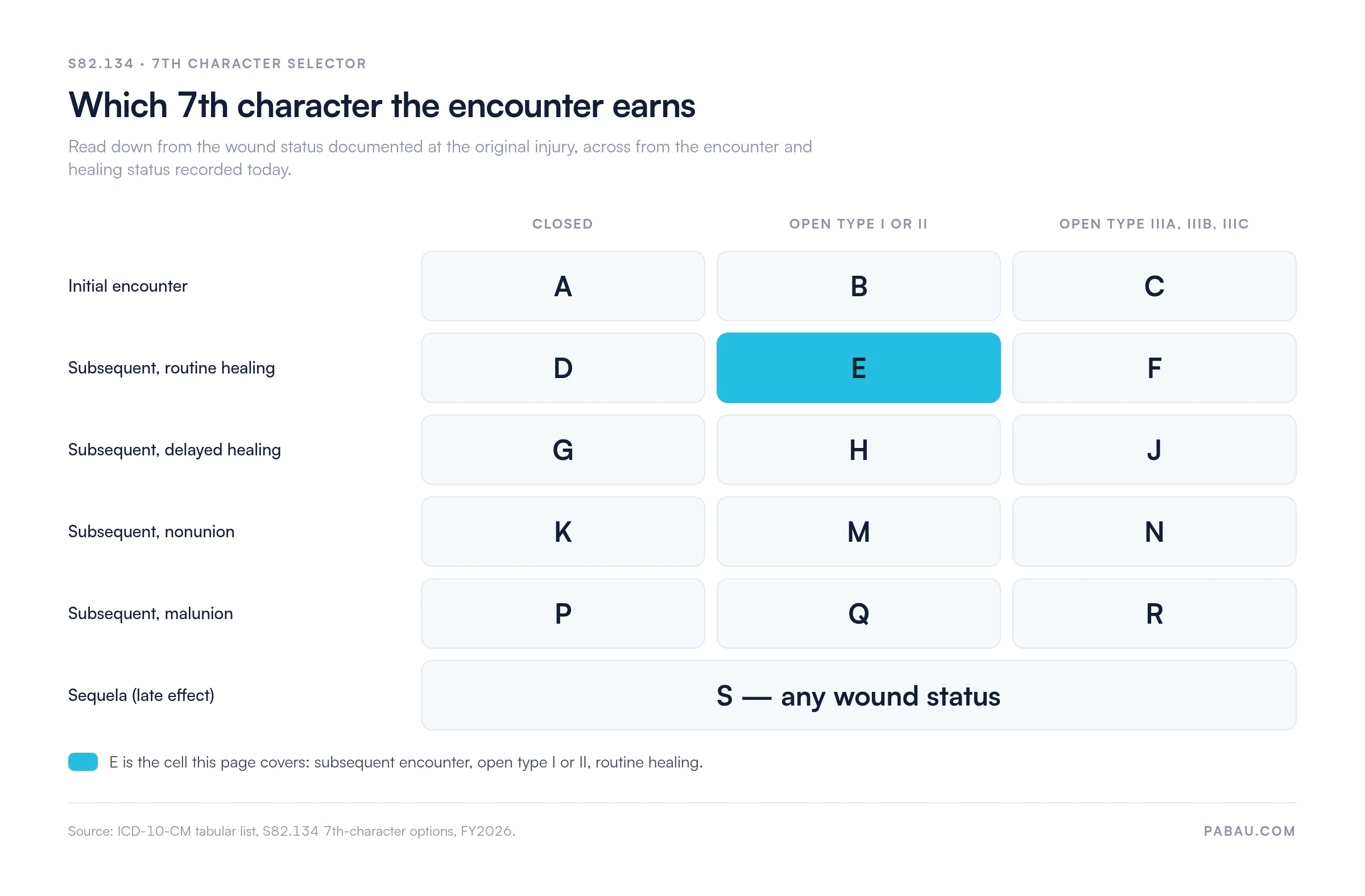
The 7th character in S82.134x codes encodes three pieces of information simultaneously. It records the encounter type, the fracture opening status, and the healing status. Getting this character wrong is the single most common reason S82.134 claims are denied or audited.
The table below lists every valid 7th character for the S82.134 code family. The open-fracture characters follow the Gustilo-Anderson grade documented at the time of the original acute injury.
Character E is the only option in this family that satisfies all three conditions at once. The encounter is a follow-up, the wound was graded I or II at injury, and healing is running normally. The grid below puts every combination on one screen.
The AAPC Codify ICD-10-CM lookup can confirm which 7th character options are valid for a given code.
The Gustilo-Anderson classification is the grading system ICD-10-CM uses to map open fracture severity to 7th characters. A physician or surgeon must document the Gustilo grade in the operative or clinical note at the time of acute injury. Without that note, coders cannot accurately assign the E character on subsequent visits.
Gustilo grading is a physician determination. Coders should never assign an open fracture grade from the wound description alone. When the operative note documents only “open fracture” without specifying the type, query the treating physician. Defaulting to type I without documentation is an audit risk.
S82.134E sits within the ICD-10-CM chapter covering injury, poisoning, and certain other consequences of external causes (S00-T88). Reading the full parent hierarchy is what keeps Includes and Excludes notes applied at the right level.
The sixth character of S82.134 carries displacement and laterality together, and a 4 means nondisplaced on the right. Its siblings are S82.135 for the left tibia and S82.136 where the side is not recorded. All three share the same 7th character options. ICD-10-CM guidelines direct coders to select the most specific code the documentation supports.
The encounter type character is the most clinically nuanced element of S82.134 coding. “Subsequent encounter” does not mean the patient’s second visit. It means the patient is receiving care after the initial definitive treatment for the fracture has been completed.
One rule from the ICD-10-CM Official Guidelines, Section I.C.19 catches most teams out. A patient may need several initial-encounter visits before definitive treatment is finished. A patient seen in the ED for emergent debridement, then returning next day for ORIF, gets the initial encounter character on both visits. The subsequent encounter character begins with the next visit after that.
Check the operative note for the phrase ‘definitive fixation’ or ‘definitive management.’ Once that language appears, subsequent visit coding begins. If the note describes staged procedures still in progress, the initial encounter character still applies. For open type I or II that character is B, until the final stage is documented as complete.
S82.134E belongs to a family of codes sharing the same anatomical site. Choosing among them means confirming three data points: laterality, displacement status, and whether an open wound was present at the original injury. The table below maps the S82.13x variants you meet most often during claim review.
Every code in that table stays at the medial condyle. When the record places the fracture in the tibial shaft instead, coders leave S82.13 for the S82.2 family. A nondisplaced spiral shaft fracture on the right, open type IIIA, IIIB, or IIIC and healing routinely, is coded S82.244F.
Four data elements must be explicitly documented to support S82.134E on a claim. Missing any one of them shifts the code to a less specific alternative, which can trigger a records request or a denial on specificity grounds. The documentation standards set out in medical billing compliance show how a thin note becomes claim risk.
When any of the four elements is missing, query the physician before coding rather than defaulting to an unspecified variant. ICD-10-CM coding guidelines do not permit coders to infer clinical information the documentation never states.
The S82 category carries Excludes2 notes that define which conditions may be coded alongside S82.134E on the same claim.
No Excludes1 notes apply directly to S82.134E itself. The Excludes1 restrictions on the broader S82 category concern ankle fractures (S82.84-). They apply when an ankle fracture and a tibial condyle fracture occur at the same encounter. The full WHO ICD-10 classification hierarchy lists the notes attached at each code level.
Most claim denials and audit flags for this code cluster around four predictable errors. Each one surfaces on the remittance advice as one of the common denial codes, so the pattern is visible well before an appeal is written.
Practices submitting orthopedic claims electronically benefit from structured coding workflows. Practice management software like Pabau screens ICD-10-CM codes against payer edits before a claim is transmitted. Mismatched code combinations get flagged at the point of care. Tracking outcomes over time through cleaner claims management shows billing teams where the same error repeats across providers and encounter types.
Run a quarterly audit on all S82.134x claims submitted with character D. Cross-reference against the original injury notes for Gustilo documentation. Any claim where the original injury was open but D was used should be reviewed for corrected claim submission within the payer’s timely filing window.
Most orthopedic billing teams verify the 7th character by hand. A coder opens the operative note to find the Gustilo grade. A second lookup in the follow-up note confirms the encounter type. The code is then typed into a claim form. No step in that chain catches a wrong character before submission.
Pabau keeps the coding decision next to the record it came from. Diagnosis codes attach to the encounter inside the patient record. A follow-up visit therefore carries the injury it follows and the grade documented at the time. Claims then route through Claim.MD, the clearinghouse Pabau submits through, which screens ICD-10-CM codes against payer edits first.
The outcome is fewer corrected claims and shorter appeal queues. A wrong 7th character surfaces while the encounter is still open, rather than 30 days later on a remittance advice.

Pabau’s claims management supports accurate ICD-10-CM coding, cleaner claim submission, and faster reimbursement for orthopedic and trauma practices.

S82.134E rewards practices that write the Gustilo grade down once, at the moment of injury, and keep it where the follow-up coder can find it. Every later decision on this code rests on that one line in the operative note.
The trade-off worth remembering is specificity against speed. Reaching for D because the chart never says “open” is faster, and it is the error payers spot most reliably in claims history. A physician query costs a day; a corrected claim costs a cycle.
Set the standard at the injury visit, and the subsequent encounters code themselves. Book a demo to see how Pabau keeps each coding decision attached to the orthopedic record it came from.

Need guidance on denial management for orthopedic claims? Denial management in healthcare billing covers how to identify, track, and appeal common payer denials across ICD-10-CM coded claims.
Looking for a reference on ICD-10-CM coding compliance? Medical billing compliance outlines documentation standards and coding accuracy requirements for US healthcare practices.
Want to understand how clearinghouses process fracture claims? 837 file submission explains how electronic claim files carry ICD-10-CM diagnosis codes from practice management systems to payers.
ICD-10 Code S82.134E is the billable ICD-10-CM diagnosis code for a nondisplaced fracture of the medial condyle of the right tibia. It covers a subsequent encounter for an open fracture, type I or II, with routine healing. It is valid for HIPAA-covered claim submissions under the FY2025/FY2026 ICD-10-CM code set.
Yes, S82.134E is a billable, specific ICD-10-CM code valid for use in HIPAA-covered electronic transactions. It is not a header or non-billable category code. Claims submitted with S82.134E meet the specificity requirements of CMS and commercial payers for subsequent-encounter orthopedic fracture coding.
The 7th character E in ICD-10-CM fracture codes means subsequent encounter, open fracture type I or II, with routine healing. It applies when the patient is in follow-up care after definitive treatment. The original injury must have been graded Gustilo I or II, with no nonunion or malunion documented.
Use S82.134A for the initial encounter when the fracture is closed. Use S82.134D for a subsequent encounter on a closed fracture with routine healing. Use S82.134E for a subsequent encounter when the original fracture was open, Gustilo grade I or II, and is healing without complication. The open-versus-closed distinction at the time of original injury drives the choice between D and E.
Four elements must be documented. The fracture must be explicitly described as nondisplaced, and the site must be identified as the medial condyle of the tibia. The original operative or emergency note must record a Gustilo grade I or II open wound. The current visit must be a follow-up after definitive treatment is complete. Missing any element shifts the code to a less specific alternative.
The Gustilo-Anderson classification maps directly to the 7th character for open fracture codes in ICD-10-CM. Grade I and II injuries use 7th characters B (initial), E (subsequent routine), H (subsequent delayed), or M (subsequent nonunion). Grades IIIA, IIIB, and IIIC map to characters C, F, J, and N instead. A physician must document the grade at the time of the acute injury, because coders cannot infer it from a wound description.