ICD-10 Code S66.308A: Extensor muscle injury, other finger
ICD-10 Code S66.308A: Definition and code hierarchy ICD-10 Code S66.308A is the ...

Last Updated: Oct 14, 2026
Billable Code Specific Code
S82.122R is the billable ICD-10-CM code for displaced fracture of lateral condyle of left tibia, subsequent encounter for open fracture type IIIA, IIIB, or IIIC with malunion. Assigning it correctly means five elements appear in the record. Those are the fracture site and side, displacement, encounter type, Gustilo grade, and healing outcome.
The code is valid for FY2026, effective October 1, 2025.
Let Pabau's smart automation suggest the right codes, reduce claim denials, and keep your practice compliant—effortlessly.
Automate repetitive tasks and focus on what matters most—your patients.
Reduce coding errors and ensure compliance with the latest regulations.
Clean claims, fewer denials, and faster reimbursements.
Powerful insights and reporting to help your practice thrive.
HIPAA compliant SOC 2 certified GDPR-compliant Trusted by 4,000+ clinics worldwide

S82.122R is a billable ICD-10-CM code, valid for fiscal year 2026, for a displaced fracture of the left tibial lateral condyle.
The 7th character R encodes three facts at once: subsequent encounter, open fracture type IIIA, IIIB or IIIC, and malunion.
All three must be documented. If any one is missing, a different sibling code in the S82.122 family applies instead.
Malunion and nonunion are separate healing outcomes with separate codes, and imaging alone cannot settle which one the physician has diagnosed.
Pabau’s claims management software integrates with Claim.MD to validate ICD-10-CM codes at submission and route clean claims to thousands of US payers.
ICD-10 Code S82.122R is a billable ICD-10-CM diagnosis code for a follow-up visit after a displaced fracture of the left tibial lateral condyle. The original injury was an open fracture, graded Gustilo type IIIA, IIIB, or IIIC, and it has since healed in an abnormal position.
Initial encounter codes, the suffixes A, B, and C, cover active treatment. S82.122R applies only once that treatment is complete and the patient returns for ongoing management of the healing complication. Medicare, Medicaid, and commercial payers accept it for reimbursement when documentation supports every component of the full description.
The code is active and valid for the 2025 and 2026 fiscal years with no scheduled revision. It sits within the S82 category for fractures of the lower leg, alongside tibial shaft, fibular, and bimalleolar fractures.
The 7th character in ICD-10-CM fracture codes carries three pieces of clinical information at once. It records the encounter phase, the fracture type and its Gustilo grade, and the healing outcome.
For S82.122R, the character R combines subsequent encounter, open type IIIA/IIIB/IIIC, and malunion. All three must be present in the clinical record. The grid below maps every suffix in the S82.122 family onto the two facts that decide it.
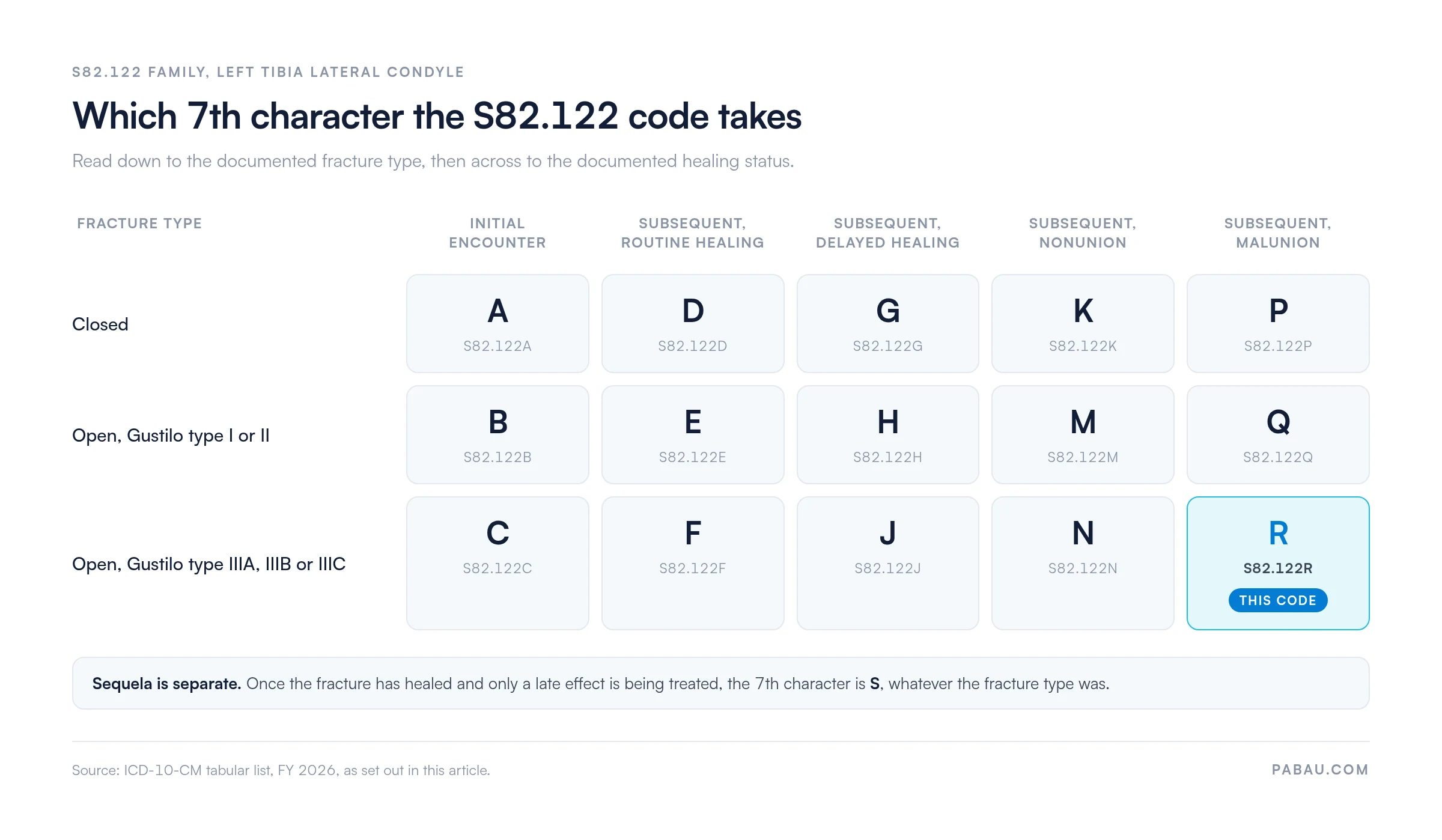
The full 7th character table for the S82.122 code family is below. Use it alongside physician documentation to confirm the suffix before submitting a claim.
The S82.122 family covers every encounter type and healing outcome for a displaced fracture of the lateral condyle of the left tibia. The table below maps each sibling code. Check it before submitting to Medicare or a commercial payer, and verify against the CDC/NCHS ICD-10-CM web tool for the current fiscal year.
S82.122R sits at the sixth level of the ICD-10-CM hierarchy. Understanding the structure helps coders confirm specificity and find adjacent codes when documentation is incomplete. The tabular list moves from broad injury chapters down to codes specific by site, laterality, and encounter.
If the fracture is on the right side, the correct parent is S82.121 rather than S82.122. If displacement is not documented, move to S82.125 for the left nondisplaced variant.
The Gustilo-Anderson classification is the clinical framework ICD-10-CM uses to distinguish open fracture severity. Per AAPC ICD-10-CM coding guidance, coders must identify the Gustilo type from operative or clinical notes before assigning an open-fracture 7th character. The type cannot be inferred from imaging or assumed from the mechanism of injury.
The operative report is the primary source for Gustilo type. Documentation of a high-energy open fracture with extensive soft tissue loss requiring flap coverage points to type IIIB.
Where the type is stated outright, use the stated classification. Coders should query the physician when documentation is ambiguous rather than defaulting to a lower grade.
Malunion and nonunion are the two most commonly confused healing outcomes in fracture coding. For an open type IIIA/IIIB/IIIC left tibial condyle fracture, the choice is between S82.122R and S82.122N. Both are billable, but they describe clinically distinct situations and pair with different surgical CPT codes.
ICD-10-CM coding conventions require coders to work from physician-documented diagnoses. Never upgrade a note of delayed healing to nonunion or malunion based on the number of weeks since injury.
When querying a physician about healing status, ask whether the fracture has healed in an abnormal position (malunion) or has failed to heal (nonunion). These are distinct clinical terms and distinct ICD-10 codes. Phrasing the query correctly reduces back-and-forth and gets a usable answer the first time.
Every element below must be confirmed in the clinical record before assigning ICD-10 Code S82.122R. A single missing element shifts the code to a different sibling or requires a physician query.
The AHA Coding Clinic for ICD-10-CM/PCS is the definitive source for scenario-specific guidance when documentation does not map cleanly to a single code. Review the relevant quarterly issues on tibial fracture coding before finalizing complex cases.
The ICD-10-CM Official Guidelines for Coding and Reporting are published annually by the NCHS and CMS. They set the rules for fracture subsequent encounters in Chapter 19. The points that matter most for S82.122R are these:
The CMS ICD-10-CM coding guidelines page publishes the full guidelines document for each fiscal year. Download the current version before coding complex fracture cases, because minor rule clarifications appear in the annual update.
S82.122R is accepted by Medicare, Medicaid, and most commercial payers when it is paired with a clinically appropriate CPT procedure code. For malunion repair of a tibial condyle fracture, coders commonly pair the diagnosis with CPT codes for osteotomy or revision internal fixation. Verify the pairing against current NCCI edit tables before submitting.
Practice management software like Pabau submits claims electronically through Claim.MD, routing ICD-10-CM coded claims to thousands of US payers including Medicare and Medicaid. Codes are validated at submission, and ERA remittance data returns to the practice so reimbursements can be reconciled quickly.
For orthopedic and musculoskeletal practices, the most common denial pattern on subsequent encounter claims is an initial encounter code submitted for a follow-up visit. Catching it before the claim leaves the practice is cheaper than appealing it afterwards.
Common denial triggers for S82.122R and its siblings include:
A systematic process catches these errors before they reach the payer. Our guide to denial management sets out how practices build one, from the first rejection through to appeal.
The codes below are the most clinically adjacent to S82.122R. Verify laterality, displacement, and encounter type against the clinical scenario before selecting any of them. Our diagnostic codes library carries a reference page for each one. The ICD List lookup tool confirms current code validity and descriptions for the active fiscal year.
Orthopedic and musculoskeletal practices face a particular coding challenge. The 7th character changes at every visit as healing status progresses. The original Gustilo type also has to travel accurately through the whole episode of care. A documentation error on the initial encounter note cascades through every later code for that patient.
Pabau’s claims management software connects to the Claim.MD clearinghouse and applies built-in CPT and ICD-10-CM catalogs at submission. Codes are checked before the claim leaves the practice, so a mismatch surfaces while the chart is still open.
For a code like S82.122R, where five clinical parameters must align, that timing matters. Correcting the record at the point of coding avoids an appeal weeks later.
Structured encounter notes carry the original fracture type, laterality, and displacement into every follow-up visit template. That removes the manual step of re-reading the initial operative note each time a subsequent encounter code is assigned.
Build a simple encounter note template for tibial condyle fracture follow-ups that auto-populates the Gustilo type, laterality, and displacement from the initial encounter. This ensures the five elements required for S82.122R are always present without relying on the coder to cross-reference the original operative report.

Pabau’s claims management software validates ICD-10-CM codes at submission and routes clean claims through Claim.MD to thousands of US payers. See how orthopedic and musculoskeletal practices connect coding and reimbursement in one system.

Assigning ICD-10 Code S82.122R correctly depends on five documented facts aligning in the record. Those are the left lateral condyle, displacement, a subsequent encounter, open type IIIA/IIIB/IIIC, and malunion.
Miss one and the claim carries a different sibling code, with different reimbursement and a different denial risk. The practical safeguard is a follow-up note template that carries the initial encounter’s facts forward. The coder then never has to reconstruct them from an operative report.
Book a demo to see how Pabau validates ICD-10-CM codes and routes clean claims for orthopedic practices.
ICD-10 Code S82.122R is the billable ICD-10-CM code for a displaced fracture of the lateral condyle of the left tibia. It applies to a subsequent encounter for an open fracture of type IIIA, IIIB, or IIIC that has healed with malunion. It is valid for fiscal year 2026 and accepted by Medicare, Medicaid, and most commercial payers.
The 7th character R combines three facts: a subsequent encounter, an open fracture of type IIIA, IIIB, or IIIC, and malunion. It applies only after active treatment is complete and the fracture has healed in an abnormal position, as documented by the treating physician.
Malunion means the fracture healed in an abnormal position. For an open type IIIA/IIIB/IIIC left tibial condyle fracture, that is S82.122R. Nonunion means the fracture failed to heal within the expected timeframe, which is S82.122N. Both require explicit physician documentation, because imaging or elapsed time cannot settle the outcome.
Yes, S82.122R is a fully billable and specific ICD-10-CM code, confirmed valid for fiscal year 2026 by the NCHS and CMS tabular list. It can be submitted directly on a claim without further extension.
Subsequent encounter fracture codes, the 7th characters D through S, apply once active treatment is complete. The patient is then returning for routine management of the healing phase, such as physical therapy, cast changes, or monitoring. Use initial encounter codes, B or C for open fractures, when the patient receives definitive treatment for the first time. They also apply when a new provider takes over active care.
The Gustilo-Anderson classification determines which 7th character group applies to an open fracture. Types I and II use one set of suffixes: B for initial, then E, H, M and Q for subsequent outcomes. Types IIIA, IIIB and IIIC use a separate set: C for initial, then F, J, N and R for subsequent outcomes. The treating physician must document the Gustilo type, because coders cannot assign an open fracture grade without it.