

ICD-10 Code S42.444P: Medial epicondyle fracture, right humerus
ICD-10 Code S42.444P: full descriptor and code validity ICD-10 Code S42.444P car...

Last Updated: Oct 13, 2026
Billable Code Specific Code
S82.091N is the billable ICD-10-CM code for other fracture of right patella, subsequent encounter for open fracture type IIIA, IIIB, or IIIC with nonunion.
One letter is doing all of that work. Change the grade to type I or II and the code becomes S82.091M, a different injury with different documentation behind it. So the Gustilo grade is the first fact to confirm, ahead of the healing status.
Let Pabau's smart automation suggest the right codes, reduce claim denials, and keep your practice compliant—effortlessly.
Automate repetitive tasks and focus on what matters most—your patients.
Reduce coding errors and ensure compliance with the latest regulations.
Clean claims, fewer denials, and faster reimbursements.
Powerful insights and reporting to help your practice thrive.
HIPAA compliant SOC 2 certified GDPR-compliant Trusted by 4,000+ clinics worldwide

ICD-10 code S82.091N reports an other fracture of the right patella at a subsequent encounter. The original open fracture was Gustilo type IIIA, IIIB, or IIIC, and it has reached nonunion.
The Gustilo grade is what the N character turns on. If the open fracture was type I or II, the nonunion code is S82.091M instead.
S82.091N is billable and valid for CMS claim submission in fiscal years 2026 and 2027. A closed patella fracture with nonunion takes S82.091K.
Nonunion is not delayed healing. On a type III open patella fracture, routine healing takes F, delayed healing takes J, and malunion takes R.
ICD-10 code S82.091N is a billable ICD-10-CM diagnosis code. Its full official description is: Other fracture of right patella, subsequent encounter for open fracture type IIIA, IIIB, or IIIC with nonunion.
That description is unchanged across the FY2026 and FY2027 code sets. Confirm it in the CDC/NCHS ICD-10-CM web tool or the CMS ICD-10-CM tabular list.
Four clinical facts sit inside that one code. The fracture is of the right patella, not the left and not an unspecified side. It was an open fracture, so bone or the fracture site communicated with the outside through the wound.
The Gustilo grade was type IIIA, IIIB, or IIIC, meaning extensive soft tissue damage or a vascular injury. And the bone has reached nonunion at a subsequent encounter, after active treatment ended.
Assign S82.091N only when the record supports all four.
ICD-10-CM is hierarchical, and each level adds specificity. Reading the chain matters for one practical reason. Excludes notes and coding instructions attach at the category and block level, then apply to every code beneath them.
The rules that govern S82.091N sit several levels above it in the tabular list.
S82.091 on its own is not billable. It needs the 7th character, and because the base code is only six characters long, no placeholder X is required. Payers reject the stem code outright, so the full seven characters have to reach the claim form intact.
That final letter carries the most billing-critical information in the code. It encodes three things at once.
The first is the encounter phase: initial, subsequent, or sequela. The second is the fracture type: closed, open type I or II, or open type IIIA to IIIC. The third is how the bone healed. For S82.091N, the answers are subsequent, open type IIIA/IIIB/IIIC, and nonunion.
The full set for S82.091 runs from A to S, though the letters I, L, and O are never used. ICD-10-CM avoids I and O because they read like the digits 1 and 0 on a claim form.
Here is every option, with the three-way split laid out.
Read the table in columns rather than rows and the logic falls out. Each fracture type owns a run of four subsequent-encounter characters. The order never changes: routine healing, delayed healing, nonunion, then malunion.
Laid out as a grid, the whole set fits on one screen, and N stops being a letter you have to memorize.
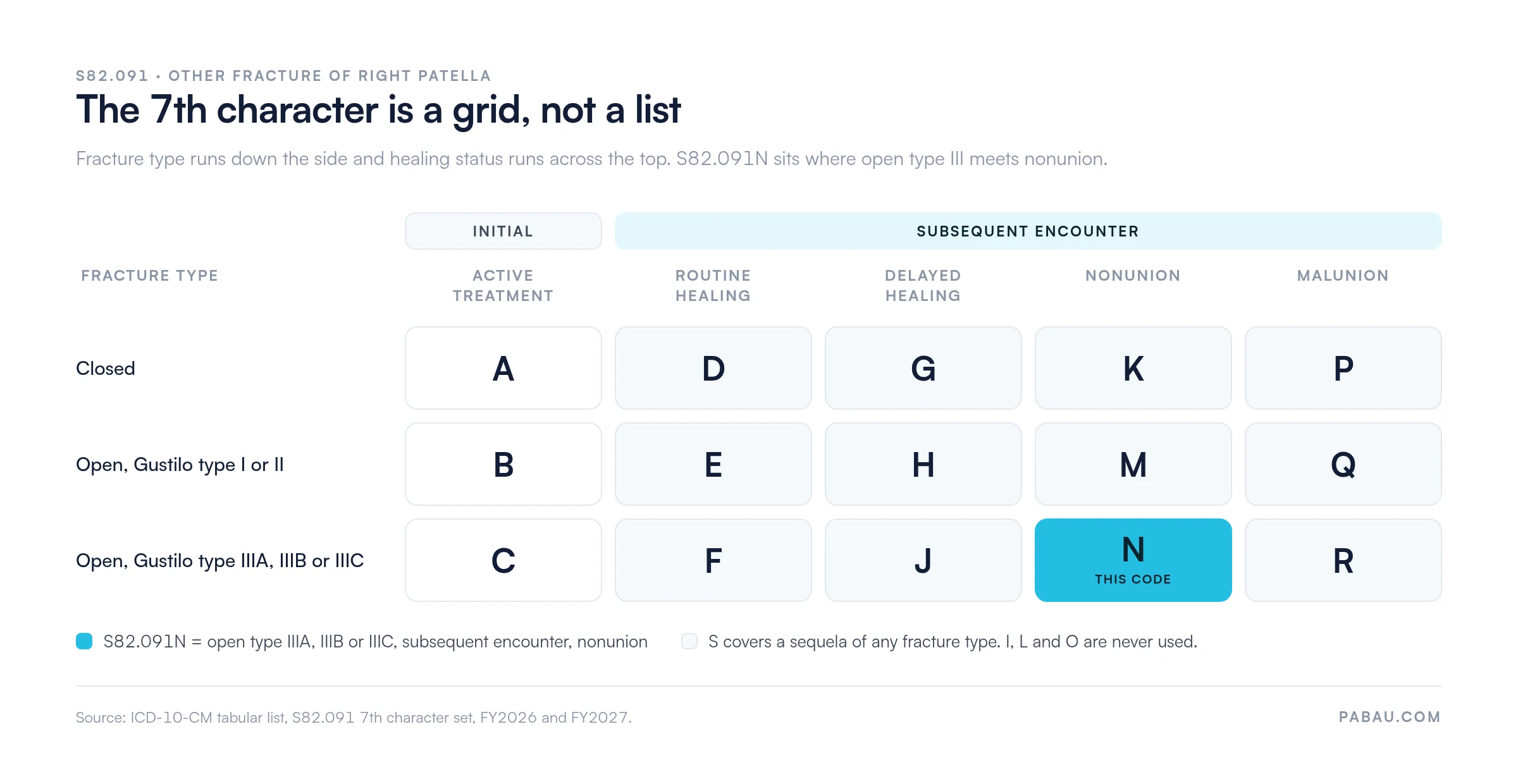
AAPC’s ICD-10-CM code reference lists the same 16 extensions for the S82.091 stem.
Coders misapply encounter type more often than any other part of a fracture code. The ICD-10-CM Official Guidelines define it by treatment phase, not by visit number, and the difference has direct billing consequences.
For S82.091N, the patient is past active treatment. Imaging or clinical assessment shows the right patella has stopped healing.
One caveat trips coders here. Say the surgeon performs a fresh operative procedure for the nonunion at this visit. That surgery treats the nonunion, so the encounter still takes N, the subsequent character. Initial-encounter characters belong to active treatment of the original fracture, not to a later revision.
Confirm that the treating clinician has written the healing status in the note before you assign nonunion (N), delayed healing (J), or malunion (R). Phrases such as ‘healing slowly’ or ‘not yet healed’ do not support a nonunion code. The note should say ‘nonunion’ outright, or reference imaging that shows no bridging callus across the fracture line.
The Gustilo-Anderson classification grades open fractures by wound size, contamination, and soft tissue damage.
ICD-10-CM borrows it directly, and the category note at S82 states that the open fracture designations are based on it. S82.091N belongs to the type III group only.
Two consequences follow from that table. First, ICD-10-CM collapses IIIA, IIIB, and IIIC into one 7th character group, so you never have to choose between them for coding purposes. The subgrade still belongs in the operative note, but it does not change the letter.
Second, and this is the error to watch, a type I or II open patella fracture with nonunion is S82.091M, not S82.091N. Malunion after a type I or II open fracture is S82.091Q. Neither of those is a type III code.
Nonunion means the fracture has stopped healing. Orthopedic practice commonly treats a fracture as a nonunion when serial imaging shows no progressive healing over roughly six to nine months.
That threshold varies by bone and by institution. Check your own protocol or the orthopedic literature rather than assuming a single universal number.
Coding-wise, the distinction matters because each healing status carries its own character. For a right patella open type III fracture at a subsequent encounter, the four options are:
Delayed healing and nonunion get confused constantly, because both describe a fracture that has not united. The clinical record has to draw the line. If the note describes progressing callus, J is correct.
If it describes a fracture line that has not changed across two or more imaging studies, N is the one to use.
Six facts have to be on the chart before S82.091N holds up, and the Gustilo grade is the one that usually is not. Start with why these injuries are difficult in the first place.
The patella is a sesamoid bone sitting inside the quadriceps tendon, which is part of why open patella fractures behave badly. A type III injury usually comes from high-energy trauma, such as a motor vehicle collision or a fall onto a hard surface.
By the time nonunion is on the chart, the surgeon is typically weighing bone grafting, revision fixation, bone stimulation, or partial patellectomy.
None of that reaches the payer unless the note carries it. Run this checklist against every subsequent encounter you code with S82.091N.
The Gustilo grade is the item that goes missing most often. It gets documented once, in the operative report, and then never repeats.
Six months later the follow-up note says “right patella fracture, nonunion” with no fracture type at all. A coder cannot assign N from that. Pulling the grade forward into the problem list at discharge solves it in one step.
Chapter 20 codes do not stop at the initial visit, and that trips people up. Report the external cause code for every encounter where you are treating the injury, and give it 7th character D for a subsequent encounter.
So a fall coded W19.XXXA at presentation becomes W19.XXXD at the nonunion follow-up.
Three companion code sets work differently. Place of occurrence (Y92), activity (Y93), and external cause status (Y99) are reported only at the initial encounter for the injury.
Repeating them on a follow-up claim is a common audit finding. It is easy to avoid once the rule sits on the team’s cheat sheet.
Patients move through this family as the episode unfolds, from the initial open fracture code to whichever healing outcome the bone reaches.
Keeping the whole set in view makes the jump from one encounter to the next much less error-prone.
Two neighboring stems are worth knowing as well.
S82.001, S82.002, and S82.009 cover unspecified patella fractures. S82.01 through S82.04 cover the named patterns, meaning osteochondral, longitudinal, transverse, and comminuted displaced fractures. S82.09 is the “other” bucket, used when the record names a patella fracture that none of those patterns fit.
Transverse is one of those named patterns, so a documented displaced transverse break leaves the S82.09 stem entirely. For a closed right patella at the initial encounter, the displaced transverse code is S82.031A. If that transverse fracture was open at Gustilo type IIIA to IIIC with no side documented, the initial-encounter code is S82.033C.
At a nonunion follow-up, the procedure performed drives CPT selection, and the diagnosis code supports medical necessity for it. The codes below show up most often on type III patella nonunion claims.
Verify each one against the current AMA codebook before you submit, since CPT is revised annually. The AMA CPT code set overview is the authoritative reference.
Global period is what to watch on this list. If the original fracture surgery is still inside its 90-day global period, an unrelated follow-up needs the right modifier. A return to the operating room for the nonunion needs modifier 78.
Check the surgery date before the claim goes out.
Each of these turns up repeatedly on orthopedic audits. Fixing them upstream costs far less than working the appeal.
When one of these does slip through, the remittance advice usually tells you which. Our guide to denial codes in medical billing maps the common CARC and RARC codes to the correction each one needs. That is the fastest route from a rejection to a clean resubmission.
Audit your S82 subsequent-encounter claims once a quarter. Pull every claim coded with a routine-healing character (D, E, or F) and read the matching clinical note. If the note says ‘no callus’, ‘failed union’, or ‘nonunion’, the character should have been K, M, or N instead. Systematic misassignment across a busy orthopedic caseload builds audit exposure.
S82.091N inherits instructions from S82 and from the S80-S89 block. Check them against the rest of the diagnosis list before the claim leaves.
That last point is easy to lose. Type IIIC is defined by arterial injury. If the vascular repair still matters clinically at this encounter, it needs its own code alongside S82.091N. New to this level of specificity? Our primer on medical billing covers how diagnosis and procedure codes support each other on a claim.
Run these seven questions over the claim. If any answer is no, the claim is not ready.
Most S82.091N denials start as a documentation handoff problem. The grade was documented and the coder knew the rule. The detail simply did not survive the trip from the operative report to the claim form six months later. That is a systems issue, and software is where you fix it.
Pabau, practice management software built for healthcare practices, keeps the diagnosis attached to the record rather than to someone’s memory. Coders search an ICD-10 lookup library inside the EMR, so the seven-character code goes on the encounter at the point of care.
That code then pre-fills onto the claim instead of being retyped. Required-field validation runs before submission, so an incomplete code or a missing field surfaces while the claim is still yours to fix.
From there, Pabau’s claims management submits electronically through Claim.MD in the US, Healthcode in the UK, and Tyro in Australia. The dashboard then shows where each claim stands. Pabau does not decide whether N or M is correct. It keeps the code you chose intact all the way to the payer.
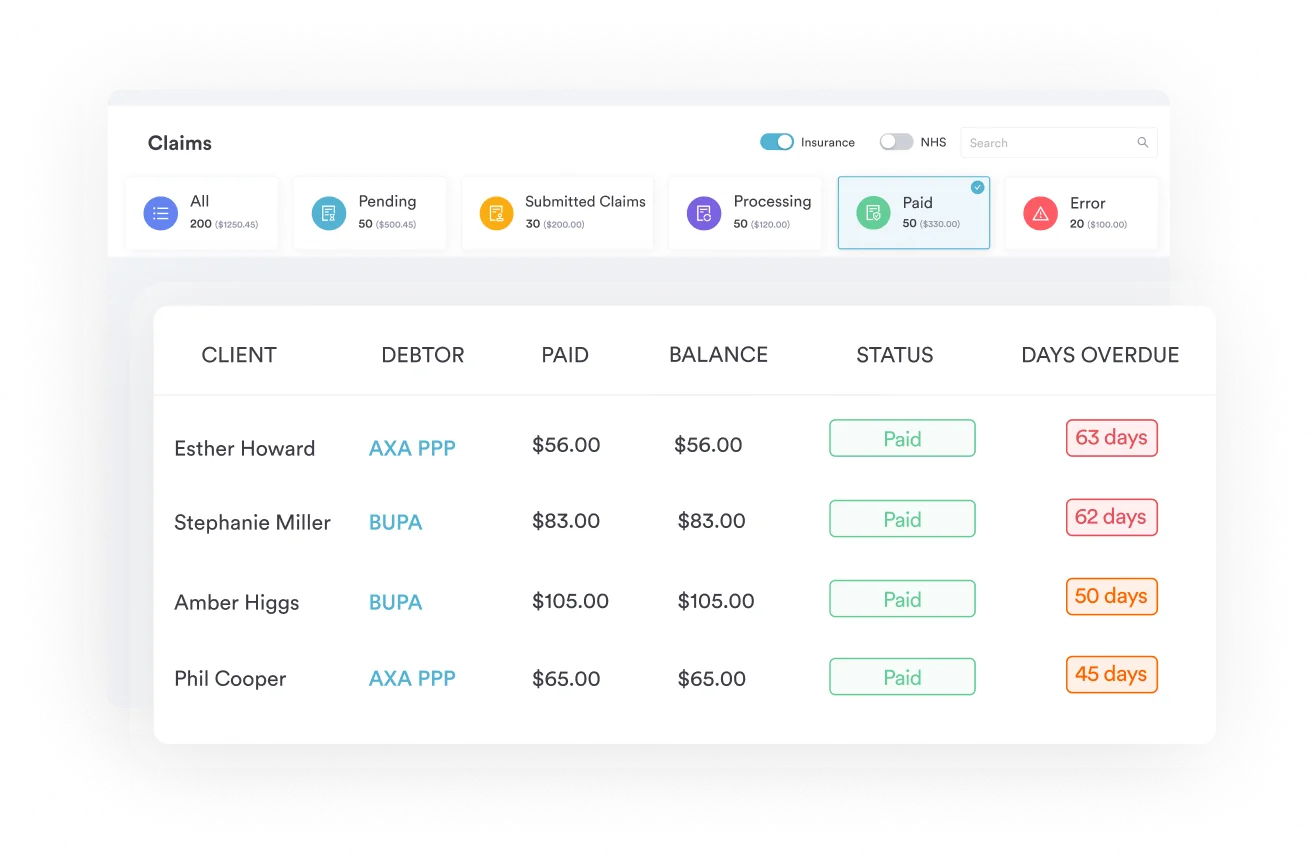

Pabau puts an ICD-10 lookup inside the EMR, pre-fills the code onto the claim, and checks required fields before you submit. See how it handles complex fracture follow-ups.

S82.091N comes down to one distinction. The right patella was broken by a Gustilo type IIIA, IIIB, or IIIC open fracture. Active treatment has finished, and the bone has not united.
Change any one of those facts and the code changes with it. Type I or II shifts the letter to M, a closed fracture to K, delayed healing to J, and malunion to the R character.
If codes keep getting lost between the chart and the claim, fix it at the workflow level rather than the appeal level. Book a demo and see how Pabau carries a seven-character diagnosis from the encounter note straight through to submission.

Working a rejection on a fracture claim? Denial codes in medical billing explains the common CARC and RARC codes and the correction each one calls for.
New to the claim lifecycle? What is medical billing walks through how a diagnosis code, a procedure code, and the documentation behind them combine into a payable claim.
Seeing repeat denials across a whole code family? Denial management in healthcare covers how to spot the pattern, appeal effectively, and stop the same error recurring.
S82.091N reports an other fracture of the right patella at a subsequent encounter. The original open fracture was Gustilo type IIIA, IIIB, or IIIC, and it has reached nonunion.
Yes. It is a complete seven-character ICD-10-CM code and is valid for CMS claim submission in fiscal years 2026 and 2027. It is also exempt from POA reporting.
Only the Gustilo grade. M covers an open type I or II fracture with nonunion. N covers open type IIIA, IIIB, or IIIC with nonunion. Laterality, encounter phase, and healing status are identical.
S82.091R on the right side, and S82.092R on the left. Within the type III group, F is routine healing, J is delayed healing, N is nonunion, and R is malunion.
Report the external cause code with 7th character D at every subsequent encounter where you treat the injury. Place of occurrence, activity, and external cause status codes belong to the initial encounter only.
No. The base code S82.091 already has six characters, so the 7th character N attaches directly. Placeholder X is only needed when a code is shorter than six characters.




