ICD-10 code K85.90: Acute pancreatitis without necrosis
ICD-10 code K85.90: Definition and clinical description ICD-10 code K85.90 is th...

Last Updated: Nov 13, 2026
Billable Code Specific Code
M25.569 is the billable ICD-10-CM code for pain in unspecified knee. It applies when the encounter note records knee pain but never names the right or left side. A note that names a side takes M25.561 (right) or M25.562 (left), and pain in both knees takes both codes.
Once the provider diagnoses a knee condition such as osteoarthritis, that code replaces M25.569, because the pain is integral to the diagnosis.
Let Pabau's smart automation suggest the right codes, reduce claim denials, and keep your practice compliant—effortlessly.
Automate repetitive tasks and focus on what matters most—your patients.
Reduce coding errors and ensure compliance with the latest regulations.
Clean claims, fewer denials, and faster reimbursements.
Powerful insights and reporting to help your practice thrive.
HIPAA compliant SOC 2 certified GDPR-compliant Trusted by 4,000+ clinics worldwide

ICD-10 Code M25.569 describes pain in unspecified knee, and it is the right code only when the encounter note records no side at all.
Use M25.561 for the right knee or M25.562 for the left whenever the physician documents a side. Choosing M25.569 when a side is on record is a coding error.
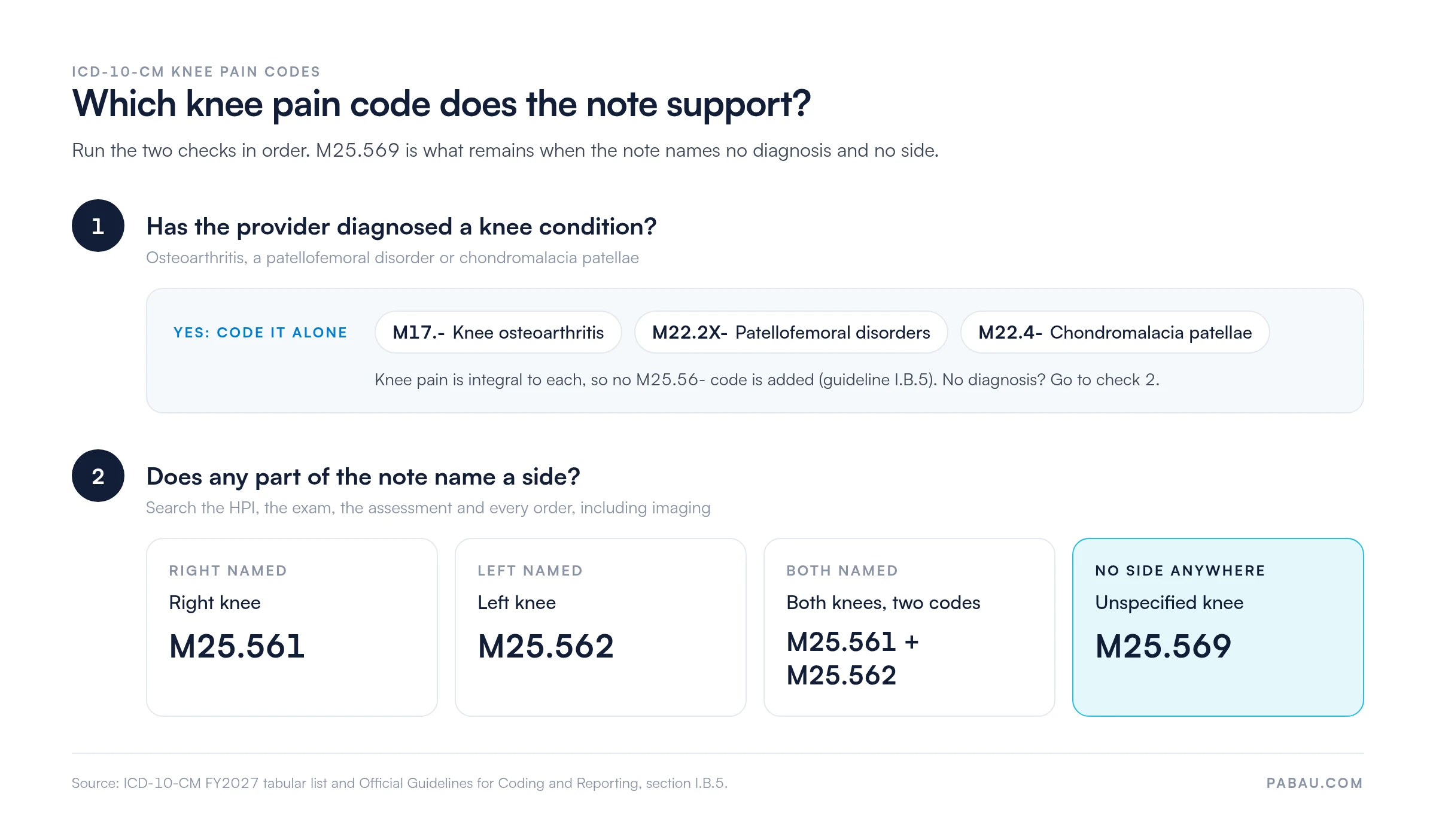
M25.569 carries no Excludes1 note. Once knee osteoarthritis (M17.-), a patellofemoral disorder (M22.2X-) or chondromalacia patellae (M22.4-) is diagnosed, report that code alone. The pain is integral to the diagnosis.
In Pabau’s claims management software, the note and the claim sit in one record. Coders can check the documented side before submission.
ICD-10 Code M25.569 is the billable ICD-10-CM code for pain in unspecified knee. It fits a note that records knee pain but never says which knee. If the note names the right knee, use M25.561. If it names the left, use ICD-10 code M25.562, and pain in both knees takes both codes.
A diagnosed knee condition, such as osteoarthritis, replaces the symptom code altogether. The table below gives the facts a coder needs before billing M25.569.
M25.569 covers pain arising from or localized to the knee joint when the documentation does not specify right or left. The pain can come from any structure in or around the knee. That includes the articular cartilage, synovial membrane, joint capsule, patellar tendon, collateral ligaments and periarticular soft tissue.
It does not capture pain from a named, diagnosable condition such as osteoarthritis or chondromalacia. Those conditions have their own codes.
The word “unspecified” in the descriptor refers to laterality, not to clinical certainty. A patient with documented pain in both knees is not an M25.569 case. Code both knees separately, as M25.561 and M25.562. Typical M25.569 presentations include:
The M25.56 subcategory assigns a final digit to identify which knee is affected. ICD-10-CM convention requires coders to use the most specific code available, so a documented side must be coded. Shoulder pain works the same way, so a note that names the left shoulder takes M25.512.
The unspecified code M25.569 is a last resort. Per the CMS ICD-10-CM coding guidelines, coders must code to the highest level of specificity supported by documentation. If a provider writes “right knee” anywhere in the note, including the history of present illness or the assessment, M25.561 applies instead.
M25.569 is valid only when the physician’s documentation contains no laterality information at all. The rule is simple. Search the entire encounter note before defaulting to unspecified.
The CDC/NCHS ICD-10-CM tabular tool lists the whole M25.56 family side by side. Under the official guidelines, an unspecified code is for a record that lacks the detail, not for coder convenience. The chart below puts the checks in the order a coder runs them.
M25.569 carries no Excludes1 note. Every exclusion note above it in the FY2027 ICD-10-CM tabular list is an Excludes2. That means the excluded condition is not part of M25.569, but both codes may be reported when the patient has both conditions.
Knee osteoarthritis (M17.-), patellofemoral disorders (M22.2X-) and chondromalacia patellae (M22.4-) appear in none of these notes. M25.569 still stays off the claim once one of them is diagnosed, for a different reason.
Section I.B.5 of the ICD-10-CM Official Guidelines says signs and symptoms routinely associated with a disease process are not coded separately. Knee pain is integral to all three conditions, so report the definitive diagnosis on its own.
Adding M25.569 next to one of those codes is a specificity and guideline error, not a tabular Excludes1 code pair. Payer edits and medical review can still deny or pend the claim, so remove the symptom code before submission.
Several knee-related codes share overlapping clinical presentations with M25.569. The table below gives the differentiators coders need to choose correctly on the first submission.
A claim supported by M25.569 must have documentation that justifies both the knee pain diagnosis and the absence of laterality. Payer auditors look for five elements in the clinical note.
M25.569 appears as the primary diagnosis on claims across evaluation, imaging, therapy, and injection services. The table lists the most common CPT pairings and the medical necessity context each requires.
When 73721 (knee MRI) is ordered alongside M25.569, check that the radiology requisition does not name a specific knee. If it does, laterality is documented and M25.561 or M25.562 applies. Submitting M25.569 against an order for the right knee is a reconciliation error that payers catch routinely.
Medicare and commercial payer policies for knee pain claims vary by MAC jurisdiction and plan. No universal prior authorization rule applies to M25.569 itself, but several downstream services trigger review.
Knee pain claims coded with M25.569 are denied more often than their laterality-specific counterparts. The denial patterns below account for the majority of rework on these claims.
The denial management workflow matters as much as the first submission. An M25.569 appeal works best with a copy of the original note, the line showing no side was recorded highlighted. Add any imaging report that supports the unspecified code.
The checklist in what makes a clean claim stops most of these denial patterns at the point of service.
Understanding where M25.569 sits in the ICD-10-CM hierarchy explains why coders must exhaust more-specific options before landing here.
A final character of 9 usually signals “unspecified” in ICD-10-CM. Before reporting one, a coder confirms that the record holds no more specific detail. For M25.569, that means checking every part of the encounter note for a side: subjective, objective, assessment and plan.
The AAPC ICD-10-CM lookup and the ICD List tool both show the full code hierarchy and excludes notes. Either works as a second check before submission.
Most M25.569 denials start with a mismatch between documents. The exam names a side, the imaging order names a side, and the claim still says unspecified. A coder working across separate systems has to compare them by hand, claim by claim.
Pabau, the practice management platform we build, keeps the encounter note, the orders and the claim on one patient record. Its claims management software lets your coder check the diagnosis against the note before submission. If the MRI order says right knee, that shows up before M25.569 reaches the payer.
US claims go out through Claim.MD, a clearinghouse for electronic claims submission to thousands of US payers. It also runs real-time eligibility verification for over 400 payers.
Eligibility checks and remittances come back to the same record. Prior authorizations for knee MRIs are tracked on the case, with a warning when one is missing.

Pabau keeps the encounter note, the imaging orders and the claim on one record. Your team confirms the documented side before a knee pain claim goes out.

Treat M25.569 as the code for a note that never names a side. Before you bill it, read the HPI, the exam, the assessment and every order for “right” or “left.” If a side turns up, the specific code applies. If a diagnosis such as osteoarthritis turns up, its code replaces the symptom.
Querying the provider costs a day on one claim. Skipping the query on an imaging or injection claim risks a denial, an appeal and a second wait for payment.
Pabau’s medical billing workflow keeps the note, the orders and the claim in one record, so that check happens in one place. Book a demo to see how it handles knee pain claims from encounter to payment.

Need to manage physical therapy claims alongside knee pain diagnoses? Physical therapy EMR software covers the documentation workflows that support M25.56x medical necessity.
ICD-10 Code M25.569 is the billable diagnosis code for pain in unspecified knee. The patient has knee pain, but the documentation does not say whether the right or left knee is affected. It sits in the M25.56 subcategory of ICD-10-CM Chapter 13 (M00-M99). It is valid for HIPAA claims when no side appears anywhere in the encounter note.
Use M25.569 only when the physician’s documentation contains no reference to a specific side. M25.561 applies when the right knee is documented, M25.562 when the left knee is documented. If the provider mentions a side anywhere in the subjective, examination, assessment or plan, the laterality-specific code is required. M25.569 is not a permissible substitute.
Yes, M25.569 is a billable ICD-10-CM diagnosis code in the 2027 edition. It is valid for HIPAA-covered transactions. Payers accept it when the documentation shows no side was recorded. Some payers and MAC jurisdictions look harder at unspecified knee codes on imaging or injection claims.
No. Bilateral knee pain documented in the clinical note requires two separate codes: M25.561 (right knee) and M25.562 (left knee). M25.569 is not a bilateral code. It is an unspecified-laterality code for use when no side is documented. Using M25.569 to represent bilateral pain is a coding error. Payers cannot track injections by side, and the claim may trigger an audit.
M25.50 describes pain in an unspecified joint. It is used when the joint involved has not been identified at all. M25.569 is more specific, because the joint is known (the knee), but the side is unspecified. Once a provider documents that the knee is the painful joint, M25.50 no longer applies and the coder should select from the M25.56 family instead.
The most common denial reason is using M25.569 when a side is documented in the chart, usually in the examination or the radiology order. Other denial triggers include billing M25.569 alongside a knee osteoarthritis code, although the pain is integral to OA. The M17 code should be reported alone. Another is submitting an MRI claim without the documented conservative treatment that the applicable LCD requires.