ICD-10 code S61.201A: Open wound of left index finger without nail damage
ICD-10 code S61.201A covers a left index finger wound of unstated type ICD-10 co...

Last Updated: Oct 16, 2026
Billable Code Specific Code
S82.025G is the billable ICD-10-CM code for nondisplaced longitudinal fracture of left patella, subsequent encounter for closed fracture with delayed healing.
The 7th character supplies the rest. It marks a subsequent encounter for a closed fracture with delayed healing.
That closed-fracture detail is where claims are lost. The letter G never describes an open fracture. If the original injury broke the skin, the delayed-healing character is H or J instead.
Delayed healing also has to be stated by the physician. Elapsed time since the injury does not establish it, and neither does a radiology report on its own.
Let Pabau's smart automation suggest the right codes, reduce claim denials, and keep your practice compliant—effortlessly.
Automate repetitive tasks and focus on what matters most—your patients.
Reduce coding errors and ensure compliance with the latest regulations.
Clean claims, fewer denials, and faster reimbursements.
Powerful insights and reporting to help your practice thrive.
HIPAA compliant SOC 2 certified GDPR-compliant Trusted by 4,000+ clinics worldwide

ICD-10 code S82.025G describes a nondisplaced longitudinal fracture of the left patella, coded at a subsequent encounter where a closed fracture is healing slowly.
The 7th character G means closed fracture with delayed healing. Open-fracture delayed healing uses H for Gustilo type I or II, and J for type IIIA, IIIB, or IIIC.
Delayed healing must be stated by the treating physician. Coders cannot infer it from elapsed time or from an imaging report alone.
The right-side sibling is S82.024G. S82.015 is not the right-side pair, because it describes an osteochondral fracture on the same left side.
Practice management software like Pabau ties the 7th character to the note behind it, so wound status and healing outcome are recorded before billing.
Every element of the description carries a coding consequence. Misread one and you select the wrong character or the wrong side. Here is what each part means at the desk.
Coders working from the alphabetic index will find the base code under patella, and under fracture, patella, longitudinal. The quick reference below summarizes its billing status.
Every code in the S82 category needs a 7th character. It records three details at once. The character carries the encounter type, the wound status of the original injury, and the healing outcome.
Delayed healing splits three ways inside that set. G covers closed fractures. H covers open type I or II, and J covers open type IIIA, IIIB, or IIIC. The split follows the documented wound, not the length of the delay. The grid below shows where all 16 characters land.
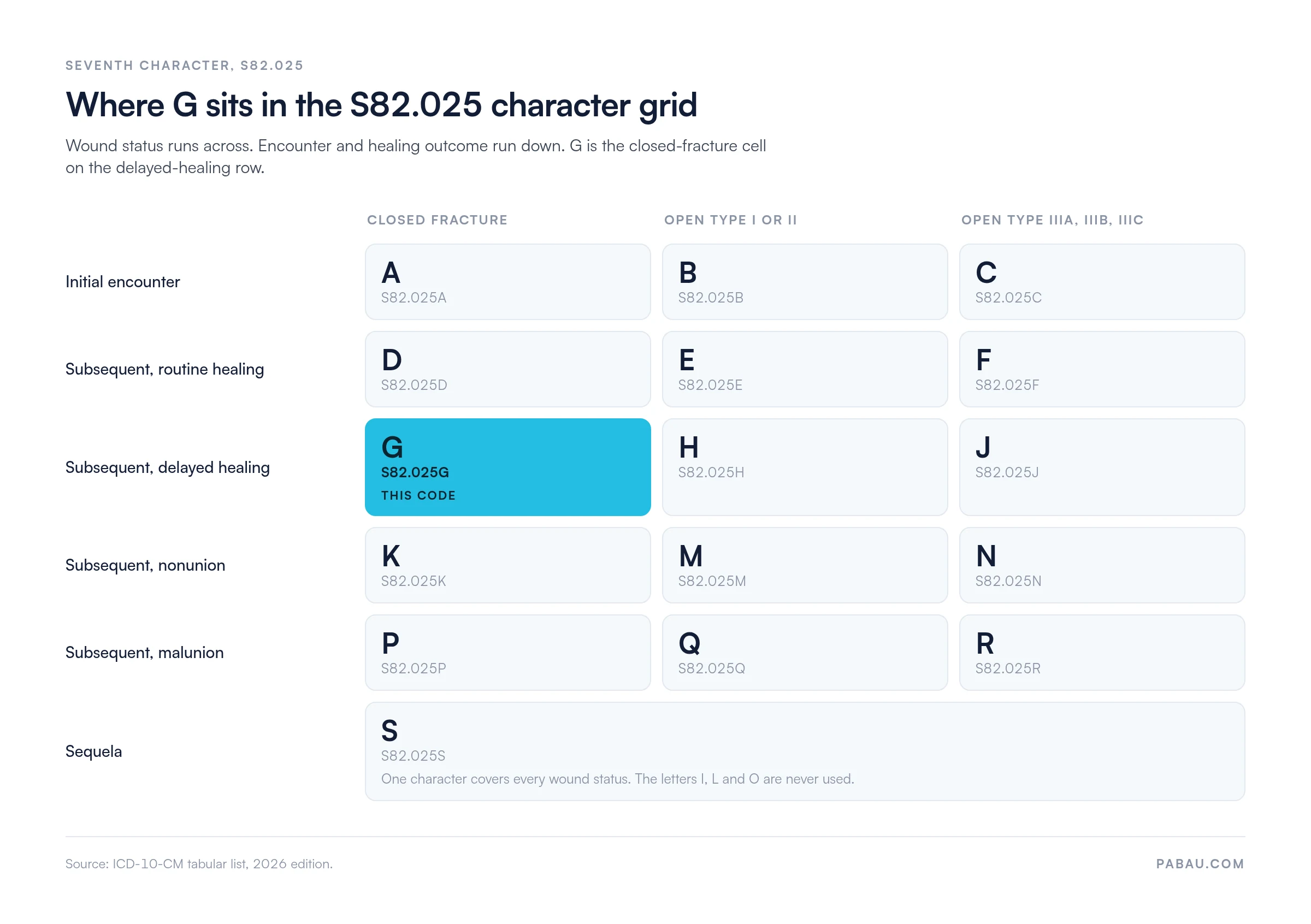
Choosing the wrong character is one of the leading causes of denial on musculoskeletal claims. The same three-way split runs through the tibia shaft codes at S82.226G.
S82.025 has 16 valid 7th characters, and every one of them produces a billable code. The five-character base code S82.025 is never billable on its own.
The set runs from A to S, but the letters I, L and O are never used. That is why the sequence steps from H to J, from K to M, and from N to P.
S82.025G sits in the delayed-healing row for closed fractures. Its neighbor one row down covers the same delay after an open type I or II injury. For malunion in the same fracture family, compare S82.026P.
The patella is the largest sesamoid bone in the body, held inside the quadriceps tendon. It transmits the force of the extensor mechanism across the front of the knee.
A longitudinal fracture runs vertically, parallel to the long axis of the bone. It usually follows a direct blow to the front or the side of the knee. Transverse patterns are considerably more common.
The extensor mechanism often survives a nondisplaced vertical fracture intact. That is why conservative management is standard here. Immobilization in extension is followed by progressive range of motion and weight-bearing.
Nondisplaced patella fractures commonly unite within six to eight weeks. Delayed healing is raised when radiographs show incomplete callus well past that window, while union is still progressing. Several factors make a slow union more likely.
None of these belong in the code itself. They belong in the note that justifies it. Practices running post-fracture rehabilitation can capture them in physical therapy documentation.
Use S82.025G when all five of the following are documented for the same encounter.
Miss the wound status and the claim becomes a guess between G and H. Miss the laterality and the code is unsupported. Both are routine reasons a fracture claim comes back.
The three healing complications are distinct clinical findings, and each has its own character. For a closed fracture in this family, the choice is between G, K and P.
Sequela takes the character S, and only after the healing phase has ended. A nondisplaced transverse patella fracture with a late residual effect is coded S82.036S.
The Gustilo-Anderson system grades the severity of open fractures. ICD-10-CM uses it directly in the 7th character set, so it comes up constantly in fracture coding.
It has no bearing on S82.025G. The letter G describes a closed fracture, and a closed fracture has no wound to grade. Gustilo type only matters once you are choosing between the open-fracture characters.
For delayed healing in this code family, that means H or J. The table below shows which characters each Gustilo type drives.
If the chart records an open patella fracture, take the Gustilo type from the initial operative or emergency note. Coders in sports medicine billing and orthopedics meet this distinction often.
Record why the 7th character was chosen in the coding note. At audit, payers look for physician language stating that healing is delayed, and for the wound status of the original fracture. A note that only shows a return visit will not carry the claim.
The hierarchy explains why the code runs to seven characters, and where to look when the note is less specific. S82.025G sits at the foot of the patella branch of the knee and lower leg block.
S82.025 by itself is not billable. A claim submitted without the 7th character is invalid, and it will reject at the clearinghouse or at the payer.
The codes below are the ones most often confused with S82.025G. Two of them deserve particular attention, because they look like siblings and are not.
S82.015 is the code most often misfiled as the right-side pair for S82.025. It is not. S82.015 sits in the osteochondral subcategory S82.01, on the same left side, describing a different injury.
The right-side longitudinal family is S82.024, so the sibling for this encounter is S82.024G. Every code in the table still needs its own 7th character before it goes on a claim.
Category S82 carries both Excludes1 and Excludes2 notes. The difference between them decides whether two codes may appear together on the same claim.
Excludes notes are revised alongside the tabular list each October. Verify a pairing in the current edition rather than trusting the version you used last year. The AAPC ICD-10-CM lookup is a quick way to cross-check.
S82.025G is valid on the CMS-1500 for professional claims and on the UB-04 for institutional claims. Practices using claims management software can submit it electronically through an integrated clearinghouse.
Payers examine delayed-healing claims more closely than routine follow-up. Five documentation elements decide whether this one survives review.
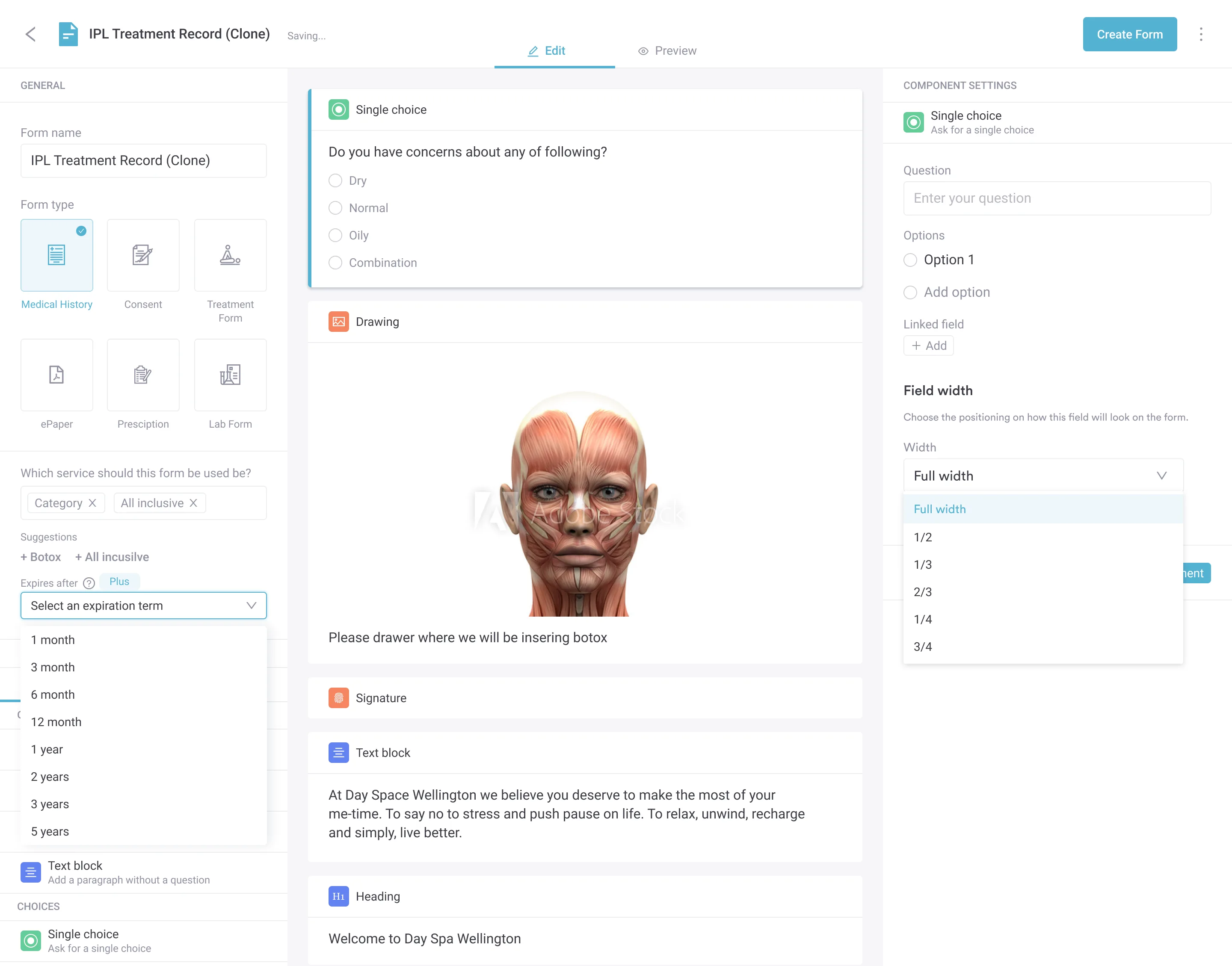
Structured digital clinical forms keep all five elements in one place. Checking those templates against your medical billing compliance policies is the other half of the job.
Diagnosis placement follows the reason for the visit. List S82.025G first when the slow-healing fracture is why the patient is there. External cause codes from Chapter 20 are optional, though they strengthen the record.
Never quote a payment figure for a diagnosis code. Reimbursement depends on the procedure codes billed, the payer, and the locality on the current fee schedule.
Pabau sends electronic claims through our Claim.MD integration, covering CMS-1500 and 837P submission across thousands of US payers. Payments are reconciled from the electronic remittance advice on the same record.
Practices migrating legacy records still need the mapping back to ICD-9-CM. The CMS General Equivalence Mappings are the authoritative source, and every fracture mapping in them is approximate.
The mapping loses almost every detail the 7th character was designed to record. Treat the output as a starting point for research, never as a coding decision.
Chapter 19 of the ICD-10-CM Official Guidelines governs fracture coding across an episode of care. Four of its rules decide most S82.025G submissions.
That second default is the one that catches S82.025G. The word nondisplaced has to be in the note. Without it, the displaced code S82.022 is the correct default for a left longitudinal fracture.
The guidelines are republished with the tabular list each fiscal year, effective October 1. Reading the Chapter 19 fracture section before your annual coding refresh is the cheapest way to catch a change.
A diagnosis code generates no payment on its own. S82.025G supports the procedure codes billed at the same encounter, and those follow the services delivered.
Bone stimulation is subject to payer-specific coverage criteria. Confirm authorization before the device is supplied, rather than after the claim rejects.
Three sources carry the official tabular list and the guidance behind it. Check S82.025G against one of them before submission, then again after each October 1 update.
Fracture coding only holds up if the notes behind it do.
Fracture coding errors usually start in the clinical note. A clinician writes patella fracture, still healing, then moves on to the rehab plan.
The coder is left without the two details that decide the character. Was the original fracture open, and which knee was it? The claim then goes out on an assumption, and it can come back with one of the standard denial codes attached.
Practice management software like Pabau lets you attach documentation prompts to the codes your practice bills most often. A fracture follow-up note then asks for encounter type, wound status, pattern, laterality and healing outcome.
Pabau’s claims management carries that structured note through to submission, so the 7th character you send is the one the record supports. Your team spends less time reworking denials and more time with patients.
Claims management, medical records and reporting are included in every Pabau subscription. No tier locks the documentation templates away, so the whole practice works from the same prompts.

Pabau lets orthopedic and physical therapy teams build code-level documentation prompts into the encounter. Wound status and laterality mismatches surface when the note is completed, well before denial review.

S82.025G is decided in the clinical note, not at the billing desk. One fact about it is worth pinning to the wall. The G stands for a closed fracture.
Get wound status, laterality, fracture pattern and healing outcome into every follow-up note. The 7th character then stops being the coder’s best guess, and the extension table becomes a lookup rather than a gamble.
Pabau’s claims management helps orthopedic and physical therapy practices build those prompts into the encounter workflow. Book a demo to see how it keeps fracture claims tied to the notes that support them.

Need a structured framework for fracture claim submissions? Clean claim submission guidelines covers what makes a claim error-free before it reaches the payer.
Working with orthopedic or physical therapy billing? Revenue cycle management overview explains how ICD-10 diagnosis coding fits into the full claims workflow.
S82.025G is a billable ICD-10-CM code for a nondisplaced longitudinal fracture of the left patella. The 7th character G marks a subsequent encounter for a closed fracture with delayed healing. The original injury was closed, and the physician has documented that union is running behind schedule.
Yes. S82.025G is a specific, billable code valid on the CMS-1500 and UB-04 claim forms. The five-character base code S82.025 is not billable on its own. The 7th character has to be present for the claim to be accepted.
Both are subsequent encounters for a closed fracture, so the difference is the healing outcome. S82.025D is used when healing is on schedule. S82.025G is used only when the physician documents that healing is delayed.
Wound status. G describes a closed fracture with delayed healing, and H describes an open fracture of Gustilo type I or II with delayed healing. Type IIIA, IIIB and IIIC injuries take J instead. Take the wound status from the original injury record, not from the follow-up note.
S82.024G. The right-side longitudinal family is S82.024, so the same encounter and healing detail on a right patella is S82.024G. S82.015 is not the right-side pair, because it describes a nondisplaced osteochondral fracture of the left patella.
Delayed healing means union is running behind the expected timeline while still progressing. The treating physician has to state it in the note. Coders cannot assign it from elapsed time or from an imaging report alone.
Use a subsequent encounter character while the patient is still receiving care for the fracture itself. Follow-up visits, immobilization changes, imaging and rehabilitation all qualify. Reserve the sequela character S for a residual condition that remains after the healing phase has ended.
No. The S82.02 longitudinal patella fracture family has been in ICD-10-CM for years, and it predates the FY2020 edition. S82.025G appears in the 2026 edition of the ICD-10-CM manual the same way every other active code does.