ICD-10 Code Y76.0: Diagnostic obstetric and gynecological devices
ICD-10 Code Y76.0: Definition and billable status ICD-10 Code Y76.0 is a valid, ...

Last Updated: Oct 23, 2026
Billable Code Specific Code
S82.022J is the billable ICD-10-CM code for displaced longitudinal fracture of left patella, subsequent encounter for open fracture type IIIA, IIIB, or IIIC with delayed healing.
Sixteen different 7th characters attach to that same base code, each marking a different point in the recovery. Here's how the letter J pins down this exact patient, and why the parent code alone won't get the claim paid.
Let Pabau's smart automation suggest the right codes, reduce claim denials, and keep your practice compliant—effortlessly.
Automate repetitive tasks and focus on what matters most—your patients.
Reduce coding errors and ensure compliance with the latest regulations.
Clean claims, fewer denials, and faster reimbursements.
Powerful insights and reporting to help your practice thrive.
HIPAA compliant SOC 2 certified GDPR-compliant Trusted by 4,000+ clinics worldwide

S82.022J is a billable ICD-10-CM code for a displaced longitudinal fracture of the left patella. It covers a subsequent encounter for an open fracture type IIIA, IIIB, or IIIC with delayed healing.
The 7th character J carries three facts at once. The encounter is subsequent, the original wound was graded Gustilo type IIIA, IIIB, or IIIC, and healing is delayed.
Delayed healing is one step short of nonunion. Once the surgeon declares nonunion on a type IIIA to IIIC open fracture, the code becomes S82.022N.
S82.022 is non-billable on its own. Sixteen 7th characters turn it into a valid code, and J is the one for a type IIIA to IIIC wound that is healing late.
Practice management software like Pabau pre-fills the claim from the visit record and routes it to your clearinghouse. The 7th character stays a coder’s call.
ICD-10 code S82.022J covers a displaced longitudinal fracture of the left patella, seen at a follow-up visit. The original wound was open and graded Gustilo type IIIA, IIIB, or IIIC, and healing is running late.
That single letter J says the encounter is subsequent, the wound was type III open, and healing is delayed. Change one of those facts and the letter changes, which is where these claims usually go wrong.
The parent code S82.022 will not pay on its own, because it needs a 7th character to be complete. Sixteen letters are available, and the sections below narrow them down to the one this patient needs.
S82.022J is a billable FY 2026 code in the injury chapter, S00-T88, under category S82. Both CMS in the ICD-10-CM annual release and the CDC/NCHS ICD-10-CM web tool carry the descriptor word for word.
S82.022J sits at the bottom of a seven-step ladder. Reading it from the top is the quickest way to land on the right child code.
The same ladder shape repeats across our other ICD-10-CM code guides, so the route down to this one will look familiar.
Note where the displaced and nondisplaced split happens. S82.02 covers longitudinal patella fractures as a group, and the next digit separates displaced (S82.021 to S82.023) from nondisplaced (S82.024 to S82.026).
The right patella takes S82.021J, and an unspecified side takes S82.023J. Laterality is not optional, so the note has to name the left patella.
Three facts sit inside that one letter. It records the phase of care, the Gustilo grade on the original wound, and the current healing status.
For ICD-10 code S82.022J, all three have to be true together. Active fracture care is finished, the original wound was graded Gustilo type IIIA, IIIB, or IIIC, and the physician has documented delayed healing. Miss any one of them and a different letter applies.
The table below shows every billable child code under S82.022, per the AAPC ICD-10-CM code lookup.
There is no I, L, or O in that list. ICD-10-CM skips those three letters across fracture 7th characters so they cannot be misread as the digits 1 and 0. A claim built around S82.022I or S82.022O will fail validation, because neither code exists.
Read the same 16 characters as a grid and the choice gets faster. Find the wound status on the left, the healing status along the top, and the letter is where they meet.
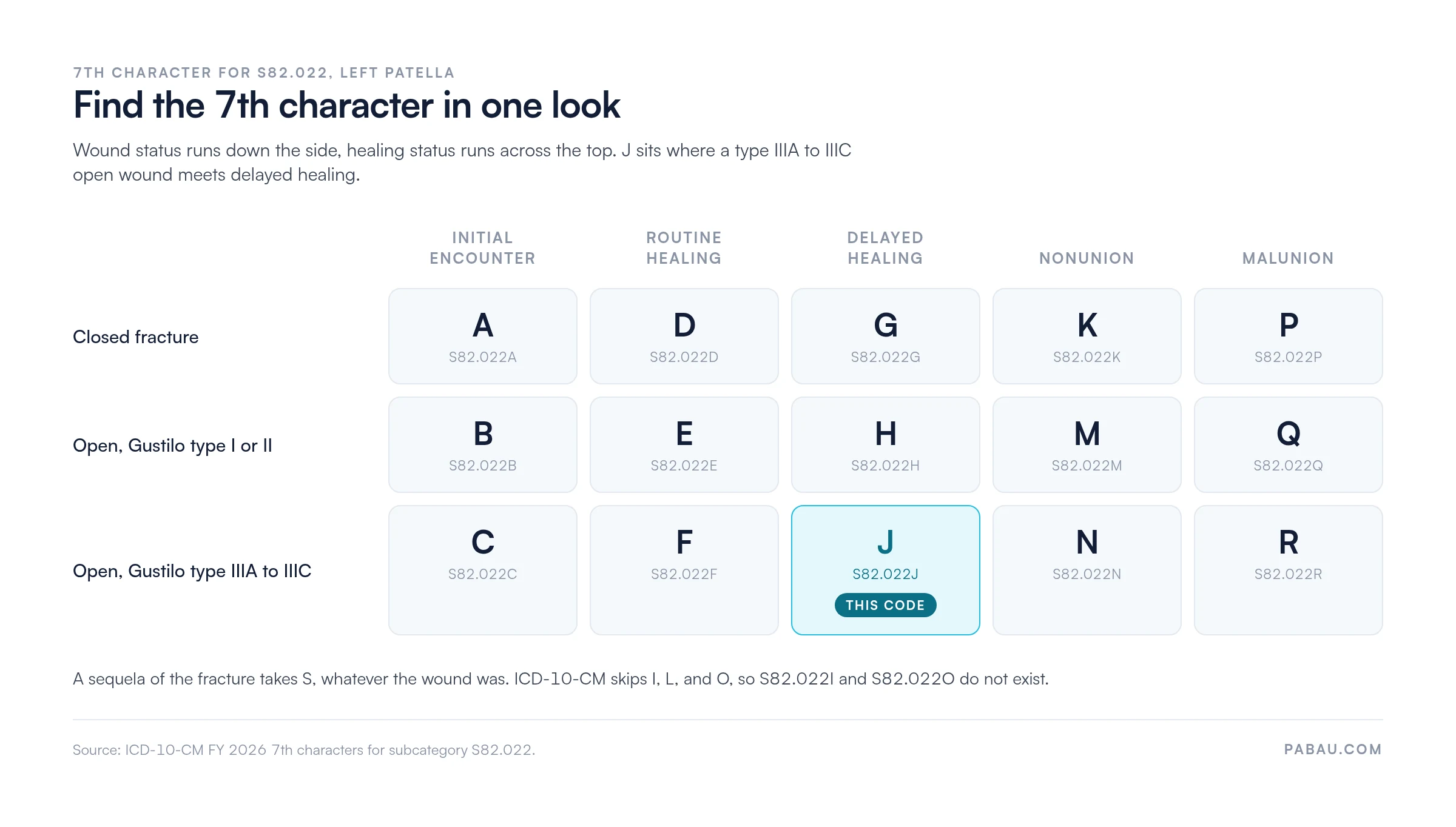
Displacement matters here for two reasons. It decides whether the fracture goes to surgery, and it puts the case on the S82.022 branch rather than the nondisplaced one.
The patella (kneecap) is a sesamoid bone embedded in the quadriceps tendon. A longitudinal fracture splits it along its vertical axis, roughly parallel to the long axis of the leg. That is a different pattern from the common transverse split, and from a comminuted fracture with several fragments.
A displaced transverse fracture of the right patella, closed at the initial encounter, takes S82.031A instead. Where the record names no side and the wound was graded type IIIA, IIIB, or IIIC, that first visit takes S82.033C.
Displaced means the fragments have moved apart. Orthopedic consensus puts that at more than 2 mm of separation, or more than 2 mm of articular step-off. A nondisplaced longitudinal fracture is often managed conservatively instead.
These fractures usually follow direct trauma, such as a dashboard injury, a fall onto the knee, or a sports impact. They are less common than transverse fractures. Patients present with anterior knee pain and swelling, and where displacement is significant they cannot perform a straight-leg raise.
Character J applies only when the original fracture was graded Gustilo type IIIA, IIIB, or IIIC. The Gustilo-Anderson classification grades open fractures by how much soft tissue was damaged. A type I or type II wound with the same delayed healing takes character H instead.
That single grade, recorded once at the first debridement, drives the letter on every later claim.
Treat the wound sizes above as guides rather than rules. Gustilo grading is a clinical judgment the treating surgeon makes at the first debridement, and the measurement matters less than the soft tissue picture. Type IIIC is graded on the arterial injury alone, whatever the wound measures.
For a coder, the grade is a fact to look up rather than to derive. If the operative report names type IIIA, IIIB, or IIIC and the current note documents delayed healing, character J applies.
So the operative report decides the letter, not the follow-up note. Where it says only open fracture, query it before the claim goes out.
Delayed healing means the fracture is still uniting, only slower than expected for this pattern and this patient. No fixed day count moves a patella fracture from routine healing to delayed.
The usual support is serial radiographs showing callus that is thinner or later than the surgeon expected, read alongside the clinical picture.
Open type III injuries drift into this territory often. Stripped periosteum and lost soft tissue slow the blood supply the bone heals on.
Three neighboring healing states each take their own character, and on a type IIIA to IIIC open patella fracture they read as follows.
For S82.022J, the physician has to say that healing is delayed. A line reporting continued pain does not carry the character on its own. Point to the imaging finding, add the clinician’s reading of it, and the assignment holds up in an audit.
Documenting nonunion by mistake pushes the claim onto S82.022N, which is a different clinical story and often a different treatment plan.
Encounter type turns on the phase of care, not on whether the patient has been seen before. The ICD-10-CM guidelines are explicit about it.
A patient can be brand new to your practice and still need a subsequent-encounter character, because active treatment for the fracture happened somewhere else.
The Official Guidelines put an initial character (A, B, or C) on any visit where the patient is receiving active treatment. That covers surgery, emergency care, and a new physician who starts a treatment plan.
Once active treatment ends and the patient moves into aftercare or monitoring, the subsequent characters take over.
Those scenarios all run on the same rulebook. Seven rules from the CMS ICD-10-CM Official Guidelines for Coding and Reporting do most of the work on this code.
Applying those rules the same way every time keeps patella claims out of the rework pile. Practices that lean on medical claims management get the claim form pre-filled from the visit record.
They also get a warning when a payer-required field is left blank. Choosing the 7th character is still a human judgment on the chart.
Six elements have to appear in the medical record to support S82.022J. Each one maps to a distinct piece of the descriptor, and missing any of them creates an undercoding or overcoding risk.
Structured note templates and digital forms can prompt the provider for all six while the patient is still in the room. That costs a few seconds. A query letter three weeks later costs a good deal more.
S82.022J travels on the charge line, attached to the service the provider billed. From there the finished claim goes to your clearinghouse first, not straight to the payer.
Your clearinghouse screens the format and checks that every code on the claim exists. Only then does the payer weigh up whether the story hangs together.
Those two checkpoints catch very different mistakes. A claim carrying the bare parent S82.022 gets rejected early, because a code without its 7th character is not a code.
By contrast, nobody upstream can see that the note says type II while the claim says J, so that one sails straight through. It surfaces months later, in an audit or a records request.
A clean claim is one that clears both checkpoints first time, and on this code it comes down to the same five details. Run them before you submit.
Two mistakes account for most of the rework on this code. One is carrying J forward on autopilot after the surgeon has declared nonunion, when the code should have moved to S82.022N.
The other is a laterality slip, where an earlier claim says left and this one says right.
The table below gathers the codes most often swapped for this one. Some share the wound grade and differ on healing. Others share the healing status and differ on the wound, and two are simply the other side.
ICD-9-CM never had this much detail on fracture laterality or healing status. The equivalents below help with retrospective chart reviews and legacy data mapping, but they are approximate rather than exact.
ICD List offers free ICD-9 to ICD-10 crosswalk tools if you want to check a mapping.
ICD-9-CM had no code for delayed healing at all. A slow-healing open patella fracture was reported as 822.1, with the healing detail left in the note. ICD-10-CM moved healing status into the 7th character, which is why J exists and why the chart now has to support it.
A practice following a delayed-healing patella fracture handles the same facts several times over. The Gustilo grade sits in an operative report from whoever did the first debridement. Today’s note holds the healing status. Then someone types the claim form up from both.
Practice management software like Pabau closes that loop. Pabau pre-fills the claim from the visit record, so the codes attached to the service land on the charge line without re-typing. It then checks that the fields your payer requires are complete before anyone can send the claim.
From there Pabau routes the claim to the clearinghouse your region uses, such as Claim.MD for US practices. Choosing between H, J, and N stays with your coder, because that call belongs to whoever read the operative report. What you get back is the time you used to spend re-keying and chasing half-finished claim forms.
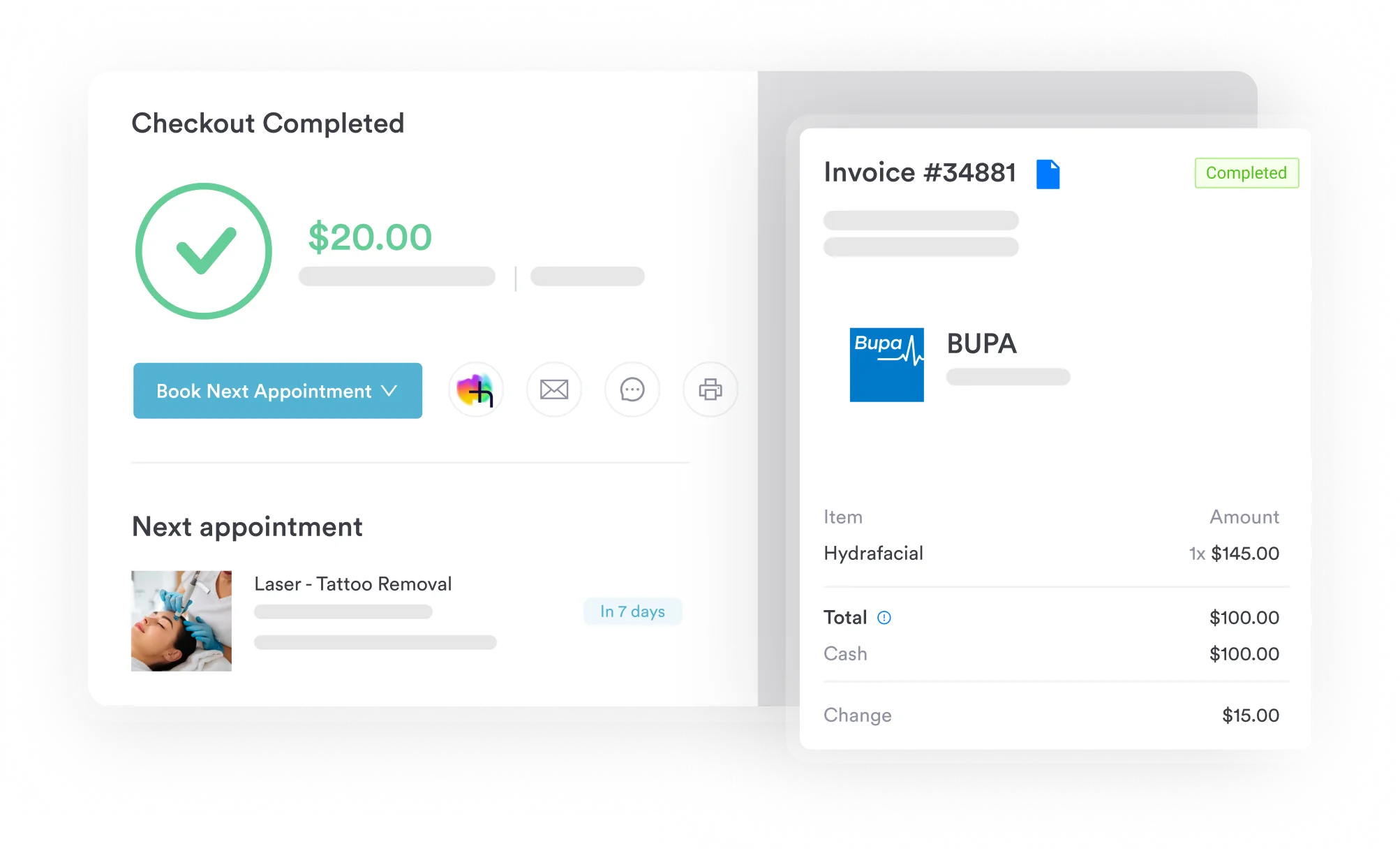

Pabau pre-fills the claim from the visit record, checks the fields your payer requires, and routes it to your clearinghouse. See how that works for orthopedic and physical therapy practices.

S82.022J asks for four facts that sit in four different corners of the chart. Only one of them, the healing status, turns up in the note you are reading today. The other three travel from the operating room, the imaging report, and whoever first wrote down a side.
So pull the operative report before you code. Then confirm the grade, the side, and the healing status while the patient is still in the room. A minute of specificity at the visit saves a week of rework later. The letter only gets harder to defend as the chart ages.
Pabau keeps the visit record, the codes, and the claim in one place, so those four facts stop travelling by memo. Book a demo to see how that shortens the trip from note to paid claim.

Working through the rest of the patella subcategory? S82.016B takes the same subcategory to an osteochondral pattern, graded open type I or II at the initial encounter.
Need the nondisplaced, closed corner of the same table? S82.026P shows how the pattern and the healing status pull the code away from S82.022J.
Coding a fracture where healing has stopped altogether? S72.309N puts the nonunion character on a femur shaft fracture, which is the same call one step up the leg.
Want fewer of these claims coming back? Denial management in healthcare sets out a process for catching documentation problems before the payer does.
No. ICD-10-CM reports fracture aftercare through the injury code and its 7th character, so S82.022J covers the follow-up visit on its own. Z codes stay for separate services, such as removal of internal fixation.
Report one while the injury is still being treated. External cause codes carry their own 7th character, so a subsequent visit takes D there instead. Sequence the fracture code first, then the code for how the injury happened.
No. ICD-10-CM has no separate code for the wound grade, so the 7th character is the only place it appears on the claim. That is why the original operative report has to be in front of you.
No. Modifiers attach to the procedure code, not the diagnosis. ICD-10-CM already carries the side inside S82.022J, so LT or RT belongs on the CPT line if your payer asks for it.
No. S82.022 already fills six characters, so J drops straight into the seventh position. A placeholder X appears only where the base code is shorter, which is common in the external-cause chapter.