ICD-10 Code S42.444P: Medial epicondyle fracture, right humerus
ICD-10 Code S42.444P: full descriptor and code validity ICD-10 Code S42.444P car...

Last Updated: Oct 13, 2026
Billable Code Specific Code
S75.809D is the billable ICD-10-CM code for unspecified injury of other blood vessels at hip and thigh level, unspecified leg, subsequent encounter.
Getting the code right means reading two things off the note. The vessel class comes first, then the subsequent-encounter requirement carried by the D character. The code is effective for fiscal year 2026 and valid in every HIPAA-covered transaction from October 1, 2025 through September 30, 2026.
The CDC/NCHS ICD-10-CM web tool is the authoritative source for confirming billable status by fiscal year. Always verify against the current tabular list before submitting a claim, particularly when a code has not been used recently.
Let Pabau's smart automation suggest the right codes, reduce claim denials, and keep your practice compliant—effortlessly.
Automate repetitive tasks and focus on what matters most—your patients.
Reduce coding errors and ensure compliance with the latest regulations.
Clean claims, fewer denials, and faster reimbursements.
Powerful insights and reporting to help your practice thrive.
HIPAA compliant SOC 2 certified GDPR-compliant Trusted by 4,000+ clinics worldwide

S75.809D is a billable ICD-10-CM code for unspecified injury of other blood vessels at hip and thigh level, unspecified leg, subsequent encounter
The 7th character D confirms a subsequent encounter: active treatment is complete and the patient is receiving routine follow-up care
Use S75.809D only when laterality is genuinely undocumentable, not simply undocumented by oversight
Pabau’s claims management software and Claim.MD clearinghouse integration help coders submit S75.809D claims accurately across thousands of US payers
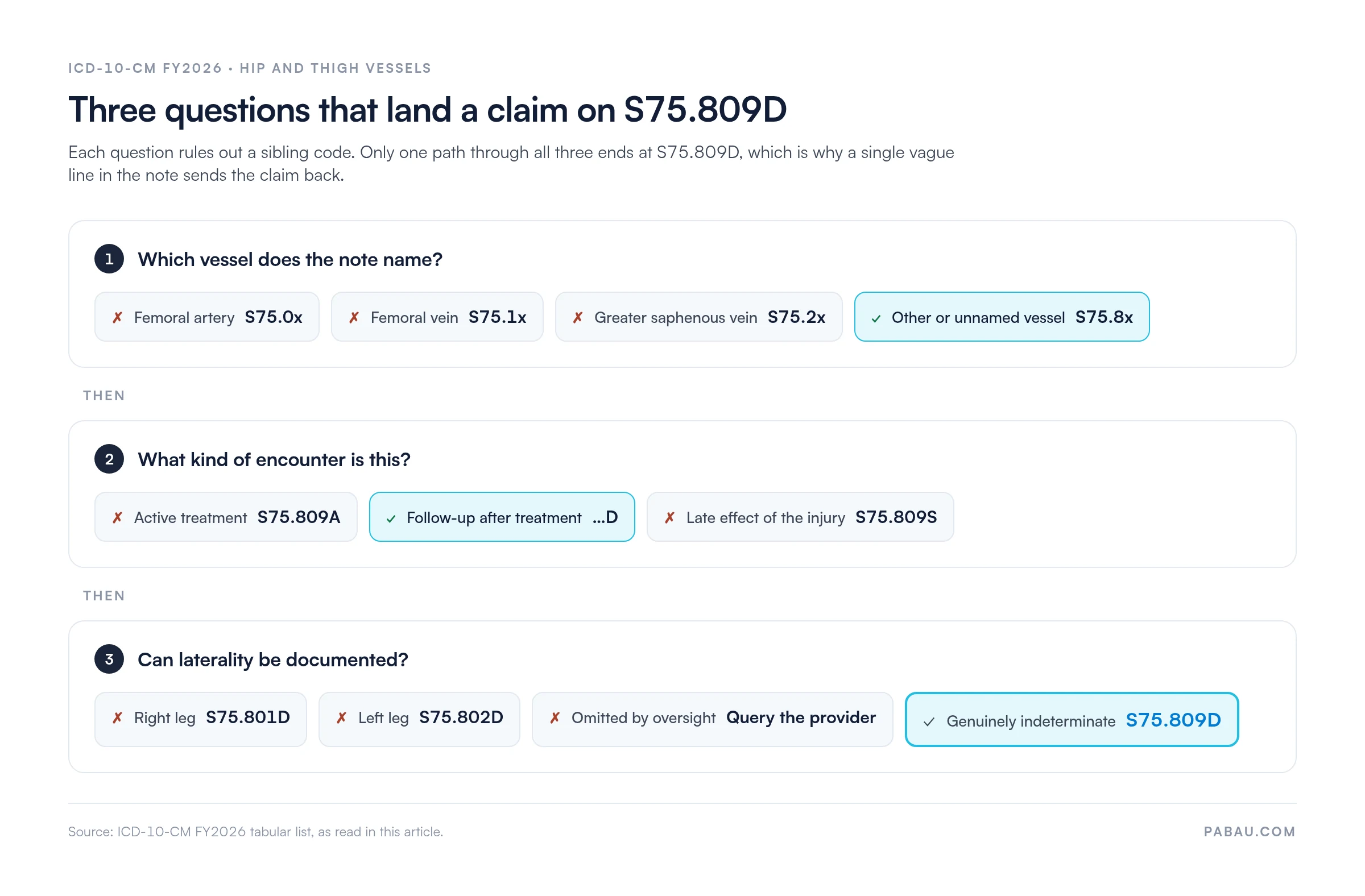
S75.809D encodes three distinct clinical facts, one per structural layer of the ICD-10-CM code. Misreading any one of them is the most common source of denials on this code.
If the documentation names the femoral artery or the femoral vein, S75.809D is incorrect, and the claim belongs under S75.0 or S75.1 respectively. S75.809D applies when the vessel sits in the hip or thigh and the note names no specific vessel.
The three layers work as a sequence of gates, and the diagram below shows where each answer sends the claim.
The D suffix in S75.809D is one of the most misapplied elements in ICD-10-CM injury coding. According to the CMS ICD-10-CM coding guidelines, the 7th character must reflect the nature of the encounter, not simply the passage of time since injury. Below are all three valid 7th characters for this code family and the documentation triggers that distinguish them.
A frequent coding error is using D for the first follow-up visit when the patient is still receiving active treatment. If a surgeon is still managing an open wound or monitoring a vascular repair, the A character still applies. It moves to D only once the physician documents that active treatment is complete.
S75.809D is valid for the full FY2026 fiscal year. No changes were made to this code’s description or status between FY2025 and FY2026; it carries forward without modification.
Coders working on claims that span fiscal years should confirm the date of service to determine which edition’s tabular list governs. For services provided on or after October 1, 2025, the 2026 edition applies. The AAPC Codify ICD-10-CM lookup allows coders to filter by fiscal year and verify current validity before submission.
Clinical documentation rarely uses the exact ICD-10-CM phrasing. Coders meet these alternate terms in provider notes, and each maps to S75.809D when laterality is unspecified and the encounter is subsequent.
When reviewing provider notes, flag any mention of a blood vessel, a vascular injury, or vessel trauma at the hip or thigh. Then check whether the note specifies left or right. That combination, paired with a follow-up visit, points to S75.809D rather than a laterality-specific sibling code.
Knowing where S75.809D sits in the ICD-10-CM hierarchy helps coders find parent notes, excludes guidance, and sibling codes quickly. The full parent chain is below.
Every code in the S75 category carries a 7th character, so encounter type is a requirement at every level of this chain. The category-level parent notes are also where the excludes guidance lives, which is the next section.
The “unspecified leg” qualifier in S75.809D requires a specific justification. ICD-10-CM guidelines state that laterality should be documented to the highest degree of specificity supportable by clinical notes. Using an unspecified-laterality code when the side is clearly documented in the chart is a documentation error that can trigger medical necessity audits.
Use S75.809D when one of the following genuinely applies at the time of the encounter, not simply because laterality was overlooked.
When laterality is genuinely absent, coders should query the treating provider before defaulting to an unspecified code. Payers increasingly flag high rates of unspecified-laterality codes as an audit indicator, particularly for trauma cases where imaging usually clarifies the affected side.
The S75 category carries parent-level excludes notes that apply to all codes within it, including S75.809D. Violating these exclusions by coding them alongside S75.809D will result in claim edits or denials.
A sciatic nerve injury at the same hip and thigh level is one such structure. It sits in category S74, where the 7th character tracks the encounter in the same way. The right-leg code reads S74.01XA at the initial encounter, and S74.01XD once care moves to follow-up.
Verify excludes notes when you assign the code, not when the claim reaches the scrubber. Catching an exclusion conflict at that point costs a note review, not an appeal.
S75.809D sits within a structured family of sibling codes that share the same anatomical scope but differ by injury type, laterality, and encounter. The table below shows the most commonly referenced codes in this group.
Cross-check your selection against the tabular list whenever the documentation points to a more specific code in this block. Sibling codes differ by one character, so the wrong row is easy to carry into the claim.
The S75.9 subcategory is the other unspecified route in this category. It carries injuries where the documentation never identifies the vessel, rather than naming one outside S75.0 to S75.2. A right leg at a follow-up visit codes to S75.901D.
Precise documentation is what separates a clean first-pass claim from a rejection. The checklist below covers what providers must record in the clinical note to support S75.809D through audit.
Submitting these claims through a clearinghouse that checks ICD-10-CM codes against payer rules cuts avoidable rejections. Practice management software like Pabau connects to the Claim.MD clearinghouse, which reaches thousands of US payers and validates diagnosis codes before transmission. That check matters most on injury codes, where laterality and encounter-type errors are the common denial triggers.
Denial rates rarely fall from coder education alone. Our guide to denial management pairs that training with clearinghouse validation, which is the combination that holds across a whole ICD-10-CM portfolio.
Before coding S75.809D, run a three-part check. (1) Is the injured vessel something other than the femoral artery, the femoral vein, or the greater saphenous vein? (2) Has active treatment concluded, with the patient back for follow-up? (3) Is laterality genuinely indeterminate, or was it simply omitted from the note? Query the provider on any point that is unclear before submitting.
Vascular injury codes in the S75 family are scrutinized closely during payer review, because they often accompany high-cost hospital encounters and surgical procedures. Coders and billing teams should apply these submission-level checks before claims leave the practice.
The procedure side of that pairing sits in our CPT code reference, where the wound-evaluation and vascular-monitoring codes are listed. Matching the diagnosis to the right procedure code is what keeps the medical necessity argument intact.
A laterality or encounter-type error on an injury code usually surfaces twice. The scrubber catches it first, and the remittance advice raises it again weeks later, once the payment window has already moved.
Pabau’s billing tools are built around cleaner claims management, so diagnosis codes are validated against the built-in ICD-10-CM catalog before a claim goes out. Claim edits surface before transmission, and electronic remittance advice from payers feeds back into the billing record automatically.
For a trauma or orthopedic team, that turns a rejected S75.809D line into a correction made while the note is still open. The result is fewer appeals and reimbursement that lands on the first cycle.

Pabau’s integrated claims management and Claim.MD clearinghouse connection validates diagnosis codes, flags edits before transmission, and processes ERAs across thousands of US payers. See how it handles S75.809D and related injury codes in practice.

S75.809D is a narrow code, and that is its value. It says the vessel was not one of the three named in S75, the encounter was follow-up, and the side could not be established.
The habit worth building is the provider query. An unspecified-laterality code that the chart could have specified is the one a payer audits. The fix costs one question at the time of coding.
Practices that submit vascular injury claims every week get more from validation than from appeals. Book a demo to see how Pabau checks ICD-10-CM codes before the claim leaves your practice.

Need to understand how clearinghouse submissions work? What is medical billing explains the full claim lifecycle from code assignment through payer adjudication.
Struggling with denied vascular injury claims? Denial management in healthcare covers root-cause strategies for reducing rejection rates on injury diagnosis codes.
Want to see how ICD-10-CM coding connects to billing compliance? Medical billing compliance outlines the documentation standards payers use to audit diagnosis code selection.
S75.809D is an ICD-10-CM diagnosis code for an unspecified injury of other blood vessels at hip and thigh level, unspecified leg, subsequent encounter. It applies when the injured vessel is not the femoral artery, the femoral vein, or the greater saphenous vein. Laterality must also be undocumentable, with active treatment complete and the patient back for follow-up care.
Yes, S75.809D is a valid billable ICD-10-CM diagnosis code. It is accepted for use in all HIPAA-covered transactions from October 1, 2025 through September 30, 2026 under the FY2026 edition of ICD-10-CM.
The 7th character D indicates a subsequent encounter. The patient has completed active treatment and returns for routine follow-up, wound checks, physical therapy, or monitoring of the healing condition. It differs from A (initial encounter, active treatment) and S (sequela, late effect of the injury).
Use S75.809D only when laterality is genuinely indeterminate at the encounter. Bilateral vascular involvement and imaging that cannot confirm the side both qualify. If the clinical note documents left or right leg, use S75.802D or S75.801D respectively. Defaulting to unspecified because laterality was omitted is incorrect coding. Query the provider first.
The most closely related codes are S75.809A (same injury, initial encounter), S75.809S (sequela), S75.801D (right leg, subsequent encounter), and S75.802D (left leg, subsequent encounter). Femoral artery injury (S75.0x) and femoral vein injury (S75.1x) sit in the same S75 category. They cover different vessel classes, so they are not interchangeable with S75.809D.
The S75 category covers injuries to blood vessels at hip and thigh level. It sits in the S70-S79 block, injuries to the hip and thigh, in Chapter 19 of ICD-10-CM. It includes the femoral artery, femoral vein, greater saphenous vein, and other blood vessels in this anatomical region.