ICD-10 Code S42.444P: Medial epicondyle fracture, right humerus
ICD-10 Code S42.444P: full descriptor and code validity ICD-10 Code S42.444P car...

Last Updated: Oct 13, 2026
Billable Code Specific Code
S72.399N is the billable ICD-10-CM code for other fracture of shaft of unspecified femur, subsequent encounter for open fracture type IIIA, IIIB, or IIIC with nonunion.
Change any one of those facts and the 7th character changes too. Nonunion after an open type I or II wound is S72.399M, not S72.399N. Pick the wrong letter and the claim carries a diagnosis the operative note cannot support.
That is how a routine follow-up becomes a denial. This page covers the full 7th character grid, the documentation payers expect, and the errors that draw audits.
Let Pabau's smart automation suggest the right codes, reduce claim denials, and keep your practice compliant—effortlessly.
Automate repetitive tasks and focus on what matters most—your patients.
Reduce coding errors and ensure compliance with the latest regulations.
Clean claims, fewer denials, and faster reimbursements.
Powerful insights and reporting to help your practice thrive.
HIPAA compliant SOC 2 certified GDPR-compliant Trusted by 4,000+ clinics worldwide

S72.399N codes other fracture of shaft of unspecified femur, subsequent encounter for open type IIIA, IIIB, or IIIC with nonunion.
The 7th character N needs three documented facts: a subsequent encounter, an open type IIIA to IIIC wound, and nonunion.
Nonunion after an open type I or II fracture is S72.399M, and malunion in those same wounds is S72.399Q.
Only the physician can call a nonunion, so imaging that still shows a fracture line will not support the code alone.
Pabau keeps the operative note and the diagnosis code on one record, so 7th character errors surface before the claim leaves.
S72.399N tells a payer one thing. A femoral shaft fracture that began as an open type IIIA, IIIB or IIIC injury has still not healed.
It is billable and specific, so it can stand alone as the diagnosis on a claim. Four facts are packed into those eight characters, and each one has to trace back to something a physician wrote.
The code itself is not new. S72.399N has been valid since October 1, 2015, and the FY2026 edition carries it forward unchanged. Coders who treat it as a fresh FY2026 addition sometimes hold claims for encounters that were always codable.
You can confirm the current wording in the CDC ICD-10-CM web tool.
Every level of the S72 hierarchy narrows the same injury by one step. Reading down it is the quickest way to confirm you are on the most specific valid code before submission.
The description makes four separate claims about the patient.
Laterality is the easiest of the four to lose. When the record names the right femur, code S72.391N. When it names the left, code S72.392N.
Reaching for the unspecified code while laterality sits in the operative note is a specificity error, and payers query it.
The 7th character carries three pieces of information at once. It states the encounter type, whether the wound was closed or open, and how the bone is healing.
Category S72 offers 16 of them, and only one fits any given visit.
Laid out as a grid rather than a list, the same 16 characters stop looking arbitrary.
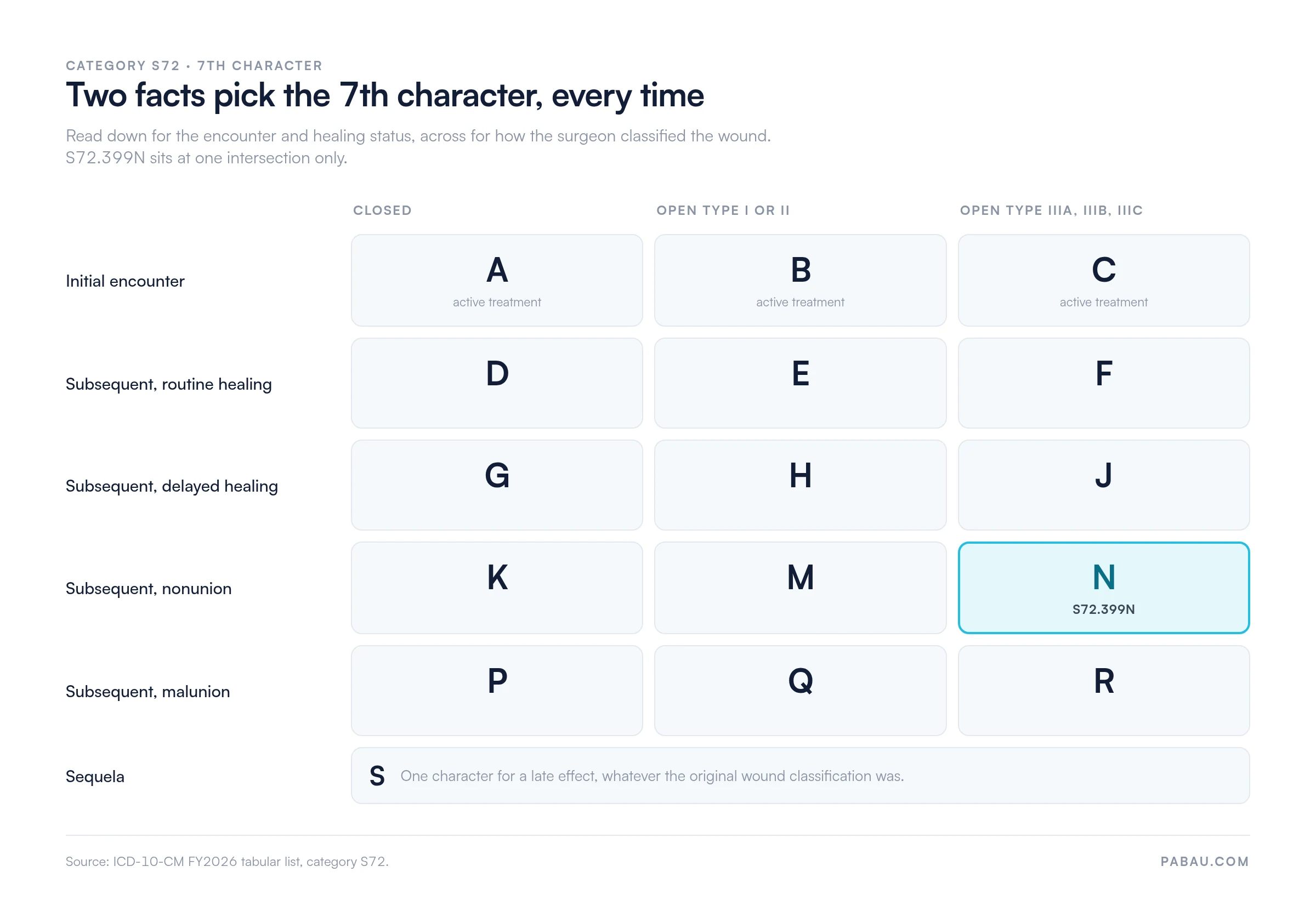
That repetition explains the most audited error on these claims. N and M both report a nonunion at a subsequent encounter, so the healing status is identical.
What separates them is the wound. M belongs to Gustilo types I and II, and N to types IIIA, IIIB and IIIC. The follow-up note rarely repeats the wound classification, because the surgeon recorded it months earlier.
Check the operative report, not just the discharge summary, when you pick the 7th character. Surgeons record the Gustilo type in the operative note at initial wound management. That single line governs the initial encounter code and every subsequent encounter code for the same fracture.
The coder never assigns a Gustilo type. The surgeon does, in the operative note, and that classification travels with the fracture for the rest of its coding life.
Gustilo-Anderson classification, published in the Journal of Bone and Joint Surgery in 1976, grades open fractures by the soft tissue damage around them.
The characters C, F, J, N and R cover all three severe subtypes in ICD-10-CM. Once the note confirms nonunion, the code is S72.399N whether the surgeon wrote IIIA, IIIB or IIIC.
They never split at the code level, so a vague “type III” in the chart still supports this character.
Nonunion is a fracture that has stopped healing. Orthopedic practice generally puts the threshold at six to nine months after injury, though the treating physician’s judgment governs. Coders take the label from the note, never from the calendar and never from imaging alone.
Section I.C.19 of the ICD-10-CM Official Guidelines requires the nonunion to appear in the record. A radiograph showing a persistent fracture line, with no written statement from the physician, will not carry the code.
Two calls come up constantly on these charts.
The note says “delayed healing at eight months.” Can I code nonunion? No. Delayed healing has its own characters, G, H and J. Query the physician rather than upgrading the language yourself.
The surgeon wrote “failed union.” Is that enough? Yes. Nonunion, failed union and non-healing fracture all read as nonunion for code selection.
A rejected S72.399N claim is rarely a wild guess. It is usually one character off. These are the neighbors worth knowing by sight.
Every code in that table keeps the same fracture pattern. A nondisplaced spiral fracture of the right femoral shaft moves to the S72.344 series instead. At a subsequent encounter with an open type IIIA to IIIC wound healing routinely, that code is S72.344F. A displaced oblique fracture of the left femoral shaft sits in the S72.332 series. At the initial encounter for a Gustilo type IIIA, IIIB, or IIIC open wound, that code is S72.332C.
The AAPC ICD-10-CM code lookup is quick for checking these side by side during chart review.
Five elements have to be in the record. Miss one and the code is not supportable, whatever the imaging shows.
Laterality and Gustilo type are the two that go missing most often. A standing physician query for fracture cases with no recorded Gustilo type closes both before the claim is ever built.
The diagnosis code is one field on a claim that passes through four stages before payment lands. Knowing where the code is read at each stage tells you where an error will surface.
On an inpatient claim under Medicare’s Inpatient Prospective Payment System, S72.399N feeds MS-DRG grouping. Nonunion codes tend to group higher than routine healing codes, because the case usually carries further surgery.
The CMS ICD-10 codes page notes that groupings are refreshed with each annual IPPS final rule. Check the current MS-DRG Definitions Manual rather than last year’s.
Outpatient nonunion visits bill on the professional or facility fee schedule instead. There S72.399N sits on the superbill next to the E/M or procedure code, with the supporting note retrievable if the payer asks for it.
When one of these claims comes back unpaid, the explanation arrives as an adjustment reason code on the remittance. Reading the denial codes on that file tells you whether the problem was specificity, the encounter character, or eligibility.
Five questions, answered from the chart rather than from memory of the last visit, catch almost every S72.399N rejection before it happens.
Work through all five and the claim goes out supportable. For the codes an orthopedic panel bills every week, a printed medical coding cheat sheet at the desk beats a lookup mid-claim.
Each of these is avoidable with one extra document open on the screen.
One control works well in practice. Flag any S72 claim whose 7th character is K, M, N, P, Q or R for a second read. Those six letters all report a healing complication, and they draw more payer attention than a routine D, E or F.
An open fracture that goes to nonunion generates encounters across months, sometimes years. The Gustilo type is set once, in the operative note, and every later claim depends on it.
In many practices that note lives in one system while the claim is built in another. The coder ends up working from whatever the follow-up note happened to repeat.
Practice management software like Pabau keeps both in the same patient record. The operative note, the follow-up charting and the diagnosis code sit together. Whoever builds the subsequent-encounter claim can read the wound classification without chasing a scanned report around the practice.
Pabau’s claims management software then attaches that documentation to the claim before it goes out, and submits electronically through Claim.MD, our US clearinghouse partner.
Claim.MD reaches thousands of payers, and eligibility checks and remittance advice come back into the same record the note sits in.
Some of these cases run to several subsequent encounters. One continuous record of the original classification and the physician’s evolving assessment keeps the 7th character right at submission.

Pabau links operative notes, follow-up charting and diagnosis codes in one patient record, so orthopedic teams submit fracture claims with the documentation already attached.

S72.399N is a narrow code doing precise work, and the precision is borrowed from someone else’s writing. The surgeon set the Gustilo type. The treating physician called the nonunion. A coder reads both accurately and resists filling in the rest.
So the change worth making is rarely a coding change. It is making the operative note reachable at the moment the subsequent-encounter claim is built. Practices that fix that stop arguing about 7th characters altogether.
If your fracture documentation and your claims live in different systems, that split is where the errors come from. Book a demo to see how Pabau keeps the operative note and the diagnosis code on one patient record.

Need to understand how medical billing compliance protects your practice? Medical billing compliance covers the audit framework and documentation standards that apply to ICD-10-coded claims.
Looking for a structured approach to claim denials? Denial codes in medical billing explains the CARC denial reason codes that appear when fracture claims are rejected at the clearinghouse.
Want to understand how electronic remittance advice works? Electronic remittance advice details how ERA and 835 files confirm or deny claim payment for ICD-10-coded orthopedic diagnoses.
Yes, when the nonunion is the reason for admission. If the patient is admitted for another condition and the nonunion is treated alongside it, sequence S72.399N as a secondary diagnosis.
No. ICD-10-CM guidelines direct coders to report the injury code with the correct 7th character for follow-up fracture care. The 7th character already says the encounter is subsequent.
ICD-10-CM does not require one, but many payers and state reporting programs do. External cause codes take only A, D, or S as a 7th character, so a subsequent visit takes D.
S72.309N reports a femoral shaft fracture whose pattern the note never states. S72.399N reports a pattern that is documented, but that none of the named subcategories covers.
No. S72.399 already holds six characters, so N attaches directly. Placeholder X is only used where a code runs shorter than six characters and still needs a 7th.