ICD-10 Code S42.444P: Medial epicondyle fracture, right humerus
ICD-10 Code S42.444P: full descriptor and code validity ICD-10 Code S42.444P car...

Last Updated: Oct 13, 2026
Billable Code Specific Code
S72.344F is the billable ICD-10-CM code for a nondisplaced spiral fracture of the shaft of the right femur. It applies at a subsequent encounter for an open fracture of type IIIA, IIIB, or IIIC with routine healing.
Coders use it for follow-up visits where imaging confirms healing on schedule and the record shows no complications. Two errors drive most denials on this code. The first is choosing F when healing is delayed, which takes S72.344J. The second is using it during active fracture management, which takes S72.344C.
Let Pabau's smart automation suggest the right codes, reduce claim denials, and keep your practice compliant—effortlessly.
Automate repetitive tasks and focus on what matters most—your patients.
Reduce coding errors and ensure compliance with the latest regulations.
Clean claims, fewer denials, and faster reimbursements.
Powerful insights and reporting to help your practice thrive.
HIPAA compliant SOC 2 certified GDPR-compliant Trusted by 4,000+ clinics worldwide

S72.344F codes a nondisplaced spiral fracture of the right femur shaft at a subsequent encounter. The wound must be an open Gustilo type IIIA, IIIB, or IIIC injury that is healing routinely.
Seventh character F covers open type IIIA, IIIB, or IIIC fractures only. Delayed healing takes J, the initial encounter takes C, and a closed fracture takes D.
Per ICD-10-CM Official Guidelines, fractures are presumed displaced unless the record explicitly states nondisplaced, so documentation must confirm displacement status.
Pabau’s claims management software flags seventh-character mismatches before submission, reducing denial rates on fracture aftercare claims.
ICD-10 code S72.344F is a valid, billable ICD-10-CM diagnostic code for FY2026, confirmed in the current CMS tabular list.
Coders should verify annually against the CMS ICD-10 codes page since code validity is updated each October 1.
The official descriptor reads: Nondisplaced spiral fracture of shaft of right femur, subsequent encounter for open fracture type IIIA, IIIB, or IIIC with routine healing. Every character in the code encodes a specific clinical decision.
The sixth character distinguishes displacement and laterality simultaneously: 4 = nondisplaced, right side. The seventh character F separates this open-fracture aftercare code from the matching initial encounter, S72.344C. It also separates it from the problem-encounter variants for the same wound grade: J, N, and R.
S72.344F applies when all six of the following conditions are documented in the clinical record for the encounter being billed.
A spiral fracture of the femoral shaft is most commonly caused by indirect rotational forces. Falls involving a planted foot and sporting injuries are typical presentations. A type III open wound points to high-energy trauma, such as a motor vehicle collision. The nondisplaced variant means the bone held position after the fracture, which influences treatment planning and the documentation a coder needs to see.
Using S72.344F for any of the scenarios below creates an immediate coding error and a likely denial. The code is narrowly defined and has no flexibility across these exclusion boundaries.
Check displacement status before pulling any S72.344x code. ICD-10-CM Official Guidelines state that fractures are presumed displaced unless the physician explicitly documents nondisplaced. If the note says only ‘spiral fracture’ with no displacement qualifier, you must default to the displaced code S72.341F, not S72.344F.
The seventh character is where most billing errors on this code originate. Each character maps to a specific clinical scenario, and selecting the wrong one is functionally equivalent to billing for the wrong encounter type. Two documented facts settle the choice every time: the grade of the wound and the healing status at this visit. The grid below plots the full S72.344x family against both.
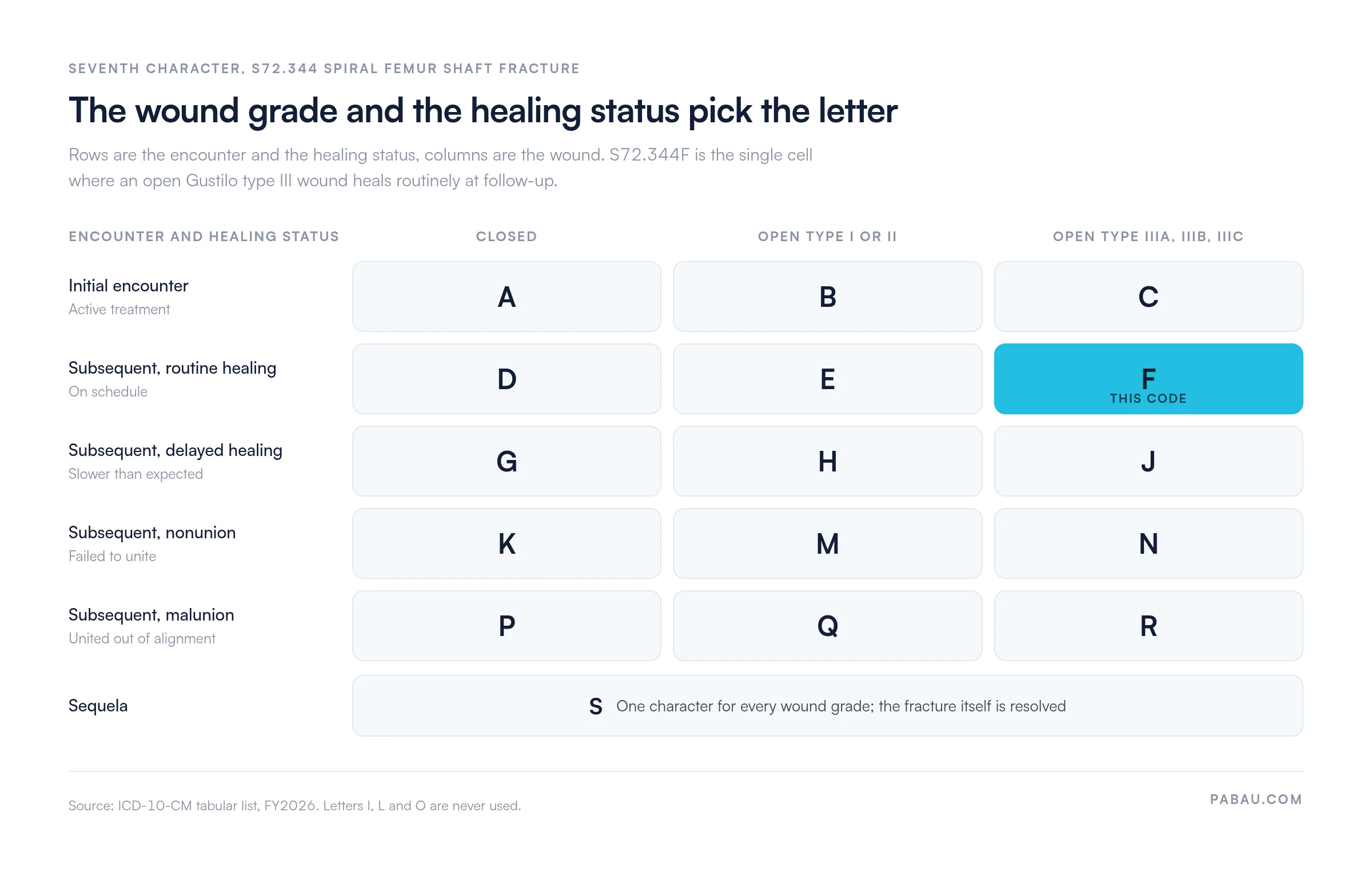
The table below carries the official descriptor wording behind each of those letters. ICD-10-CM never uses I, L, or O in this position, because they read too easily as the digits 1 and 0. Section I.C.19 of the ICD-10-CM Official Guidelines governs the whole set.
The critical distinction between F and J: Both cover an open type IIIA, IIIB, or IIIC fracture at a follow-up visit. Use F where the note documents healing as expected, with callus formation visible, pain decreasing, and weight-bearing improving. Use J where the note documents slow healing, absent callus at the expected timeframe, or clinical concern about the trajectory. Billing F when J is clinically correct misrepresents the encounter and triggers a denial.
The distinction between D and F: Both describe a subsequent encounter with routine healing, and the wound decides which one applies. D applies to a closed fracture, and F applies to an open wound graded Gustilo type IIIA, IIIB, or IIIC. A type I or II wound takes E instead of either one. The Gustilo grade in the operative or emergency record settles it, so there is no coder discretion here.
The S72.34x group covers all spiral fractures of the femoral shaft. Within it, displacement status and laterality are the only differentiators. The table below maps the full sibling set for subsequent encounters carrying seventh character F, meaning routine healing. Use it to select accurately when laterality or displacement is in question. Pabau’s diagnostic codes library carries the complete tabular listing for each one.
Spiral vs oblique fracture morphology: A spiral fracture has a helical fracture line wrapping around the bone shaft. An oblique fracture runs diagonally across the shaft without rotating around it. Oblique femur shaft fractures are coded under the S72.33x group. Within that group, S72.332C covers a displaced oblique fracture of the left femoral shaft. The seventh character C marks an initial encounter for an open Gustilo type IIIA, IIIB, or IIIC fracture. Confusing the two morphologies means billing a code that does not match the imaging report, which payers catch on medical review.
S72.344F is a diagnosis code, not a procedure code. Every claim using it needs at least one CPT code describing what was done at that encounter. The codes below are commonly used alongside S72.344F in orthopedic and physical therapy settings. CPT-to-ICD pairings are not universally mandated. Individual payer local coverage determinations (LCDs) may impose specific pairing requirements, so verify with the billing payer before you assume a pairing is accepted.
Physical therapy providers handling femur fracture aftercare should confirm which of these procedures their state allows PT staff to bill. Scope-of-practice rules vary by state. A modality billed outside them is denied regardless of how carefully the diagnosis was coded.
Payers adjudicating S72.344F claims audit the medical record for several specific elements. A claim that passes edit checks at submission can still be reversed on post-payment audit if the documentation does not support the code. The list below reflects what standard payer LCDs expect to see in the record.
Femur fracture subsequent-encounter codes generate a specific cluster of denials that differ from initial-encounter fracture claims. The patterns below reflect the most common reasons commercial payers and Medicare reject S72.344F claims. The grouping follows how denial management workflows classify these rejections.

Running a pre-submission review on every S72.344F claim catches most of these while the record is still open. The seventh-character check alone resolves the majority of the patterns above. Practices using claims management software can run that review automatically on each claim.
The CDC/NCHS ICD-10-CM web tool publishes the official tabular list used to verify S72.344F and its sibling codes. The governing coding rules for this code fall primarily under Section I.C.19 of the ICD-10-CM Official Guidelines for Coding and Reporting. Key rules that directly affect S72.344F use are outlined below.
Per Section I.C.19.c of the Official Guidelines, fractures are presumed displaced unless the provider’s documentation explicitly states nondisplaced. This means S72.344F requires the word “nondisplaced” in the clinical record. No exception exists for radiologic inference; the coder cannot look at an X-ray description and decide displacement status independently.
Traumatic fractures coded under Chapter 19 require sequencing with an external cause code from Chapter 20 (V00-Y99). The external cause code identifies the mechanism of injury (e.g., a fall, a motor vehicle collision, a sports injury). The fracture code S72.344F is sequenced as the principal or first-listed diagnosis; the external cause code follows. This sequencing rule applies at every encounter in the episode, not only the initial one.
When the patient presents with multiple injuries from the same incident, the most severe injury is sequenced first. If the femur fracture is the primary diagnosis driving the encounter, S72.344F takes precedence. Additional injury codes for the same episode follow in descending clinical significance. The AAPC ICD-10-CM code reference lists the adjacent injury codes that often apply to multitrauma encounters involving a femoral shaft fracture.
Flag each S72.344F claim for a healing-status audit before submission. Pull the physician note, locate the explicit language about healing progress, and confirm it describes routine healing rather than delayed or complicated healing. That check eliminates the most common denial reason for this code before the claim leaves the practice.
The documentation a payer wants on an S72.344F claim already exists somewhere in the record. The Gustilo grade sits in the operative report, the displacement wording in the physician’s assessment, and the healing status in the most recent follow-up note. Locating all three before the claim goes out is the coder’s job.
Practice management software like Pabau keeps those three in one patient file. Treatment notes, digital forms, and uploaded imaging reports attach to the same record as the appointment. A coder reviewing a subsequent encounter reads the episode in sequence instead of chasing the operative report through another system.
Pabau’s claims management tools then check the diagnosis and procedure pairing before submission. A seventh character that contradicts the documented healing status is flagged on screen. That is weeks earlier than a remittance advice would raise it, and it is the difference between a correction and a rework.

Pabau’s claims management software validates ICD-10 and CPT code combinations before submission and flags seventh-character mismatches. It streamlines fracture aftercare billing so your team spends less time on rework and more time on patient care.

Assigning S72.344F correctly depends on the operative report as much as the diagnosis line. The wound grade and the healing language decide the seventh character, and both sit outside the fields a coder usually works from. Pulling those two facts before you assign the code is the habit worth building.
The trade-off worth remembering is that the presumption runs against you. A note reading only “spiral fracture” codes as displaced, whatever the imaging suggests. Querying the physician costs an afternoon. An audit reversal months later costs the payment and the staff time to rebuild the claim.
Moving that check upstream turns a denial into a question you answer before submission. Book a demo to see how Pabau catches seventh-character and pairing errors on fracture aftercare claims before they reach the clearinghouse.

Need to understand how claims move through the clearinghouse? Medical claims clearinghouse guide explains how electronic claim routing, edits, and remittances work end-to-end.
Want to decode denial reason codes on rejected fracture claims? Denial codes in medical billing covers CARC and RARC codes with actionable correction steps.
Looking to streamline your 837 claim file submissions? 837 electronic claim file guide covers the transaction set used for submitting professional and institutional claims.
S72.344F is the billable diagnosis code for a nondisplaced spiral fracture of the right femoral shaft. It applies at a subsequent encounter for an open fracture of type IIIA, IIIB, or IIIC with routine healing. Each character encodes a clinical fact: S72 = femur fracture, .3 = shaft location, .34 = spiral morphology. The last two carry the rest: .344 = nondisplaced and right side, F = type III open fracture healing routinely at follow-up.
Yes, S72.344F is a valid, billable ICD-10-CM diagnosis code for FY2026. Use it on professional and institutional claims when the record supports every element. That means a nondisplaced spiral fracture of the right femoral shaft with an open wound graded Gustilo type IIIA, IIIB, or IIIC. The visit must also be a follow-up encounter with documented routine healing.
S72.344C is the initial encounter for the same open type IIIA, IIIB, or IIIC fracture, used while active treatment is underway. S72.344D and S72.344F both describe a subsequent encounter with routine healing, and the wound decides which one applies. D is the closed-fracture code, and F is the code for an open type IIIA, IIIB, or IIIC fracture. An open type I or II wound takes E instead.
For an open type IIIA, IIIB, or IIIC fracture, use seventh character J, which gives the code S72.344J. A closed fracture with delayed healing takes G, and an open type I or II fracture takes the letter H at that position. Billing S72.344F when the record documents delayed healing misrepresents the encounter. The physician’s note must characterize healing status explicitly, because coders cannot infer it.
S72.344F applies exclusively to the right femur. The sixth character 4 encodes nondisplaced status and right-side laterality simultaneously. For the same injury on the left side at a subsequent encounter with routine healing, the correct code is S72.345F. Using S72.344F on a left-femur case is a laterality mismatch that triggers denial when payers compare it against imaging or prior claims.
The wrong seventh character leads the list. That means using F when healing is delayed, where J is correct, or during active treatment, where C is correct. It also covers using F on a closed fracture, which takes D instead. Laterality mismatches against the imaging report come next, followed by coding nondisplaced without that word in the record. Missing healing-status language and a missing external cause code round out the set. A pre-submission edit that checks seventh-character logic and displacement documentation clears most of them.