ICD-10 Code S42.444P: Medial epicondyle fracture, right humerus
ICD-10 Code S42.444P: full descriptor and code validity ICD-10 Code S42.444P car...

Last Updated: Oct 13, 2026
Billable Code Specific Code
S72.361Q is the billable ICD-10-CM code for displaced segmental fracture of shaft of right femur, subsequent encounter for open fracture type I or II with malunion.
Let Pabau's smart automation suggest the right codes, reduce claim denials, and keep your practice compliant—effortlessly.
Automate repetitive tasks and focus on what matters most—your patients.
Reduce coding errors and ensure compliance with the latest regulations.
Clean claims, fewer denials, and faster reimbursements.
Powerful insights and reporting to help your practice thrive.
HIPAA compliant SOC 2 certified GDPR-compliant Trusted by 4,000+ clinics worldwide

S72.361Q is a billable ICD-10-CM code (FY2026) for a displaced segmental fracture of the shaft of the right femur. It applies at a subsequent encounter for an open fracture type I or II with malunion.
The seventh character Q carries three facts at once. The fracture was open and graded Gustilo type I or II, and it has healed in the wrong position.
Q is not the closed-fracture letter. Closed malunion takes P, and open type IIIA, IIIB or IIIC malunion takes R.
S72.361 accepts 16 valid seventh characters. Each one pairs a phase of care with a fracture type and a healing status.
Laterality is fixed to the right femur. A left-sided injury takes S72.362Q, and an undocumented side takes S72.363Q.
Practice management software like Pabau integrates with the Claim.MD clearinghouse, so orthopedic claims get submitted, tracked and reconciled in one place.
ICD-10 code S72.361Q is a billable ICD-10-CM diagnosis code. It covers a displaced segmental fracture of the shaft of the right femur, seen at a subsequent encounter. The injury was an open fracture graded Gustilo type I or II, and it has healed in the wrong position.
According to the CMS ICD-10-CM code files, the FY2026 edition took effect on October 1, 2025.
Each part of the code carries one piece of the clinical picture. “Segmental” means two fracture lines isolate a middle piece of the femoral shaft. “Displaced” means those fragments left their anatomical alignment, and “right femur” fixes the side.
“Subsequent encounter” places this visit after the active treatment phase ended. “Open fracture type I or II with malunion” then names both the wound severity and the healing complication in a single letter.
The seventh character is where these claims go wrong. Q is the malunion letter for an open fracture of Gustilo type I or II. Its neighbors carry the same malunion meaning for a different wound: P for a closed fracture, R for type IIIA, IIIB or IIIC.
Coding Q on a closed injury therefore tells the payer the skin was broken. The parent code S72.361 is not billable on its own, so all seven characters have to be present on the claim.
The table below lists the facts a coder needs before a claim carrying S72.361Q goes out.
The CDC’s National Center for Health Statistics maintains this code and publishes the annual ICD-10-CM updates with CMS. Descriptions and validity can change with each October 1 release, so check the current edition every year.
The seventh character carries more billing weight than any other part of S72.361Q. Get it wrong and the claim either misstates the patient’s status or draws an automatic denial.
ICD-10-CM requires a seventh character on every fracture code in category S72. Each letter encodes two facts at once. It names the phase of care, then pairs that with the fracture type and its healing status. The 16 valid characters for S72.361 therefore sit in a grid rather than a list.
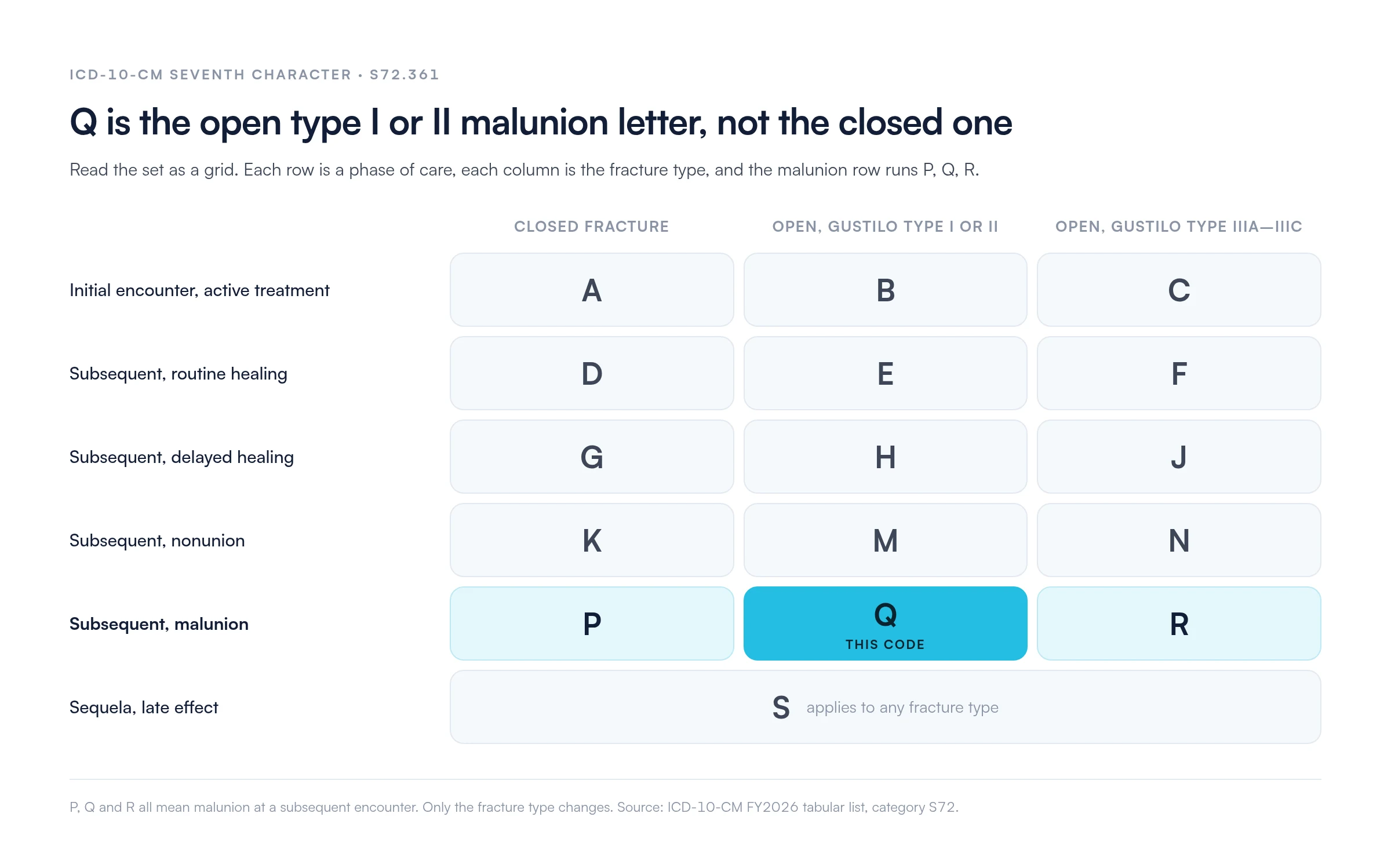
The table below carries the full description behind each letter.
There is no letter I, L or O in the set. ICD-10-CM leaves those out because they read as digits, which is why the sequence jumps from H to J and from K to M.
Read the table in columns and the logic holds. Within each healing group, the first letter belongs to closed fractures. The second covers Gustilo type I or II open fractures, and the third covers type IIIA, IIIB or IIIC. Malunion is the P, Q, R trio, and Q is the middle member.
Q applies when two conditions hold at the same encounter. The fracture was open and graded type I or II, and imaging shows it united in an abnormal position. Both facts have to appear in the record.
If the skin was never broken, P is the malunion letter. A type IIIA, IIIB or IIIC wound takes R instead. Confusing Q with M is the other frequent error, since malunion and nonunion look alike in a claim queue.
Check the Gustilo grade in the original emergency or operative record. That grade is what decides between the letters Q and R on a malunion claim. It is set at the index surgery, not at the follow-up visit, and it does not change as the fracture heals. If the note records an open fracture without a grade, query the surgeon rather than defaulting to Q on the claim.
ICD-10-CM bases the open fracture designations in category S72 on the Gustilo-Anderson classification. That classification grades the wound and the soft-tissue damage, not the bone. Two grades share the seventh characters B, E, H, M and Q.
Type I and type II route to the letter Q. All three type III grades route to R instead. That is why the grade recorded at the index surgery decides the follow-up code.
ICD-10-CM guidance also defaults a fracture to closed when the record is silent on the question. So the open designation has to be documented explicitly. Without it, a coder reading the chart is directed to P rather than Q.
Segmental femoral shaft fractures are high-energy injuries. They usually follow motor vehicle collisions or falls from height. Two separate fracture lines isolate a middle segment of the femoral diaphysis, and that segment loses its periosteal blood supply from both ends.
An open wound adds contamination and further periosteal stripping to that picture. Even a type I or type II wound raises the risk of a healing complication compared with a closed injury of the same pattern.
Malunion is the specific complication S72.361Q documents. The bone unites, but the segment consolidates in an angulated, shortened or rotated position. Clinically that can leave a measurable leg-length discrepancy, a rotational gait abnormality, and accelerated hip or knee arthritis.
The pathway that generates this code usually starts with irrigation and debridement of the wound, followed by intramedullary nailing or external fixation. Malunion is often picked up on radiographic review at the three-month or six-month follow-up. When imaging confirms union in malposition, the surgeon assesses whether a corrective osteotomy is warranted. That evaluation visit is where S72.361Q belongs.
Every ICD-10-CM code sits inside a nested hierarchy. Knowing where S72.361Q falls helps a coder reach its siblings quickly and confirm the category placement is right.
Category S72 is not billable on its own. Only the fully extended seventh-character codes at the bottom of the hierarchy are, and S72.361Q meets that test. The AAPC Codify entry for S72.361Q confirms both the hierarchy and the billable status.
Clinical documentation rarely uses the official description word for word. Coders meet variant wording in physician notes, operative reports and radiology findings. The terms below all map to S72.361Q.
When any of these appear alongside right laterality, an open type I or II wound, and a subsequent encounter, S72.361Q is the correct code. Work the ICD-10-CM index the way you would for any fracture. Start at the main term “fracture”, then the anatomical site, then the qualifier.
S72.361Q sits among a set of closely related codes, and picking the wrong sibling is an auditable error. The table covers the codes most often confused with it.
The two worth double-checking every time are S72.361P and S72.362Q. One flips the fracture type, the other flips the side, and both sit a single character away from the code you meant.
The three variants coders confuse most often map to three phases of fracture management. Choosing the wrong one is a compliance problem, not just a billing inconvenience.
The ICD-10-CM Official Guidelines apply “subsequent encounter” to visits after active or definitive treatment has been given. Take a patient who sustains an open segmental femur fracture in January and is nailed the same week.
From the first post-operative check onward, that patient is in the subsequent phase. If the April films show the fracture healed in varus, S72.361Q is the code for that visit. Encounter type follows the purpose of the visit, not the time since injury.
Flag any S72.361B claim that appears more than 30 days after the injury date. That pattern usually means the coder never moved off the initial encounter letter. Auditors treat a stale initial encounter character as a compliance red flag.
S72.361Q is a diagnosis code, so it justifies the service rather than describing it. At a malunion follow-up it usually supports an evaluation, imaging, or a corrective procedure. The pairings below are the ones orthopedic practices reach for most often.
Treat this as a starting point rather than a fee schedule. The operative note decides which repair code fits, and payer policy decides what is covered. Check current CPT descriptors, the applicable local coverage determination, and National Correct Coding Initiative edits before you submit a surgical pairing.
Practices running legacy reports, appealing older claims, or matching historical records sometimes need the ICD-9-CM predecessors. The General Equivalency Mappings published by CMS provide that crosswalk.
ICD-9-CM never captured laterality, encounter type and healing status in one code. So the two approximate equivalents above each carry a different half of S72.361Q.
Code 821.11 records the open shaft fracture, while 733.81 records the malunion. Neither is a clean equivalent on its own, which is normal for a GEMs mapping on a code this specific.
Six elements have to be present in the record before this code is defensible on audit. Miss one and the claim becomes hard to support after the fact. Clean claim submission depends on catching all six before the encounter closes.
Practices running claims management software can build these six checks into the pre-submission workflow. A missing element then gets caught at the point of coding rather than the point of denial, which saves rebuilding the record later.

Five patterns account for most S72.361Q denials and audit findings. Each one has a specific documentation or selection fix.
An orthopedic denial workflow should carry an audit trigger for S72 codes with a malunion letter. The check confirms that the record supports both the Gustilo grade and the malunion itself. When a claim comes back, reading its denial codes next to that checklist usually pinpoints the missing element.
Run a quarterly audit of every S72 claim carrying a nonunion letter (K, M, N) or a malunion letter (P, Q, R). Compare each claim against the documentation for that encounter. A mismatch between the letter the coder picked and the healing status the physician recorded is the most common trigger for an orthopedic claim audit.
Coding S72.361Q usually spans two systems. The operative note and the follow-up imaging sit in one place, and the claim gets built somewhere else. That split is where the Gustilo grade goes missing, laterality slips, and seventh characters go stale.
Pabau, our practice management software, keeps the encounter record and the billing workflow in the same system. Notes, imaging results, coded diagnoses and invoices all sit against one patient timeline. So the person building the claim can see exactly what the surgeon recorded at that visit.
For submission, Pabau integrates with the Claim.MD clearinghouse, which generates professional CMS-1500 claims from your invoices and sends them electronically to US payers. It also runs real-time eligibility checks (270/271) before the visit, so coverage problems surface early.
Claim statuses and electronic remittance advice flow back into Pabau, so each payer payment ties to the claim it settles. Coding decisions stay with your coder. What changes is that the submission and the chase stop living in a spreadsheet.

Pabau integrates with the Claim.MD clearinghouse to send CMS-1500 claims electronically to US payers. Run real-time eligibility checks (270/271), then track claim status and ERA remittances in one place.

S72.361Q is worth reading letter by letter, because five separate facts have to line up. The femur has to be the right one, and the shaft fracture has to be segmental and displaced. The wound has to be an open type I or II, and the fracture has to have united in malposition.
The seventh character is cheap to get right and expensive to get wrong. P describes a closed injury, R describes a type III wound, and M describes a bone that never healed. Each letter tells the payer a different story about the same patient.
All five facts come out of the same encounter, so capture them during the visit rather than at the claim stage. Pabau keeps the documentation and the billing side by side, and the Claim.MD integration handles submission, eligibility checks and remittance tracking. Book a demo to see how that works on orthopedic follow-up claims in your practice.

Need to understand how claim denials affect your orthopedic billing? Denial codes in medical billing explains the most common denial reasons coders meet on musculoskeletal claims.
Want to verify your ICD-10 coding against clearinghouse edits? Clean claim submission requirements covers what a complete, edit-passing claim looks like before it reaches the payer.
Looking for billing compliance guidance for your practice? Medical billing compliance outlines the documentation and coding standards that reduce audit risk across specialties.
ICD-10 code S72.361Q is a billable ICD-10-CM diagnosis code. It covers a displaced segmental fracture of the shaft of the right femur at a subsequent encounter. The injury was an open fracture graded Gustilo type I or II, and it has healed in an abnormal position. That complication is called malunion.
An open fracture. The seventh character Q means an open fracture of Gustilo type I or II with malunion. The closed-fracture malunion letter is P instead. So S72.361P covers a right femoral shaft segmental fracture that healed in malposition with the skin intact.
Yes. S72.361Q is a specific, billable ICD-10-CM code, valid for submission under the FY2026 edition that took effect on October 1, 2025. The parent code S72.361 is not billable without a seventh character, so all seven characters are required.
Only the fracture type. Both letters mean a subsequent encounter with malunion of the same displaced segmental right femoral shaft fracture. Q applies when the original injury was an open fracture of Gustilo type I or II, and P applies when it was closed.
The Gustilo grade of the open wound. Q covers type I and type II wounds, which are under 1 cm or larger without extensive soft-tissue damage. R covers type IIIA, IIIB and IIIC wounds, which involve extensive soft-tissue injury, periosteal stripping, or arterial repair.
Malunion means the fracture finished healing, but in an abnormal position. Nonunion means it failed to unite at all. For an open type I or II right femoral shaft fracture, malunion takes Q and nonunion takes M instead. The two call for different treatment and different procedure codes.
Common pairings include 27506 for intramedullary implant fixation, 27507 for plate and screw fixation, and 27450 for an osteotomy of the femoral shaft with fixation. CPT 27448 covers the same osteotomy without fixation. Evaluation-only visits usually use 99213 or 99214. Check the applicable local coverage determination and payer policy before submitting.
No. S72.361Q is specific to the right femur. A displaced segmental fracture of the left femoral shaft with open type I or II malunion takes S72.362Q. Using the right-sided code on a left-sided injury is an error that can produce a denial or an audit finding.
Six elements. The record needs right laterality, a shaft location, a segmental pattern, and documented displacement. It also needs the open fracture designation carrying a Gustilo type I or II grade. Finally, radiology must confirm that the fracture united in an abnormal position.