ICD-10 Code S42.444P: Medial epicondyle fracture, right humerus
ICD-10 Code S42.444P: full descriptor and code validity ICD-10 Code S42.444P car...

Last Updated: Oct 13, 2026
Billable Code Specific Code
S72.135C is the billable ICD-10-CM code for nondisplaced apophyseal fracture of left femur, initial encounter for open fracture type IIIA, IIIB, or IIIC. The 7th character C is what ties the code to a Gustilo-Anderson type III injury during active treatment.
The code is valid for FY2026, effective October 1, 2025.
Let Pabau's smart automation suggest the right codes, reduce claim denials, and keep your practice compliant—effortlessly.
Automate repetitive tasks and focus on what matters most—your patients.
Reduce coding errors and ensure compliance with the latest regulations.
Clean claims, fewer denials, and faster reimbursements.
Powerful insights and reporting to help your practice thrive.
HIPAA compliant SOC 2 certified GDPR-compliant Trusted by 4,000+ clinics worldwide

ICD-10 Code S72.135C is a billable code for a nondisplaced apophyseal fracture of the left femur at open fracture severity IIIA, IIIB, or IIIC.
The 7th character C marks the initial encounter for an open fracture graded IIIA, IIIB, or IIIC under the Gustilo-Anderson classification.
Subsequent encounters and sequelae for the same injury take different 7th characters, so the code moves as treatment moves.
The operative note must state laterality, displacement status, fracture site, open fracture grade, and encounter type before the code is reportable.
Practice management software like Pabau checks ICD-10 diagnosis codes against CPT procedure codes before a claim leaves the practice.
S72.135C is the billable ICD-10-CM code for a nondisplaced apophyseal fracture of the left femur. It applies to the initial encounter for an open fracture of type IIIA, IIIB, or IIIC. The code appears in the current FY2026 edition of ICD-10-CM and is valid for HIPAA-covered transactions.
The Centers for Medicare and Medicaid Services (CMS) maintains ICD-10-CM jointly with the National Center for Health Statistics (NCHS). Apophyseal fracture codes in the S72.13 subcategory are long-standing entries, so the FY2026 update did not introduce S72.135C.
A nondisplaced apophyseal fracture of the left femur is a break at an apophysis of the left femoral bone. The fragments stay in anatomical alignment, which is what nondisplaced means. An apophysis is a bony prominence where major muscle tendons attach.
On the femur that usually means the greater or lesser trochanter. The bone ends have not shifted, but the open wound classification in S72.135C still signals significant soft tissue injury.
An operative report that describes a nondisplaced apophyseal fracture does not support a displaced or shaft-level code. Choosing one anyway is a common reason orthopedic fracture claims get down-coded or denied. A displaced oblique fracture of the left femoral shaft at an initial open type IIIA, IIIB, or IIIC encounter is S72.332C.
The Gustilo-Anderson classification grades open fractures by wound size, soft tissue damage, and vascular injury. Gustilo and Anderson introduced it in 1976 and refined it in 1984. ICD-10-CM still references it for 7th character selection in open femur fractures. S72.135C covers the type III injuries, which involve large wounds, heavy contamination, and often periosteal stripping.
All three subtypes map to the same 7th character C for the initial encounter. The clinical distinction between them affects surgical planning and prognosis, but it does not change the ICD-10-CM code at this level.
Coders do not need to work out which subtype the surgeon documented. Any type IIIA, IIIB, or IIIC grade on an initial encounter maps to S72.135C.
The 7th character is required for every fracture code in the S72 category. It encodes the encounter type and, for open fractures, the Gustilo-Anderson grade. S72.135C uses character C, which is reserved for the initial encounter for open fracture type IIIA, IIIB, or IIIC.
The initial encounter character applies to every visit where the patient receives active fracture treatment. That covers more than the emergency department visit and the surgical admission.
Two questions decide the character. One is how the wound was documented, and the other is where the patient sits in the course of treatment. The grid below separates them.
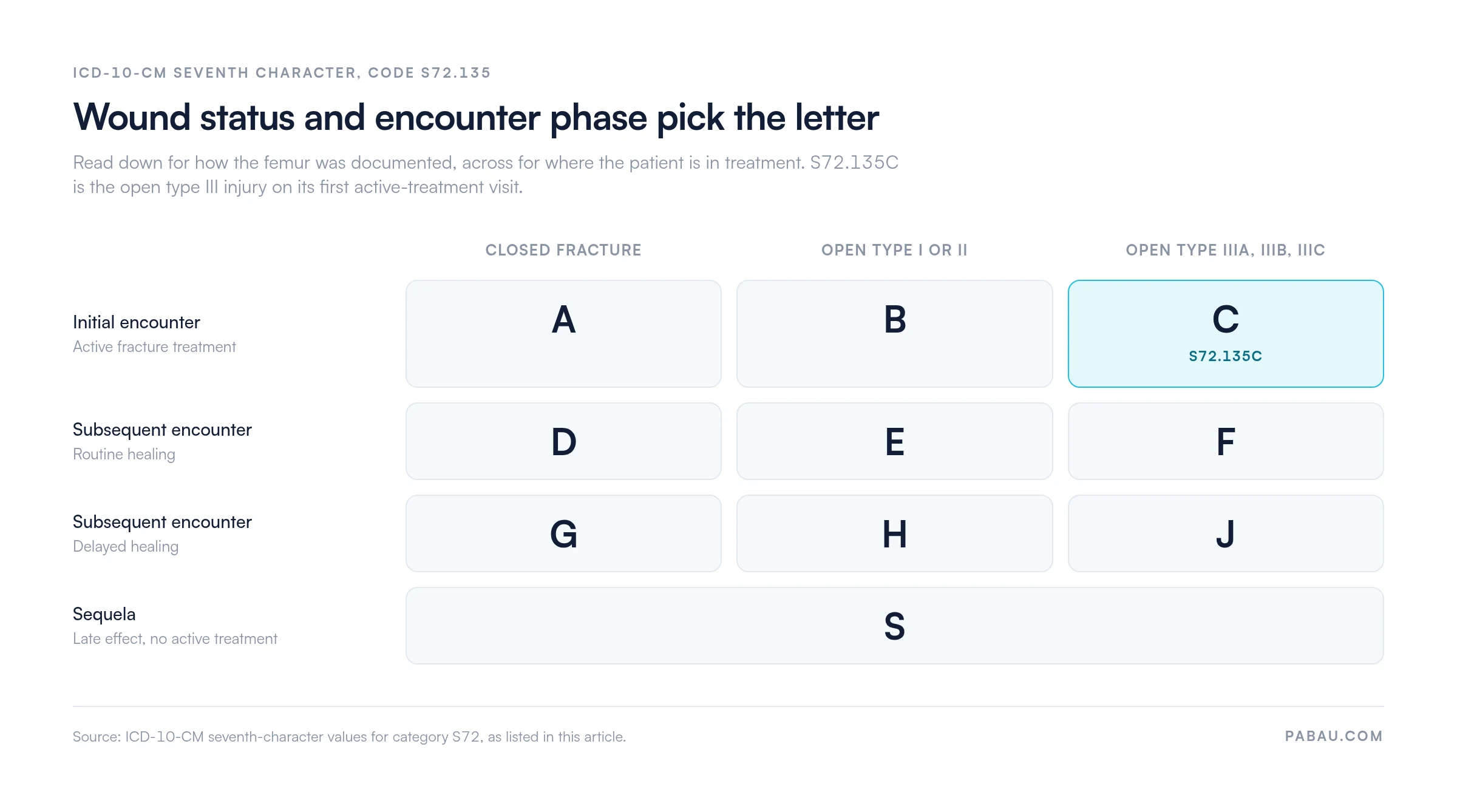
Use character C only while the patient is receiving active fracture treatment. Once surgical stabilization is complete and follow-up visits focus on healing, the character shifts to F for routine healing or J for delayed healing.
Failing to update the 7th character at that transition is a common audit finding in orthopedic coding. Practices that track it through denial management can see which character errors cost them the most.
Many patients stay non-weight-bearing through the post-operative follow-up phase and cannot drive themselves. Medicaid transportation providers bill each one-way trip under HCPCS code T2003, and several states require the trip record to name the supporting ICD-10 diagnosis.
The parent code tree runs from the chapter down to the billable code. Following it in order reduces selection errors among closely related S72 codes. The CDC and NCHS ICD-10-CM web tool displays the same hierarchy for each fiscal year edition.
The S72.13 subcategory covers apophyseal fractures of the femur. S72.131 and S72.132 are the displaced variants for the right and left femur. S72.134 and S72.135 are the nondisplaced pair, and the 7th character then sets the encounter and the wound type.
S72.135C sits in a tightly grouped family of apophyseal and pertrochanteric femur fracture codes. Selecting the wrong sibling is the most common error in this category. The table below shows the codes most often confused with it, alongside the other encounter codes for the same injury.
The rest of the S00-T88 injury chapter follows the same pattern, and our ICD-10 diagnostic code library indexes those codes by category.
S72.135C pairs with CPT procedure codes for surgical and non-surgical management of open femur fractures. The CPT code depends on the treatment method, whether that is internal fixation, external fixation, or non-operative stabilization.
The AAPC ICD-10-CM code reference provides crosswalk guidance for orthopedic fracture cases. A clearinghouse edit check catches a mismatched diagnosis-procedure pair before the claim reaches the payer.
This crosswalk is informational. Payers may apply their own medical necessity policies to these procedure codes, so confirm coverage before billing. A claim that pairs S72.135C with a closed-treatment code will draw scrutiny, because the diagnosis describes an open injury.
Section I.C.19 of the official ICD-10-CM coding guidelines governs fracture coding across the S70-S79 hip and thigh injury block. These rules apply directly to S72.135C and are the primary reference for any coding dispute or audit response. Apply them consistently across every trauma encounter, not only the high-complexity open fractures.
The encounter-type character structure is consistent across Chapter 19 injury codes, so the logic carries over to other fracture types. Electronic remittance advice shows which 7th character errors generate the most rejections, so coder training can be aimed at the costly ones.
S72.135C cannot be assigned from incomplete documentation. Every component of the code description maps to a specific piece of clinical information that the operative or emergency note must supply. Missing any one element forces a less-specific code that may not support medical necessity for the CPT procedure.
A pre-billing check on the operative report catches the missing element while the surgeon is still available to clarify it. Once the note is signed and the claim has gone out, the fix costs an appeal instead of a query.
Run a monthly query on your open fracture claims that carry 7th character C as the last digit. Filter for cases where the next encounter still carries that character instead of moving to D, F, or G as expected. Persistent use beyond the initial surgical episode is a red flag for audit. Update the character as soon as the notes confirm the active treatment phase has ended.
Most orthopedic practices find a 7th character error after the payer does. The coder assigns C, the claim goes out, and the rejection arrives weeks later. By then nobody can trace it back to a single line in the note.
Practice management software like Pabau runs that check before the claim is submitted. Pabau’s claims software for practices holds the ICD-10 and CPT catalogs in one place. A diagnosis-procedure pair that a payer will not accept is flagged at the point of entry.
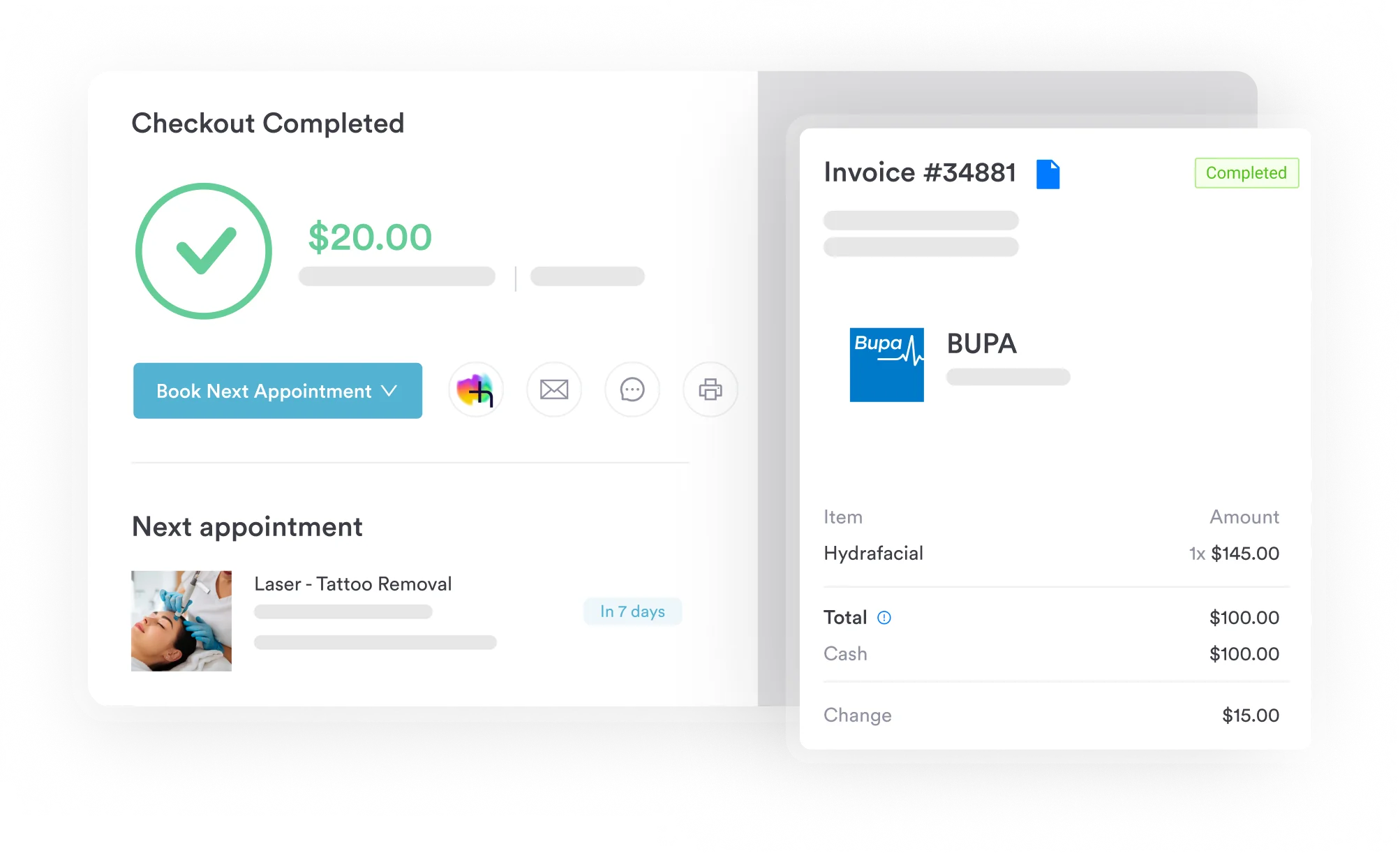
Claims leave as 837P files through the Claim.MD clearinghouse, and eligibility responses and ERA remittances come back into the same record. For a trauma admission carrying several procedure codes against one diagnosis, that removes most of the manual reconciliation.

Pabau validates ICD-10 diagnosis codes against CPT procedure codes and sends clean 837P claims through the Claim.MD clearinghouse. Fewer mismatches, fewer denials, and faster payment on orthopedic and trauma cases.

S72.135C is a four-part code, and the operative note has to carry all four parts. Laterality, displacement, fracture site, and open fracture grade each need to be documented before the code is assignable.
Get one of them wrong and you land on a sibling code that no longer matches the procedure billed. The 7th character is the one piece that keeps moving. Build the C-to-F transition into your post-operative review rather than your denial log.
Book a demo to see how Pabau validates ICD-10 and CPT pairings before an orthopedic claim leaves your practice.

Need guidance on managing claim denials for complex codes? Denial codes in medical billing covers the most common denial reason codes and how to appeal them effectively.
Submitting 837P claims for orthopedic procedures? Electronic 837 claim file explains the EDI transaction format, required segments, and how clearinghouse validation works.
Want to understand the clearinghouse that processes your ICD-10 claims? Claim.MD pricing and features outlines what the clearinghouse covers and how it integrates with Pabau’s billing workflow.
ICD-10 Code S72.135C is the billable diagnosis code for a nondisplaced apophyseal fracture of the left femur. It covers the initial encounter for an open fracture of type IIIA, IIIB, or IIIC. The parts are laterality, displacement status, fracture site, wound severity, and encounter type.
Yes. S72.135C is a billable, specific ICD-10-CM code and is valid for HIPAA-covered transactions. It appears in the current FY2026 edition of ICD-10-CM, and the FY2026 update did not introduce it.
The Gustilo-Anderson classification grades open fractures by wound size, soft tissue damage, and vascular status. It sorts them into types I, II, IIIA, IIIB, and IIIC. ICD-10-CM uses it to set the 7th character. Type I or II takes character B, and type IIIA, IIIB, or IIIC takes character C.
Switch from character C to character F once active surgical treatment is complete. Character F covers a subsequent encounter for an open type IIIA, IIIB, or IIIC fracture with routine healing. Keeping character C on routine post-operative visits is a common audit finding.
Common pairings include 27506 for open treatment of a femoral shaft fracture with internal fixation. CPT 27507 covers plate or blade plate fixation, and 27236 covers open treatment of a proximal femur fracture. The right code follows the surgical technique in the operative report, and payer coverage policies vary.
Initial encounter means the patient is receiving active treatment for the fracture, not that it is their first visit. Under CMS guidelines, any visit involving active fracture management uses the initial encounter character. That holds even if the patient has already been seen several times. The character changes once active treatment ends.