ICD-10 Code S53.013D: Anterior subluxation of unspecified radial head
ICD-10 Code S53.013D: Quick reference summary Use the table below as your first ...

Last Updated: Nov 6, 2026
Billable Code Specific Code
ICD-10 code S72.001Q means fracture of unspecified part of neck of right femur, subsequent encounter for open fracture type I or II with malunion. It is a billable code for follow-up care after active treatment ends.
Assign it when imaging confirms that an open type I or II fracture of the right femoral neck healed in an abnormal position. A closed fracture with malunion takes S72.001P, and an open type IIIA, IIIB or IIIC malunion takes S72.001R.
Let Pabau's smart automation suggest the right codes, reduce claim denials, and keep your practice compliant—effortlessly.
Automate repetitive tasks and focus on what matters most—your patients.
Reduce coding errors and ensure compliance with the latest regulations.
Clean claims, fewer denials, and faster reimbursements.
Powerful insights and reporting to help your practice thrive.
HIPAA compliant SOC 2 certified GDPR-compliant Trusted by 4,000+ clinics worldwide

S72.001Q is billable in ICD-10-CM 2027 and covers the right femoral neck only. The left side is S72.002Q, and unspecified laterality is S72.009Q.
The 7th character Q means a subsequent encounter for an open type I or II fracture that healed malunited. It is distinct from closed nonunion (K) and closed malunion (P).
A fracture the record does not describe as open is coded as closed, so an undocumented open fracture moves the claim from Q to P.
Malunion must be documented by the treating provider and supported by imaging in the record. A coder cannot assign Q from clinical impression alone.
Pabau, the practice management platform we build, checks each claim for missing or invalid details before it leaves the practice.
ICD-10 code S72.001Q is the billable code for a fracture of an unspecified part of the neck of the right femur. It applies at a subsequent encounter for an open fracture type I or II with malunion.
The code sits in category S72 (fracture of femur) and subcategory S72.0 (fracture of head and neck of femur). It carries four pieces of clinical specificity a payer needs: Anatomical site, laterality, encounter type, and healing status.
The CDC/NCHS ICD-10-CM web tool is the authoritative source for confirming billable status and fiscal-year validity. Always verify codes against the release year that applies to the date of service, not the date of billing.
Every character in S72.001Q carries a specific meaning, and misreading one of them produces the wrong code. Understanding medical billing fundamentals starts with decoding the alphanumeric string correctly.
The 5th character “0” means the record did not specify which part of the femoral neck broke. Where documentation supports greater specificity, use a more specific code with the matching 7th character. Examples include S72.031- (displaced midcervical fracture) or S72.041- (displaced fracture of base of neck of right femur).
When the record documents a head or neck fracture that fits none of those more specific subcategories, the 5th character becomes 9 instead. At a closed nonunion follow-up on the right femur, that is S72.091K.
The 7th character Q combines three facts, and all three must be documented. The patient is at a subsequent encounter, receiving routine care during the healing or recovery phase after active treatment. The original fracture was open type I or II, and it has healed in an abnormal position.
The S72 series uses 16 values for the 7th character, covering encounter type, open or closed status and healing status. Selecting the wrong one is a common cause of claim rejections on fracture claims.
The ICD-10-CM Official Guidelines for Coding and Reporting are maintained by the Centers for Medicare and Medicaid Services (CMS) and NCHS. They use subsequent encounter characters once active treatment is complete. Cast changes, medication adjustments, follow-up imaging and other aftercare visits all fall in that phase.
The open fracture types follow the Gustilo classification. When the record documents an open fracture but not its Gustilo type, the guidelines direct coders to the type I or II character. At a malunion encounter, that character is Q.
The grid below lays out the 12 subsequent-encounter characters by original fracture type and healing status.
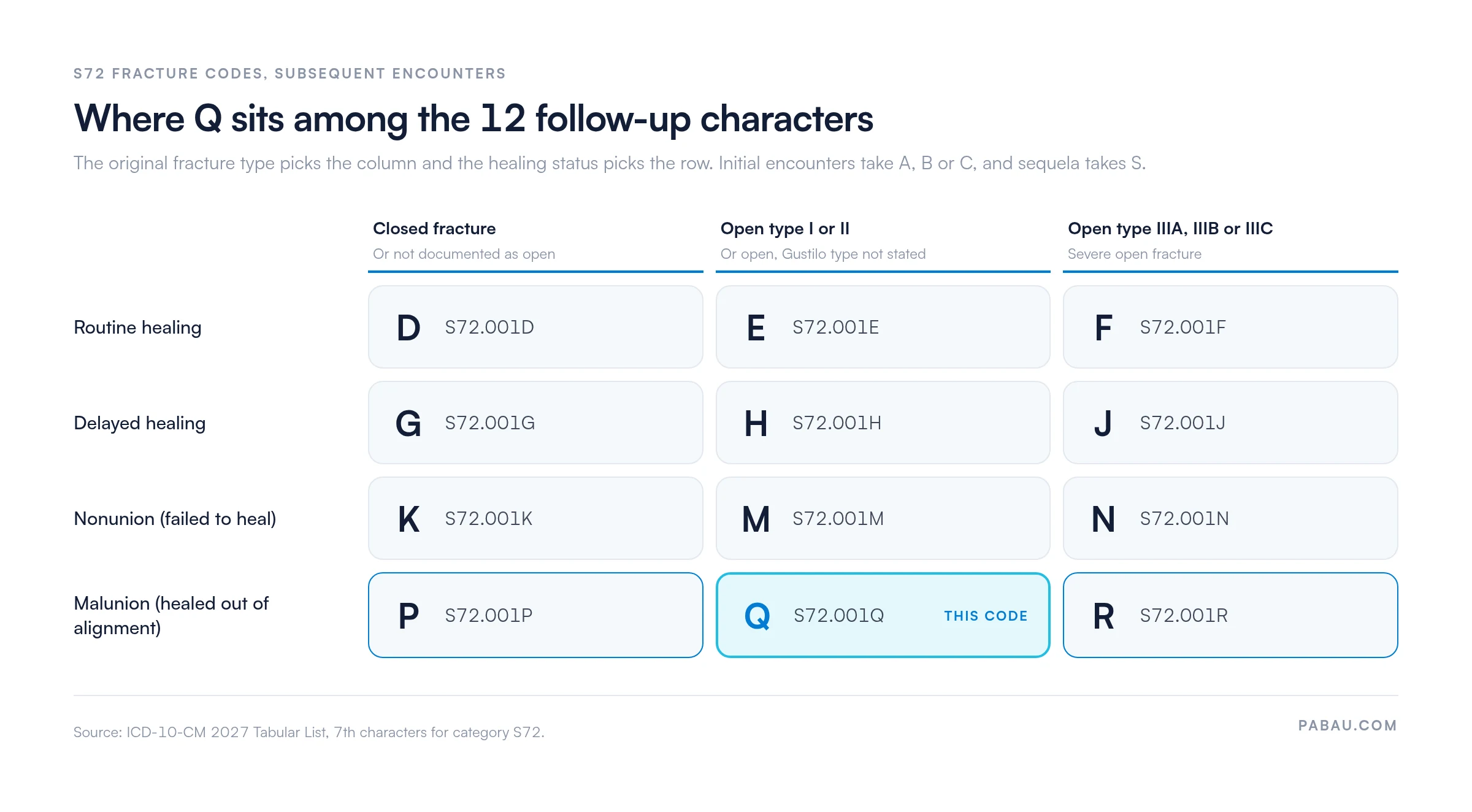
Capture open or closed status and the Gustilo type at the initial encounter, because they decide the malunion character months later. If imaging later confirms malunion, update the coding record straight away rather than waiting for a corrective procedure.
Malunion and nonunion are separate findings with separate 7th characters. Confusing them produces the wrong code, a mismatched CPT pair, and a denial that needs a record amendment to correct.
Thresholds for how much angulation or rotation counts as malunion vary by anatomy and treating surgeon. For coding purposes, the physician documents the healed-but-malaligned finding. The coder does not make that clinical determination independently.
The S72 category carries instructional notes that govern how and when ICD-10 code S72.001Q can be used. Reviewers and payers reference these notes during audits.
Laterality and 7th character errors are common causes of miscoding on S72.001Q claims. This sibling table covers the codes most often confused with it. Codes outside the S72.00- family are in our ICD-10-CM library for coders.
Use the AAPC Codify ICD-10-CM lookup to browse the full S72 range and confirm sibling code descriptors before finalizing a claim.
ICD-10 code S72.001Q describes the diagnosis, and CPT codes describe what the surgeon did about it. Because malunion means the fracture healed in the wrong position, the corrective procedures differ from those used for acute fractures. Verify all pairings against the current CMS National Correct Coding Initiative (NCCI) edits before submitting.
The operative note should name the procedure site precisely. A femoral neck osteotomy (27161) and an intertrochanteric osteotomy (27165) are not interchangeable, and the site must match the S72.0 diagnosis. When the surgeon replaces the hip instead, the procedure is reported with CPT 27130.
External cause codes capture how the original femoral neck fracture happened, such as a fall or a transport accident. They are secondary codes, and their 7th character is limited to A, D or S as the encounter requires. At a subsequent encounter coded S72.001Q, the external cause code takes D.
Place of occurrence (Y92.-) and activity (Y93.-) codes can be added where payer or state reporting rules ask for them. There is no national requirement to report external cause codes, so check each payer’s rules.
Every element of ICD-10 code S72.001Q must be supported by the medical record. A code the record cannot support exposes the practice to recoupment at audit.
The checklist below reflects what a clean claim submission requires when this code appears on the claim form. Confirm each element is documented before coding.
Medicare accepts S72.001Q as a valid diagnosis code. Coverage for the procedures that usually follow malunion, such as corrective osteotomy or hip arthroplasty, is decided separately. Local Coverage Determinations (LCDs) from each Medicare Administrative Contractor (MAC) and commercial payer policies set those rules.
Commercial payers often require prior authorization before elective corrective surgery. The request should include the S72.001Q code, the imaging that confirms malunion, and the initial treatment history. That history should show the original fracture was open type I or II, plus the clinical rationale for the planned procedure.
Check payer-specific LCD updates and NCCI edits every quarter. External cause code requirements for subsequent encounter hip fracture claims vary between traditional Medicare, Medicare Advantage plans, and commercial payers. A policy update that goes unnoticed can produce a run of denials on claims that were clean the previous quarter.
S72.001Q generates a predictable set of denials. Each one maps to a specific documentation or coding error that a structured denial management workflow can catch before submission.
Without a check at coding time, a malunion claim can leave the practice with the wrong 7th character or a missing field. The payer finds the problem weeks later, and the claim comes back for rework.
In Pabau’s claims management software, each claim is raised from the patient’s invoice. Claim validation then checks every claim for missing or invalid details before it leaves Pabau.
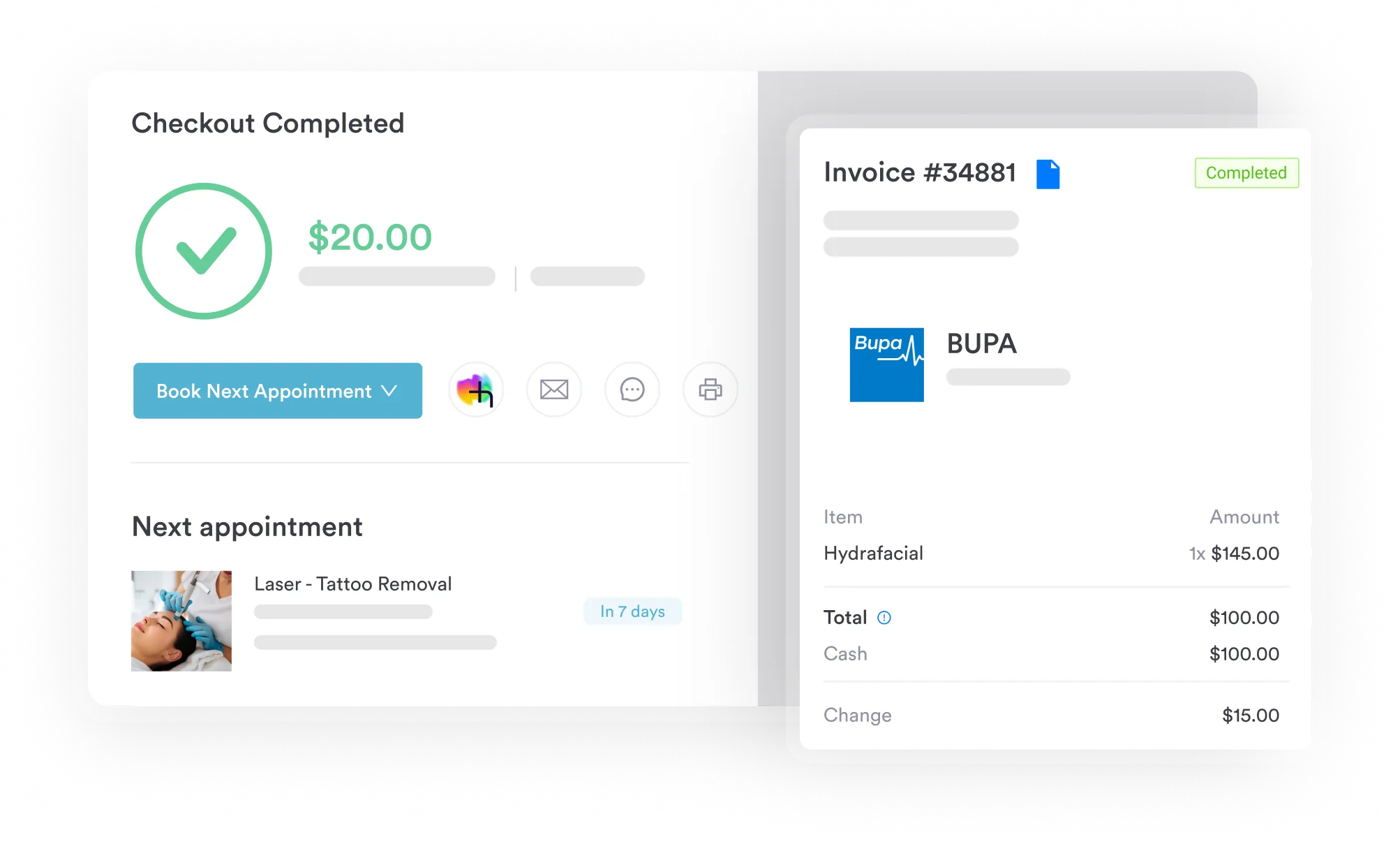
US practices send ICD-10 code S72.001Q claims electronically through Claim.MD, Pabau’s integrated US clearinghouse partner. Claim.MD checks each claim for errors before it reaches the payer.

Pabau checks every claim for missing or invalid details before it leaves the practice, so fracture claims reach the payer complete. See the billing workflow in a live demo.

S72.001Q is safe to assign once the record holds four facts. Those are imaging-supported malunion, right-side laterality, a subsequent encounter, and documentation that the original fracture was open type I or II.
The open fracture fact is the one to check first. Without it, the S72 default treats the fracture as closed, and the correct code becomes S72.001P. Confirming it at coding time takes a minute and spares the practice a rejected claim.
Book a demo to see how Pabau checks fracture claims for missing details before they reach the payer.

Need to understand the full medical billing process behind these claims? What is medical billing covers the end-to-end revenue cycle from charge capture through payment posting.
Dealing with denied S72.001Q claims after submission? Denial management in healthcare outlines the appeal workflow and root-cause analysis steps that recover rejected revenue.
Want to submit cleaner claims from the start? Clean claim submission details the pre-submission checks that keep fracture code claims off the denial list.
Billing the hip replacement that follows a symptomatic malunion? CPT code 27130 covers the total hip arthroplasty code and its documentation rules.
Decoding the reason a fracture claim came back? Denial codes in medical billing explains what each payer denial code means and how to respond.
ICD-10 code S72.001Q means fracture of unspecified part of neck of right femur, subsequent encounter for open fracture type I or II with malunion. It applies after active treatment, when imaging confirms the open fracture healed in an abnormal position.
The 7th character Q designates a subsequent encounter for an open fracture type I or II with malunion. The patient is past active treatment, and the fracture has healed in an abnormal position. P is the closed equivalent, and R covers open types IIIA, IIIB, and IIIC.
S72.001Q is for malunion of an open type I or II fracture, which healed in the wrong position. S72.001K is for nonunion of a closed fracture, which failed to heal. Malunion shows bridging callus with malalignment, while nonunion shows no bridging callus.
S72.001D is for a closed fracture healing normally on follow-up, so the two codes never apply to the same fracture. An open type I or II fracture healing normally takes S72.001E. The record moves to S72.001Q once imaging confirms malunion, not when corrective surgery starts.
There is no national requirement, but many payers and state reporting rules ask for external cause codes on injury claims. External cause codes use only A, D or S as the 7th character. When you report one with S72.001Q, it takes D at a subsequent encounter.
Malunion means the fracture healed with bridging callus but in an abnormal alignment, and it takes P, Q or R as the 7th character. Nonunion means healing failed, with no bridging callus beyond the expected window, and it takes K, M or N as the 7th character. The provider’s documentation and imaging decide which one is present.