ICD-10 code S61.201A: Open wound of left index finger without nail damage
ICD-10 code S61.201A covers a left index finger wound of unstated type ICD-10 co...

Last Updated: Oct 16, 2026
Billable Code Specific Code
S65.301D is the billable ICD-10-CM code for unspecified injury of deep palmar arch of right hand, subsequent encounter.
Accurate assignment also means knowing the parent category S65, which covers injuries of blood vessels at wrist and hand level.
Coders in hand surgery, orthopedics, emergency medicine, and physical therapy practices meet this code at follow-up visits after a palmar arch injury treated elsewhere.
Let Pabau's smart automation suggest the right codes, reduce claim denials, and keep your practice compliant—effortlessly.
Automate repetitive tasks and focus on what matters most—your patients.
Reduce coding errors and ensure compliance with the latest regulations.
Clean claims, fewer denials, and faster reimbursements.
Powerful insights and reporting to help your practice thrive.
HIPAA compliant SOC 2 certified GDPR-compliant Trusted by 4,000+ clinics worldwide

ICD-10 Code S65.301D describes an unspecified injury of the deep palmar arch of the right hand during a subsequent encounter (7th character D).
This is a fully billable ICD-10-CM code, effective October 1, 2025, valid for FY2026 claim submissions.
The 7th character D applies when the patient receives routine care during the healing phase, not active initial treatment.
Documentation must confirm right-hand laterality, the subsequent encounter designation, and the specific vascular structure involved.
S65.301D sits on the CMS present on admission exempt list, so inpatient claims need no POA determination for it.
ICD-10 Code S65.301D is a fully billable, specific ICD-10-CM diagnosis code. Its official description is Unspecified injury of deep palmar arch of right hand, subsequent encounter.
It became effective October 1, 2025 under the FY2026 ICD-10-CM edition and remains valid for all claims submitted under the current coding year.
The code breaks down into four parts.
The CDC ICD-10-CM tool confirms billable status and shows the full tabular description and effective date for any code in the current edition.
The 7th character in ICD-10 Code S65.301D tells the payer which phase of care the visit represents. Choosing the wrong character is among the most audited errors in trauma billing.
The ICD-10-CM Official Guidelines for Coding and Reporting are explicit about subsequent encounter (D). It applies when the patient is receiving routine care during the healing or recovery phase.
That covers wound checks, cast or splint changes, ongoing monitoring, and referrals to occupational therapy practices. The patient does not have to be fully healed.
The 7th character reflects the phase of care, not the number of visits. A patient seen for the first time by a new provider still gets the D character. What matters is that the injury is healing and no active treatment is being delivered. The same principle runs through the whole S00-T88 chapter, from S63.501D to S42.302K.
Check whether the visit involves any active surgical intervention, debridement, or new treatment. If yes, A is correct. If the provider is monitoring progress, adjusting a splint, or reviewing healing status, D is appropriate. When in doubt, review the clinical note for phrases like ‘healing well,’ ‘follow-up,’ or ‘wound check.’
All three codes share one base descriptor, unspecified injury of the deep palmar arch of the right hand. The 7th character alone decides which one applies.
Sequela coding needs a second code for the residual condition itself, linked to the injury code carrying the S character. The ICD-10-CM Official Guidelines set that instruction out in Section I.C.19. The same pattern applies to other S65 sequela codes such as S65 sequela codes such as S65.919S.
The deep palmar arch is formed mainly by the terminal branch of the radial artery. A communicating branch from the deep branch of the ulnar artery completes it. The arch runs across the palm at the level of the metacarpal bases, deep to the long flexor tendons.
Location matters for coding accuracy. An injury to the superficial palmar arch maps to a different subcategory within S65. That arch is more ulnar-dominant and sits closer to the skin. Confusing the two produces the wrong code even when laterality and encounter type are right.
When the documentation does not specify whether the injury involved the deep or superficial arch, query the treating clinician before assigning S65.301D. The unspecified designation in the code refers to the nature of the injury, not to the anatomical structure.
S65.301D sits in a family of codes that coders meet together. Knowing the adjacent codes reduces selection errors and supports accurate crosswalk queries. The AAPC Codify lookup lists the full S65 subcategory, including every encounter-type variant.
Laterality, encounter type, and the specificity of the vessel involved are the three axes that decide the correct code across hand trauma. Get all three from the note before you code.
A claim carrying ICD-10 Code S65.301D invites a payer audit if the note misses any of its three core elements. Those are the anatomical structure, the laterality, and the encounter phase.
Maintaining compliant clinical records that capture encounter-specific detail reduces denial risk and the time spent on appeals. Practices using structured clinical documentation tools can template these checkpoints into follow-up note workflows.
For subsequent encounter visits involving vascular injuries, add a documentation prompt to your follow-up note template: ‘Encounter type: healing/recovery phase (initial treatment completed [date/provider]).’ This single line creates an auditable trail that supports the 7th character D selection and reduces payer queries.
S65.301D is a valid diagnosis code for claim submission in both inpatient and outpatient settings. A few billing details decide whether it clears on the first pass, and they differ between Medicare billing and commercial payers.
S65.301D maps to MS-DRG groups within the musculoskeletal and injury chapters. The exact group depends on the accompanying procedure codes and the patient’s comorbidities.
Specific DRG assignments change with each annual CMS IPPS final rule, so verify current mapping against the CMS ICD-10 resources rather than last year’s file.
S65.301D appears on the CMS present on admission (POA) exempt code list. An inpatient claim therefore needs no POA determination for this code. The exemption covers codes that describe an encounter for care rather than a new acute condition, which is what the D character signals. Every other diagnosis on the same claim still needs its own POA indicator. Most claim errors are structural rather than clinical, which is why scrubbing rules catch them. Keeping a code lookup current matters more than keeping it comprehensive.
Practices using claims management software can build rule sets that flag S65.301D for a documentation check before submission. Pair the diagnosis with the right CPT code for the follow-up service.
That usually means an evaluation and management code rather than a surgical code such as 11043. Automated workflows can also confirm the earlier initial-encounter claim was accepted before the subsequent-encounter claim goes out.
Several patterns show up repeatedly in audits of S65 family codes. Each one has a direct fix.
Good EHR integration keeps these error patterns visible before claims leave the practice. When coders and clinical staff share one system with structured note templates, the documentation that supports S65.301D is collected at the point of care.
Follow-up visits for hand and wrist injuries create a recurring coding problem. The visit looks routine, but the encounter-type documentation has to be explicit enough to survive payer review.
Practice management software like Pabau lets billing teams build pre-submission checklists tied to specific diagnosis codes. A claim carrying ICD-10 Code S65.301D then gets checked against encounter-type criteria before it leaves the system.
Pabau Scribe, our AI scribe, drafts the follow-up note while the visit is still fresh. Healing status, prior treatment, and laterality land in the record instead of being reconstructed at billing review. Digital intake forms prompt for the same three elements at check-in, so the documentation behind S65.301D is built at the point of care.
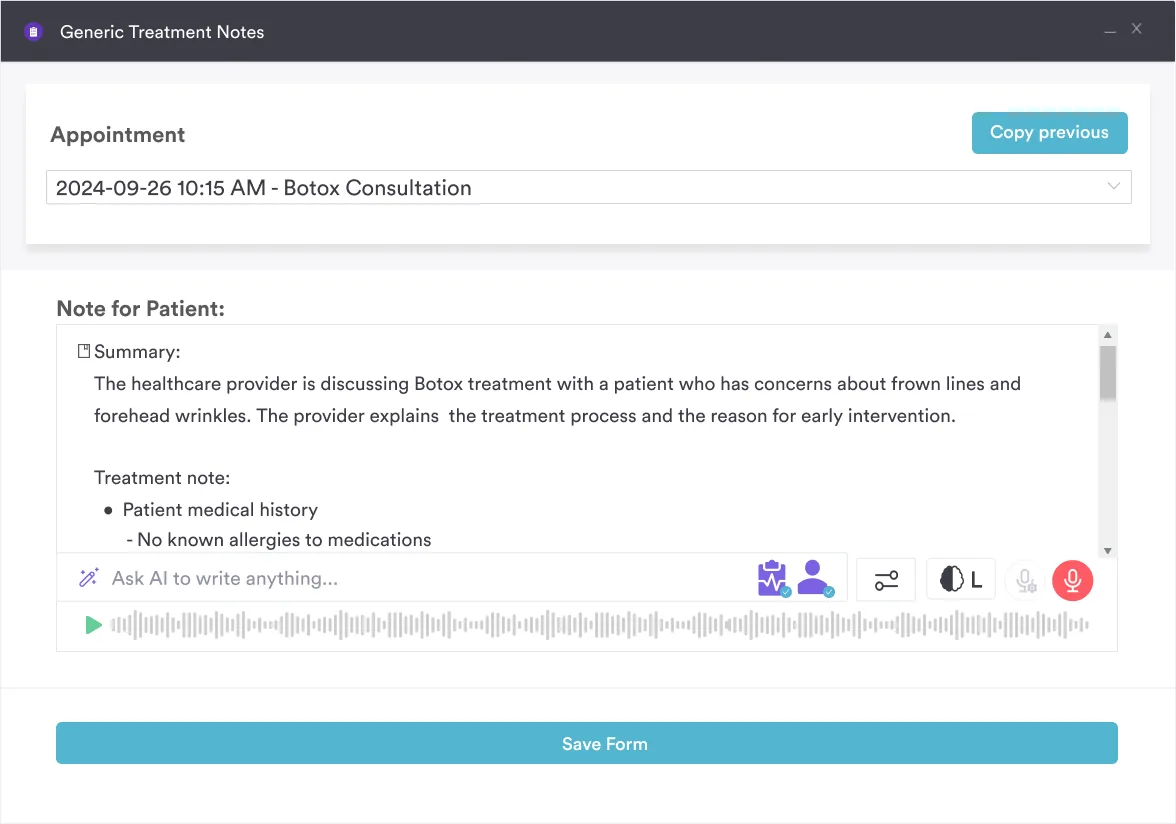
Coding staff working from live patient records catch preventable denials that printed encounter summaries hide. Running documentation and billing in a single practice management system is what makes that possible.

Pabau helps practices document encounter types accurately, track follow-up visits, and submit cleaner claims with fewer denials.

The safest habit with S65.301D is to read the note before reaching for the code. If it names the deep palmar arch, the right hand, and routine care during healing, submit it. If any one of the three is missing, query the clinician rather than guess.
Sorting that out at the documentation stage takes a minute. Sorting it out after a denial takes an appeal, a resubmission, and weeks of delayed payment.
Pabau’s claims and documentation tools build those checks into your standard follow-up workflow. Book a demo to see how encounter-type documentation and coding stay in one place.

Coding a hand tendon injury as a late effect? S66.527S covers sequela coding for an extensor tendon laceration in the hand.
Need the follow-up rules for a hand laceration? S61.441D applies the same subsequent encounter logic to an open wound of the hand.
Working with fracture codes that carry a 7th character? S62.185K covers what to do when a hand fracture fails to heal.
Coding the acute presentation instead? S63.121A walks through initial encounter documentation for a thumb dislocation.
Coding a shoulder tumor excision instead? Shoulder soft tissue tumor excision covers the CPT code for removing a subfascial shoulder tumor of 5 cm or greater.
ICD-10 Code S65.301D is the diagnosis code for an unspecified injury of the deep palmar arch of the right hand during a subsequent encounter. Subsequent encounter means the patient is receiving routine care during the healing phase, after active initial treatment. It is a fully billable ICD-10-CM code under the FY2026 edition.
Yes, S65.301D is a specific, billable ICD-10-CM code valid for FY2026 claim submissions. The base code S65.301 without a 7th character is not billable. Claims need the complete seven-character code S65.301D to be accepted.
All three codes describe an unspecified injury of the deep palmar arch of the right hand. S65.301A applies during the initial encounter, when active treatment is provided. S65.301D applies at subsequent encounters, while the patient is in the healing phase. S65.301S applies to a late effect or residual condition arising from the original injury, such as scar contracture.
Use D when the patient is receiving routine care during the healing or recovery phase, rather than active treatment. That includes follow-up visits, wound checks, cast or splint management, and monitoring appointments. The character still applies the first time a particular provider sees the patient, as long as initial treatment is complete.
The record must confirm three things. The injury involves the deep palmar arch, and the affected hand is the right hand. The visit must also be routine care during healing rather than active initial treatment. Notes should reference completed initial treatment and use phrases such as follow-up or healing well.
Key related codes are S65.301A for the initial encounter and S65.301S for sequela. S65.302D covers the left hand, S65.309D the unspecified hand, and S65.201D the superficial palmar arch. The parent category S65 covers all injuries of blood vessels at wrist and hand level, but is not billable itself.
S65.301D maps to MS-DRG groups in the injury and trauma chapters. The specific assignment depends on the accompanying procedure codes and the patient’s comorbidities. DRG mappings change annually with the CMS IPPS final rule, so verify current assignments through official CMS resources.
Yes. S65.301D sits on the CMS present on admission exempt list, so an inpatient claim needs no POA determination for it. Every other diagnosis on the same claim still needs its own indicator.