ICD-10 Code S42.444P: Medial epicondyle fracture, right humerus
ICD-10 Code S42.444P: full descriptor and code validity ICD-10 Code S42.444P car...

Last Updated: Oct 13, 2026
Billable Code Specific Code
S63.399D is the billable ICD-10-CM code for traumatic rupture of other ligament of unspecified wrist, subsequent encounter.
Coders often leave the initial-encounter character in place well into rehab, and the claim then describes the wrong phase of care.
Let Pabau's smart automation suggest the right codes, reduce claim denials, and keep your practice compliant—effortlessly.
Automate repetitive tasks and focus on what matters most—your patients.
Reduce coding errors and ensure compliance with the latest regulations.
Clean claims, fewer denials, and faster reimbursements.
Powerful insights and reporting to help your practice thrive.
HIPAA compliant SOC 2 certified GDPR-compliant Trusted by 4,000+ clinics worldwide

S63.399D covers traumatic rupture of another ligament of the unspecified wrist at a follow-up encounter.
The 7th character D applies while active treatment continues, so use it for rehab visits, cast changes, and therapy appointments.
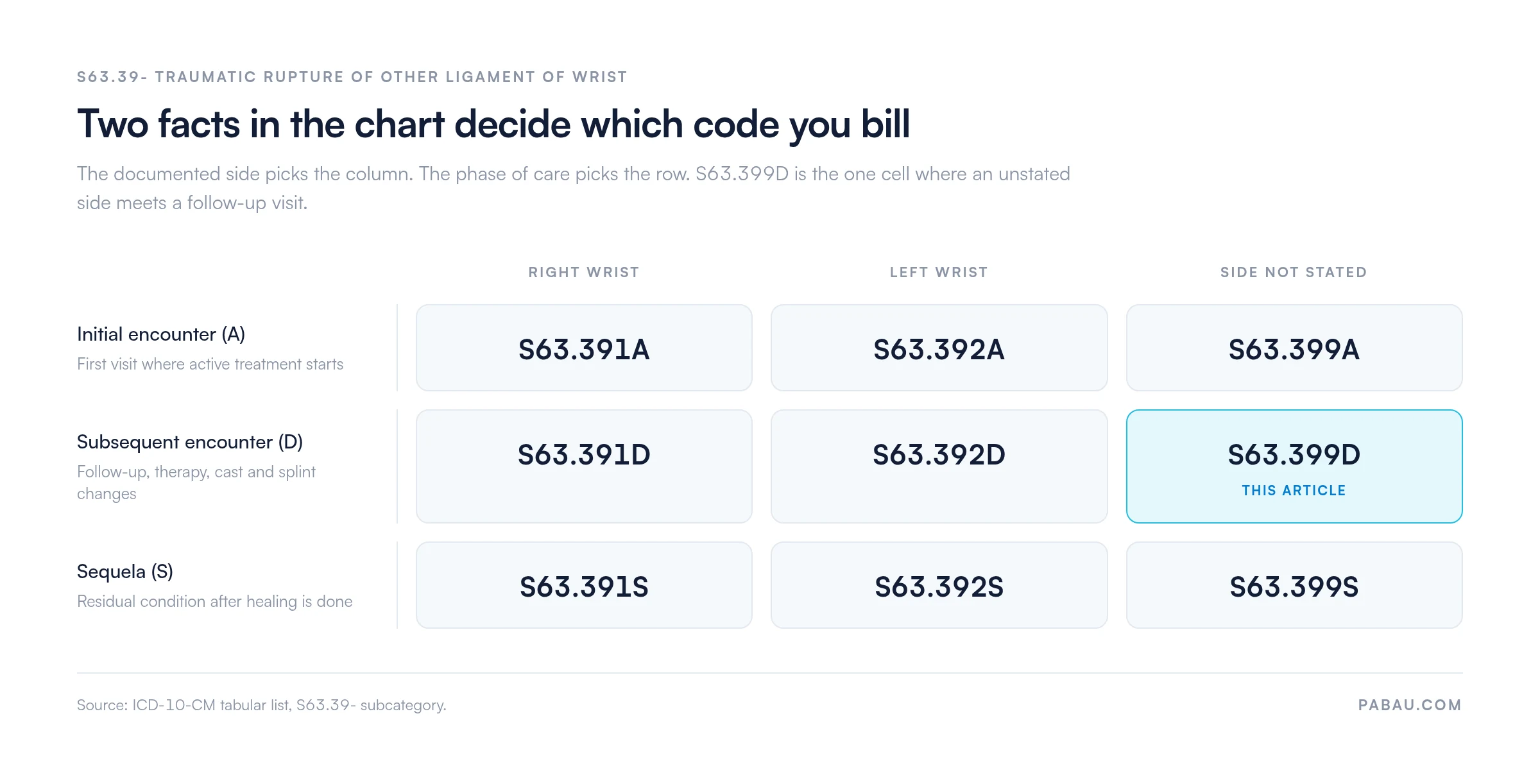
S63.391D covers the right wrist and S63.392D the left, so save S63.399D for records that truly do not name a side.
The code has been valid since October 1, 2015, and nothing changed for it in the FY2026 code set.
Practice management software like Pabau helps orthopedic and sports medicine teams submit S63.399D claims and track encounter type across an episode of care.
S63.399D is a billable, specific ICD-10-CM code, valid for reimbursement. Its full description reads Traumatic rupture of other ligament of unspecified wrist, subsequent encounter.
The CDC/NCHS ICD-10-CM web tool places it in Chapter 19, which covers injury, poisoning and certain other consequences of external causes. It applies when a provider manages a wrist ligament rupture that was diagnosed and treated at an earlier visit.
The phrase “other ligament” separates this code from the named-ligament codes in the same subcategory.
When the note names one of those, code it there. S63.399D fits when the rupture is described generically, or when the chart does not let you identify the ligament.
The 7th character records the phase of care, not the severity of the injury. CMS ICD-10-CM coding guidance is explicit about that. The character describes where the patient sits in their treatment on the day of the encounter.
Three characters apply across the S63.399 family. A marks the initial encounter, D marks subsequent encounters, and S marks a sequela. Choosing the wrong one is the most common reason these claims fail an audit.
Subsequent encounter does not mean the injury has resolved. Physical therapy, splinting, and pain management during follow-up all still qualify for the D character. Reach for S only once healing is complete and a residual condition persists.
Each level above S63.399D narrows the injury, first by body region, then by structure, then by side. Reading the chain back up is the quickest way to confirm you landed in the right category.
ICD-10-CM asks for the side wherever a code family offers one. The S63.39 subcategory gives three choices at a subsequent encounter, and only one of them is unspecified.
Payers increasingly scrutinize unspecified laterality codes. A note that mentions the dominant hand, or refers to imaging of one side, counts as implied laterality. Query the provider instead of defaulting to S63.399D.
Put both decisions side by side and the whole subcategory fits into a single grid.
Four elements have to be in the record before S63.399D holds up under review.
Capture them at intake and at every return visit and the denial risk drops sharply. AHIMA and the AHA Coding Clinic remain the authoritative references when a documentation question is genuinely unclear.
Run a quarterly audit on all S63.399 claims. Filter for cases where the 7th character is A but the visit date is more than 21 days after the injury date. These are high-probability miscodes that payers flag during post-payment review.
The code is one field on a document that passes several checkpoints before it pays. Knowing where it stops tells you what to fix.
The visit generates a note. A coder reads that note, assigns S63.399D, and pairs it with the procedure codes for what was done. The claim leaves as a CMS-1500 professional claim, usually through a clearinghouse. Automated payer edits run first, and a human reviewer only sees the ones that fail.
That edit stage is where wrist ligament claims stall. An unspecified laterality code on a chart that names a side will trip one. So will a D character on a visit the payer already holds on file as the initial encounter. Neither needs a person to catch it, which is why a claim can bounce the same day.
A clean claim leaves with the phase of care, the side, and the injury category all matching the note. Six checks before submission take less time than a rework afterwards.
When one does come back, the remittance advice names a reason code. Our guide to denial codes explains what each one is asking you to fix.
The S63.399 family fails in predictable ways, and the 7th character or the side causes almost all of it.
Coders in orthopedics, sports medicine, and hand surgery cross-reference the same short list. The AAPC Codify ICD-10-CM lookup lets you hold these next to the note while you decide.
Practices submitting S63.399D through a clearinghouse should know what that connection does and does not check.
Pabau’s Claim.MD integration reaches thousands of US payers and files CMS-1500 professional claims. It verifies patient eligibility before the visit and flags missing fields on the claim itself. What it will not do is tell you the 7th character contradicts the note, and that judgment stays with the coder.
Most practices carry encounter type in their heads. The coder opens the chart, scrolls back to find the first visit for the injury, and decides whether today counts as ongoing active treatment.
On a busy orthopedic list, that call gets made dozens of times a day.
Practice management software like Pabau keeps the whole episode in one client record. The visit history that settles the 7th character then sits on the same screen as the note.
Pabau’s claims management software then submits the claim and tracks its status through to payment. The Claim.MD integration checks coverage before the visit rather than after the denial.
None of that reads the clinical note for you. It does spare the coder two slow jobs, hunting for the injury’s first date of service and chasing a claim that failed eligibility.

Pabau’s claims management software files CMS-1500 professional claims through Claim.MD, checks patient eligibility before the visit, and keeps every encounter in one client record. Your coders spend less time reconstructing an episode of care.

Three judgment calls decide whether an S63.399D claim pays. The encounter type, the side, and the injury category are each a one-line check against the note. Each one has an automated payer edit waiting behind it.
The habit worth building is smaller than it sounds. Read the note for the phase of care before you reach for the code, and query the side rather than defaulting to unspecified. Wrist ligament claims stop bouncing once that order becomes routine.
Those calls get easier when the visit history and the claim status sit on one screen. Book a demo to see how Pabau handles a whole episode of care.

Was it a sprain rather than a rupture? S63.501D covers unspecified sprain of the right wrist, under the same 7th character rules.
Need the sequela side of a wrist injury? S63.592S walks through coding a left wrist sprain once active treatment has ended.
Working out why a claim came back? Denial management in healthcare sets out a workflow for tracking and reworking rejections.
Auditing your documentation habits? Medical billing compliance covers the standards an ICD-10-CM audit is measured against.
There is no day limit in ICD-10-CM. D applies for as long as the patient receives active treatment for the injury, whether that runs three weeks or nine months. Switch to S only once healing is complete and a residual condition remains.
Yes. Where the wrist rupture is the reason for the follow-up visit, S63.399D is reported first. Sequence it lower only when the visit is chiefly for something else, or when you are coding a sequela.
The S63.39 subcategory has no bilateral option, so report both sides. Assign S63.391D for the right wrist and S63.392D for the left on the same claim. The unspecified code is never a shortcut for a bilateral injury.
Yes. External cause codes carry their own 7th character, so a follow-up visit takes the D version of the W, X, or Y code as well. Report it for as long as the injury is being treated.