

ICD-10 Code S42.444P: Medial epicondyle fracture, right humerus
ICD-10 Code S42.444P: full descriptor and code validity ICD-10 Code S42.444P car...

Last Updated: Oct 13, 2026
Billable Code Specific Code
S62.291G is the billable ICD-10-CM code for other fracture of first metacarpal bone, right hand, subsequent encounter for fracture with delayed healing.
The one judgment call is G, and it belongs to the treating provider rather than the coder. Pick the wrong character and the claim tells the payer a different clinical story than the chart does.
Let Pabau's smart automation suggest the right codes, reduce claim denials, and keep your practice compliant—effortlessly.
Automate repetitive tasks and focus on what matters most—your patients.
Reduce coding errors and ensure compliance with the latest regulations.
Clean claims, fewer denials, and faster reimbursements.
Powerful insights and reporting to help your practice thrive.
HIPAA compliant SOC 2 certified GDPR-compliant Trusted by 4,000+ clinics worldwide

S62.291G is a billable ICD-10-CM code for other fracture of the first metacarpal bone, right hand, at a subsequent encounter with delayed healing.
The seventh character G means healing is slower than expected, which separates it from D for routine healing and K for nonunion.
Other fracture is a residual category, so Bennett, Rolando, base, shaft and neck fractures of the thumb metacarpal all code elsewhere.
Delayed healing is the provider’s documented judgment, so query the chart before you swap D for G.
Practice management software like Pabau sends CMS-1500 and 837P claims through a clearinghouse, so format errors surface early.
S62.291G is a billable, specific ICD-10-CM code. It describes an “other fracture” of the first metacarpal bone, right hand. You report it at a follow-up visit where the provider has documented slower-than-expected healing.
Per the CDC/NCHS ICD-10-CM lookup tool, the code is valid in every HIPAA-covered transaction from October 1, 2025.
Billable is not the same as paid. The code clears format edits on a CMS-1500 or an 837P, but coverage policies for fracture follow-up visits still vary by plan. Reimbursement rests on medical necessity, which in practice means the note underneath the code.
S62.291G is the seventh-character extension of S62.291, inside the injury chapter’s wrist and hand block. Reading the chain upward is the quickest way to confirm you are at the right level of specificity.
The full code runs to seven characters. S62.291 on its own is a header, so a claim carrying it rejects before a payer ever reads it. The CMS ICD-10 codes page publishes the annual tabular list and the update files behind that rule.
Character G marks a follow-up visit where the bone is still knitting, only later than it should. Healing that has genuinely stopped is K, and the two get confused constantly.
The fracture characters split three ways first, into initial encounter, subsequent encounter, and sequela. Within subsequent, the character then reports healing status. The decision runs in that order, so work down it rather than scanning for the label that sounds closest.
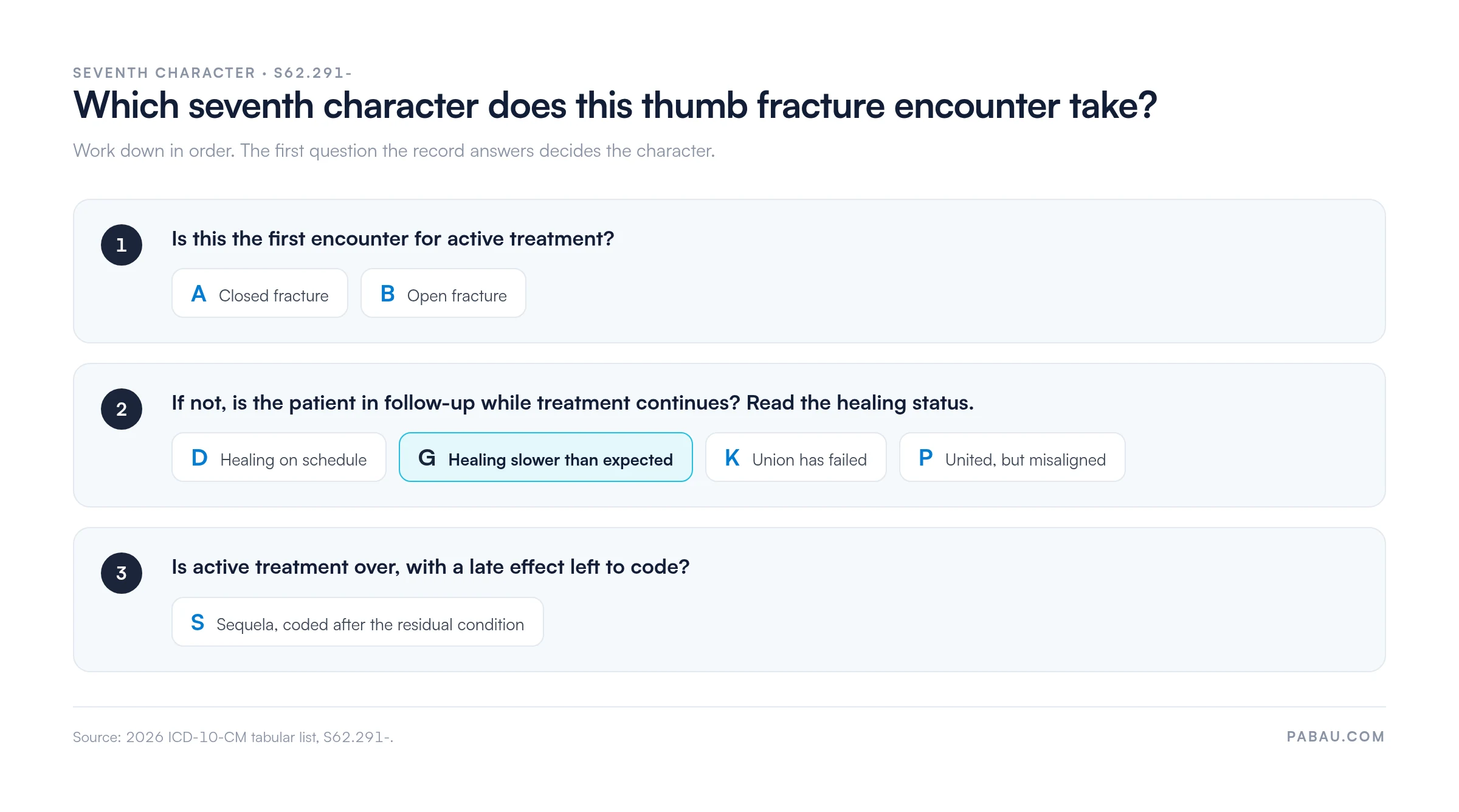
One detail catches coders who move between body regions. Hand and wrist fracture codes are not split by Gustilo classification, so there is no type I/II versus type IIIA/B/C pair here. S62 gives you a single open-fracture character, and that character is B.
Key distinction: swapping G in for K overstates the severity on the claim. Swapping D in for G understates the work the provider actually did. Auditors watch both directions, which is why the healing statement in the note matters more than the character itself.
The treating provider does. No week count turns D into G, because delayed healing is a clinical determination rather than a deadline.
The ICD-10-CM official guidelines from CDC/NCHS set out the fracture seventh characters and leave that judgment with the clinician. Worth noting: this encounter-based system is specific to ICD-10-CM in the United States. The WHO’s international ICD-10 does not use it, so a coder trained abroad will not recognise the pattern.
Clinical literature generally expects radiographic healing in a metacarpal fracture within four to eight weeks. Age, comorbidities, and fracture pattern all move that window, which is why the guidelines refuse to name a number.
To support character G on S62.291G, the record needs at least one of the following:
Without one of those, a payer can reassign or deny the line because the qualifier is unsupported. When the record sits somewhere between routine and delayed, query the provider before you choose.
A note that reads ‘patient returns for follow-up, x-ray reviewed’ will not support character G. It confirms the visit happened and nothing more. Ask the provider for one line on whether healing is on track, then code from that.
S62.29 is a residual subcategory. It catches first metacarpal fracture patterns that none of the named subcategories describe, and nothing beyond that.
The first metacarpal is the thumb metacarpal, the shortest of the five and the most radially placed. Metacarpals run I to V, thumb to little finger. Thumb fractures carry clinical weight because pinch and grip both depend on that ray.
Subcategory S62.2 splits by fracture pattern before it splits by hand, and each named pattern has its own codes:
So the residual code is a last stop, never a default. Read the operative note or the imaging report for the fracture pattern first, and only land on S62.291G when none of the named patterns fit.
S62.291 carries seven billable extensions, and the same set repeats for the left hand under S62.292 and the unspecified hand under S62.299. The AAPC ICD-10-CM lookup lists the whole S62.29 family in one view.
Laterality is not optional here. S62.299G holds up only when the record genuinely never states which hand, which is rare for a thumb injury. If laterality appears anywhere in the chart, code it.
Other fracture sites follow the same seventh-character logic, and our ICD-10 diagnostic code library breaks each one down the same way. A displaced middle phalanx fracture at a delayed-healing follow-up takes the same G character under S62.628G.
Providers rarely write in tabular language. These phrasings all land on S62.291G through the alphabetic index:
Before you commit to any of them, the chart has to confirm four facts. Right hand, first metacarpal, a pattern that is neither Bennett’s nor Rolando’s, and provider-documented delayed healing.
Nothing about this code changes how a claim travels. What changes is where it gets stuck, and it is almost always the same place.
That gives you a short pre-submission routine. Run these five checks before the claim goes out:
Four of those five are chart problems. Only the last one is a keystroke, which tells you where to spend your review time.
The record has to carry three parts of the code description at once. Fracture type, anatomy, and encounter status all need to appear, and a claim built on the code holds up when they do.
Most of the work above happens in two places that rarely talk to each other. The healing statement lives in the clinical note, and the claim gets rebuilt somewhere else, often from a superbill written after the fact.
Practice management software like Pabau keeps both on one record. Pabau’s tools for cleaner claims management build the CMS-1500 or 837P line straight from the encounter. The diagnosis you coded is the diagnosis that ships. Eligibility checks run before the visit instead of after the denial.
Remittance advice comes back into the same record. A denial on a fracture line lands next to the note that caused it. The coder reads the reason code and the documentation together, instead of chasing both.
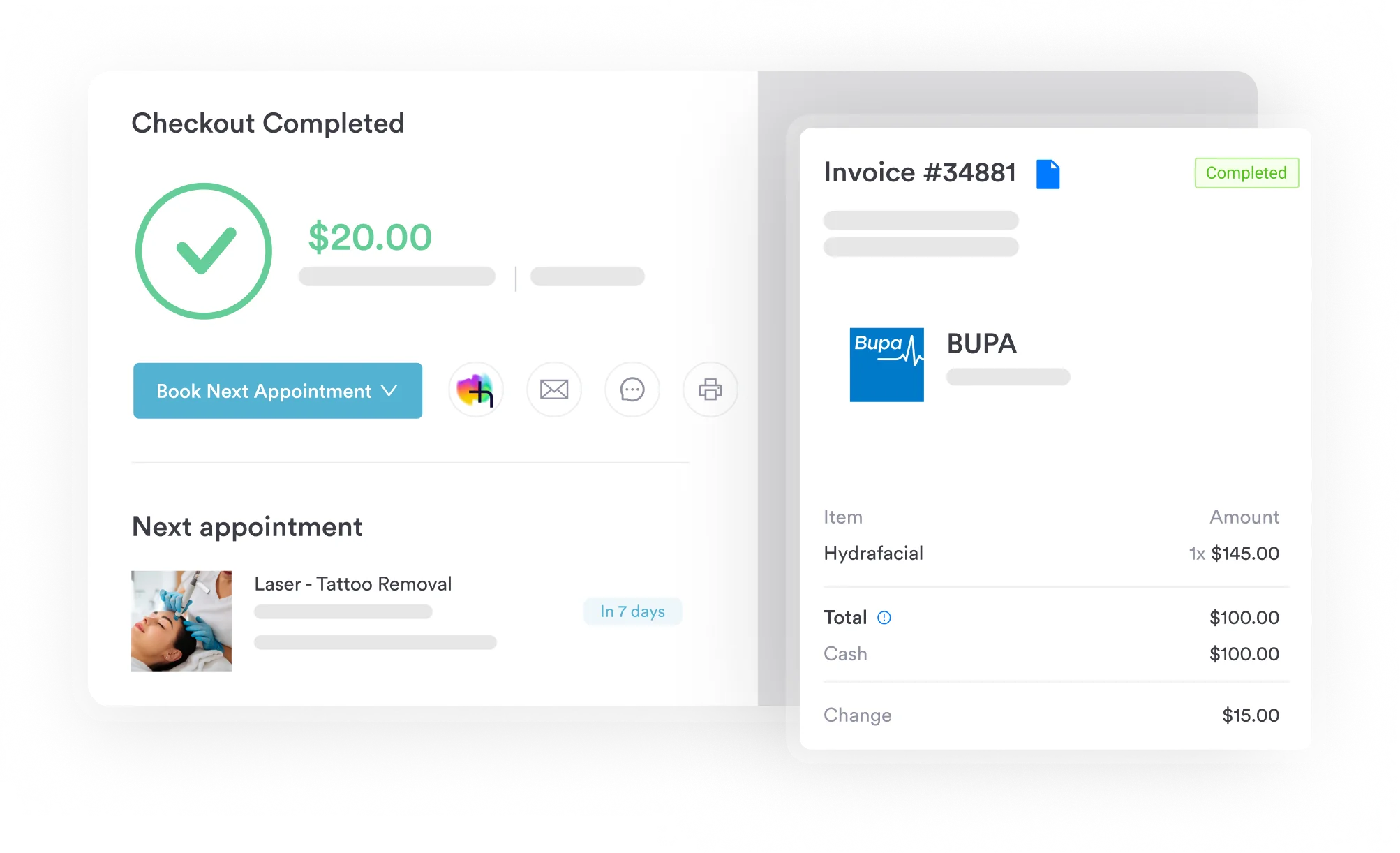

Pabau builds CMS-1500 and 837P claims from the encounter record, checks eligibility before the visit, and returns remittance advice to the same chart. Coders read the note and the denial reason side by side.

Seventh characters reward reading the chart twice. On S62.291G the code is settled the moment the provider writes that healing has slowed. The coder’s job is to find that line, or to ask for it.
Denials on this code usually trace back to the note rather than the code choice. A follow-up template that prompts for healing status will do more for your clean-claim rate than another cheat sheet.
Book a demo to see how Pabau ties the coded encounter to the claim that goes out.

Not sure what makes a claim clean before it leaves? Clean claim sets out the formatting and documentation checks that stop a rejection at the clearinghouse.
Reading a denial on a fracture line? Denial codes in medical billing maps the reason codes you will meet most often, and the response each one needs.
Coding the first visit for the same thumb? ICD-10 code S62.291B covers the open fracture at the initial encounter, with the same documentation breakdown.
New to electronic claim submission? Claim.MD clearinghouse explains how 837P submission, remittance advice, and eligibility checks fit together.
Yes. Report it at every follow-up where the provider documents that healing is still slower than expected. There is no visit limit. Repeated use across many months can trigger a medical necessity review, so each note needs its own healing statement.
No. External cause codes in Chapter 20 use only A, D, or S as their seventh character. At a follow-up visit the injury code takes G, while the external cause code takes D. The two are meant to differ.
No. Global periods attach to the CPT procedure code, not to the diagnosis. A routine follow-up inside a fracture-care code’s 90-day global is not separately payable, whichever seventh character the diagnosis carries.
Move to S62.291K at the visit where the provider documents nonunion. Leave earlier claims alone if they were correct on the day. The seventh character reports the fracture’s status at that encounter, not its final outcome.
Only if a late effect remains. Once active treatment ends, code the residual condition first, such as stiffness or chronic pain, then add the injury code with seventh character S.




