ICD-10 Code Y76.0: Diagnostic obstetric and gynecological devices
ICD-10 Code Y76.0: Definition and billable status ICD-10 Code Y76.0 is a valid, ...

Last Updated: Oct 23, 2026
Billable Code Specific Code
S62.181G is the billable ICD-10-CM code for displaced fracture of trapezoid [smaller multangular], right wrist, subsequent encounter for fracture with delayed healing.
Swap the two and the claim describes a patient the chart never documented. A routine aftercare visit then turns into a denial and a records request.
Let Pabau's smart automation suggest the right codes, reduce claim denials, and keep your practice compliant—effortlessly.
Automate repetitive tasks and focus on what matters most—your patients.
Reduce coding errors and ensure compliance with the latest regulations.
Clean claims, fewer denials, and faster reimbursements.
Powerful insights and reporting to help your practice thrive.
HIPAA compliant SOC 2 certified GDPR-compliant Trusted by 4,000+ clinics worldwide

S62.181G is the ICD-10 code for a displaced fracture of the trapezoid bone in the right wrist, at a subsequent encounter with delayed healing.
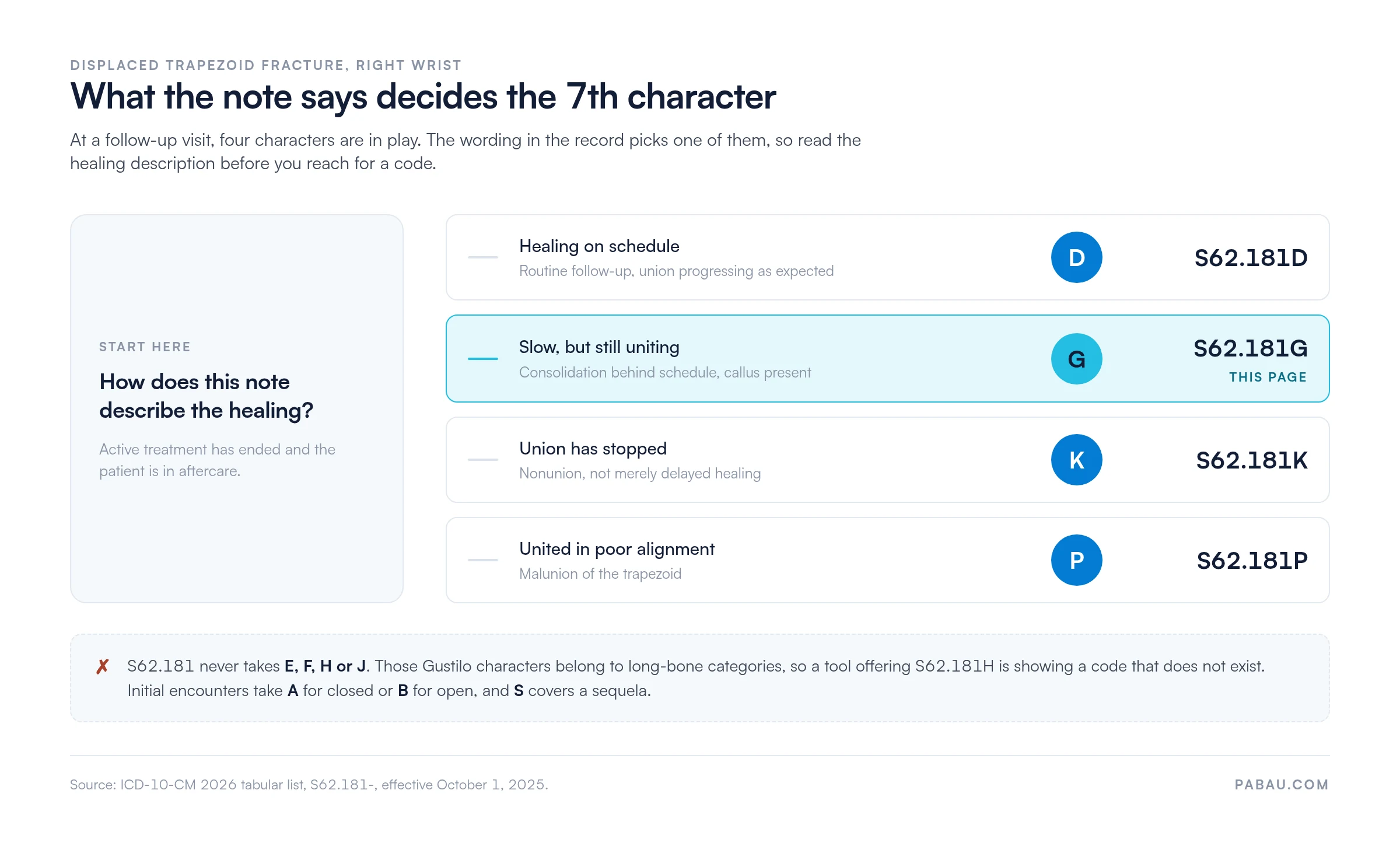
The 7th character G means delayed healing. Nonunion is a separate character, K, so the nonunion code for this fracture is S62.181K.
Laterality sits in the sixth digit. S62.181 is the right wrist, S62.182 is the left, and S62.183 covers a wrist the record never names.
The S62 category takes only seven 7th characters, so the Gustilo characters E, F, H and J never appear on a carpal code.
Practice management software like Pabau carries a verified code from the chart to the claim, so no one re-keys it into a separate billing tool.
S62.181G is a complete, billable ICD-10-CM diagnosis code. Seven characters is the full length for this subcategory, so you submit it exactly as written.
The table below is the code’s official identity, taken from the current tabular list.
Two of those rows matter more than the rest. The laterality row rules out any note that fails to name a side, and the 7th character row rules out nonunion.
You can confirm both against the CDC/NCHS ICD-10-CM web tool, which mirrors the official CMS tabular list.
No character in this code is filler. Read it left to right and each position narrows the diagnosis, from the chapter down to the healing status at this visit.
The sixth digit is the one that trips people up, because it does two jobs at once. It tells the payer the fragments moved and it tells the payer which wrist. Lose either fact from the note and the code no longer matches the chart.
S62.181 is always the right wrist. It is never an unspecified-wrist code, and no 7th character changes that.
Coders who learned the S62.18 family as a single block of unspecified codes will misread the whole run. Map the sixth digit once and keep it somewhere you can see it.
Here is how that plays out in practice. A patient returns nine weeks after a fall, and the surgeon writes that the displaced right trapezoid fracture shows callus but has not consolidated.
Right wrist gives you the sixth digit 1. Displaced keeps you in the S62.181 run, and healing that is slow but present gives you the G character. So the code is S62.181G. No laterality modifier is needed on a diagnosis line.
Reserve S62.183G for the case where no source in the record names a side. That is rare in hand surgery, since imaging reports label laterality by default.
Auditors treat a run of unspecified-wrist codes as a documentation problem rather than a coding preference.
The trapezoid hides from a plain radiograph, which is why its fractures get picked up late. It is the smallest bone in the distal carpal row, wedged between the trapezium, the capitate and the base of the second metacarpal.
Isolated trapezoid fractures are uncommon. They usually follow an axial load driven up through the index finger metacarpal, or a crush injury that catches the whole distal row.
The shielding matters for coding, not just for anatomy. A first visit often gets coded to a broader wrist injury, because the trapezoid only shows up once CT or MRI confirms it.
A fracture that spent weeks unrecognized is also the one most likely to be healing behind schedule. Charts reach the G character that way.
Chart notes and operative reports use several names for the same bone. Any of these support a code in the S62.18 subcategory:
The 7th character G means subsequent encounter for fracture with delayed healing. It does not mean nonunion.
Delayed healing describes a fracture that is still uniting, just slower than the timeline the surgeon expected. Nonunion describes a fracture where union has stopped, and that is character K. The same G character runs through the finger codes. A displaced middle phalanx fracture with delayed healing takes S62.628G when the note names the finger but not the side.
So the wording in the follow-up note picks the character for you. The diagram below maps four ways a surgeon might describe the healing onto the four codes they produce.
S62.181 accepts seven 7th characters in total. Every one of them is listed below, with the complete code it produces.
Notice what the table does not contain. There is no E, F, H or J here. Those characters carry Gustilo open-fracture classifications, and ICD-10-CM applies them to long-bone categories such as the forearm, the femur and the lower leg.
Carpal fractures under S62 never use them. A lookup tool offering you S62.181H is showing a code that does not exist.
Three questions come up on almost every audit of this code:
Walking up the hierarchy is the fastest way to spot a code that almost fits. Each level above S62.181G carries notes and exclusions that apply to the code itself, so the parents are worth reading before you commit.
Three notes from those parent levels change how you code. S62 instructs that a fracture not described as displaced or nondisplaced is coded to displaced. The same note sends an undescribed fracture to closed rather than open.
S62 also excludes traumatic amputation of the wrist and hand, which belongs to S68. S62.1 excludes scaphoid fractures, which sit in their own subcategory at S62.0.
The chapter adds one more instruction. Report a secondary code from Chapter 20 to identify the cause of the injury, and add Z18 if a foreign body was retained. Annual tabular updates are published on the CMS ICD-10 codes page.
Fracture care moves through several codes as healing progresses, and the trapezoid family follows that arc closely.
Keep this run visible while you work a follow-up visit, because the difference between two of these rows is a single character.
Denials in this family cluster around two rows, S62.181D and S62.181G, because a slow-healing fracture still looks like a routine check on the schedule.
If a payer rejects the pairing, our guide to reading denial codes tells you what the reason code is asking for before you resubmit.
If the provider never says displaced or nondisplaced, you code displaced. That instruction sits in the tabular list under S62, so it is not a house rule or a payer preference.
Nondisplaced works the other way and has to be earned. The provider must state it, or the imaging report must, before you move to the S62.184 run.
Note the spelling ICD-10-CM uses. The official descriptions read nondisplaced as one word, so a search for non-displaced in some lookup tools returns no results.
That small mismatch sends coders back to the broader carpal codes when the specific one was sitting right there.
Delayed healing is a physician’s finding, never a coder’s inference. Five facts have to be present in the record, and each one maps to a specific part of the code.
When the language sits between two of these, query the provider rather than picking the closer character. A one-line clarification costs far less than an appeal.
Pull a monthly report of every S62.18 claim you sent with the G character. Then check that each note actually describes healing as slow or behind schedule. If a note says union has stopped instead, that claim needed K, and correcting it now costs far less than answering a payer request later.
An S62.181G denial is usually preventable in the moments before the claim goes out. The visit note gets finalized, the diagnosis pointer gets set, and the claim moves to the clearinghouse.
Here is what to confirm at that point.
That last item is worth flagging to whoever built your encounter templates. Carrying Y92 and Y93 codes into every follow-up is a quiet, repeated error. It shows up across a whole fracture panel rather than on one claim.
Template fixes are easier with the claim form in front of you. On a professional claim the diagnosis sits in box 21, and box 24E points each service line at it. Our CMS-1500 claim form guide covers all 33 numbered fields.
The same handful of errors accounts for most rejections on this code. Each one has a short fix.
Notice that five of the six are documentation problems wearing a coding costume. Fix them at the point the note is written and the claim side gets quiet.
Getting the character right is only half the job. In many practices the diagnosis lives in the chart, then someone types it again into a separate billing tool. Every re-entry is another chance for G to become K, or for a right wrist to become a left one.
Practice management software like Pabau keeps both sides in one record. The diagnosis is captured where the note is written, and the claim picks it up from there. Pabau’s built-in claims management carries ICD-10 and CPT catalogs, real-time eligibility checks and 837P submission to US payers through Claim.MD, our clearinghouse partner.
Remittances post back to the same record, so a denial on a fracture follow-up sits next to the note that produced it. For orthopedic and hand surgery practices, that shortens the trip from a documentation query to a corrected claim. Aftercare visits stop aging quietly in a worklist.

Pabau connects your coding workflow to Claim.MD for electronic submission to US payers. Built-in ICD-10 and CPT catalogs, real-time eligibility and ERAs cut manual entry, so aftercare claims reach the payer with the character you verified.

S62.181G states four facts at once. The trapezoid is fractured, the fragments are displaced, the wrist is the right one, and this follow-up found healing behind schedule.
Check all four against the note before the claim leaves and most denials on this code never happen. Watch the 7th character hardest, since G and K sit one line apart in every lookup tool.
When coders and billers work in two separate systems, that hand-off is where accuracy gets lost. Pabau keeps the diagnosis, the claim and the remittance in one patient record instead.
To see how that fits your fracture follow-up workflow, book a demo.

Need guidance on denial resolution for fracture claims? Denial management in healthcare covers how to identify, appeal, and prevent the most common claim denial patterns across injury codes.
Looking to understand the clearinghouse submission process? How a medical claims clearinghouse works explains EDI submission, ERA processing, and payer enrollment in plain language.
Want a broader overview of fracture coding and billing workflows? What is medical billing? walks through the end-to-end revenue cycle from code assignment to payment posting.
ICD-10-CM sets no timeframe. Delayed healing is the treating provider’s judgment, based on serial imaging and the expected union time for that fracture. Code what the note says, and query the provider when the wording is unclear.
No. ICD-10-CM guidelines state that aftercare Z codes are not used for injury aftercare. You report the injury code with a subsequent-encounter 7th character instead, which is exactly the job the G does here.
Yes. The trapezoid family has no bilateral code, so two documented fractures need two codes. Report S62.181G for the right wrist and S62.182G for the left, each supported by its own imaging and note.
Yes. Under MS-DRG version 43.0 it groups to 559, 560 or 561, aftercare for the musculoskeletal system and connective tissue. Which one applies depends on whether an MCC or a CC is also reported.
No. It arrived with the first non-draft edition in 2016, effective October 1, 2015, and no annual update has revised it since. The 2026 edition, effective October 1, 2025, carries identical wording.