ICD-10 Code S66.308A: Extensor muscle injury, other finger
ICD-10 Code S66.308A: Definition and code hierarchy ICD-10 Code S66.308A is the ...

Last Updated: Oct 14, 2026
Billable Code Specific Code
S62.111K is the billable ICD-10-CM code for displaced fracture of triquetrum [cuneiform] bone, right wrist, subsequent encounter for fracture with nonunion.
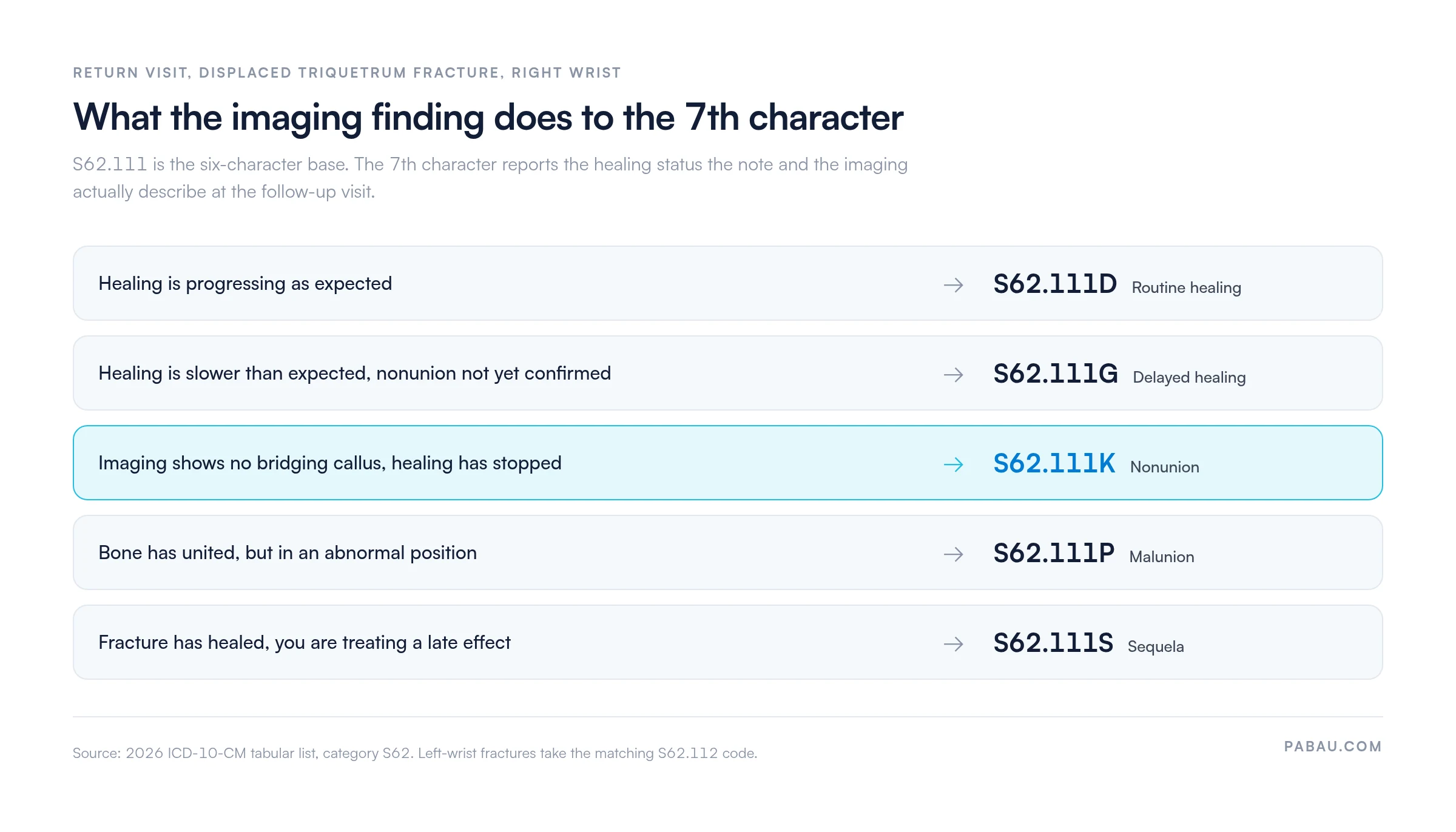
The 7th character K carries the clinical claim. It reports that the fracture has stopped healing and the patient is back for ongoing management. Imaging evidence of nonunion has to sit behind it in the record. Suffix A belongs to the active treatment phase and D to a routine follow-up. Payers flag both when the note describes nonunion.
Let Pabau's smart automation suggest the right codes, reduce claim denials, and keep your practice compliant—effortlessly.
Automate repetitive tasks and focus on what matters most—your patients.
Reduce coding errors and ensure compliance with the latest regulations.
Clean claims, fewer denials, and faster reimbursements.
Powerful insights and reporting to help your practice thrive.
HIPAA compliant SOC 2 certified GDPR-compliant Trusted by 4,000+ clinics worldwide

S62.111K reports a displaced triquetrum fracture of the right wrist that has failed to heal. The left-wrist code is S62.112K.
The 7th character K means nonunion. Routine subsequent healing takes D, slow but unconfirmed healing takes G, and malunion takes P.
Imaging showing absent bridging callus has to be in the record, alongside the treating provider’s own assessment of nonunion.
Displacement decides the sixth character. A nondisplaced triquetrum fracture of the right wrist takes the S62.114 codes instead.
Pabau’s claims management software validates the 7th character before submission and keeps the imaging reference attached to the claim.
ICD-10 Code S62.111K is a billable, specific ICD-10-CM code valid for HIPAA-covered transactions. It became effective on October 1, 2025, as part of the 2026 ICD-10-CM edition, and remains the current version of the code for reporting purposes.
S62.111K is a diagnosis code rather than a procedure code. It describes what is wrong with the patient, while ICD-10-PCS codes carry the surgical intervention. On the claim, S62.111K is the supporting diagnosis. The CMS ICD-10 codes page requires ICD-10-CM codes to be reported at the highest level of specificity available. For this fracture that means the full 7-character code, K suffix included.
The 7th character K means the patient is presenting at a subsequent encounter for a fracture that has failed to heal within the expected timeframe. It signals nonunion specifically, a clinically distinct failure state that imaging must confirm before the code can be used. Subsequent-encounter characters work the same way across every injury category. The nonunion distinction matters most for carpal bone fractures, where healing timelines vary by mechanism and by the vascularity of the bone.
The G suffix is worth pausing on. Where a provider suspects healing is slow but cannot yet confirm nonunion radiographically, G (delayed healing) is the appropriate interim code. The same 7th character logic applies elsewhere in the hand, where a displaced middle phalanx fracture with delayed healing is coded S62.628G. Jumping straight to K before imaging confirms the failure overstates the clinical picture and may not hold up under audit. Once nonunion is confirmed on X-ray or CT, the code advances to K.
S62.111K sits under Chapter 19 of the ICD-10-CM code index, among the injury and trauma codes. Knowing where the code falls in the hierarchy helps coders confirm specificity and spot when a less-specific parent code is behind a billing problem.
Category S62 requires a 7th character to be billable. Submitting S62.111 or S62.11 without the 7th character returns an invalid-code edit from the clearinghouse before the claim reaches the payer. The CDC/NCHS ICD-10-CM web tool shows the full tabular list including all valid 7th characters for S62 fractures.
A displaced fracture of the triquetrum bone is a break in which the fragments have shifted out of normal anatomical alignment. The triquetrum is the small pyramidal carpal bone on the ulnar side of the wrist. It is the second most commonly fractured carpal bone, after the scaphoid, and is sometimes called the cuneiform bone. Both names appear in the ICD-10-CM code description.
Displaced triquetrum fractures typically result from a fall on an outstretched hand or a direct blow to the dorsal surface of the wrist. The displacement distinction drives the sixth character of the code. A nondisplaced fracture of the same bone on the right side takes S62.114x, not S62.111x. Using the wrong displacement digit alters the clinical picture for the payer and can complicate prior authorization for surgical repair.
Fracture nonunion is the failure of a broken bone to heal within the expected timeframe. It is typically defined as no radiographic evidence of progressive bridging callus after several months of appropriate treatment. The American Academy of Orthopaedic Surgeons distinguishes nonunion from delayed union. Delayed union (7th character G) is a slowed healing process that is still progressing. Nonunion (7th character K) is a cessation of healing activity confirmed on imaging.
ICD-10-CM separates nonunion from routine subsequent encounters because the clinical management is materially different. A patient coded S62.111D may only need occupational therapy or a scheduled follow-up. A patient coded S62.111K requires reassessment for surgical intervention, bone stimulation, or grafting. Payers treat the two differently as well: nonunion claims may require additional documentation or prior authorization that a routine follow-up claim does not.
Every 7th character in the subsequent-encounter range answers one question, which is what the imaging shows at the return visit. The chart below maps each finding to the code it produces.
Document the imaging findings explicitly in the encounter note. State the modality used (X-ray or CT), the date of imaging, and the finding. For example: ‘CT wrist dated [date] confirms absent bridging callus at triquetrum fracture site consistent with nonunion’. Vague notes that reference ‘failed healing’ without specifying the imaging basis risk denial under medical necessity review.
S62.111K requires documentation that goes beyond what a routine fracture follow-up note contains. The K suffix asserts a specific clinical finding. The record has to substantiate it at the level the ICD-10-CM Official Guidelines for Coding and Reporting require. The core elements are below.
Attaching the imaging reference and the provider attestation to the claim before submission keeps the evidence with the claim. The alternative is producing the same two documents weeks later, during a denial appeal, when the encounter is no longer fresh in anyone’s memory.
S62.111K belongs to a structured family of triquetrum fracture codes. Selecting the correct code means confirming three things: the side, the displacement status, and the 7th character. The table below covers the codes coders meet most often when managing triquetrum fractures across the care continuum. For a searchable reference, AAPC Codify’s ICD-10-CM lookup allows filtering by code range and keyword.
Two rows in that table cause most of the confusion. S62.112K looks like a displacement variant of S62.111K but is the left-wrist code. S62.114K is the nondisplaced right-wrist code that coders often reach for by mistake. Reading the sixth digit before the 7th character settles both.
Triquetrum fracture nonunion claims generate a predictable set of denials. Most trace back to three error patterns: the wrong 7th character, nonunion and malunion confusion, and a note that never states the side. Catching them before submission is far less costly than working a denial appeal. Building the review step into standard billing practice is what denial management workflows are for.
Routing S62.111K claims through a short pre-submission checklist removes most of these. A claim that goes out clean on the first pass is paid faster. A denial and resubmission cycle typically adds 30 to 45 days to accounts receivable.
The ICD List reference tool lets coders cross-reference S62.111K against DRG groupers and code edits, which can surface pairing issues before the claim is submitted. Retention rules that govern clinical records apply to the imaging studies behind a nonunion code. Keep the report retrievable for the full retention period.
Build a triquetrum fracture coding checklist into your billing workflow. First, confirm the side: S62.111x is the right wrist and S62.112x the left. Second, confirm displacement status, which decides S62.111x against S62.114x. Third, verify the 7th character matches the healing stage in the note. Fourth, check the encounter references imaging confirming nonunion. Fifth, add any associated injury codes. Running this before submission prevents the most common denial patterns.
In most practices the wrong 7th character is caught by the payer rather than by the practice. The denial lands, a biller pulls the chart, finds the imaging report, and resubmits weeks later. The coding was fixable in seconds at the point of claim creation.
Practice management software like Pabau moves that check forward. Pabau’s claims management software validates code completeness before transmission, so a missing 7th character is flagged while the coder still has the encounter open. Supporting documents attach to the claim at the same moment, which means the imaging reference and the provider attestation travel with it.
Claims then go out through the Claim.MD clearinghouse with that evidence already in place. Every Pabau subscription includes the full claims module, so a single-site orthopedic practice runs the same validation as a multi-location group.

Pabau’s claims management software checks code completeness before a claim leaves the practice and keeps the imaging evidence attached to it. Coders catch a missing 7th character before the payer does.

Two decisions carry S62.111K. The imaging has to confirm nonunion before the K suffix is used. The note has to name the right wrist, because the code already does. Get either one wrong and the claim is not defensible, however complete the rest of the record looks.
The trade-off worth remembering is timing. Coding G while the imaging is pending costs a little reimbursement now and protects the claim under audit later. Coding K early does the reverse. Book a demo to see how Pabau validates fracture codes and attaches imaging evidence before a claim is submitted.

Need to understand how medical billing fundamentals apply to fracture care claims? What is medical billing covers the end-to-end process from code selection to payment posting.
Managing denial appeals on complex orthopedic claims? Medical billing compliance outlines the documentation standards that support nonunion and delayed-healing code submissions.
Want fewer fracture claims coming back for rework? What makes a clean claim sets out the checks that get a claim paid on its first submission.
ICD-10 Code S62.111K is the billable ICD-10-CM diagnosis code for a displaced fracture of the triquetrum (cuneiform) bone of the right wrist. It applies at a subsequent encounter with confirmed nonunion. The code signals that the patient is returning for ongoing management of a fracture that has failed to heal, supported by imaging evidence. It is valid for HIPAA-covered transactions under the 2026 ICD-10-CM edition, effective October 1, 2025.
Yes, S62.111K is a billable and specific ICD-10-CM code valid for use in HIPAA-covered reimbursement transactions. It is a 7-character code meeting the highest level of specificity ICD-10-CM requires. It can be used as a standalone diagnosis code on a claim without additional specificity modifiers.
S62.111A is for the initial encounter during active treatment of the displaced triquetrum fracture. S62.111K is for a subsequent encounter where the fracture has not healed. S62.111A applies while the provider is delivering definitive fracture care. S62.111K applies when the patient returns and imaging confirms the fracture failed to heal within the expected timeframe.
The 7th character K across ICD-10-CM fracture codes designates a subsequent encounter for fracture with nonunion. The patient is past the initial treatment phase and imaging confirms that healing has failed. It is distinct from 7th character D (routine subsequent encounter), G (delayed healing), and P (malunion). Each represents a different stage or outcome in fracture healing.
A displaced triquetrum fracture of the left wrist with nonunion is coded S62.112K. Laterality is carried by the sixth digit of the code rather than by a modifier. S62.111K and S62.112K are therefore two separate codes. The nondisplaced equivalents are S62.114K on the right and S62.115K on the left.
The clinical record must include imaging (X-ray or CT scan) confirming the absence of bridging callus. It also needs a provider attestation that nonunion is present. Confirm that this is a subsequent encounter, and document the right wrist as the affected side. Missing imaging references or vague notes describing “failed healing” without specifying the imaging basis can result in medical-necessity denial.
Reference the specific imaging study in the encounter note, including the modality, the date, and the finding. An example: “CT wrist dated [date] shows no bridging callus at triquetrum fracture site, consistent with nonunion”. State the encounter type explicitly, document the side involved, and record your clinical assessment linking the imaging finding to the diagnosis. Attaching the imaging report to the claim is advisable for high-scrutiny nonunion claims.