ICD-10 code S61.201A: Open wound of left index finger without nail damage
ICD-10 code S61.201A covers a left index finger wound of unstated type ICD-10 co...

Last Updated: Oct 16, 2026
Billable Code Specific Code
S56.919A is the billable ICD-10-CM code for strain of unspecified muscles, fascia and tendons at forearm level, unspecified arm, initial encounter.
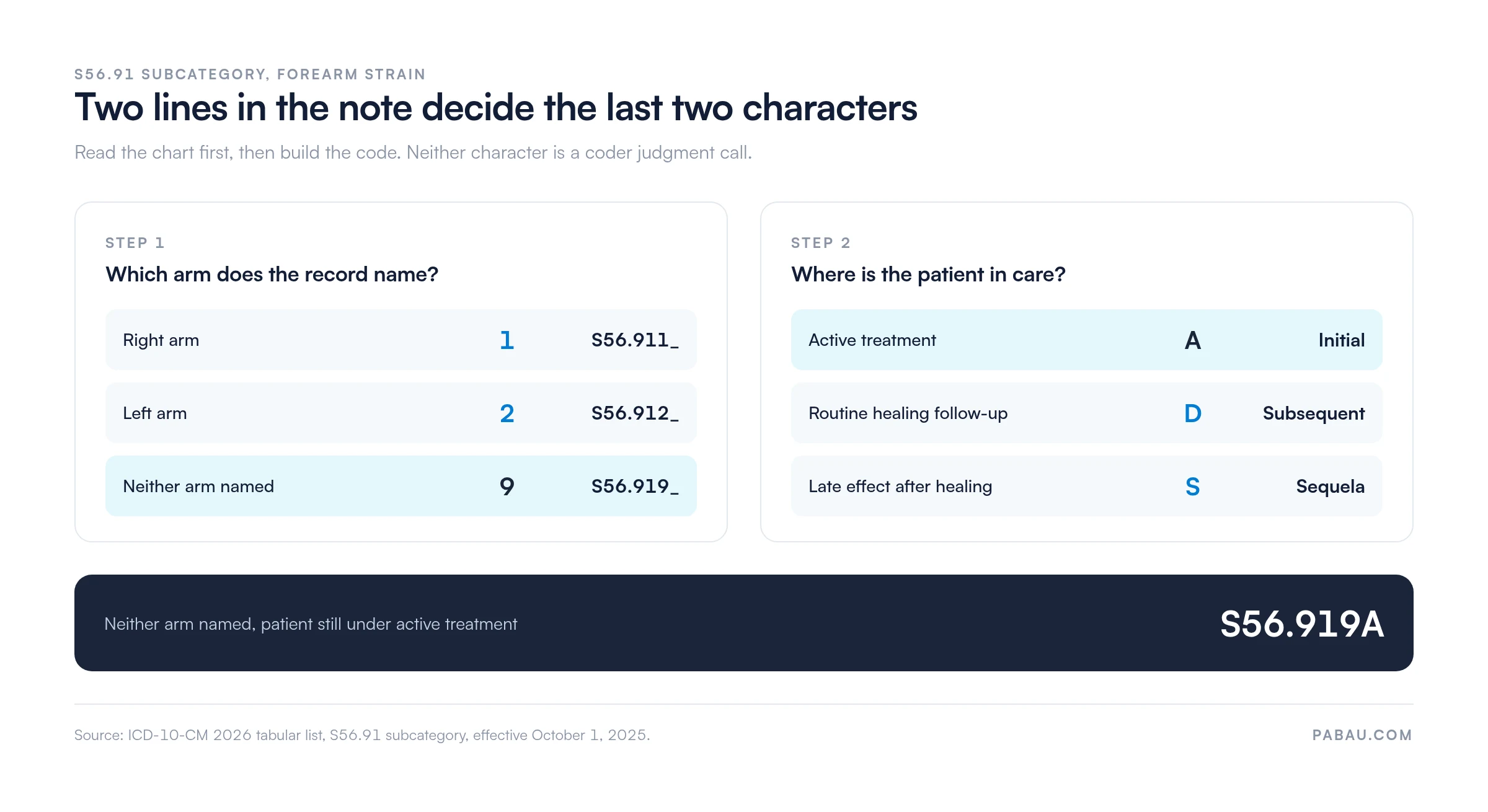
Two characters decide whether the claim clears. The sixth carries laterality and the seventh carries the encounter type, and the chart settles both.
Let Pabau's smart automation suggest the right codes, reduce claim denials, and keep your practice compliant—effortlessly.
Automate repetitive tasks and focus on what matters most—your patients.
Reduce coding errors and ensure compliance with the latest regulations.
Clean claims, fewer denials, and faster reimbursements.
Powerful insights and reporting to help your practice thrive.
HIPAA compliant SOC 2 certified GDPR-compliant Trusted by 4,000+ clinics worldwide

S56.919A is the billable ICD-10-CM code for a forearm muscle or tendon strain when the arm is not documented. It is valid for the 2026 edition, effective October 1, 2025.
The 7th character A means initial encounter, D covers subsequent encounters, and S covers sequela. Picking the wrong qualifier is the most common error with this code.
Use S56.919A only when laterality is genuinely unknown. If the record names the right or left arm, S56.911A or S56.912A applies instead.
The record has to support forearm-level soft tissue involvement, a mechanism of injury, and active treatment for the A qualifier.
Practice management software like Pabau connects to the Claim.MD clearinghouse, so practices can submit, track, and validate claim details for forearm injury encounters.
The table below covers the facts a coder needs before the code structure and the documentation rules.
Every character in S56.919A carries a specific clinical meaning. Misreading one character leads to the wrong code family entirely. The table below decodes each segment, so you can see where the code sits in the hierarchy.
The fourth character (.9) separates this code from the more specific S56 subcategories. Those name individual muscles, such as flexor pollicis longus and flexor digitorum profundus. When the record does not specify which forearm muscle group is strained, the .9 subcategory is correct. Urgent care notes often stop short of that detail, because imaging has not been completed yet.
Understanding where S56.919A sits in the full ICD-10-CM hierarchy helps coders navigate to more specific codes when documentation supports them. According to the CMS ICD-10 codes page, the S56 category falls within the S50-S59 block covering injuries to the elbow and forearm.
CMS and NCHS build every injury chapter on this same hierarchy. Reading down the levels, from block to category to billable code, lands a coder on the right answer faster than searching by keyword.
The 7th character is the most frequently misapplied element in S56 coding. The same injury takes a different 7th character at each visit. What decides it is where the patient sits in their care, per CDC and NCHS coding guidelines.
Initial encounter does not mean the first calendar visit. It means the patient is still receiving active treatment.
Someone who sees a primary care physician on day one gets S56.919A. If they see a sports medicine practice on day fourteen while still braced, that visit is S56.919A too. The qualifier shifts to D only once the treatment phase ends and routine care begins.
Laterality coding is where claims for S56 codes most often draw payer scrutiny. Use unspecified only when the medical record genuinely does not document which arm is affected.
Many payers flag repeated unspecified-laterality codes for the same patient. If the first visit uses S56.919A because the provider did not name an arm, check the second note. When laterality is still missing there, query the provider before submitting.
Repeated use of .919A on a chart that probably does record a side is a compliance risk. Two lines in the note settle the last two characters of the code.
The following clinically accepted alternate descriptions and documentation phrases are associated with this code. When any of these appear in a medical record, S56.919A, or its laterality-specific sibling, is the appropriate ICD-10 code. The 7th character still has to match the encounter.
These terms map directly to S56.919A in the ICD-10-CM alphabetic index under “Strain, forearm.” Coders can verify these synonyms using the ICD List code lookup tool, which mirrors official CMS/NCHS tabular data.
S56.919A sits within a larger S56 code family. When clinical documentation specifies a particular muscle group or tendon, coders should use the more granular code rather than defaulting to the unspecified subcategory. This table covers the most commonly used forearm muscle strain ICD-10 codes and when each applies.
Before defaulting to S56.919A, check the note for a side. The physical exam, the mechanism of injury, and the treatment plan are the three places an arm usually gets named. If one of them names it, use S56.911A or S56.912A instead.
Supporting S56.919A on a claim takes specific documentation elements in the medical record. Missing any one of them raises the risk of a medical necessity denial. The record has to substantiate every element of the descriptor, from the tissue involved to the phase of care.
Injuries above the elbow follow the same logic. A triceps laceration documented at shoulder and upper arm level belongs in the S46 block, such as S46.329A when the note names no side.
Denials on S56.919A usually trace back to five errors, and each one is visible in the note before the claim leaves the practice. Each also comes back later as one of the avoidable denial codes on the remittance.
ICD-10 Code S56.919A is a diagnosis code. The CPT codes below are the procedures typically rendered at the same encounter. Verify medical necessity and payer coverage before pairing any CPT with S56.919A.
CPT choice follows the service rendered, and the claim still has to reach the payer cleanly. Practice management software like Pabau connects to the Claim.MD clearinghouse. From there a practice can submit claims, track their status, and validate claim details across thousands of US payers. The medical claims clearinghouse process covers what happens between submission and payment.
For practices reconciling historical records or working with payers still referencing ICD-9-CM data, the approximate crosswalk for S56.919A is shown below. ICD-9-CM to ICD-10-CM conversions are approximate, because the code systems do not map one-to-one. The AAPC ICD-10-CM code lookup provides additional crosswalk context.
ICD-9 codes still turn up in archived charts and older payer records, so the crosswalk matters mostly for reconciliation work. Treat 841.9 as approximate. It covers sprains and strains of an unspecified site of the elbow and forearm, with no encounter type attached.
Coding a forearm strain usually means working across three places. The note sits in one system, the code lookup in another, and the claim in a third. Details get retyped, and a missing laterality line only surfaces when the payer rejects the claim.
Pabau holds the appointment, the treatment note, and the invoice in one client record. Cleaner claims management runs from that same record and connects to the Claim.MD clearinghouse. Your team can submit claims and track their status without a separate export step.
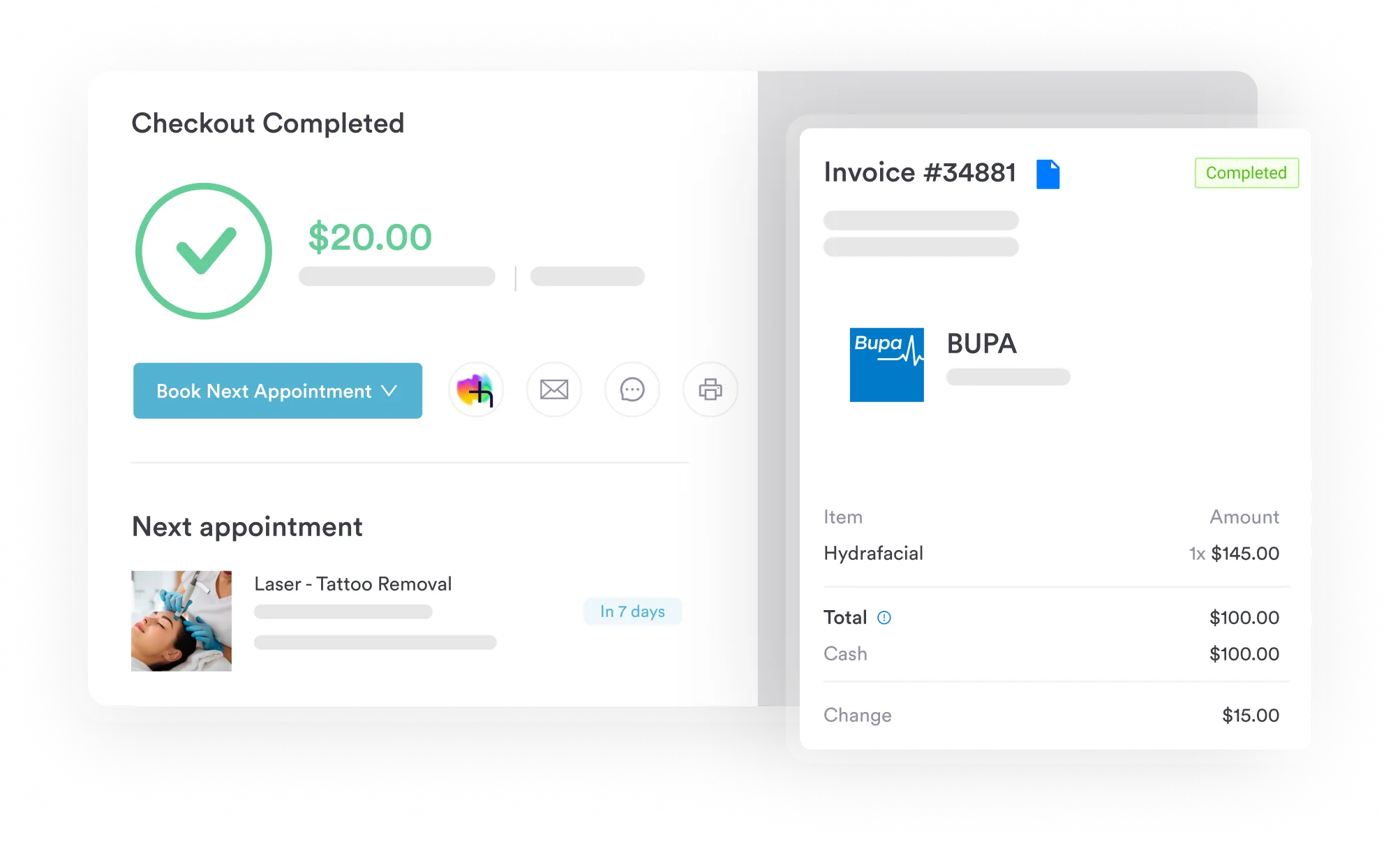
The payoff is a shorter path from the visit to a submitted claim. When a payer asks what was documented and when, the answer sits in the record rather than in someone’s memory.

Pabau keeps the treatment note, the invoice, and the claim in one client record, and connects to the Claim.MD clearinghouse. Your team can submit claims, track their status, and validate claim details in one place.

S56.919A is the right code in one situation. The note confirms a forearm-level strain, the patient is under active treatment, and no arm is named anywhere in the chart.
Anywhere else, a more specific code is already waiting. The habit worth building is two checks before the claim goes out. Does the note name an arm, and is treatment still active?
Answer both and the last two characters pick themselves. Book a demo to see how Pabau keeps forearm injury coding, documentation, and claim submission in one record.

Coding an unspecified forearm flexor injury? S56.109A covers injury of the flexor muscles at forearm level when the record does not name the tissue.
Following a forearm strain into its late effects? S56.519S handles sequela of an extensor strain at forearm level, where the 7th character is S.
Coding a healing-phase visit for a finger tendon? S56.411D covers an extensor tendon strain of the right index finger during the healing phase.
Nerve injury rather than a muscle strain? S54.92XA applies to a nerve injury at forearm level in the left arm, initial encounter.
Wondering what happens after you hit submit? Medical claims clearinghouse process walks through how an electronic claim travels from the practice to the payer.
ICD-10 Code S56.919A is a billable diagnosis code for strain of unspecified muscles, fascia and tendons at forearm level, unspecified arm, initial encounter. It sits in the S56 category, which covers injury of muscle, fascia and tendon at forearm level. Use it when the record confirms a forearm-level strain but names neither the arm nor the muscle group.
Yes. S56.919A is a valid billable ICD-10-CM code for all HIPAA-covered electronic health transactions. It took effect on October 1, 2025, as part of the 2026 ICD-10-CM edition. Payer coverage rules and local coverage determinations can still add requirements, so check payer-specific edits before you submit.
Common pairings include 99203 and 99213 for office evaluation and management, and 97110 for therapeutic exercises. Physical therapy encounters also use 97530 for therapeutic activities. Imaging at the forearm and wrist junction uses 73100, and a tendon sheath injection uses 20550. CPT selection follows the service rendered, not the diagnosis.
All three describe the same injury, a strain of unspecified forearm muscles, fascia and tendons in an unspecified arm. Only the 7th character changes. A marks visits during active treatment, D marks routine follow-up while the injury heals, and S marks a sequela that develops after it resolves.