

ICD-10 code S61.201A: Open wound of left index finger without nail damage
ICD-10 code S61.201A covers a left index finger wound of unstated type ICD-10 co...

Last Updated: Oct 16, 2026
Billable Code Specific Code
S56.519S is the billable ICD-10-CM code for strain of other extensor muscle, fascia and tendon at forearm level, unspecified arm, sequela.
That final letter carries the weight. Swap the S for a D and you tell the payer the injury is still healing. The note will not back that up, and the claim comes back.
Three codes share the S56.519 stem, so the phase of care decides which one you send.
Let Pabau's smart automation suggest the right codes, reduce claim denials, and keep your practice compliant—effortlessly.
Automate repetitive tasks and focus on what matters most—your patients.
Reduce coding errors and ensure compliance with the latest regulations.
Clean claims, fewer denials, and faster reimbursements.
Powerful insights and reporting to help your practice thrive.
HIPAA compliant SOC 2 certified GDPR-compliant Trusted by 4,000+ clinics worldwide

S56.519S is the billable ICD-10 code for a strain of other extensor muscle, fascia and tendon at forearm level, unspecified arm, sequela.
The 7th character S means you are treating a late effect of a healed strain, not the strain itself.
S56.519 is not billable on its own, so append A, D, or S before the claim goes out.
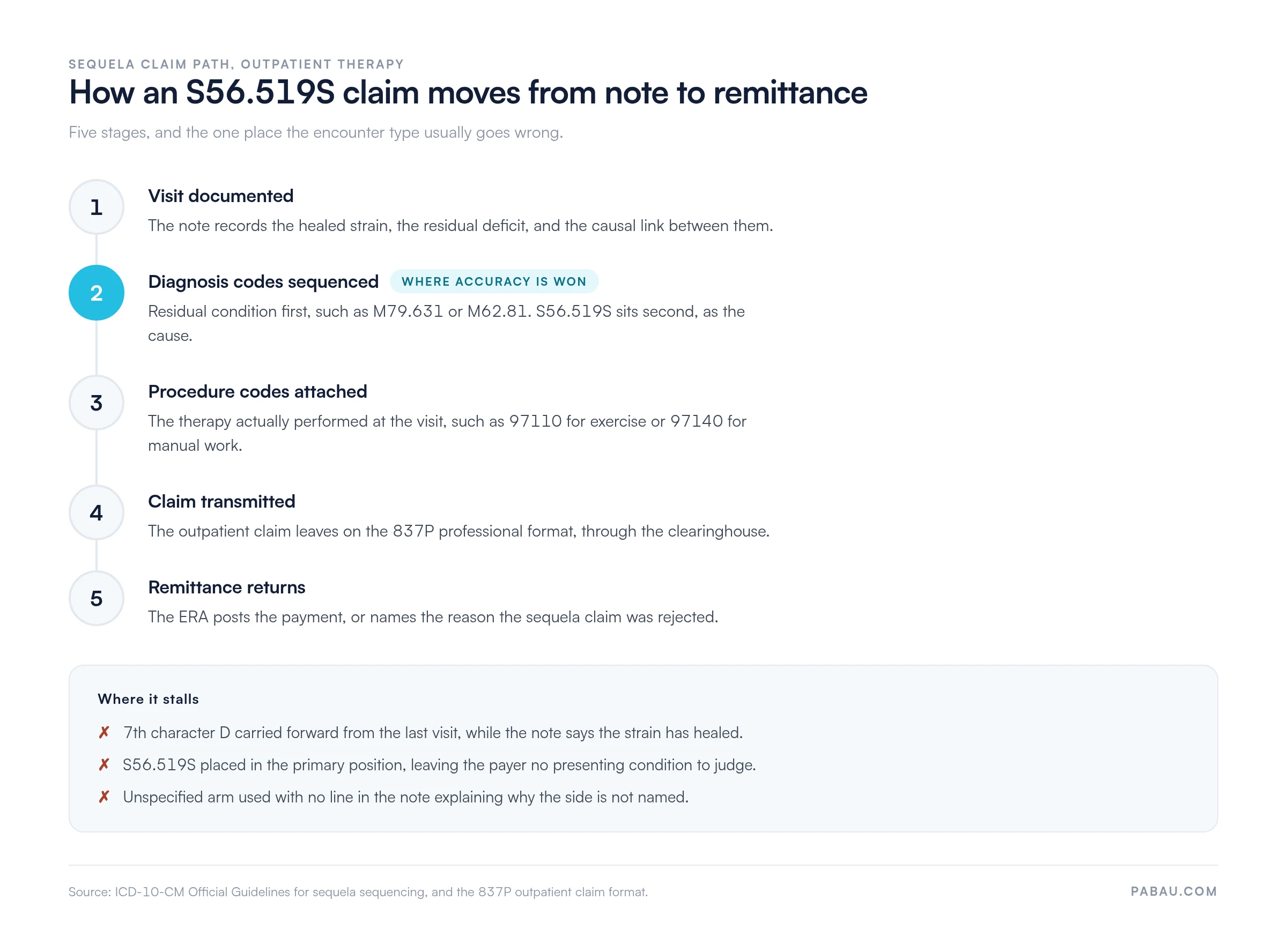
Code the residual condition first and S56.519S second, because the late effect is the reason for the visit.
Practice management software like Pabau tracks these claims through the clearinghouse, so denials on sequela encounters surface quickly.
The CDC/NCHS ICD-10-CM web tool confirms S56.519S is valid for the current fiscal year. You can check effective dates, parent-child relationships, and billability against the official tabular list before a claim goes out.
Each segment carries its own meaning, so reading the code left to right tells you what the payer sees. Break it down once, and the common selection errors become obvious.
The “other extensor” label in .5 is broader than it sounds. S56.4 covers only extensor injuries tied to a specific finger, so S56.5 collects the rest of the extensor compartment.
That includes the major wrist extensor tendons running along the back of the forearm. The “unspecified arm” in .519 simply means nobody wrote down which side.
Documenting left versus right is worth the extra second, even when both arms are involved. Payers increasingly apply laterality edits, and an unspecified code can pull a request for records.
Where the therapy note does not name the side, query the treating clinician before coding.
The 7th character is not optional on S56.519. Leave it off and the code is not billable, so the claim never gets past the first edit. All three extensions describe the same injury, and only the phase of care separates them.
The CMS ICD-10-CM Official Guidelines set the sequencing rule. A sequela code stays in use for the late effect, never for the original injury, so it never leads the claim.
You pair S56.519S with the code for the residual problem itself, such as M62.81 for muscle weakness or M79.631 for forearm pain.
Elapsed time alone does not make an encounter a sequela. The record has to show that the original strain healed and that the current problem grew out of it.
Flag sequela encounters with their own appointment type in the schedule. The clinician then sees the prompt to document the causal link before signing the note, instead of the biller chasing it later.
S56.519S sits at the fifth level of the S56 hierarchy. Reading that structure once makes it much faster to move sideways when laterality is documented, or when the note points at a different structure.
Laterality siblings live inside S56.51 as well. S56.511 covers the right arm and S56.512 the left, each carrying its own A, D, and S extension.
Reach for those whenever the note names a side. The ICD-10-CM code index lists the full sibling set if you need to check a neighboring stem.
For a second view of the same structure, the AAPC Codify ICD-10-CM lookup lays out the S56.5 family side by side. That helps during documentation review, when you are checking whether a more specific code existed.
Payers reviewing a sequela claim are looking for one thing, a clear causal chain in the record. Missing documentation, rather than a wrong code, is what turns most of these claims into post-payment denials.
Five elements make an S56.519S claim defensible:
None of this asks for new paperwork. It asks for one sentence a reviewer can find without reading the whole chart.
Sequela claims fail in predictable ways, which makes them easy to catch. Two minutes with the note beats a 30-day appeal.
Here is the version that goes wrong. A patient finishes twelve weeks of rehab for a healed extensor strain, then returns for grip weakness.
The biller copies last month’s claim, which carried S56.519D, and sends it out. Meanwhile the note reads “resolved strain with residual deficit”, so the encounter type and the record now disagree.
Length of care is the usual culprit. The longer a case sits on the caseload, the more likely last visit’s code gets carried forward without a second look.
On outpatient and physician office claims, S56.519S works as a secondary diagnosis. The primary code carries medical necessity and drives payment, while S56.519S supplies the cause. Send it alone and the payer has no presenting condition to price the visit against.
The procedure codes come from what happened at the visit. Therapy for a residual forearm deficit usually bills 97110 for exercise or 97140 for hands-on work. The diagram below traces the whole path, and marks the stage that decides the claim.
Inpatient claims work differently. MS-DRG assignment for a sequela musculoskeletal code usually lands in the musculoskeletal and connective tissue groups, though secondary diagnoses and procedure codes move it. CMS updates the mappings every fiscal year, so check any DRG you see quoted against the current tables.
Unspecified laterality carries its own risk. Some commercial payers hold the .519 stem for review, or ask for a note explaining why the side is missing. Checking the payer’s policy first is cheaper than appealing a clean coding decision.
Forearm extensor injuries sit next to several codes that look almost identical on a lookup screen. Knowing which one the note points to saves a query later.
Both S56.4 and S56.5 sit at forearm level, so the split is anatomical detail rather than location. S56.4 covers extensor injuries tied to a specific finger, and S56.5 picks up the remaining extensors, including the major wrist extensors. Tendon injuries below the wrist joint leave S56 altogether and land in the S66 range.
Most sequela denials start in the note, not on the claim form. The therapist writes up the deficit, but the causal line never makes it in. Weeks later, the remittance makes it obvious. By then the encounter is cold, and someone has to chase the clinician for wording.
Pabau keeps the clinical record and the claim in one place. Custom forms and clinical templates hold the fields a sequela note needs. Staff capture the healed-injury reference and the causal statement during the visit itself, so billing works from a note that already exists.
From there, claims software for practices carries the coded encounter out to the clearinghouse and back. Built-in ICD-10 and CPT catalogues pre-fill the claim instead of asking someone to retype it. Remittance and denial detail then land against the same patient record, so a rejected sequela claim shows up the same week.
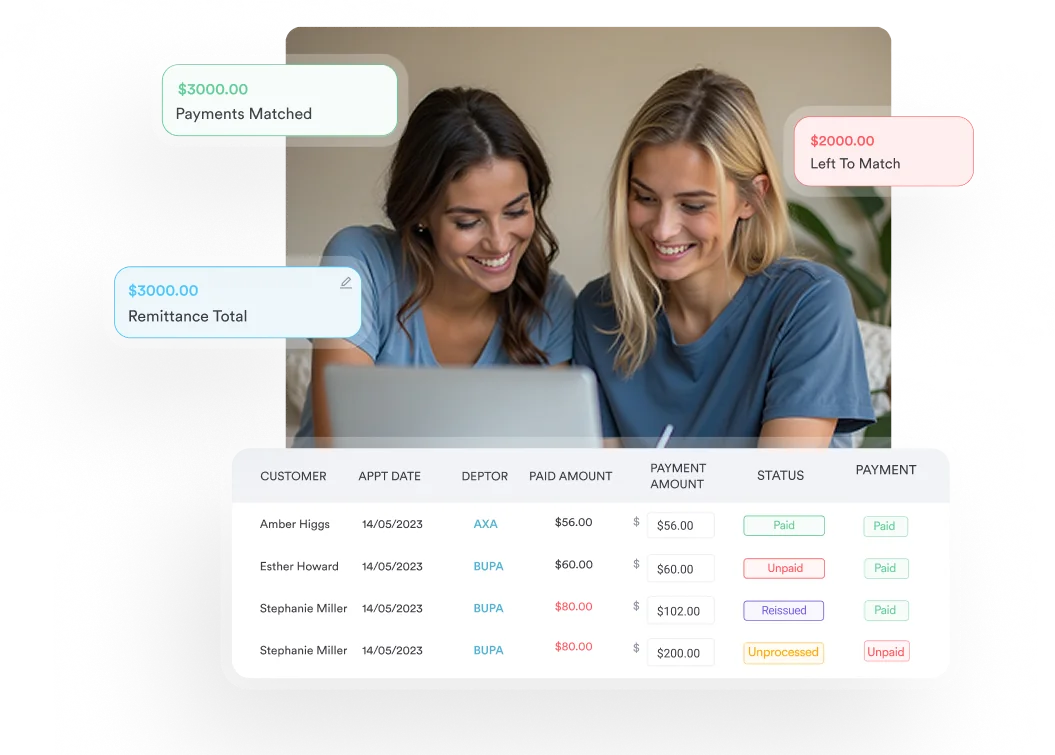

Pabau’s built-in ICD-10 and CPT catalogues pre-fill the claim instead of asking staff to retype it. Clearinghouse submission and ERA tracking then show exactly where each sequela claim stands.

S56.519S is a small decision with a long tail. Get the 7th character and the code order right at the visit, and the claim moves without a conversation. Miss either one, and you are reconstructing a healed injury from memory six weeks later.
The habit worth building is a simple one. Ask the clinician to name the old injury and the residual problem in the same sentence, every time. The rest of the claim follows from that line.
Sequela documentation and claim tracking often live in two separate systems. Book a demo to see how Pabau keeps the note and the claim on one patient record.

Coding another forearm sequela? ICD-10 code S51.801S works through an open wound of the right forearm, sequela, using the same 7th character logic.
Dealing with a healed forearm fracture instead? ICD-10 code S52.119S covers a torus fracture of the upper end of the radius, sequela.
Billing the therapy that treats the residual deficit? CPT code 97140 explains how to bill, time, and document manual therapy.
Working through denials on musculoskeletal claims? Denial management in healthcare covers how to spot, appeal, and prevent coding-related denials.
Curious what happens after you hit submit? How Claim.MD works as a medical claims clearinghouse explains 837P transmission, eligibility checks, and ERA handling.
No. Tennis elbow is lateral epicondylitis, which ICD-10-CM codes in the M77.1- range as an overuse condition rather than an injury. S56.519S needs a documented traumatic strain that has since healed. If the record describes gradual onset with no injury event, the M77.1- codes fit better.
Report both laterality codes, S56.511S for the right arm and S56.512S for the left. ICD-10-CM offers no bilateral option in the S56.51 group, so two codes cover it. Keep the unspecified .519 stem for records that genuinely never name a side.
It should not be. S56.519S explains the cause, so the residual problem needs its own code in the primary position. A claim carrying the sequela code alone gives the payer no presenting condition to judge medical necessity against.
Anatomical level decides it. S56 covers muscle, fascia and tendon injuries at forearm level, while the same structures at wrist and hand level move to S66. If the note places the tendon injury below the wrist joint, look in S66 rather than S56.



