ICD-10 code S61.201A: Open wound of left index finger without nail damage
ICD-10 code S61.201A covers a left index finger wound of unstated type ICD-10 co...

Last Updated: Oct 16, 2026
Billable Code Specific Code
S53.193D is the billable ICD-10-CM code for other subluxation of unspecified ulnohumeral joint, subsequent encounter.
One character causes most of the trouble. The 3 sits in the laterality slot, and it means unspecified rather than left. Left has its own code, S53.192D, and the two are not interchangeable.
Read the 3 as left and you reach for a code that contradicts the note, which is how these claims stall.
Let Pabau's smart automation suggest the right codes, reduce claim denials, and keep your practice compliant—effortlessly.
Automate repetitive tasks and focus on what matters most—your patients.
Reduce coding errors and ensure compliance with the latest regulations.
Clean claims, fewer denials, and faster reimbursements.
Powerful insights and reporting to help your practice thrive.
HIPAA compliant SOC 2 certified GDPR-compliant Trusted by 4,000+ clinics worldwide

S53.193D is the ICD-10-CM code for other subluxation of unspecified ulnohumeral joint, subsequent encounter.
The ulnohumeral joint is the elbow hinge, where the humerus meets the ulna.
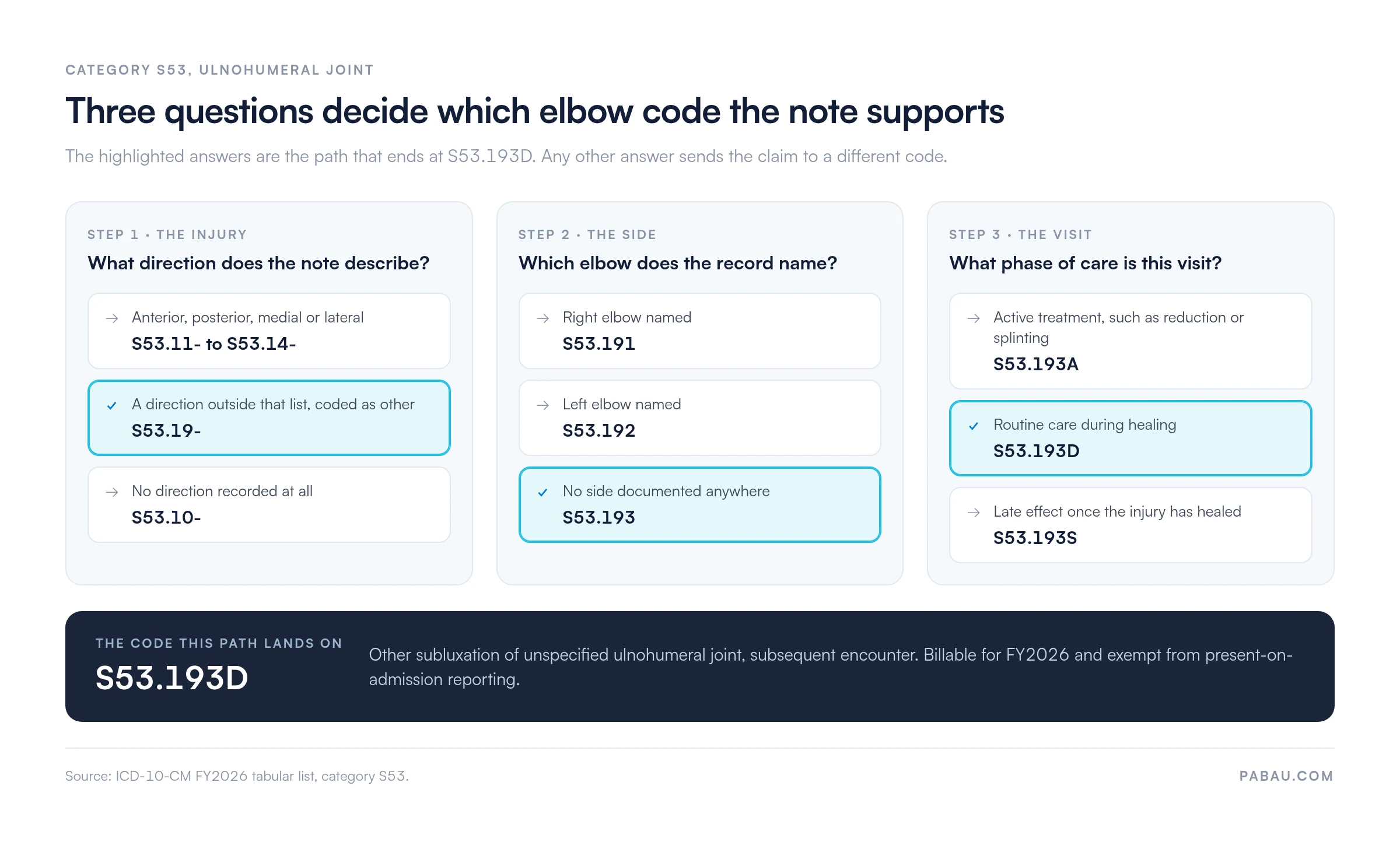
The 3 in the sixth position means the record never named a side, so it is unspecified rather than left.
The 7th character D covers routine care during healing, which includes therapy visits and follow-up checks.
S53.193D is billable for FY2026, exempt from present-on-admission reporting, and crosswalks to ICD-9-CM aftercare code V58.89.
S53.193D reports a partial displacement of the ulnohumeral joint at a follow-up visit. The direction of that displacement does not match any of the named options.
The trochlea of the humerus sits inside the trochlear notch of the ulna. That pairing is the elbow’s hinge, and it is the only joint this code covers. Radial head displacement is a separate injury with its own codes under S53.0-.
The word “other” in the description earns its place. ICD-10-CM already names four directions. Anterior sits in S53.11-, posterior in S53.12-, medial in S53.13-, and lateral in S53.14-. S53.19- picks up the displacements that fall outside that list.
The table below carries the fields you need before the claim goes out.
S53.193D runs to seven characters, and each slot narrows the diagnosis. Read them in order and the code stops being a string of digits. It becomes a sentence about the joint, the injury, the side, and the visit.
Coding cheat sheets often call the 3 a fifth character. Count again and the seven slots read S, 5, 3, 1, 9, 3, D. Laterality lives in the sixth position. The encounter type fills the seventh. That distinction matters when you write a scrubber rule or brief a new coder.
Provider notes almost never use the tabular wording. Expect phrases such as elbow subluxation, partial elbow dislocation, ulnohumeral instability on follow-up, or elbow subluxation NOS.
The tabular list files subluxation and dislocation of elbow NOS under S53.1, so a bare mention of elbow subluxation still lands in this family.
A 3 in S53.193D marks a side that the documentation never gave. It is not a code for left. Left is S53.192-, right is S53.191-, and the numbering then repeats for dislocation.
Confirm any assignment against the AAPC ICD-10-CM code lookup or the official tabular list before you submit.
The pattern runs 1, 2, 3 for subluxation and 4, 5, 6 for dislocation. The subcategory stops there. There is no S53.197, no S53.198, and no S53.199. A scrubber rule or an old cheat sheet offering S53.199D points at a code that never existed. Claims built on it reject at the front end.
S53.193D is valid, but treat it as a query trigger rather than a resting place. Most elbow records name a side somewhere. The exam, the imaging order, and the therapy plan of care are the three places to look first.
Payers do accept the unspecified code, but auditors still ask why the chart could not support S53.191D or S53.192D.
D applies to any visit where the patient is healing and receiving routine care after active treatment has ended. It is not a count of visits, and it does not depend on which provider is in the room. ICD-10-CM Official Guidelines Section I.C.19 ties the character to the phase of care.
Injury codes in this chapter reject without one, so the field is never optional. Three options exist for S53.193, and the CDC ICD-10-CM browser tool lists them all.
Walk one patient through all three. A cyclist lands on an outstretched arm and goes to urgent care, where the elbow is reduced and splinted. The note reads “elbow subluxation” with no side and no direction, so that visit bills S53.193A.
Two weeks later the patient starts therapy three times a week. Every one of those visits bills S53.193D, including the ones months later.
A year on, the elbow still gives way under load. That residual instability is a sequela. Code the residual condition first, then add S53.193S to show where it came from. Notice that the sequence never returns to A, even if the patient sees a brand new provider.
Every code above S53.193D in the chain is too vague to bill on its own. Following the chain matters anyway, because the notes attached to each level travel down to the billable code.
Three notes in that chain change how a claim is built. S53.1 carries an Excludes1 for dislocation of radial head alone, which belongs in S53.0-. Excludes1 means the two conditions do not occur together, so never report them side by side for the same injury.
Category S53 also tells you to code any associated open wound, and Chapter 19 asks for a secondary external cause code from Chapter 20. The CMS ICD-10 codes page publishes the official tabular list each fiscal year.
Most misassignments in this family come from one of two mix-ups. Coders swap subluxation for dislocation, or they treat “other” and “unspecified” as the same word. The table below sorts the neighbors that show up most often on elbow follow-up claims.
Two distinctions sort the whole family out. Subluxation is a partial shift of the joint surfaces, while dislocation is a complete separation.
The sprain row at the bottom of that table is neither. A sprain injures the ligaments while the joint stays seated, and sprain codes name the ligament as well as the side. S53.442A covers a left ulnar collateral ligament sprain during active treatment.
“Other” means the provider described a direction that none of the named codes cover. “Unspecified” means the provider described no direction at all. Payer edits treat those as different claims, so the wrong pick shows up as a denial rather than a warning.
Three questions settle the pick, and the flow below runs them in order.
Coding this well takes a little anatomy. The ulnohumeral joint is a hinge, and stability comes from the bony fit plus the ulnar and radial collateral ligaments.
A subluxation shifts the ulna off the trochlea without letting it clear the joint. The elbow stays partly articulated, which is what separates the injury from a full dislocation.
Most of these injuries follow a fall onto an outstretched hand. Others come from hyperextension in contact sports or repeated valgus stress in throwing athletes.
Patients describe the elbow catching, giving way, or feeling loose under load. Exam findings usually include swelling, guarded extension, and tenderness along the medial or lateral gutter.
The vague codes get used for a practical reason. Many subluxations reduce on their own before imaging, so the films come back normal and the direction of displacement never makes it into the note. The provider writes “elbow subluxation” and moves on to the plan.
Run this list against the note before the claim leaves. It takes under a minute and it catches the errors that turn into rework.
Three mistakes account for most S53.193D denials. Leaving A on the claim after active treatment ended is the first, and it is also the easiest to spot on an audit.
Choosing S53.193D when the chart clearly says left is the second, and it under-codes a documented fact. Submitting S53.199D is the third, and that code has never existed.
When the side really is missing, send a query rather than guessing. A one-line question to the provider costs less than an appeal, and it leaves a record that the practice looked.
That trail is what protects the unspecified code if a payer challenges it later.
S53.193D is a diagnosis code, so it never travels alone. Every claim also needs at least one CPT code describing what happened at the visit.
The pairings below show up most often on elbow follow-up claims, and each has a full entry in our CPT code library. They are examples rather than guarantees, and payer policy still decides.
The clock matters on three of those codes. 97110, 97140 and 97530 all bill in 15-minute units, so the note has to record treatment minutes for each one.
Medical necessity still decides payment. An unspecified-laterality diagnosis sitting next to a one-sided therapy plan invites a records request, because the two documents appear to describe different things. Check coverage and prior authorization with the payer, and make sure the therapy note and the claim agree on which elbow is being treated.
The General Equivalence Mapping for S53.193D does not point at an elbow injury at all. It points at V58.89, other specified aftercare. That surprises people the first time they see it, and it explains a lot about how the 7th character works.
Under ICD-9-CM, one code described the injury and a separate V code described the follow-up care. ICD-10-CM folded both jobs into a single code, and the 7th character now carries the part the V code used to carry. That is also why S53.193D groups to MS-DRG 949 and 950, the aftercare pair.
GEM mappings stay approximate, so label them that way in any appeal packet or legacy records request. The mappings themselves have not moved in years.
CMS and CDC froze the General Equivalence Mappings after the 2018 release, so no refresh shipped with the FY2026 update. These three values remain the official mappings in effect. Teams handling legacy workers’ compensation files or old prior-authorization appeals are the ones who still need them.
Audit the S53.19- family once a quarter. Pull every claim line with a 3 or a 6 in the sixth position, then open the matching note. If the chart names a side, the claim should have carried S53.191, S53.192, S53.194 or S53.195 instead. A high unspecified rate across one provider is exactly the pattern payer audits look for.
Most of the work on an S53.193D claim happens before submission. Someone reads the note, picks the diagnosis, matches it to the therapy or E/M code, and confirms the payer fields are filled in. Pabau moves that work into the patient record instead of a separate billing screen.
In Pabau, the CPT code attached to a service lands on the charge line automatically. The ICD-10 slots are seeded from the client’s recorded problem list.
Built-in ICD-10-CM and CPT lookup libraries let a biller search the S53.19- range without leaving the claim. Before the send button unlocks, Pabau’s software for claims teams confirms that required fields such as membership and authorization numbers are complete.
US claims then route through our Claim.MD clearinghouse integration for real-time eligibility checks, 837P submission, claim-status tracking, and ERA posting.
Pabau does not judge whether your 7th character matches the clinical note, and no software should pretend to. A coder owns that call. What the platform removes is the retyping, the missing-field rejections, and the silence between submission and remittance.

Pabau pre-fills claim lines from the visit record and checks required fields before submission. US claims route through Claim.MD for eligibility checks, 837P filing, and ERA posting.

S53.193D is a precise code with one soft spot. It pins down the joint, the injury type, and the phase of care, then leaves the side blank. That blank is the part a payer notices, and it is the part an auditor asks about.
So treat the code as a checkpoint rather than a default. Read the note once more for a side, a direction, and a mechanism. If the record supports S53.191D or S53.192D, use it. If it genuinely does not, S53.193D is the honest answer, and your query trail should show that you looked.
Accurate codes still have to survive the claim form. Book a demo to see how Pabau builds, checks, and submits follow-up claims straight from the patient record.

Want to know what a payer checks before it pays? Clean claim requirements and validation walks through the fields that decide whether an electronic claim clears on the first pass.
Chasing coverage before a course of therapy starts? Insurance eligibility verification workflows shows how real-time checks cut rejections on repeat follow-up visits.
Dealing with denials on musculoskeletal claims? Denial management in healthcare sets out how to track, categorize, and appeal coding-related rejections.
It reports other subluxation of an unspecified ulnohumeral joint at a subsequent encounter. The ulnohumeral joint is the elbow hinge. Unspecified means the record never named a side, and D means the patient is in the healing phase.
No. Left is S53.192 and right is S53.191, so 3 is the unspecified-laterality option. Check the exam, the imaging order, and the therapy plan for a documented side before you settle on S53.193D.
Yes. It is a billable, specific ICD-10-CM code for FY2026 and valid for HIPAA-covered transactions. It is also exempt from present-on-admission reporting, and it groups to MS-DRG 949 or 950 for aftercare.
No. The subcategory runs from S53.191 to S53.196 and stops there. Use S53.193D when the subluxation has no documented side, or S53.196D when a dislocation has no documented side.
Yes, when the subluxation is the reason for the visit. On a therapy claim it usually leads the diagnosis list. Sequence a residual condition ahead of the injury code only when you are reporting a sequela with S53.193S.
For as long as the patient receives routine care for that injury. No visit cap or time limit applies, and a change of provider does not reset it. Move to S only when treatment ends and a late effect remains.