Pabau Engage inbox

Pabau Engage is here: every patient conversation in one inbox.

Learn more
Book a demo Book a demo
ICD-10-CM Code

ICD code S53.442A Left elbow UCL sprain

Billable Code Specific Code


Code Definition

S53.442A is the billable ICD-10-CM code for ulnar collateral ligament sprain of left elbow, initial encounter.

Two mistakes account for most denials on this code. The first is a seventh character that does not match the phase of care, usually D or S during active treatment. The second is billing the unspecified code S53.449A when the note already names the left side.

Chapter
S00-T88 Injury, poisoning and certain other consequences of external causes
Category
S53 Dislocation and sprain of joints and ligaments of elbow
Group
S53.442 Ulnar collateral ligament sprain of left elbow
Billable
Yes
Code also known as
medial elbow sprain, UCL sprain elbow, ulnar collateral ligament injury elbow, thrower's elbow
Save time. Improve accuracy. Get paid faster.
Automate coding with Pabau

Let Pabau's smart automation suggest the right codes, reduce claim denials, and keep your practice compliant—effortlessly.

  • AI-powered code suggestions
  • Real-time compliance checks
  • Faster claims, fewer denials
Why practices choose Pabau
Save hours every week

Automate repetitive tasks and focus on what matters most—your patients.

Improve accuracy

Reduce coding errors and ensure compliance with the latest regulations.

Get paid faster

Clean claims, fewer denials, and faster reimbursements.

Grow with confidence

Powerful insights and reporting to help your practice thrive.

HIPAA compliant SOC 2 certified GDPR-compliant Trusted by 4,000+ clinics worldwide

Key takeaways

Key takeaways

ICD-10 Code S53.442A is a valid, billable ICD-10-CM code for a left elbow UCL sprain, initial encounter – confirmed for FY 2026.

The seventh character A applies only during active treatment; switch to D (subsequent encounter) once active treatment ends.

Laterality is mandatory: always document ‘left’ explicitly to avoid a downcode to unspecified S53.449A and the denial that follows.

Pabau’s claims management software submits S53.442A claims through Claim.MD and tracks eligibility, claim status and ERAs in one workflow.

What is ICD-10 Code S53.442A?

ICD-10 Code S53.442A is the full-specificity, billable ICD-10-CM code for a sprain of the ulnar collateral ligament of the left elbow, initial encounter. It sits in the ICD-10-CM code set under category S53, dislocation and sprain of joints and ligaments of elbow. The code is valid on claims for fiscal year 2026 under the CDC/NCHS ICD-10-CM classification.

Key facts about this code at a glance:

  • Official descriptor: Sprain of ulnar collateral ligament of left elbow, initial encounter
  • Code system: ICD-10-CM (Clinical Modification, United States)
  • Billable status: Yes – valid for HIPAA-compliant electronic claim submission
  • FY 2026 status: Active, no changes
  • Parent code: S53.442 (sprain of UCL, left elbow – not billable alone)
  • Laterality: Left elbow only
  • Encounter type: Initial (seventh character A)

Code hierarchy: where S53.442A sits in ICD-10-CM

Understanding the parent-child structure helps coders verify they have the right level of specificity and spot valid alternatives quickly. S53.442A is a leaf node, meaning it cannot be further subdivided.

Level Code Description
Chapter S00-T88 Injury, poisoning, and certain other consequences of external causes
Block S50-S59 Injuries to the elbow and forearm
Category S53 Dislocation and sprain of joints and ligaments of elbow
Subcategory S53.4 Sprain of elbow
Group S53.44 Sprain of ulnar collateral ligament
Code (no 7th char) S53.442 Sprain of UCL, left elbow – NOT billable
Billable code S53.442A Sprain of UCL, left elbow, initial encounter – BILLABLE

The CMS ICD-10-CM code files confirm this hierarchy annually. Coders who bill S53.442 without a seventh character will receive an edit rejection – the code requires the full seven characters to be valid.

Understanding the seventh character: A, D, and S extensions

ICD-10-CM Section I.C.19 governs seventh-character assignment for injury codes. The character records the phase of care rather than how far the ligament has healed.

7th Character Full Code Use When Documentation Must Show
A – Initial encounter S53.442A Patient is receiving active treatment (first or any visit during active treatment phase) Injury still being actively managed; treatment plan ongoing
D – Subsequent encounter S53.442D Patient is in the recovery or rehabilitation phase after active treatment has concluded Active treatment complete; follow-up or therapy for healing in progress
S – Sequela S53.442S Patient presents with a late effect or complication directly attributable to the original UCL sprain Causal link between healed injury and current condition clearly documented

A common misconception: “initial encounter” does not mean the first visit. It means any visit where the patient is still under active treatment for this injury. A patient seen three weeks post-injury for a follow-up cast check is still coded A if treatment is ongoing.

Clinical description: ulnar collateral ligament sprain of the left elbow

The ulnar collateral ligament (UCL) runs along the medial (inner) aspect of the elbow joint. It connects the medial epicondyle of the humerus to the coronoid process and olecranon of the ulna. It is the primary stabilizer against valgus stress. Overhead athletes present with medial elbow pain often, so UCL injuries are routine in sports medicine and orthopedic practices.

A sprain describes stretching or partial disruption of the ligament fibers without complete rupture. Sprains are classified in three grades:

  • Grade I: Microscopic tears, no instability, point tenderness over the UCL
  • Grade II: Partial ligament tear, mild-to-moderate instability on valgus stress testing
  • Grade III: Near-complete or complete tear. At this severity the documentation often shifts from “sprain” to “tear” or “rupture,” which points to a different code

Common mechanisms documented with S53.442A include:

  • Valgus overload from repetitive overhead throwing
  • A fall on an outstretched hand with the elbow extended
  • Direct trauma to the medial side of the elbow

Clinicians should state the mechanism explicitly in the note to support medical necessity, especially when MRI is ordered.

Pro Tip

Document the mechanism of injury in every note where S53.442A is coded. Payers increasingly require mechanism information to approve imaging (CPT 73221) and physical therapy authorizations for UCL sprains. A note that says only ‘medial elbow pain’ without a mechanism will generate a medical necessity query on the first claim.

Laterality and neighboring codes: avoiding confusion

S53.441A and S53.442A are mirror codes separated only by laterality. Using the wrong one is the single most common coding error on UCL sprain claims. Any paired laterality code requires the clinical note to state left or right explicitly. Never assume the side from the exam layout or the dominant hand.

Code Descriptor When to use Documentation trigger
S53.441A UCL sprain, right elbow, initial encounter Right elbow confirmed in note “Right” or “dominant arm – right” stated
S53.442A UCL sprain, left elbow, initial encounter Left elbow confirmed in note “Left” or “non-dominant arm – left” stated
S53.449A UCL sprain, unspecified elbow, initial encounter Laterality genuinely unknown or not documented Use only when laterality cannot be determined – not as a shortcut

ICD-10-CM Official Guidelines require coders to use the most specific code supported by the documentation. If the note says “left elbow” and the coder bills S53.449A, that is a specificity error that payers can flag during audit.

Commonly confused codes

Several codes in the S53 category and surrounding blocks are frequently confused with ICD-10 Code S53.442A. The distinction turns on the structure named in the note, the severity of the injury, and the side of the elbow involved.

Code Descriptor (brief) Key distinction from S53.442A
S53.402A Unspecified sprain of left elbow, initial encounter No ligament named in the note – S53.442A requires the UCL to be documented
S53.32XA Traumatic rupture of left ulnar collateral ligament A rupture rather than a sprain – S53.3 carries a Type 1 exclusion for S53.44-, so the two are never coded together
S53.432A Sprain of radial collateral ligament, left elbow Lateral (radial) ligament, not medial (ulnar) – opposite side of the elbow
S53.22XA Traumatic rupture of left radial collateral ligament Radial side and a rupture – nursemaid’s elbow sits in the S53.0- series, not here
M25.522 Pain in left elbow Symptom code only – do not use when a definitive injury diagnosis is documented
S53.442S UCL sprain, left elbow, sequela Late effects only – not for ongoing active treatment or rehabilitation visits

Those distinctions fall in a fixed order when you work from the note itself. The chart below walks that order, from the ligament named in the note down to the seventh character.
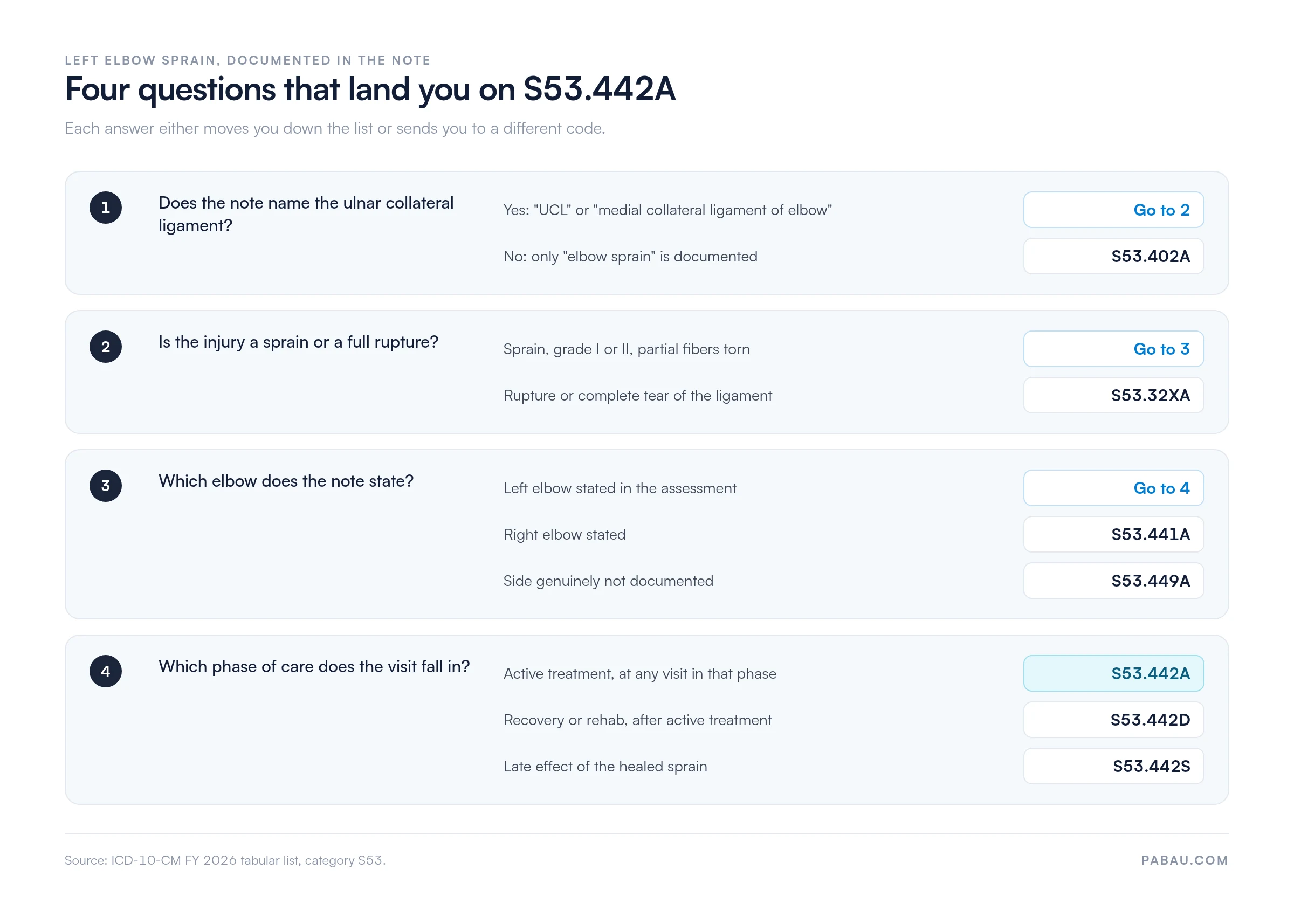
Four-step decision chart for left elbow UCL sprain coding: ligament not named gives S53.402A, rupture gives S53.32XA, right elbow gives S53.441A, undocumented side gives S53.449A, and active treatment of a documented left UCL sprain gives S53.442A, with S53.442D for recovery and S53.442S for sequela
The named ligament and the severity settle the code before laterality does, which is why a note reading only “elbow sprain” lands on S53.402A. Steps follow the FY 2026 ICD-10-CM tabular list.

Includes, excludes, and code-also notes

The S53 category carries note-level instructions that govern what can and cannot be coded alongside ICD-10 Code S53.442A. Coders should verify these notes using the AAPC ICD-10-CM code reference or the official tabular list before submitting.

  • Includes (at S53 level): Avulsion, laceration, sprain, and traumatic rupture of a joint or ligament of the elbow. Traumatic subluxation, traumatic tear, and traumatic hemarthrosis of the elbow are included as well.
  • Excludes2 (at S53 level): Strain of muscle, fascia, and tendon at forearm level (S56.-). A Type 2 exclusion means the two conditions are separate rather than mutually exclusive. Report both codes when the note documents both injuries.
  • Excludes2 (at S53.4 level): Traumatic rupture of the radial collateral ligament (S53.2-) and of the ulnar collateral ligament (S53.3-). This note governs the grade III cases described above, where the documentation says rupture rather than sprain.
  • Code also (at S53 level): Any associated open wound. Chapter 20 external cause codes report the activity (Y93.-) and the mechanism (W, X, or Y series) as secondary codes. Many payers expect both on an injury claim.

Documentation requirements for accurate coding

The clinical note must contain five discrete elements to support S53.442A without a query or denial. Submitting a clean claim on first pass depends on these being present before the encounter is closed.

  1. Explicit laterality: “Left elbow” stated in the assessment or problem list – not inferred from exam findings alone
  2. Named structure: “Ulnar collateral ligament” or “UCL” or “medial collateral ligament of elbow” documented – “elbow ligament” alone is insufficient for this level of specificity
  3. Injury type: “Sprain” or “sprained” documented. Do not code S53.442A when the note says “tear,” “rupture,” or “avulsion” without clarification, since those terms point elsewhere
  4. Encounter type: Documentation must support the phase of care to justify the seventh character chosen (A, D, or S)
  5. Mechanism of injury: Valgus stress, fall, direct trauma, or equivalent – required for external cause coding and often required by payers for imaging and therapy authorization

Associated CPT procedure codes

ICD-10 Code S53.442A appears on claims alongside a range of procedure codes, depending on the encounter type and treatment plan. Check each pairing against the payer’s own edits before you submit, because a procedure that does not match the documented diagnosis is a routine denial.

CPT Code Description Typical context
99202-99215 Office or outpatient E&M visit New and established patient encounters for assessment and management
73080 X-ray, elbow, minimum 3 views Initial workup to rule out fracture or dislocation
73221 MRI, elbow, without contrast Grading UCL sprain severity; payer prior auth often required
97110 Therapeutic exercise Physical therapy strengthening for UCL rehabilitation
97140 Manual therapy techniques Joint mobilization and soft-tissue work during rehab phase
24345 Repair, medial collateral ligament, elbow, with local tissue Surgical repair of the UCL, which ICD-10-CM and CPT both place on the medial side; reconstruction with a tendon graft is 24346

Carrying the ICD-10 code forward from the referring physician’s assessment cuts transcription errors when therapy staff code the session as 97110 or 97140.

Payer requirements and prior authorization

Payer rules for S53.442A claims vary by plan and jurisdiction, so no single rule applies universally. These are the patterns most commonly encountered. Build a prior-auth checkpoint into the billing workflow before an MRI is ordered or surgery is scheduled.

  • MRI (CPT 73221): Most commercial payers and Medicare Advantage plans require prior authorization for elbow MRI when a sprain is the presenting diagnosis. The auth request must reference S53.442A and document conservative treatment failure or clinical uncertainty about severity.
  • Physical therapy: Many plans limit PT visits per episode without a separate auth. Submit S53.442A as the primary diagnosis on the PT auth request, paired with the therapy CPT codes. Six to twelve visits is a common initial approval range.
  • Workers’ compensation: WC carriers require the injury to be work-related and the mechanism documented in the first treating note. The date of injury must match the employer’s First Report of Injury. Some states require specific forms before S53.442A claims are accepted. Consult your jurisdiction’s WC authority.
  • Medicare: Medicare fee-for-service does not require prior auth for most outpatient therapy for S53.442A but does apply a medical review threshold on therapy claims. Document functional limitations and measurable goals in every therapy note.

Verify the patient’s coverage before the first encounter, so plan-level auth requirements surface early. Software that checks eligibility inside the scheduling workflow can raise those requirements at the point of booking, well before a claim is denied.

Common claim denial reasons and how to avoid them

ICD-10 Code S53.442A denials follow predictable patterns. The table below lists each denial trigger with a direct corrective action.

Denial trigger Root cause Corrective action
Wrong seventh character D or S used during active treatment phase Use A for all visits where the injury is still being actively managed; switch to D only when active treatment is complete
Laterality not documented Note says “elbow” without specifying left or right Query the provider to amend the note; do not assume laterality from context or from the patient’s dominant hand
Unspecified code used when left is stated Coder selected S53.449A despite “left” in the note Specificity audits flag this; review the note and recode to S53.442A, then resubmit with the corrected code
Missing external cause code No Y93 activity or W/X/Y mechanism code on the claim Add the appropriate external cause code from the note’s mechanism documentation; required by most payers and mandatory for WC
Medical necessity for MRI not established No documented conservative treatment failure or clinical rationale Document in the ordering note why imaging is needed (e.g., grade II instability on stress testing, failed 4-week conservative care) before submitting the auth request
Forearm strain code stripped from the claim The S56.- note at S53 read as an Excludes1 rather than an Excludes2 The note is a Type 2 exclusion, so resubmit with both codes when the record documents a UCL sprain and a separate forearm strain

Real-time claim editing catches most of these errors before the claim leaves the practice. The denials above are prevented at the point of documentation rather than at the billing desk.

How Pabau keeps S53.442A claims moving

In most practices the elbow sprain is coded in the chart, then keyed into a clearinghouse portal by someone else. It gets chased through a spreadsheet when the payer goes quiet. Each handoff is a chance to lose the laterality, the seventh character, or the auth reference.

Practice management software like Pabau holds the coded encounter, the claim, and the payer response in one patient record. With cleaner claims management, the claim goes out through our Claim.MD integration, and eligibility checks, claim status and ERAs come back to the same file.

Your coder still reads the note and selects S53.442A. What changes is the work after that. Nobody re-keys the claim into a second system or opens a portal to chase a status, and denials arrive beside the encounter they belong to.

Keep S53.442A claims in one workflow

Pabau’s claims management submits your elbow sprain claims through Claim.MD, checks patient eligibility before the visit, and tracks status and ERAs against the patient record.

Pabau claims management dashboard tracking submitted claims and payer responses

Conclusion

S53.442A turns on two details, the documented side and the seventh character. Get both right and most denials on this code never start. The clinical note has to state “left” explicitly, name the UCL, call the injury a sprain, and support the phase of care.

Pabau’s claims management sends S53.442A claims to the payer through Claim.MD. Each response lands against the patient record, so a rejection shows up in the file rather than a portal nobody checks. To see how that works in a sports medicine or orthopedic practice, book a demo.

Continue your research

Continue your research

Need a framework for managing denial patterns across your practice? Denial management in healthcare walks through the systematic approach to tracking, appealing, and preventing claim rejections.

Looking to streamline the full claim lifecycle from coding to payment? Revenue cycle management explains the end-to-end workflow and where technology closes the most common gaps.

Want to understand clearinghouse submission for musculoskeletal claims? Medical claims clearinghouse covers how claims are validated, scrubbed, and routed to payers.

Frequently asked questions

What does ICD-10 Code S53.442A mean?

ICD-10 Code S53.442A is the billable ICD-10-CM diagnosis code for a sprain of the ulnar collateral ligament of the left elbow, initial encounter. It is used when a provider documents a UCL ligament sprain on the medial (inner) side of the left elbow during the active treatment phase. The code is valid for FY 2026 and is a full-specificity leaf node – no further subdivision exists below it.

Is S53.442A a billable ICD-10 code?

Yes, S53.442A is a valid billable ICD-10-CM code confirmed for fiscal year 2026 by the ICD-10 code database. It is a leaf node, meaning it carries the full required specificity (laterality, structure, injury type, and encounter character) for claim submission. Its parent code S53.442 is not billable on its own.

What is the difference between S53.441A and S53.442A?

S53.441A describes a UCL sprain of the right elbow; S53.442A describes the same injury on the left elbow. The two codes are otherwise identical in structure, seventh-character rules, documentation requirements, and associated CPT pairings. The clinical note must explicitly state laterality to determine which code applies – never infer it from the patient’s dominant hand or exam layout.

When should I use the seventh character A for S53.442A?

Use seventh character A whenever the patient is still receiving active treatment for the UCL sprain, regardless of how many visits have occurred. Switch to D (S53.442D) only after active treatment has ended and the patient is in the recovery or rehabilitation phase. Use S only for late effects causally linked to the original injury after it has healed.

What CPT codes are typically billed with S53.442A?

The most common pairings are office visit E&M codes (99202-99215), elbow X-ray (73080), and elbow MRI without contrast (73221). Physical therapy adds 97110 (therapeutic exercise) and 97140 (manual therapy). Surgical repair code 24345 may pair with S53.442A only when operative documentation confirms a UCL repair with local tissue. Reconstruction using a tendon graft is coded 24346.

Can S53.442A be used for workers’ compensation claims?

Yes, S53.442A is valid for workers’ compensation claims when the UCL sprain is documented as work-related. The mechanism of injury must be in the first treating note, and the date of injury must match the employer’s First Report of Injury. WC documentation and authorization requirements vary by state, so check your jurisdiction’s specific rules before submitting.
×