

ICD-10 code S61.201A: Open wound of left index finger without nail damage
ICD-10 code S61.201A covers a left index finger wound of unstated type ICD-10 co...

Last Updated: Oct 16, 2026
Billable Code Specific Code
S52.333R is the billable ICD-10-CM code for displaced oblique fracture of shaft of unspecified radius, subsequent encounter for open fracture type IIIA, IIIB, or IIIC with malunion.
That last detail is where claims fall over. Coders often reach for N, which reports nonunion, or F, which says the fracture healed on schedule. Either letter puts the claim at odds with the imaging the surgeon is reading, and a denial follows.
So the sections below unpack the descriptor one character at a time. They also cover the CPT codes a malunion visit pairs with, and the documentation a payer expects behind it.
Let Pabau's smart automation suggest the right codes, reduce claim denials, and keep your practice compliant—effortlessly.
Automate repetitive tasks and focus on what matters most—your patients.
Reduce coding errors and ensure compliance with the latest regulations.
Clean claims, fewer denials, and faster reimbursements.
Powerful insights and reporting to help your practice thrive.
HIPAA compliant SOC 2 certified GDPR-compliant Trusted by 4,000+ clinics worldwide

ICD-10 code S52.333R describes a displaced oblique fracture of the shaft of an unspecified radius. The bone is the radius, not the ulna.
The 7th character R means a subsequent encounter for an open Gustilo type IIIA, IIIB, or IIIC fracture that healed with malunion.
Three letters report malunion. P covers closed fractures, Q covers open type I or II wounds, and R covers open type III.
Malunion and nonunion take different letters. The bone united here, just in the wrong position, so N does not apply.
The 6th character 3 carries displacement and side together. It means displaced with the arm undocumented, so S52.331- and S52.332- are the right and left options.
Practice management software like Pabau fills the claim form from the record. US claims then route through Claim.MD, with eligibility checks built in.
According to the CDC/NCHS ICD-10-CM web tool, S52.333R is a valid, billable code.
The official description names every element. Displaced oblique fracture of shaft of unspecified radius, subsequent encounter for open fracture type IIIA, IIIB, or IIIC with malunion.
Three facts do most of the work in that descriptor. The fracture is oblique and displaced, in a radius whose side was never documented. The wound was graded Gustilo type III, and the bone then healed out of alignment. Each fact lives in its own character position.
Read the code from left to right and it travels from body region to healing outcome in seven steps. Misread any one position and you produce an invalid or incorrect code.
Here is what each position encodes.
Within S52.3, the 5th character names the shape of the break. A 3 means oblique, so the fracture line runs at an angle across the shaft. The neighboring values cover the other patterns a radiologist might describe.
One of those entries never takes an R at all. Greenstick fractures at S52.31- carry only the closed-fracture letters, so S52.311R does not exist. A right-arm greenstick that heals out of line takes the closed malunion letter instead, giving ICD-10 code S52.311P. Every other subcategory in S52.3 runs the full 16-option set.
This is the position coders underestimate. In S52.33, one digit encodes displacement and laterality at the same time. Change the side and you also change the digit that proves displacement.
The unspecified digit is honest only when no note in the file names an arm. A malunion case has usually generated months of records by this point. A missing side is worth a query rather than a default.
The 7th character is where most S52.333- claims go wrong. R does not simply mean malunion. According to CMS ICD-10-CM guidelines, R means two things at once. The open fracture was graded Gustilo type IIIA, IIIB, or IIIC, and it then healed with malunion.
The S52 category runs a 16-option 7th character table, and it moves on two axes at once. One axis is the healing outcome. The other is the severity of the open wound. Plotted as a grid, the letter you need is much easier to place.
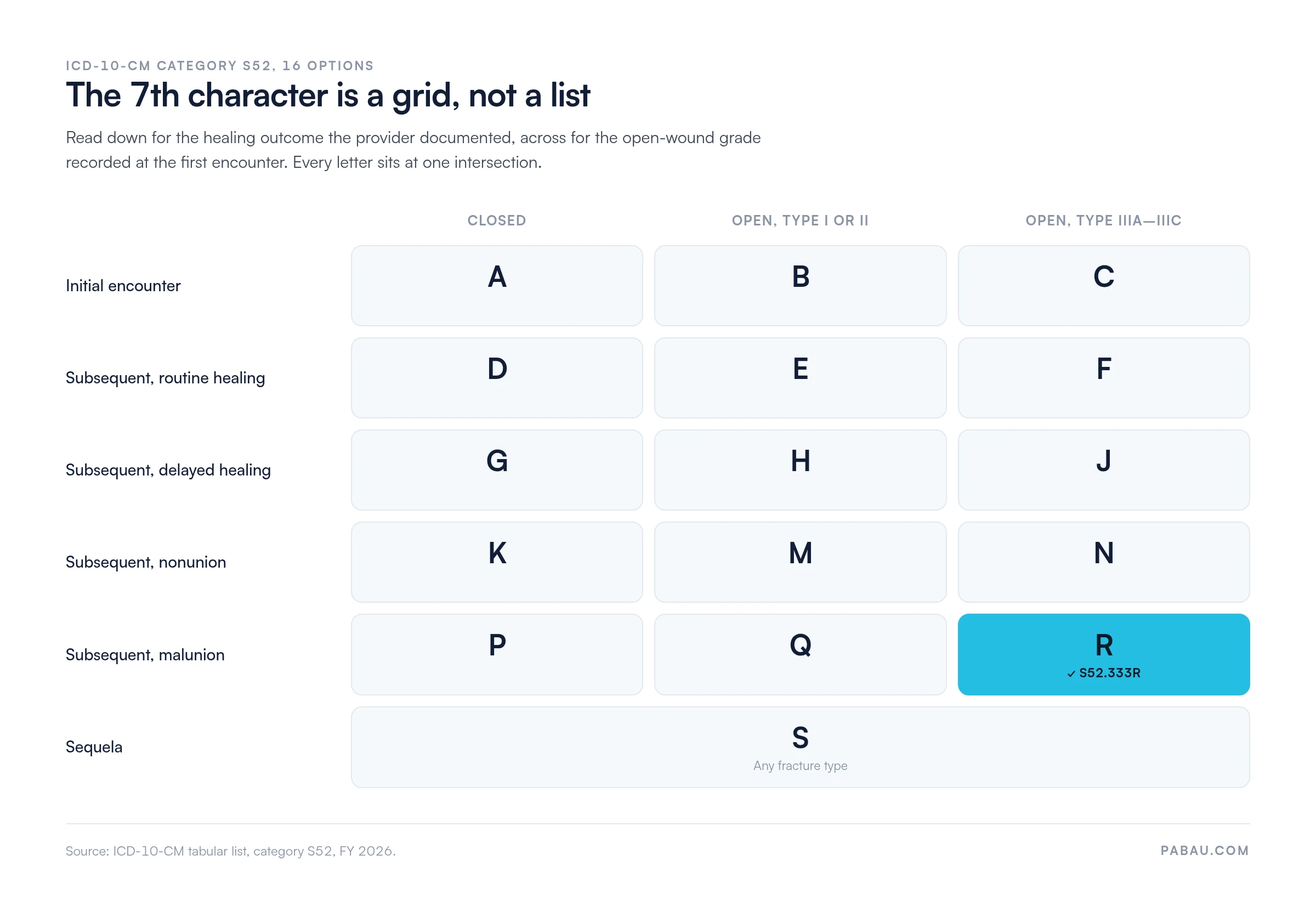
Here is the same set again, written out in full for lookup.
Character R versus characters P and Q. All three report malunion at a subsequent encounter. P is for a fracture that was closed. Q is for an open type I or II wound. R is reserved for type IIIA, IIIB, and IIIC. Verify the grade in the original emergency or operative note before you choose.
Character R versus character N. N reports nonunion for the same open type III fracture. Malunion means the bone united in a poor position. Nonunion means it never united at all. One line in the radiology impression separates the two.
ICD-10 code S52.333R covers one narrow clinical scenario. Every condition below has to hold at the same time for the code to fit.
A malunited radial shaft is more than a paperwork problem. The radius carries a natural bow, and losing it costs pronation and supination. Grip strength and distal radioulnar joint tracking usually suffer too. That combination is why these patients often come back for corrective surgery.
Move the Gustilo grade out of the original operative note and into the problem list. Do it the day the patient transfers into follow-up care. Payers auditing a malunion claim look for agreement between the initial encounter code and the 7th character used later. Coders then default to P or Q when the grade only lives in a scanned trauma record. That claim stops matching the chart.
A cyclist reaches the emergency department with an open forearm injury. The trauma surgeon documents a displaced oblique fracture of the radial shaft and grades the wound Gustilo type IIIB. That encounter codes to S52.333C.
Five months later, an orthopedic office picks the case up from outside trauma records. Imaging shows union with residual angulation, and the provider writes malunion of the radial shaft. No note in the file names the injured arm. That visit codes to S52.333R, and a note saying left would have made it S52.332R.
Displacement never appears in the 7th character. It sits in the 6th digit, alongside laterality. So a displaced and a nondisplaced oblique radial shaft fracture never share a base code, even when both healed with malunion.
Per ICD-10-CM Official Guidelines Section I.C.19, a fracture not documented as displaced or nondisplaced is coded as displaced. That default lands you on S52.333- rather than S52.336-. It does not excuse a missing laterality, which still needs a provider query.
S52.333R sits inside the S52.33 subcategory. Seeing the neighbors side by side makes the choice easier. The differences fall on the pattern, the bone, or the healing outcome.
The last row is the one worth bookmarking. S52.333R and S52.233R differ by a single digit, yet they describe fractures in two different bones. Confirm the subcategory against the current fiscal year tabular list in the AAPC Codify ICD-10-CM lookup before you submit.
S52.333R is a valid, billable ICD-10-CM code for HIPAA-covered transactions. Payment depends on a record that supports every element in the descriptor. Thin documentation is the main reason payers deny fracture follow-up claims.
The path from note to payment has five stops. A malunion claim can stall at any of them, and two of them cause most of the trouble.
Step one fails when the Gustilo grade sits in a scanned outside record that nobody opens. Step two fails when a corrective procedure is billed inside the original repair’s global period. Both are cheap to catch internally and expensive to fix after a denial.
ICD-10 code S52.333R is a diagnosis code, so it needs a CPT procedure code on the claim line. A malunion encounter pairs with a different set of procedures than a routine healing check.
Note the imaging row. CPT 73100 covers the wrist, which is the wrong region for a shaft fracture. Forearm views under 73090 are the anatomically correct pairing. Type III wound care often runs alongside the malunion too, and CPT 97597 turns up on many of these claims.
Global periods matter more here than on a routine healing visit. The original repair under 25515 carries a 90-day global period, and a malunion usually surfaces well after that window closes. Check the payer’s local and national coverage determinations, because rules on fracture aftercare vary by contract.
Not every line on a surgical claim comes from CPT. Blood products and other supplies use HCPCS Level II codes, and the form follows the billing entity rather than the setting. HCPCS code P9041 typically travels on the hospital’s UB-04, while the surgeon’s repair is submitted on a CMS-1500.
Radial shaft codes produce a lot of errors, and the reason is structural. Two mirrored bone families, 10 pattern options, and 16 seventh characters all intersect in one category.
These are the errors that show up most often in audits and denial reviews.
This is the error that costs the most. S52.2- is the shaft of the ulna and S52.3- is the shaft of the radius. The two families mirror each other digit for digit, so S52.333R and S52.233R look almost identical in a code list. Read the bone name in the descriptor before you copy a code across.
Both letters report malunion at a subsequent encounter for an open fracture. The difference is the grade recorded at the initial encounter. Q covers type I and type II wounds, while R covers the type III wounds with extensive soft-tissue damage. Coding R on a type II injury overstates severity, and coding Q on a type III understates it.
Malunion means the bone united in a poor position. Nonunion means it never united. R reports the first and N reports the second, for the same open type III fracture. When the radiology impression describes both a persistent fracture line and angulation, query the provider rather than picking a letter.
S52.333- exists for records that never name the injured arm. Even so, the ICD-10-CM Official Guidelines expect coding to the highest level of specificity available. A malunion case has usually generated months of notes, so query the provider rather than defaulting to the unspecified digit.
Character S reports a residual effect once fracture care has finished. A malunion under active management is still a subsequent encounter, so character R applies. Moving to S52.333S while the practice is planning a corrective osteotomy contradicts the treatment plan on the same claim.
Build a forearm fracture audit into the quarterly billing review. Pull every claim carrying an S52.2- or S52.3- code. Check that the bone in the descriptor matches the operative report. Then check that the 7th character matches the healing outcome documented that day. Last, check the laterality digit against the chart. Catching these internally costs far less than answering a payer audit.
A malunited radial shaft fracture generates claims for months, sometimes longer.
In many practices, someone retypes the diagnosis at every visit. That person also digs the Gustilo grade out of a scanned trauma record and rekeys it into the claim form. Each retype is another chance to land on the ulna family or the wrong 7th character.
Practice management software like Pabau takes the retyping out. The claim form fills from the record. The CPT code attached to the service lands on the charge line.
The ICD-10 slots seed from the client’s recorded problem list. Built-in ICD-10-CM and CPT lookup libraries sit behind a search icon, so coders confirm a descriptor without leaving the claim.
Pabau’s claims management software then checks the required fields before the send button unlocks. US claims route through Claim.MD, our clearinghouse partner, for eligibility checks and claim status tracking.
When a payer pushes back, the denial codes that come back name the element that failed. Fixes then happen at the code level rather than through a blind resubmission.
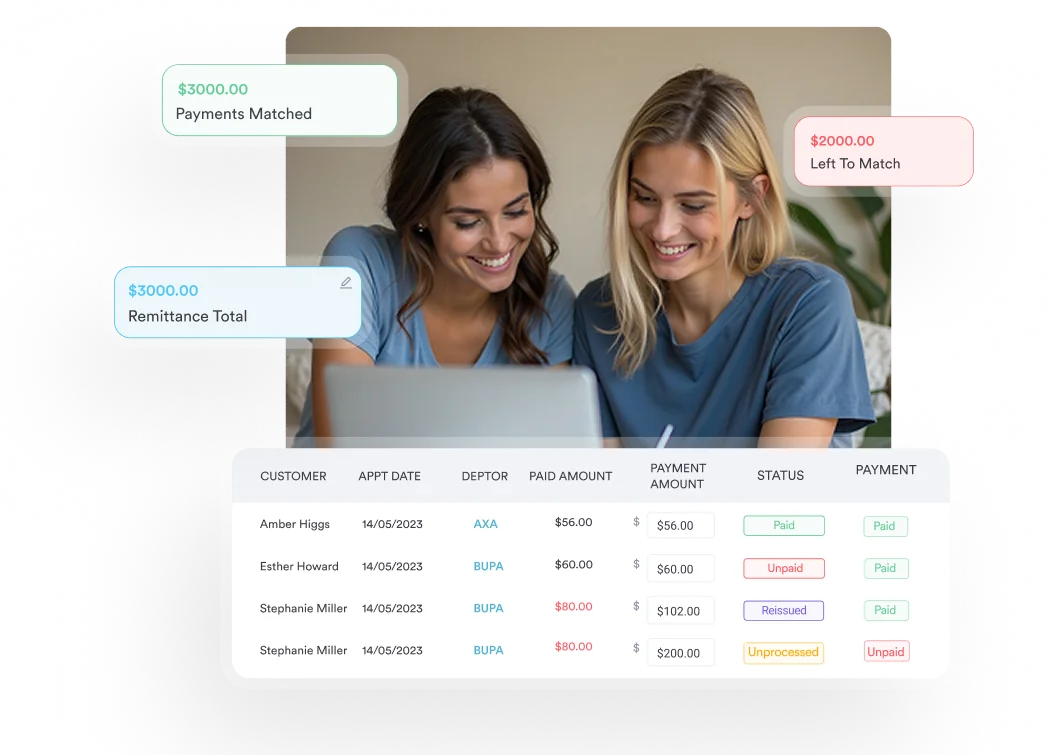

Pabau fills the claim form from the record and keeps ICD-10-CM and CPT lookups a click away. US claims go out through Claim.MD, with eligibility checks and electronic remittance advice built in.

The letter at the end of S52.333R deserves more attention than the six characters in front of it. Those six come straight off the imaging report. The seventh depends on a wound grade recorded months earlier by a different clinician. The follow-up practice may never open that record.
Fixing that is a workflow job rather than a coding one. Move the Gustilo grade into the problem list the day the patient transfers into follow-up care. Record malunion as a diagnosis rather than a radiology finding.
Practices that keep the diagnosis attached to the record spend far less time answering payer questions about fracture claims. Book a demo to see how Pabau carries a fracture diagnosis from the first encounter through to the corrective-surgery claim.

Coding the ulnar side of the same forearm injury? ICD-10 code S52.233F works through the mirrored S52.2- family and the routine healing 7th character.
Managing denials across a long run of follow-up visits? Denial management in healthcare explains how to build a review process that catches repeat coding errors before they become write-offs.
Wondering what a clearinghouse does with a claim before the payer sees it? How Claim.MD clearinghouse works walks through submission, tracking, and remittance for US practices.
No. ICD-10-CM does not use aftercare Z codes for injury follow-up. The injury code carries the follow-up itself, through the 7th character. So S52.333R stays on the claim while the practice manages the malunion.
Yes, but not for a traumatic fracture. M84.0- is titled malunion of fracture, with M84.1- for nonunion and M84.2- for delayed union. Those subcategories exclude traumatic fractures already coded by site, so a radial shaft malunion keeps the 7th character R.
Yes. Add a code from the V00 to Y99 range describing how the injury happened. It never goes first on the claim. Federal law does not mandate the reporting, but many payers and state registries expect it.
No. The 7th character already reports the open fracture at that site and its Gustilo grade. A separate wound code for the same site double-reports one injury.
Yes. The radius and the ulna sit in separate S52 families, so each one takes its own code. Pair S52.333R with the matching S52.2- code, and give each bone the 7th character its own record supports.



