

ICD-10 code S61.201A: Open wound of left index finger without nail damage
ICD-10 code S61.201A covers a left index finger wound of unstated type ICD-10 co...

Last Updated: Oct 16, 2026
Billable Code Specific Code
S52.111G is the billable ICD-10-CM code for torus fracture of upper end of right radius, subsequent encounter for fracture with delayed healing.
The code applies to follow-up visits only, never to initial treatment. Assigning the 7th character G when the record supports D, routine subsequent care, is a common source of denials on this code. It is valid for fiscal year 2026 per the CMS ICD-10-CM code files.
Let Pabau's smart automation suggest the right codes, reduce claim denials, and keep your practice compliant—effortlessly.
Automate repetitive tasks and focus on what matters most—your patients.
Reduce coding errors and ensure compliance with the latest regulations.
Clean claims, fewer denials, and faster reimbursements.
Powerful insights and reporting to help your practice thrive.
HIPAA compliant SOC 2 certified GDPR-compliant Trusted by 4,000+ clinics worldwide

ICD-10 Code S52.111G covers a torus (buckle) fracture of the upper end of the right radius, seen again for delayed healing.
The 7th character G fits only when documentation supports delayed healing past the expected recovery window. Using G on a routine follow-up instead of D is a common denial trigger.
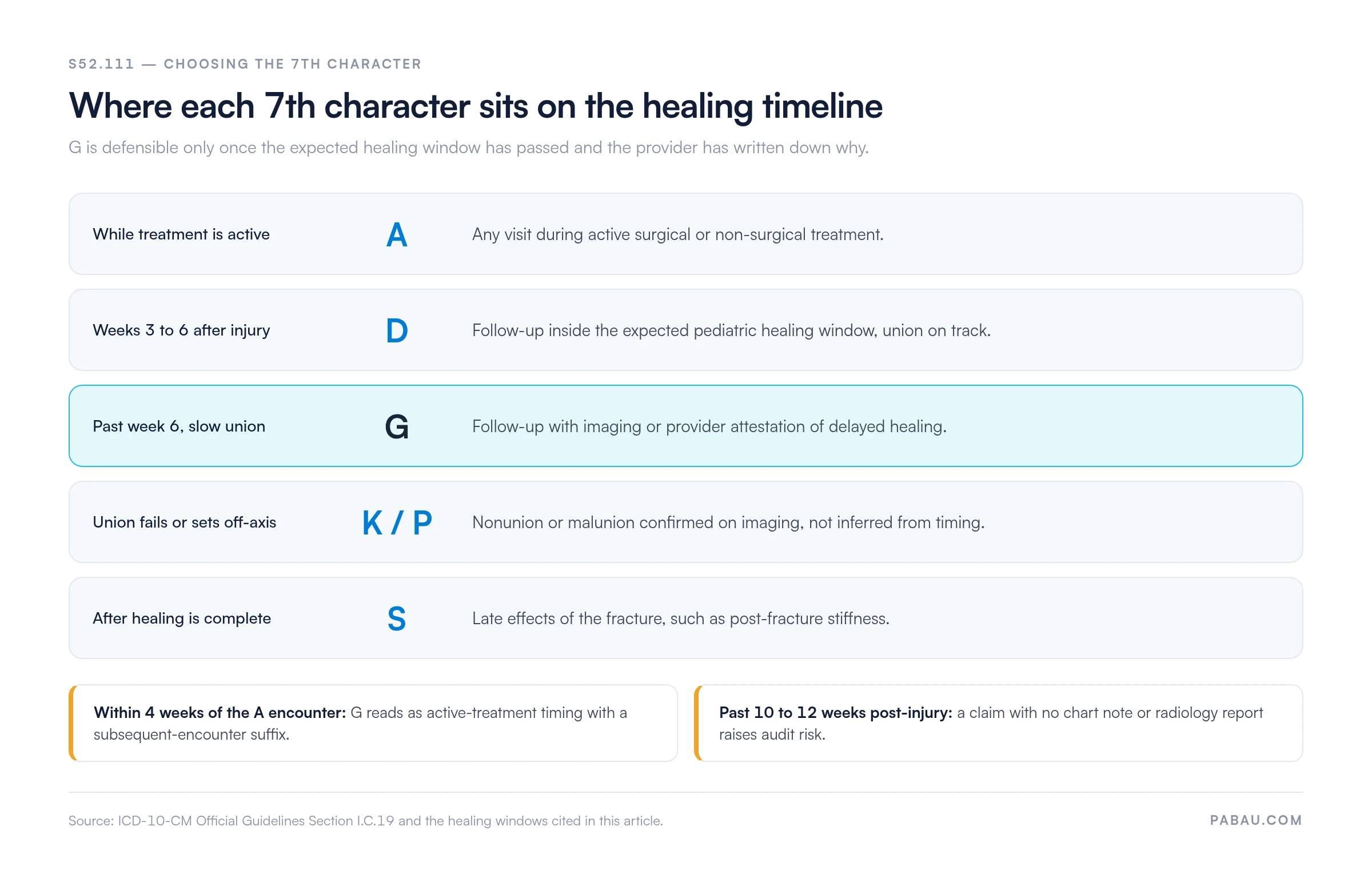
Torus fractures of the proximal radius occur mostly in children, who typically heal in 3 to 6 weeks. Past that window, imaging or a provider attestation has to carry the delayed-healing finding.
Practice management software like Pabau links ICD-10 assignment to the billing workflow, so 7th character mismatches surface before submission.
ICD-10 Code S52.111G is the billable ICD-10-CM diagnosis code for a torus fracture of the upper end of the right radius.
It applies at a subsequent encounter for a fracture with delayed healing. It is a leaf-level code, meaning no further specificity is available and it can be submitted directly on a claim. The billable 7-character torus codes under S52.111 entered the tabular list with the 2019 code year. They remain active in the 2025 and 2026 code years, as confirmed by the CDC/NCHS ICD-10-CM web tool.
Breaking down the code string is the fastest way to verify correct selection before claim submission. Fracture codes ask the coder to confirm four things at once: anatomy, laterality, fracture type, and encounter type.
No age or gender restrictions apply to ICD-10 Code S52.111G. While torus fractures are most common in pediatric patients, the code is valid for adults when the anatomic and encounter criteria are met. The applicable diagnosis classification system is ICD-10-CM, not ICD-10-PCS, which covers inpatient procedures.
The 7th character G denotes a subsequent encounter for a fracture with delayed healing. Knowing what G means, and what it does not cover, prevents the most common denial pattern on this code family. The ICD-10-CM Official Guidelines for Coding and Reporting (Section I.C.19) define the boundary. Subsequent-encounter coding begins once active treatment has finished and the visit is routine care during the healing phase.
The full set of 7th characters available for S52.111 is listed below. Choosing the wrong one carries weight, because payers read the 7th character as a clinical assertion about the patient’s healing status.
Delayed healing (G) is distinct from nonunion (K). Delayed healing means the fracture is taking longer than expected to unite, but union is still anticipated. Nonunion means union has failed and is no longer expected without intervention. K typically triggers intervention planning. G covers watchful management, once the provider records that healing is running slower than expected for the patient’s age and fracture type.
Each character maps to a point in the healing course, not to a visit number. The timeline below is the quickest way to check a selection against the chart.
A torus fracture, also called a buckle fracture, is an incomplete fracture. Cortical bone buckles on the compression side without a complete break through the cortex. It occurs at the upper (proximal) end of the radius, the bone on the thumb side of the forearm.
The fracture pattern is almost exclusively a pediatric injury. Growing bone contains more cancellous bone relative to cortical bone, which makes it buckle under axial load rather than break through. The most common mechanism is a fall on an outstretched hand (FOOSH). Compressive force travels up the forearm and concentrates at the metaphysis near the growth plate.
ICD-10 Code S52.111G belongs to the S52.111 family. Its members share the fracture type and site, then differ by 7th character and, laterally, by the final digit. Coders most frequently confuse S52.111G with S52.111D (routine subsequent care) and, less commonly, with S52.112G (left radius). The comparison table below covers the full S52.111 family plus the two laterality siblings. Confirm each descriptor against the CDC/NCHS tool for the current code year before submission.
The G suffix must be supported by explicit clinical documentation. A chart note that records a follow-up visit without addressing healing status does not justify ICD-10 Code S52.111G. Payers may deny the claim or request records. Whatever 7th character you assign, the provider’s own language has to reflect the healing status it asserts.
AHA Coding Clinic guidance reinforces that delayed healing is a clinical determination made by the treating provider, not a default selection. Coders should not assign G based on elapsed time alone.
ICD-10 Code S52.111G appears on follow-up claims, not initial fracture treatment claims. CPT codes paired with S52.111G therefore reflect continued non-operative management, rehabilitation, or follow-up imaging rather than initial fracture reduction. Initial treatment codes for this site pair with S52.111A, never with S52.111G. They are 24650 for closed treatment of a radial head or neck fracture without manipulation, and 24655 with manipulation. Submitting an initial-treatment CPT code with the G suffix is a CPT-to-ICD mismatch and a reliable denial trigger.
CPT codes for casting application or removal (e.g., 29085, 29125) may also appear alongside S52.111G when continued immobilization is part of the delayed-healing management plan. Verify payer-specific coverage policies before assuming these combinations will be reimbursed. Claims software built for practices can flag payer LCD edits at the point of submission. CPT appropriateness is presented here as examples only, and local coverage determinations vary by payer.
Medicare, Medicaid, and commercial payers read ICD-10 Code S52.111G as a medical-necessity claim. The visit is billed as management of a fracture with documented delayed healing. The payer’s expectation follows from that: the encounter must be clinically distinct from a routine check-in. Payers may flag claims when delayed healing is asserted without corroborating documentation, particularly when the time since initial fracture falls within the standard healing window.
Staying compliant on this code is principally a documentation challenge. The clinical finding must drive the code selection, never the other way round.
Claim denials on S52.111G are widely reported in coding forums and AAPC educational content as a known risk pattern, though individual payer data varies. Three denial codes come up most often on fracture 7th character errors. They are CO-4 (procedure code inconsistent with modifier), CO-11 (diagnosis inconsistent with procedure), and CO-197 (precertification or authorization absent).
Pre-submission claim scrubbing is where most of this gets caught. Correcting a 7th character mismatch in the billing queue costs a fraction of what the same error costs once it comes back as an appeal.
Three things must align before the claim on ICD-10 Code S52.111G is built. The chart confirms right laterality. The provider has explicitly documented delayed healing. The CPT code reflects a follow-up encounter rather than active treatment. When all three are present, the claim is defensible. When any one is missing, the practice is exposed to denial or post-payment audit.
Run a monthly audit of all claims billed with 7th character G across your fracture code set. Filter for claims where G was used on a date of service within 4 weeks of the initial encounter date (suffix A). These are high-probability mismatches: active-treatment timing with a subsequent-encounter suffix. Correcting these before payer audit prevents both denial accumulation and potential fraud-and-abuse exposure.
In most practices the chart note and the claim live in separate systems. A coder reads the follow-up note, picks a 7th character from memory or from a cheat sheet, and the claim goes out. Nobody compares the suffix against the date of the initial encounter until the remittance advice comes back.
Pabau is practice management software that keeps the note, the code and the claim on the same patient record. When a coder assigns S52.111G, the encounter history sits beside it. A G applied four weeks after the A encounter shows up before the claim is queued. Imaging reports and provider attestations stay attached to the same record, which is what an auditor asks for later.
The outcome is fewer fracture claims coming back for records. Denials that used to surface weeks after submission get resolved while the patient is still in follow-up. The billing team works a shorter rework list.

Pabau links ICD-10 code assignment to your billing workflow, so CPT-ICD mismatches are flagged before claims leave the practice rather than after they bounce.

ICD-10 Code S52.111G asks for precise documentation, not just a precise code. G asserts a clinical finding of delayed healing, and that finding has to appear in the provider’s note. Imaging should back it wherever the record allows.
Choosing correctly between D, G, K and P decides whether follow-up fracture claims pay on first submission or cycle through appeals. One review step in the billing queue for every fracture code carrying a subsequent-encounter suffix removes most of that risk. Book a demo to see how Pabau surfaces CPT-ICD mismatches on orthopedic follow-up claims before they leave your practice.

Need to understand how fracture claims move through a clearinghouse? How a medical claims clearinghouse works explains the validation steps claims undergo before reaching a payer.
Managing denial patterns across your fracture code portfolio? What is revenue cycle management covers the end-to-end process from coding to payment posting.
Working a backlog of denied fracture follow-up claims? Denial management in healthcare sets out how to triage, appeal and prevent repeat denials.
Checking what your documentation has to satisfy? Medical billing compliance covers the record-keeping standards auditors apply to coded claims.
ICD-10 Code S52.111G is the billable ICD-10-CM diagnosis code for a torus (buckle) fracture of the upper end of the right radius. It applies at a subsequent encounter where the provider has documented delayed healing. It is valid for fiscal years 2025 and 2026 and never applies to initial treatment encounters.
S52.111D applies when the fracture is healing normally on follow-up. S52.111G applies when the provider has documented that healing is delayed beyond the expected window. D is the correct choice for the majority of follow-up visits. G requires explicit clinical documentation of slow or impaired fracture repair, typically supported by imaging.
Use G (delayed healing) when the fracture is progressing more slowly than expected but union is still anticipated. Use K (nonunion) when fracture union has failed and is no longer expected without surgical or other active intervention. The distinction is clinical: G is watchful management, while K usually precedes a change in treatment strategy.
Yes. S52.111G is a valid, billable leaf-level ICD-10-CM code confirmed active in the 2025 and 2026 code years. It can be submitted directly on a claim without a more specific sub-code, as no further specificity exists in the classification.
No. ICD-10 Code S52.111G carries no age restriction. Torus fractures of the proximal radius are predominantly a pediatric injury pattern, because of the mechanical properties of growing bone. The code is still valid for adult patients when the fracture type and anatomic site are confirmed in the documentation.
A torus fracture is an incomplete fracture where cortical bone buckles under axial compression without a complete break through the cortex. At the upper end (proximal) of the right radius, this pattern most commonly results from a fall on an outstretched hand. It is common in children aged 5 to 10 years, because growing bone buckles rather than snapping under compressive load.



