ICD-10 Code S66.308A: Extensor muscle injury, other finger
ICD-10 Code S66.308A: Definition and code hierarchy ICD-10 Code S66.308A is the ...

Last Updated: Oct 14, 2026
Billable Code Specific Code
S42.416D is the billable ICD-10-CM code for nondisplaced simple supracondylar fracture without intercondylar fracture of unspecified humerus, subsequent encounter for fracture with routine healing.
Coders frequently confuse the 6th character (right vs. left vs. unspecified laterality) and the 7th character (A, D, or S), and both errors land the claim in denial. What follows is a coding-first breakdown of each character, the documentation a payer expects at a D-encounter visit, and the related codes that share the same anatomy but differ in displacement or laterality.
Let Pabau's smart automation suggest the right codes, reduce claim denials, and keep your practice compliant—effortlessly.
Automate repetitive tasks and focus on what matters most—your patients.
Reduce coding errors and ensure compliance with the latest regulations.
Clean claims, fewer denials, and faster reimbursements.
Powerful insights and reporting to help your practice thrive.
HIPAA compliant SOC 2 certified GDPR-compliant Trusted by 4,000+ clinics worldwide

S42.416D is a valid billable ICD-10-CM code for a nondisplaced simple supracondylar fracture of the unspecified humerus at a subsequent encounter with routine healing.
A supracondylar fracture sits at the lower end of the humerus, just above the elbow. It is not a shoulder-end injury, and greater tuberosity fractures belong to a different family (S42.25-).
The 6th character carries displacement and side together: 4 is nondisplaced right, 5 is nondisplaced left, 6 is nondisplaced unspecified.
The 7th character D applies only while the patient is still receiving care for the fracture. It is never used at the first visit (A) or for a late effect (S).
Practice management software like Pabau ties ICD-10-CM codes to the clinical note, so coding errors surface before the claim leaves the practice.
ICD-10 Code S42.416D is the billable diagnosis code for a nondisplaced simple supracondylar fracture of the unspecified humerus.
You report it at a subsequent encounter, while the fracture is still being treated and healing is routine.
The fracture sits at the lower end of the humerus, just above the elbow, and the bone ends have stayed in alignment. Two characters decide whether the claim pays. The 6th character 6 carries the nondisplaced status and the undocumented side. The 7th character D carries the encounter type.
This page covers the full descriptor and the documentation a D-encounter claim needs. It also sets out the neighboring codes this one is confused with, and the CPT codes usually billed alongside it.
The table below summarizes the billing facts for ICD-10 Code S42.416D. Verify the code against the CDC/NCHS ICD-10-CM web tool for the applicable fiscal year before submitting a claim, as code validity is confirmed annually.
S42.416D is a seven-character alphanumeric code in which each position encodes a specific clinical fact. Misreading any one character produces a different diagnosis than the treating provider documented. The breakdown below is modeled on the CMS ICD-10 coding guidelines.
Laterality clarification: In the S42.41 group the 6th character carries two facts at once, displacement and side. Characters 1, 2 and 3 cover displaced fractures of the right, left and unspecified humerus. Characters 4, 5 and 6 cover nondisplaced fractures in the same order.
S42.416D therefore encodes a nondisplaced simple supracondylar fracture of the unspecified arm at a routine-healing follow-up. Coders who read the 6 as “right” should check the mapping in the AAPC ICD-10-CM lookup. The wrong digit changes the side and the displacement status at the same time. The grid below sets out all six combinations in the group.
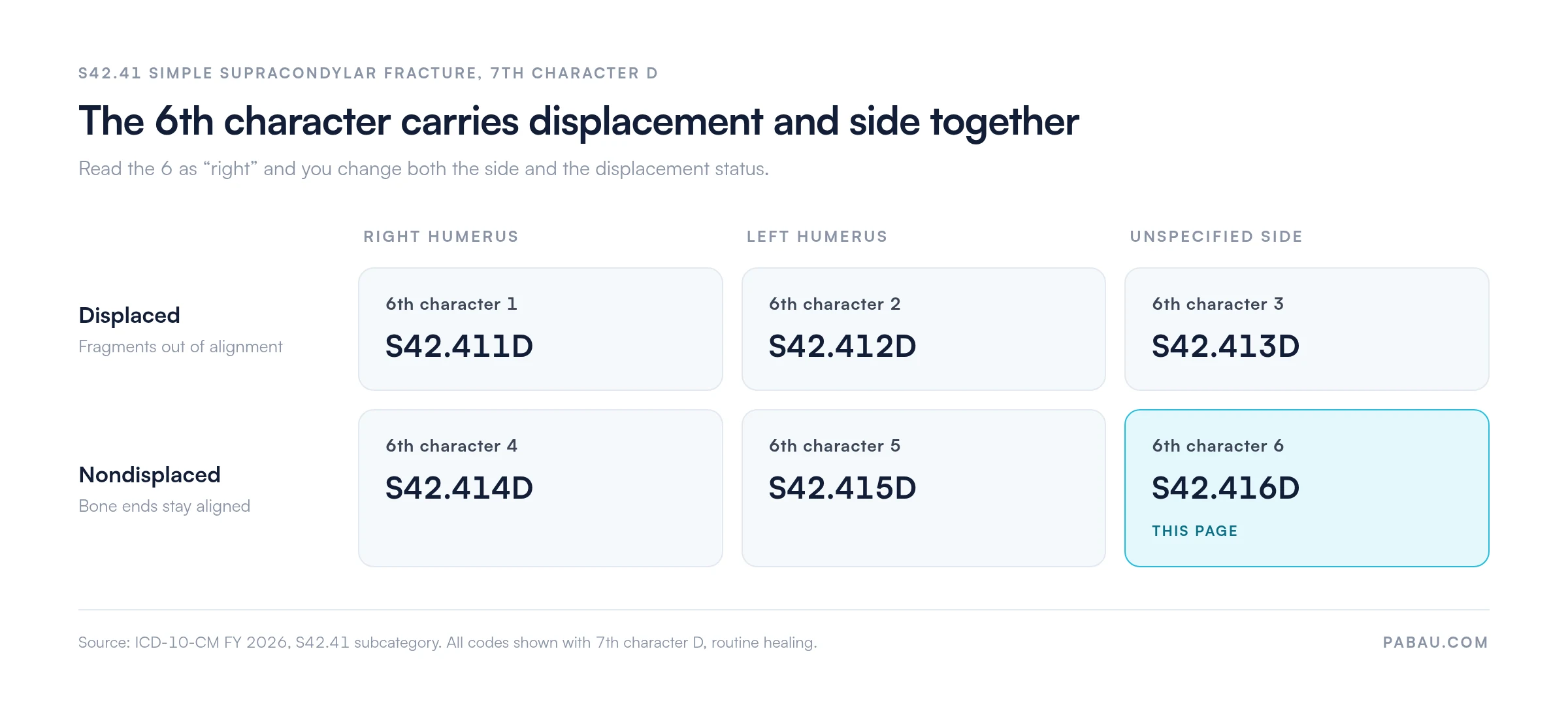
A supracondylar fracture crosses the lower end of the humerus, just above the two condyles that form the elbow joint. “Simple” and “without intercondylar fracture” together mean a single fracture line that stays outside the joint surface. “Nondisplaced” means the bone has cracked but the fragments still sit in normal alignment.
Common causes include:
Supracondylar fractures are the most common elbow fracture in children, peaking between roughly five and seven years of age. In adults they are far less frequent, and they usually follow either a direct fall onto the elbow or significant trauma.
A nondisplaced pattern, classified as Gartland type I, is managed without surgery. Treatment is typically a long-arm cast or posterior splint with the elbow held near 90 degrees for three to four weeks. Progressive range-of-motion work follows once the cast comes off.
Even a nondisplaced supracondylar fracture deserves a documented neurovascular check at every visit. The brachial artery and the median, radial and ulnar nerves all run within millimeters of the fracture line. Loss of elbow extension is the most common lasting problem, and it is what drives the therapy course these D-encounter claims pay for.
Medicare research files, as ResDAC documents, identify each of those encounters by its ICD-10-CM code alone. Character-level accuracy therefore matters well past the chart itself.
The treating clinician’s note at each subsequent encounter must document the current healing status, the ongoing treatment, and any complications. Therapy, home exercise, and repeat imaging all count as ongoing treatment. That note is the primary evidence base for choosing D instead of the sequela character.
The 7th character D designates a subsequent encounter for a fracture during routine healing, per the ICD-10-CM Official Guidelines for Coding and Reporting, Section I.C.19. “Subsequent” here is a coding term, not a clinical synonym for “follow-up visit.” The distinction between A, D, and S is where orthopedic coding errors usually start.
Key rule: D is used for every encounter while the fracture is actively being managed and healing normally, regardless of how many visits that involves. A single patient may generate dozens of D-encounter claims across weeks of physical therapy. Switch to S only when the patient presents for treatment of a consequence of the original fracture after the fracture itself has healed.
The ICD-10-CM Official Guidelines for Coding and Reporting, maintained jointly by CMS and CDC/NCHS, govern every element of fracture coding. For subsequent-encounter fracture claims, the medical record must support five documentation elements before the claim is submitted.
Payers auditing fracture claims routinely look for D-coded claims that lack one of these elements. A claim coded S42.416D needs more than “patient presents for follow-up, elbow doing better.” That note invites a medical-necessity denial or a pre-payment audit request.
Flag every D-encounter fracture claim for a documentation quick-check before submission: healing status stated, ongoing treatment confirmed, displacement unchanged, laterality matches imaging. Building this as a 30-second pre-claim review step catches avoidable denials before the claim leaves the practice.
The S42.41 group covers simple supracondylar humerus fractures across both displacement states, both sides, and every encounter type. Choosing the wrong code in this family is a common specificity error on distal humerus claims. Use the ICD List lookup to cross-reference any adjacent code before billing.
Providers rarely write the full ICD-10-CM descriptor in the chart. These are the phrases that map to S42.416D when the note also confirms routine healing at a subsequent visit:
One phrase does not belong on this list, and it is a common mix-up on humerus claims. A greater tuberosity fracture is an injury to the upper end of the humerus, at the shoulder. It is coded in the S42.25- range, not anywhere in S42.41-. A greater tuberosity follow-up with routine healing is S42.256D. If the note says “greater tuberosity,” the claim has left this code family entirely.
S42.416D is a valid billable ICD-10-CM code accepted by Medicare and most commercial payers for subsequent-encounter fracture visits. Payer coverage policies for subsequent encounters vary by local coverage determination (LCD) and payer-specific guidelines. The following points apply broadly, but always verify against current payer policy before assuming coverage.
Orthoses dispensed during fracture care are billed differently from casting, moving to the DMEPOS fee schedule under HCPCS L codes. Spinal braces such as HCPCS code L0458 need a written order, a KX modifier, and signed proof of delivery from an accredited supplier.
Eligibility is worth re-checking at every subsequent visit, not just at the first one. A long course of casting and therapy can run past a plan-year boundary. A benefit that lapsed mid-treatment turns an otherwise clean claim into a rejection.
Practices billing fracture follow-ups through a clearinghouse should check box 21 of the CMS-1500. The diagnosis code has to line up with the matching CPT in box 24. Each procedure code above carries its own documentation rules, which our CPT code reference sets out.
Orthopedic and physical therapy practices managing S42.416D claims across dozens of patients face a consistent problem. The 7th character has to be re-evaluated at every encounter. It must match the note in front of you, not the code used last time.
Picking the code by hand at every visit is what lets a D code survive past the point where S applies. The coder carries it forward long after the fracture has healed, because nobody updated the problem list.
Practice management software like Pabau ties cleaner claims management to the note itself. The coder sees the provider’s documented healing status before the claim is built, rather than after a payer rejects it.
The platform connects to Claim.MD for 837P submission and retrieves 835 ERA files automatically. Billers get a closed-loop view of each claim from submission to payment, without a separate clearinghouse login. Structured fields in the record hold healing status and treatment type, so the pre-claim check takes 30 seconds instead of a chart review.
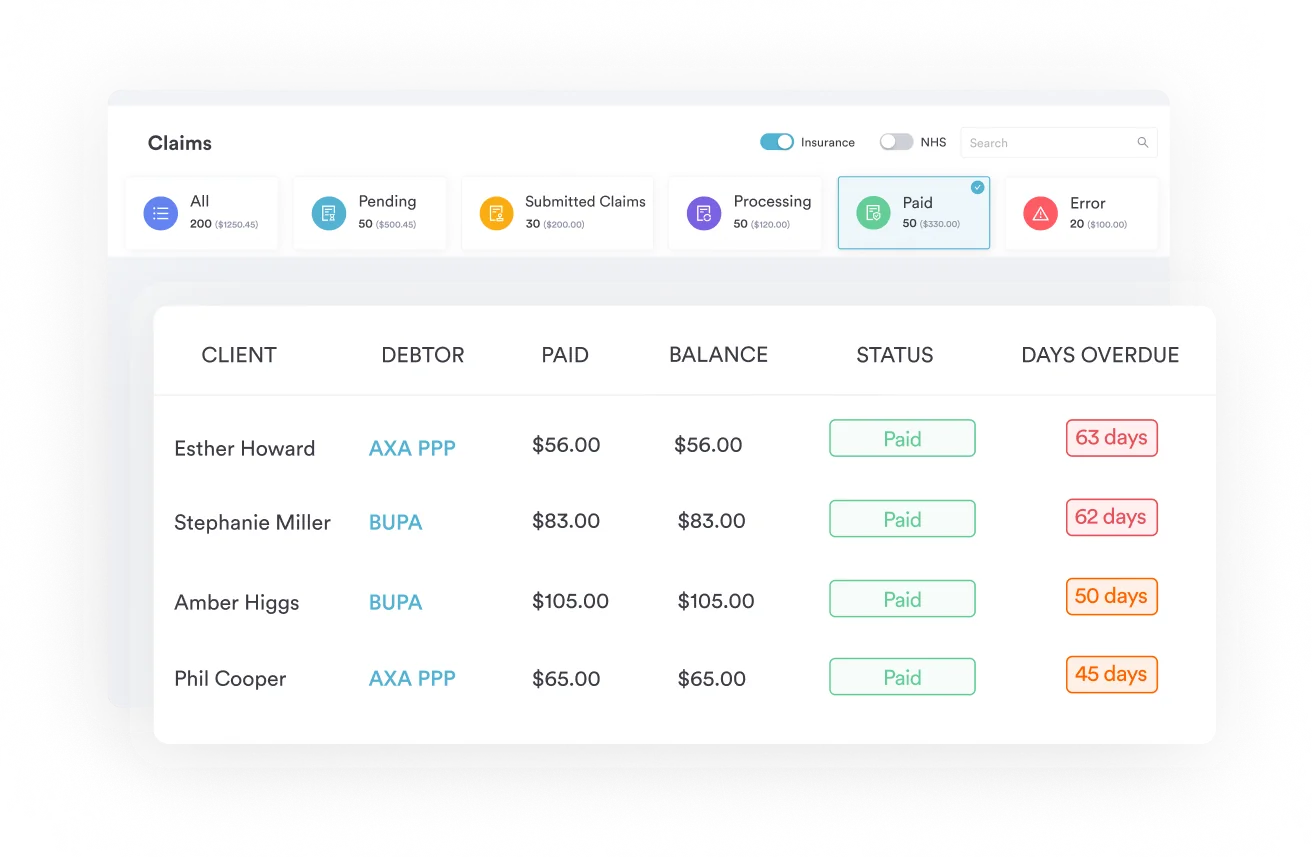
The same structure works for any fracture code with a 7th character, which is most of Chapter 19. Once the healing status lives in a structured field, the code and the note stop drifting apart across a long course of follow-up visits.

Pabau connects ICD-10-CM diagnosis codes directly to your billing workflow. Subsequent-encounter fracture claims go out with the right code, the right CPT, and the right documentation attached. Book a demo to see how the Claim.MD integration works in practice.

S42.416D rests on three characters, and only one of them moves. The 5th and 6th stay fixed across the whole course of care, because the fracture stays simple, supracondylar and nondisplaced. The 7th has to be re-read at every visit. Coding a follow-up from last month’s claim rather than this month’s note is what turns a D into a denial.
Laterality is the piece worth chasing before you submit. The unspecified 6 is valid, but a documented side is the stronger claim, so ask for the imaging report instead of defaulting to it. Keep the anatomy straight too. This code sits at the elbow end of the humerus, so a greater tuberosity note belongs in the S42.25- range.
For practices running a high volume of orthopedic follow-up visits, Pabau’s integrated billing and clearinghouse workflows reduce the manual steps that let these errors accumulate. Book a demo to see how code validation and ERA retrieval work inside the platform your clinicians already use for notes.

Coding another distal humerus fracture? ICD-10 code S42.494G covers the same segment of the humerus at a delayed-healing encounter.
Managing claim denials after submission? Denial codes in medical billing decodes the most common CARC rejection reasons and explains how to build an effective appeal.
Want to understand the full revenue cycle for orthopedic visits? Revenue cycle management explained maps every step from insurance eligibility check to ERA reconciliation.
ICD-10 Code S42.416D is the billable diagnosis code for a nondisplaced simple supracondylar fracture of the unspecified humerus, without intercondylar fracture. It sits in the S42.4 category, which covers fractures of the lower end of the humerus, just above the elbow. The 6th character 6 encodes a nondisplaced fracture with the side not documented. The 7th character D encodes a subsequent encounter with routine healing.
The 7th character D designates a subsequent encounter for a fracture during routine healing, per ICD-10-CM Official Guidelines Section I.C.19. Use D for every encounter while the patient is actively receiving care and the fracture is healing normally. Switch to G for delayed healing, K for nonunion, P for malunion, and S only when treating a late effect after the fracture has healed.
S42.416A is the initial encounter code for a closed fracture, used only at the first visit where active treatment is provided. S42.416D is used at every subsequent visit while the fracture is healing normally and care is ongoing. Both codes describe the same injury, a nondisplaced simple supracondylar fracture of the unspecified humerus, and only the 7th character changes.
Office or outpatient E/M codes (99211-99215) are billed with S42.416D for physician follow-up visits. Repeat elbow X-rays use CPT 73070 for two views or 73080 for a complete study of three or more views. Physical therapy sessions pair S42.416D with codes such as 97110 or 97530, and a replacement long-arm cast is reported with CPT 29065.
It is a break across the lower end of the humerus, just above the two condyles that form the elbow. The fragments remain in normal alignment. The fracture line stays outside the joint surface, which is what the phrase without intercondylar fracture means. Nondisplaced supracondylar fractures are usually treated without surgery, with a long-arm cast or splint for three to four weeks followed by range-of-motion work.
Yes, S42.416D is accepted by Medicare as a valid billable diagnosis code for subsequent-encounter fracture visits. Coverage for associated services such as E/M visits, imaging, and physical therapy is subject to the applicable Local Coverage Determination and medical-necessity documentation. The treating provider’s note must document ongoing active treatment and the current healing status at each D-encounter visit to support the claim.