ICD-10 Code Z74.8: Other problems related to care provider dependency
ICD-10 Code Z74.8: Definition and code details ICD-10 Code Z74.8 is the billable...

Last Updated: Oct 19, 2026
Billable Code Specific Code
S40.261D is the billable ICD-10-CM code for insect bite (nonvenomous) of right shoulder, subsequent encounter.
Two documentation mistakes come up repeatedly on this code. The first is the initial-encounter suffix "A" on a follow-up visit. The second is a clinical note that never names the right side. Either one sends the claim back.
Let Pabau's smart automation suggest the right codes, reduce claim denials, and keep your practice compliant—effortlessly.
Automate repetitive tasks and focus on what matters most—your patients.
Reduce coding errors and ensure compliance with the latest regulations.
Clean claims, fewer denials, and faster reimbursements.
Powerful insights and reporting to help your practice thrive.
HIPAA compliant SOC 2 certified GDPR-compliant Trusted by 4,000+ clinics worldwide

S40.261D is the billable ICD-10-CM code for a nonvenomous insect bite of the right shoulder at a follow-up visit.
Use S40.262D for the left shoulder, and S40.269D only when the record never names a side.
The 7th character ‘D’ belongs on every visit after the first one where active treatment was given.
The note must state right shoulder laterality, the nonvenomous nature of the bite, and the prior encounter.
Pabau, the practice management platform we build, validates each claim before submission and shows the payer’s rejection reason.
ICD-10 Code S40.261D is the billable diagnosis code for a nonvenomous insect bite of the right shoulder at a follow-up visit. It sits in the S40-S49 block, injuries to the shoulder and upper arm, within Chapter 19 of ICD-10-CM. The table below is the quick-reference data for the code.
ICD-10 Code S40.261D breaks down character by character:
Confirm the breakdown against the CDC/NCHS ICD-10-CM web tool for the current fiscal year before submitting claims.
S40.261D covers a nonvenomous insect bite on the right shoulder or deltoid region. It applies at a visit where the patient is receiving routine care during healing or recovery. The key clinical criteria are:
The superficial classification is important. S40.261D is a non-penetrating wound code. If the bite resulted in an open wound requiring debridement or suture, the S41 block (open wound of shoulder) would apply instead. If the patient reports systemic symptoms consistent with envenomation, the T63 venom codes apply instead.
The 7th character in ICD-10-CM injury codes signals the episode of care. Getting it wrong is a frequent reason S40.261D claims are denied. Per the ICD-10-CM Official Guidelines for Coding and Reporting, the three options for S40.261x are:
The critical distinction for “D”: the patient does not have to be completely healed. “D” applies whenever the patient is beyond the first active treatment visit, even if healing is ongoing. The question to ask before assigning the suffix is: Has this patient already received active treatment for this specific injury at a prior encounter? If yes, use D. If this is the first time active treatment is being provided, use A.
A and D get confused often in this code family. Work through this sequence at the point of coding, and the diagram underneath shows the same routing at a glance.
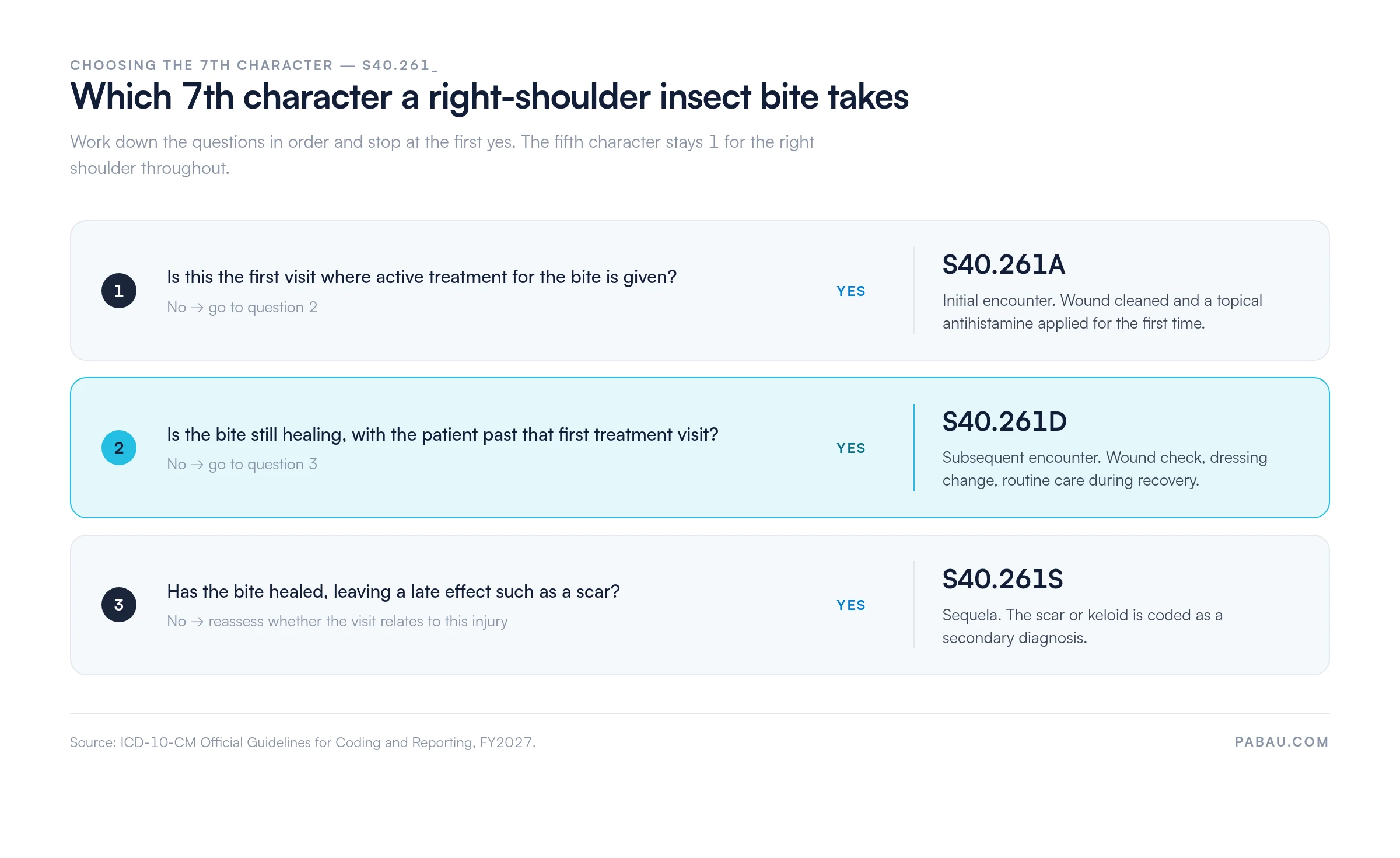
One common misconception: “subsequent encounter” does not mean the patient’s second visit to your practice. It means the second or later visit where treatment for this injury is provided. The practice does not have to be the same one. Say a patient was treated in the ER for the bite, which was coded as the initial encounter. They present to your urgent care five days later for a wound check. That visit takes the D suffix.
The S40.26x subcategory carries important boundary conditions that define what ICD-10 Code S40.261D can and cannot cover.
Never default to S40.269D (unspecified shoulder) when the laterality is not documented in the chief complaint. Pull from the physical exam or wound description in the same note. Laterality is almost always there – it just takes a second look. Using the unspecified code when a specific one is available is an ICD-10-CM Official Guideline violation and a payer red flag.
These neighboring codes sit in the same block or cover overlapping clinical scenarios. Knowing when each applies prevents misassignment.
Payers – including CMS for Medicare and Medicaid – evaluate ICD-10 Code S40.261D claims against the clinical note. The note must substantiate three points: the right site, the nonvenomous nature of the bite, and the follow-up encounter status. A medical billing workflow that catches missing fields before claim submission is far cheaper than chasing denials after the fact.
Required documentation elements:
A clinical record that templates these fields lowers the documentation burden on providers. It also makes laterality and encounter type routine entries rather than afterthoughts.
Medicare and most commercial payers accept ICD-10 Code S40.261D for wound care follow-up visits when medical necessity is established. Coverage expectations vary by payer, but the consistent requirements are:
Understanding clean claim submission standards before filing reduces rejections on technical grounds (missing fields, invalid code pairs) separately from clinical-necessity denials.
Revenue cycle teams working on denial management workflows for wound care codes meet these rejection patterns on S40.261D:
Each rejection arrives with a denial reason code, and reading it tells you which of the five you hit.
These vignettes show correct and incorrect code selection in common clinical situations, which a static lookup table cannot give you.
A patient was seen four days ago for a mosquito bite on the right shoulder. At that visit (coded S40.261A), the wound was cleaned and a topical antibiotic was applied. Today the patient returns. The wound shows early healing with mild erythema but no signs of infection. The provider performs a wound check, changes the dressing, and instructs the patient on further home care.
Correct code: S40.261D. This is a follow-up to a documented initial encounter. The site is the right shoulder. The bite is nonvenomous. The note documents the wound status and the treatment provided. The diagnosis supports medical necessity for the follow-up visit.
A patient presents for the first time after a flea bite on the right shoulder two days ago. The site is itchy and inflamed, with no sign of infection. The provider prescribes a steroid cream and goes through wound care.
Wrong code: S40.261D. This is the first visit where active treatment is provided, so the 7th character must be A. The correct code is S40.261A. The bite itself fits the S40.261x family, because a flea bite is nonvenomous. Only the encounter character is wrong.
A patient presents for follow-up after a prior shoulder bite. The provider notes the skin is fully healed but the patient has developed a raised scar at the bite site causing discomfort.
Correct code: S40.261S (sequela). The original injury has healed; the current complaint is a late effect of the bite. The scar itself would be coded as a secondary diagnosis using the appropriate scar or keloid code, per ICD-10-CM sequela coding rules.
Practices managing legacy records or older payer systems occasionally need an ICD-9-CM equivalent. The approximate crosswalk for ICD-10 Code S40.261D is ICD-9-CM 912.4 (insect bite, nonvenomous, of shoulder and upper arm, without mention of infection).
This mapping is approximate. ICD-9-CM did carry a shoulder and upper arm bite code, but it had no laterality. One code covered both shoulders, so 912.4 cannot tell a payer which side was bitten. The AAPC’s ICD-10-CM crosswalk tool and the CMS General Equivalence Mapping (GEM) files are the sources for verifying crosswalk accuracy before submission. Treat the 912.4 mapping as a starting point, not a confirmed equivalent.
When submitting claims that reference legacy ICD-9 data, flag the crosswalk as approximate in your internal notes. GEM files are bidirectional and not always accepted by older payer systems. Verify the mapping against payer-specific crosswalk requirements before filing.
In most practices the coder assigns S40.261D, the biller raises the claim, and the two only meet again when a rejection lands weeks later. By then the note is cold, and nobody remembers whether the laterality line was in it.
Pabau’s claim validation scrubs each claim for missing or invalid details before it leaves the system. When a payer still rejects one, the claims dashboard flags it as Needs action. It shows the payer’s reason, with a link straight to the field that needs correcting.
US practices submit CMS-1500 claims through Claim.MD, our clearinghouse partner, and can check a patient’s coverage before the visit. Pabau’s claims software for practices then tracks every claim from Pending to Paid on one dashboard. So a run of S40.261D rejections reads as a pattern you can act on, not a stack of separate letters.
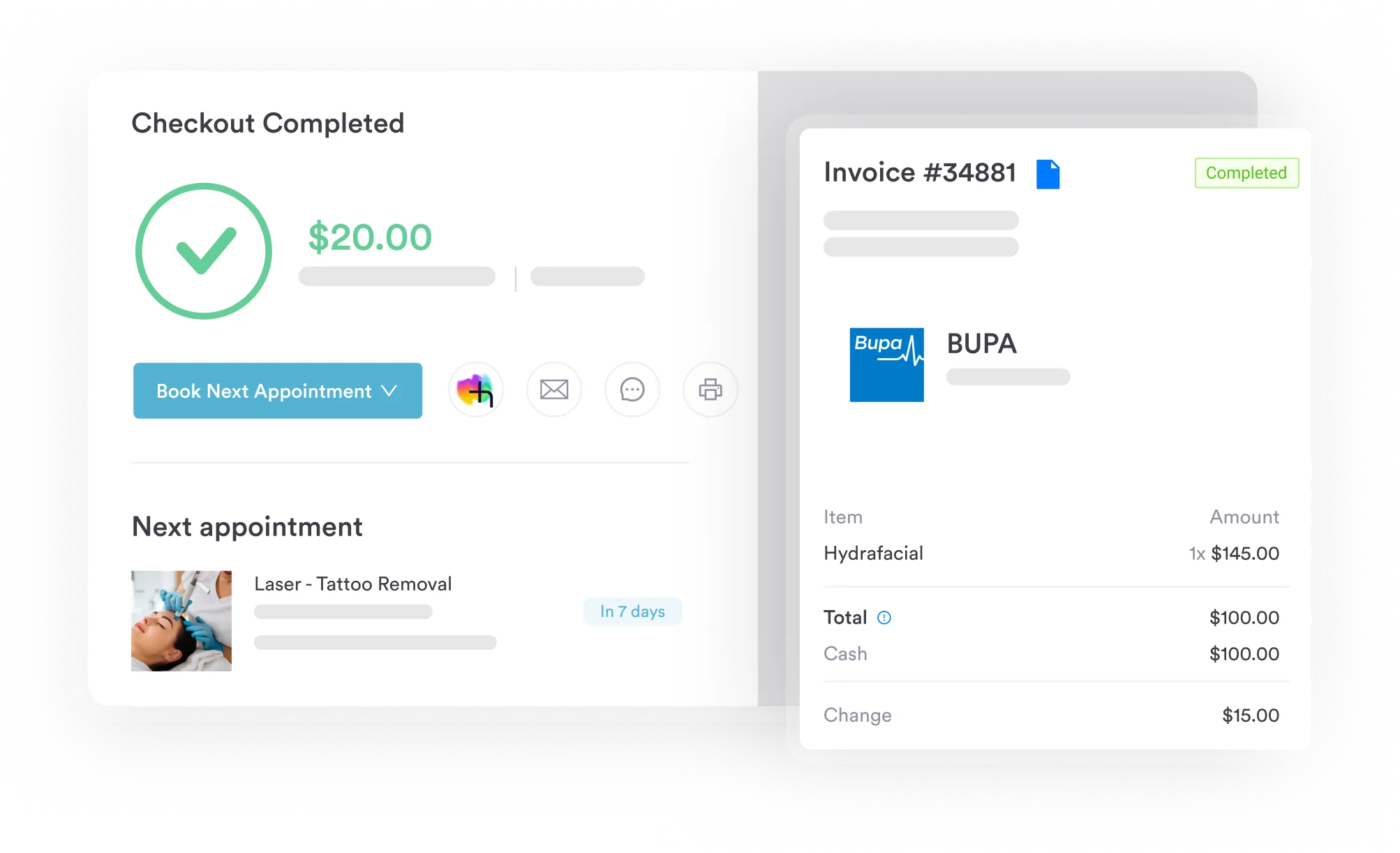

Pabau validates every claim for missing or invalid details before it leaves the system. When a payer rejects one, the dashboard shows the reason so you can correct it and resubmit.

S40.261D is not a hard code to assign. It is an easy one to get wrong. A single character and one word in the exam note separate a paid claim from a denied one.
So the fix belongs upstream of the coder. If the note template asks for the side and the encounter history every time, the coder never has to guess. The biller never has to chase an addendum either.
Reviewing your denial history by code is what turns a one-off fix into a habit. Our guide to medical billing compliance is a good place to start. Book a demo to see how Pabau checks claims before they reach the payer.

Need a clearinghouse that validates ICD/CPT pairs before submission? Pabau’s Claim.MD clearinghouse integration covers eligibility checks and CMS-1500 claim submission for US practices.
Want to understand denial codes when S40.261D comes back rejected? Denial codes in medical billing explains CARC reason codes and how to respond to each rejection category.
Looking for guidance on the full claims lifecycle from code to payment? Revenue cycle management covers the end-to-end workflow from eligibility verification through remittance posting.
ICD-10 Code S40.261D is the billable diagnosis code for a nonvenomous insect bite of the right shoulder at a subsequent (follow-up) encounter. It falls under the S40 superficial injury block in Chapter 19 of ICD-10-CM. The code is specific on three points at once: right-side laterality, nonvenomous bite type, and follow-up encounter status.
S40.261A is used for the first visit where active treatment is initiated for the bite. S40.261D is used for every follow-up visit during the healing phase. The sole difference is the 7th character: A for initial, D for subsequent. Using A on a follow-up visit, or D on a first active treatment visit, is a coding error that leads to denial.
Use ‘D’ on any visit that follows the first active treatment encounter for the same injury. The patient does not need to be fully healed. If this is the first visit where active treatment is given for this bite, use ‘A’ instead.
Yes, S40.261D is a valid billable code accepted by Medicare and most commercial payers. Coverage for the follow-up visit depends on documented medical necessity. The clinical note must show why the follow-up was clinically warranted, not just that the patient returned. Some payers may also query the prior initial encounter for the same injury.
Yes. Wound care follow-up visits for a healing nonvenomous right shoulder insect bite are a valid use of S40.261D. The note must document the wound status and the treatment provided, such as a dressing change, wound inspection or topical application. It must also confirm that this is not the first active treatment encounter. Pair the code with the wound care or E/M CPT code that matches the services rendered.
Five problems come up repeatedly on these claims. The first is the wrong 7th character, with A submitted instead of D on a follow-up visit. The second is missing laterality in the clinical note. The third is a note that never separates a venomous bite from a nonvenomous one. The fourth is no documented prior initial encounter on file. The fifth is a CPT/ICD mismatch, where the procedure code does not fit what a superficial bite requires.